Millwright Resume Examples: free ATS score and gap list
Write a Millwright Resume That Proves Precision Alignment Skill
By Mustafa Tarabya, founder of CVBooster · Published · Updated
Millwright resume example with alignment, rigging and machine install bullets, real credentials and a full section by section guide.
Sample resumes for a millwright
The same millwright content laid out in three CVBooster templates, so you can see what the finished document looks like before you write a word.
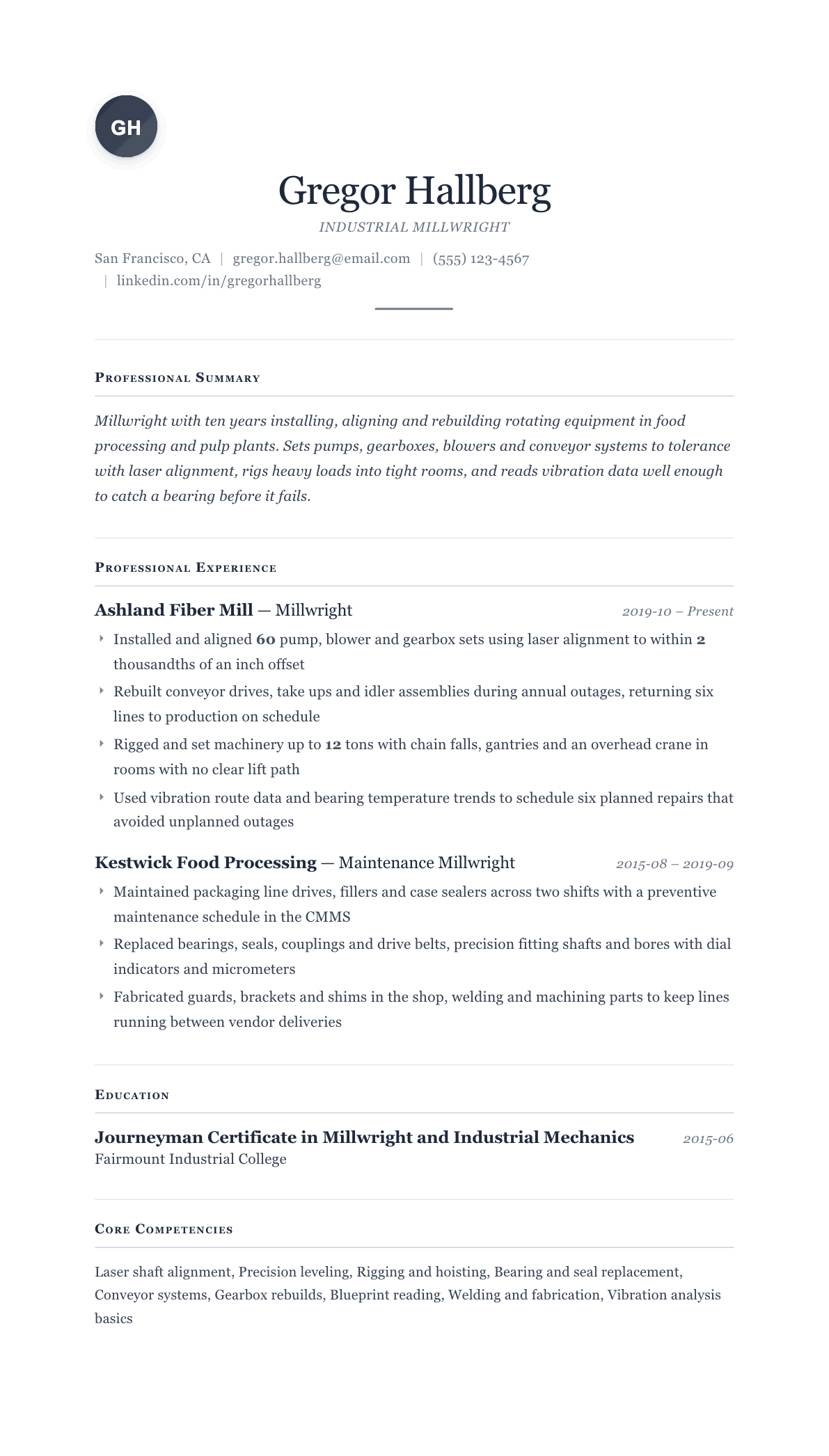
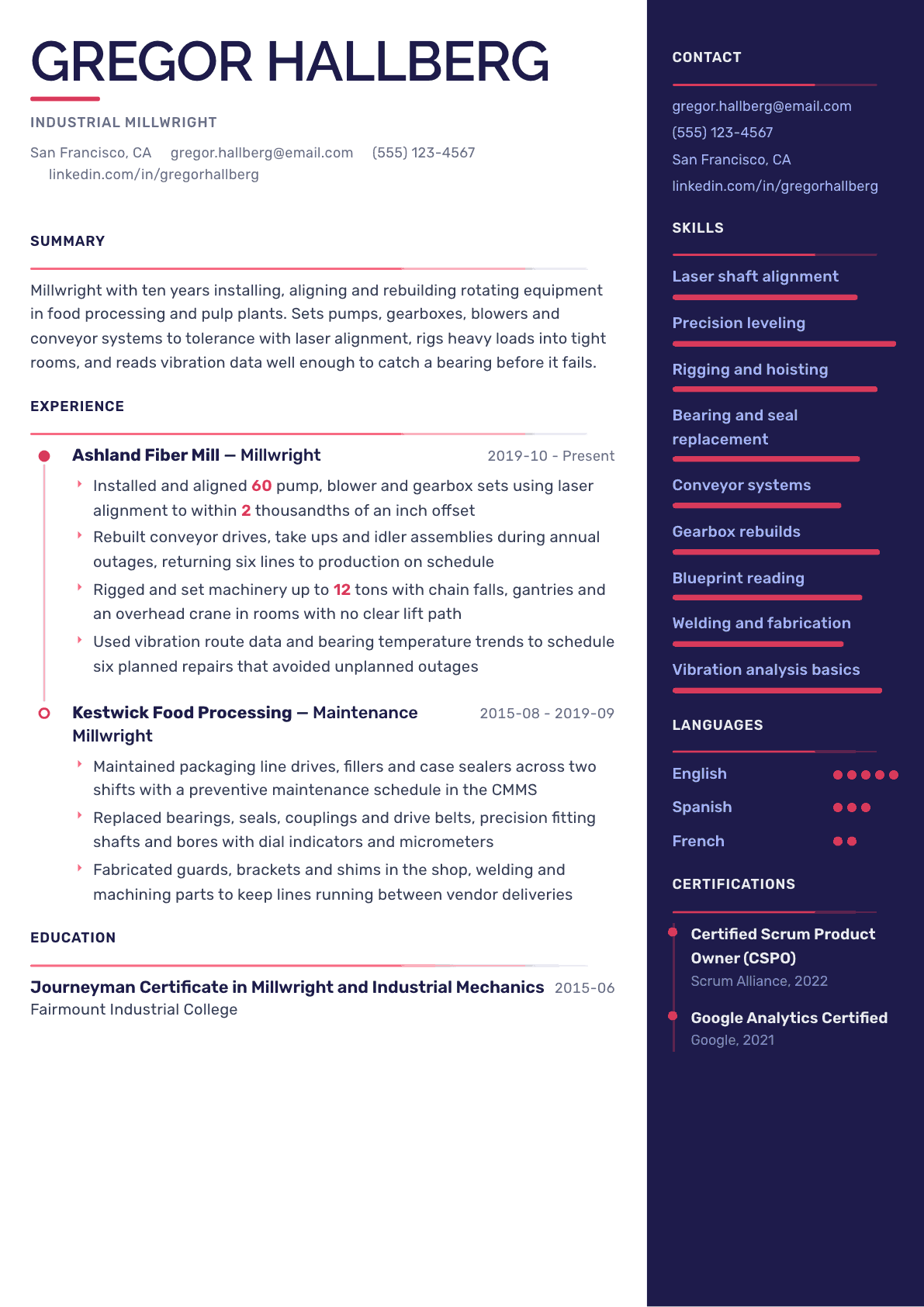
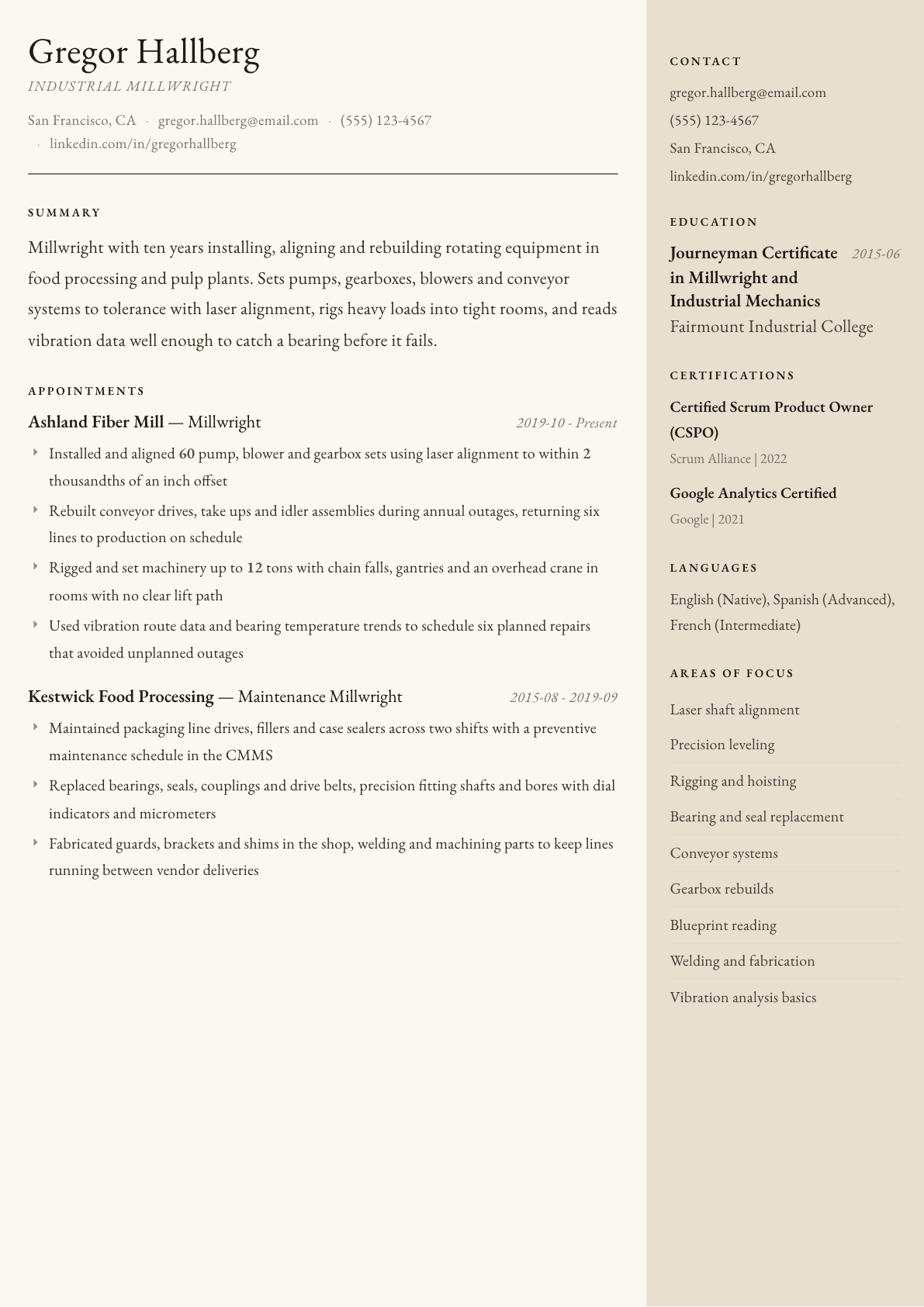
Example Millwright summary
Industrial millwright with ten years installing, aligning and rebuilding rotating equipment in pulp and food processing plants. Sets pumps, gearboxes, blowers and conveyor drives to tight tolerance with laser alignment, rigs loads into confined rooms, and uses vibration and temperature data to schedule repairs before failure. Welds, machines and fabricates his own parts during outages. Seeking a lead millwright role on a plant reliability team.
Skills to list on a Millwright resume
- Laser shaft alignment
- Dial indicator alignment
- Machinery installation
- Rigging and hoisting
- Precision leveling and grouting
- Bearing replacement
- Gearbox and pump rebuilds
- Conveyor maintenance
- Hydraulics and pneumatics
- Welding and cutting
- Machining and fitting
- Vibration monitoring
- Preventive maintenance planning
- Blueprint and schematic reading
- Lockout and tagout
What actually gets this resume read
- State the industries you have worked in, since a food plant, a paper mill and an auto line each expect different habits.
- Give alignment tolerances in real numbers, because a maintenance manager judges a millwright on precision, not on effort.
- Name your alignment and measurement tools, from dial indicators and micrometers to the laser alignment brand you use.
- Show rigging capability by load weight and method, including chain falls, gantries, jacks, rollers and overhead cranes.
- Include outage and shutdown work with the scope and the schedule you held, since planned outages are the busy season.
- List welding processes and any machining you do, because a millwright who can fabricate a part saves a whole shift.
- Add the maintenance software you have logged work in, whether that is SAP PM, Maximo, Fiix or another CMMS.
How to write a millwright resume
A millwright resume is read by a maintenance manager or a plant reliability engineer who has a machine that keeps failing and a shutdown window that will not move. He is scanning for precision: alignment tolerances, rigging capability, and whether you understand why a coupling fails rather than only how to replace one.
The trade covers two related worlds. Construction millwrights install and commission new equipment on a project schedule. Plant millwrights keep rotating equipment alive through production runs and outages. The vocabulary overlaps but the hiring criteria do not, so decide which one the posting describes before writing.
This guide walks through the format, the summary that shows precision instead of effort, how to write installation and rebuild experience with real tolerances, the credentials that carry weight in industrial maintenance, and the questions millwrights ask when moving between industries or from construction into a plant.
Format: one page early, two pages once the equipment list is long
Reverse chronological. One page while you are a journeyman with two employers, two pages once you have industries, equipment types and outage history worth listing. Keep the layout plain so plant hiring systems parse it cleanly.
Add an equipment section listing the machinery classes you have installed, aligned or rebuilt. That list is the fastest way for a maintenance manager to decide whether you have touched the assets in his plant.
- Header: name, city and state, phone, email, journeyman status, union local if applicable.
- Section order: summary, certifications, equipment and skills, experience, education and apprenticeship.
- An apprentice leads with hours completed, the classroom modules finished, and the tools they are checked out on.
Summary: industry, equipment, and the tolerance you work to
Name the industries first, because habits differ. Food and beverage means sanitary design and washdown. Pulp and paper means large rolls and long outages. Automotive means line takt and fast changeover. Mining and aggregate means dust, wear parts and remote sites.
Then name the equipment and the precision. Pumps, gearboxes, blowers, compressors, conveyors, presses, mixers and turbines are the assets. Laser alignment to a stated offset and angularity tolerance is the proof. A millwright who states a tolerance is immediately more credible than one who says he aligns carefully.
Experience: installation, alignment, rebuild, rigging
Installation bullets should carry the whole sequence: foundation checks and anchor setting, soft foot correction, precision leveling and grouting, coupling installation, alignment to tolerance, guarding, and the run in readings you took after startup.
Rebuild bullets show diagnostic depth. Bearing and seal replacement is routine, so write the fits and the measurement: shaft and bore checked with micrometers and bore gauges, interference fits set by heating, endplay verified with a dial indicator. Say what failed and why, because root cause is what a reliability team is buying.
Rigging is the third pillar. Give the load weights, the methods and the constraints: chain falls, gantries, jacks and rollers, machine skates, overhead cranes and mobile cranes, and the rooms with no clear lift path where the work actually gets interesting.
Outage and shutdown work deserves its own treatment. State the scope you carried, how many lines or machines you returned, and whether you hit the restart time. Meeting an outage schedule is the single most valued thing a plant millwright does.
- Alignment method and the offset and angularity tolerance held.
- Rigging weights, equipment used, and the site constraint you worked around.
- Outage scope, machines returned to service, and the schedule you held.
Credentials, fabrication and reliability tools
List apprenticeship completion, journeyman papers, union local and any industrial maintenance credential you hold. Add rigging qualification, crane signaling, forklift and aerial lift cards, confined space entry and energy isolation training, since a plant has to document all of it before you touch a machine.
Fabrication and reliability tools round out the profile. Welding processes and positions, torch cutting, machining and fitting on a lathe or mill, and any vibration analysis, thermography or ultrasound work you have done on a route. A millwright who can read a vibration spectrum and then fix what it points at is a different hire than one who only turns wrenches.
Name the maintenance software you have logged work in, because plants run their planning through it and a candidate who already uses one adapts to another quickly.
Keywords in industrial maintenance postings
Expect precision alignment, machinery installation, rigging, conveyor systems, gearbox rebuild, pump repair, bearing replacement, hydraulics, pneumatics, preventive maintenance, predictive maintenance, energy isolation and blueprint reading. Use the ones you can defend.
Construction focused postings shift toward equipment setting, anchor bolt work, grouting, millwright layout, commissioning and project schedules. Plant postings shift toward reliability, root cause analysis, outage planning and work order execution.
Millwright resume summary examples
Apprentice
Millwright apprentice with 4,000 hours toward journeyman status, working on pump and gearbox changeouts, conveyor repairs and outage support. Competent with dial indicators, micrometers and basic laser alignment, trained in energy isolation and rigging, and certified on forklift and aerial lift equipment.
Journeyman
Journeyman millwright with six years in food processing plants, installing and aligning pumps, blowers and gearbox drives to laser alignment tolerance. Rebuilds packaging line drives, fillers and case sealers, fabricates guards and brackets in the shop, and logs all work through the maintenance system.
Lead millwright
Lead millwright with twelve years across pulp and food plants, responsible for machinery installation, precision alignment and outage execution. Rigs loads to twelve tons into confined rooms, uses vibration and temperature trends to plan repairs before failure, and mentors apprentices through their alignment hours.
Work experience bullets: before and after
Before: Aligned pumps and motors.
After: Installed and aligned 60 pump, blower and gearbox sets with laser alignment, holding offset within two thousandths of an inch and correcting soft foot before final shimming.
A stated tolerance and the soft foot step prove precision practice rather than an approximate alignment.
Before: Rebuilt gearboxes and conveyors.
After: Rebuilt conveyor drives, take ups and idler assemblies during annual outages, returning six production lines to service inside the scheduled restart window.
Tying the rebuild to an outage schedule shows the constraint every plant actually cares about.
Before: Moved heavy machinery into place.
After: Rigged and set machinery up to twelve tons using chain falls, a gantry and an overhead crane in rooms with no clear lift path, planning each pick with the safety supervisor.
Weight, method and the planning step turn a lift into demonstrated rigging judgment.
Before: Helped prevent breakdowns.
After: Used vibration route data and bearing temperature trends to schedule six planned repairs, each replacing an unplanned outage that would have stopped a line mid run.
Predictive work with a counted outcome is the clearest evidence of reliability contribution.
Before: Made parts when they were needed.
After: Fabricated guards, brackets and shims in the shop, welding and machining replacements to keep lines running while vendor parts were on order.
Fabrication capability is a schedule saver, and naming what you made shows the range of the skill.
Hard skills
- Laser shaft alignment
- Dial indicator and reverse alignment
- Precision leveling and epoxy grouting
- Machinery installation and anchoring
- Rigging and hoisting
- Bearing and seal replacement
- Gearbox and pump rebuilds
- Conveyor system maintenance
- Hydraulics and pneumatics
- Welding and torch cutting
- Machining and precision fitting
- Vibration and thermography monitoring
- Energy isolation procedures
Soft skills
- Working to an outage clock
- Root cause thinking
- Mentoring apprentices
- Coordination with operations
- Careful documentation of work performed
Certifications worth listing
- NCCER Millwright Credential (National Center for Construction Education and Research)
- Certified Maintenance and Reliability Technician (Society for Maintenance and Reliability Professionals)
- Category I Vibration Analyst (Vibration Institute)
- Rigger Level I Certification (National Commission for the Certification of Crane Operators)
- AWS Certified Welder (American Welding Society)
Mistakes that cost millwright candidates the interview
- Writing performed alignments without a tolerance, which is the one number that proves the trade was learned properly.
- Listing machines without industries, so a manager cannot tell sanitary food equipment from heavy mill drives.
- Leaving rigging off the page even though a large share of the work is moving equipment that cannot be lifted by hand.
- Skipping outage history, which is how plant maintenance managers judge whether you can work to a hard restart time.
- Presenting fabrication and welding as hobbies rather than as the plant skills that keep a line running.
- Failing to mention energy isolation and confined space training, which every plant must document before you start.
Millwright resume questions
What is the difference between a millwright and an industrial mechanic on a resume?
The titles overlap and many plants use them interchangeably. Use the title in the posting, then prove the precision work underneath it: alignment tolerances, rigging weights, machinery installation and rebuild depth rather than general repair.
Do I need a vibration analysis certification?
Not for most positions, but it separates you for reliability focused roles. Even without the credential, describe any route data collection, spectrum reading or trending you have used to plan a repair before a failure happened.
How do I show alignment skill on paper?
State the method, the tools and the tolerance. Say whether you use laser systems, reverse dial or rim and face, mention soft foot correction and thermal growth compensation, and give the offset and angularity numbers you routinely hold.
Should I include welding certifications on a millwright resume?
Yes if they are current. Name the processes and positions you are qualified in, since a plant that can assign both welding and precision mechanical work to one person gets far more value out of the position.
How do I move from construction millwright work into a plant job?
Lead with installation, alignment and rigging, which carry across directly. Then address the gap plants worry about: work order systems, preventive maintenance routes, production pressure and troubleshooting equipment you did not install yourself.
Related resume examples
- Maintenance Technician Resume example
- Welder Resume example
- CNC Machinist Resume example
- Ironworker Resume example
- Pipefitter Resume example
- HVAC Technician Resume example