Pipe Welder Resume Examples: free ATS score and gap list
Write a Pipe Welder Resume Around Positions, Codes and Tests
By Mustafa Tarabya, founder of CVBooster · Published · Updated
Pipe welder resume example, keyword list and guide covering 6G tests, code work, root passes, x-ray results and travel or shutdown experience.
Sample resumes for a pipe welder
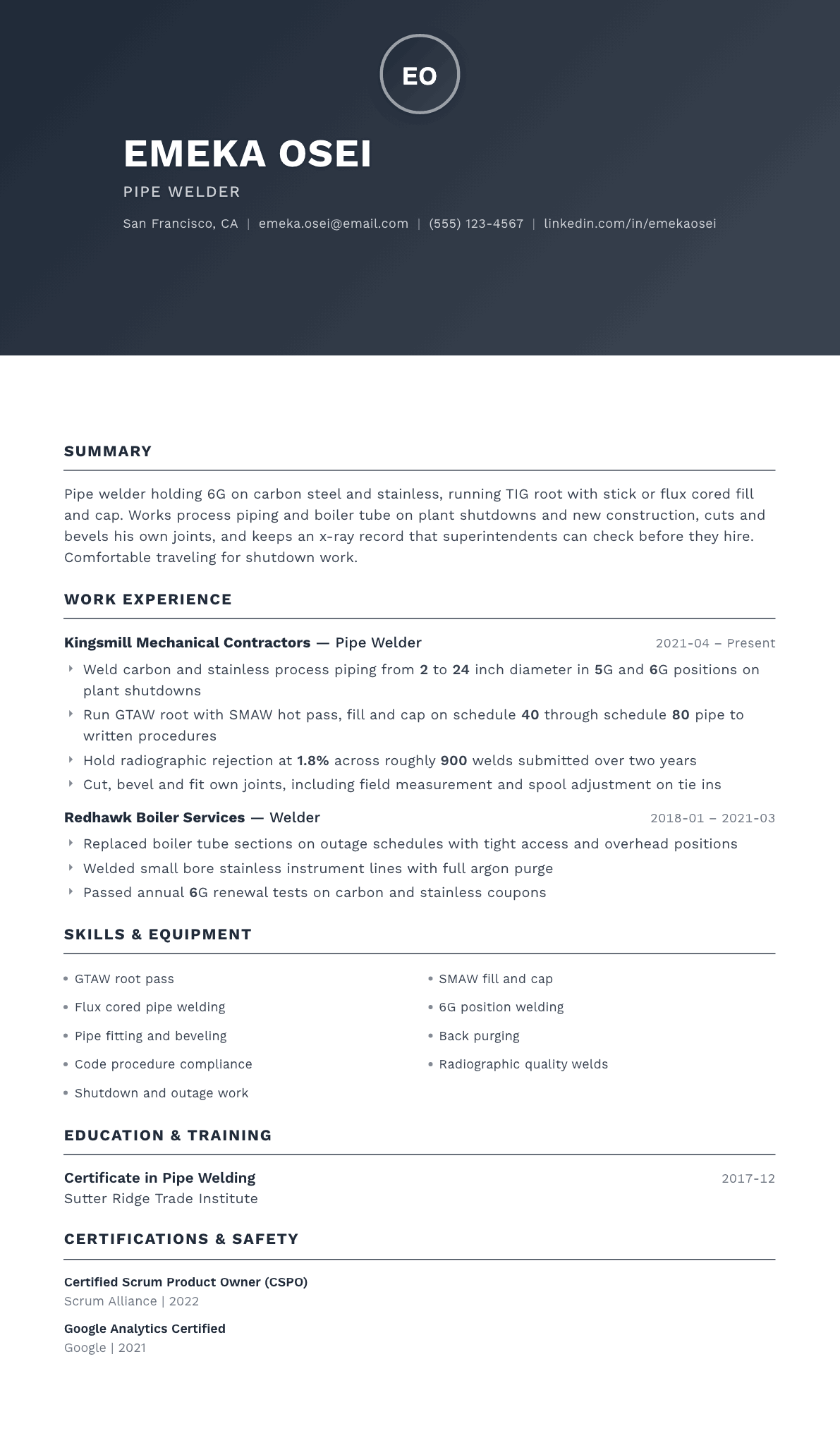
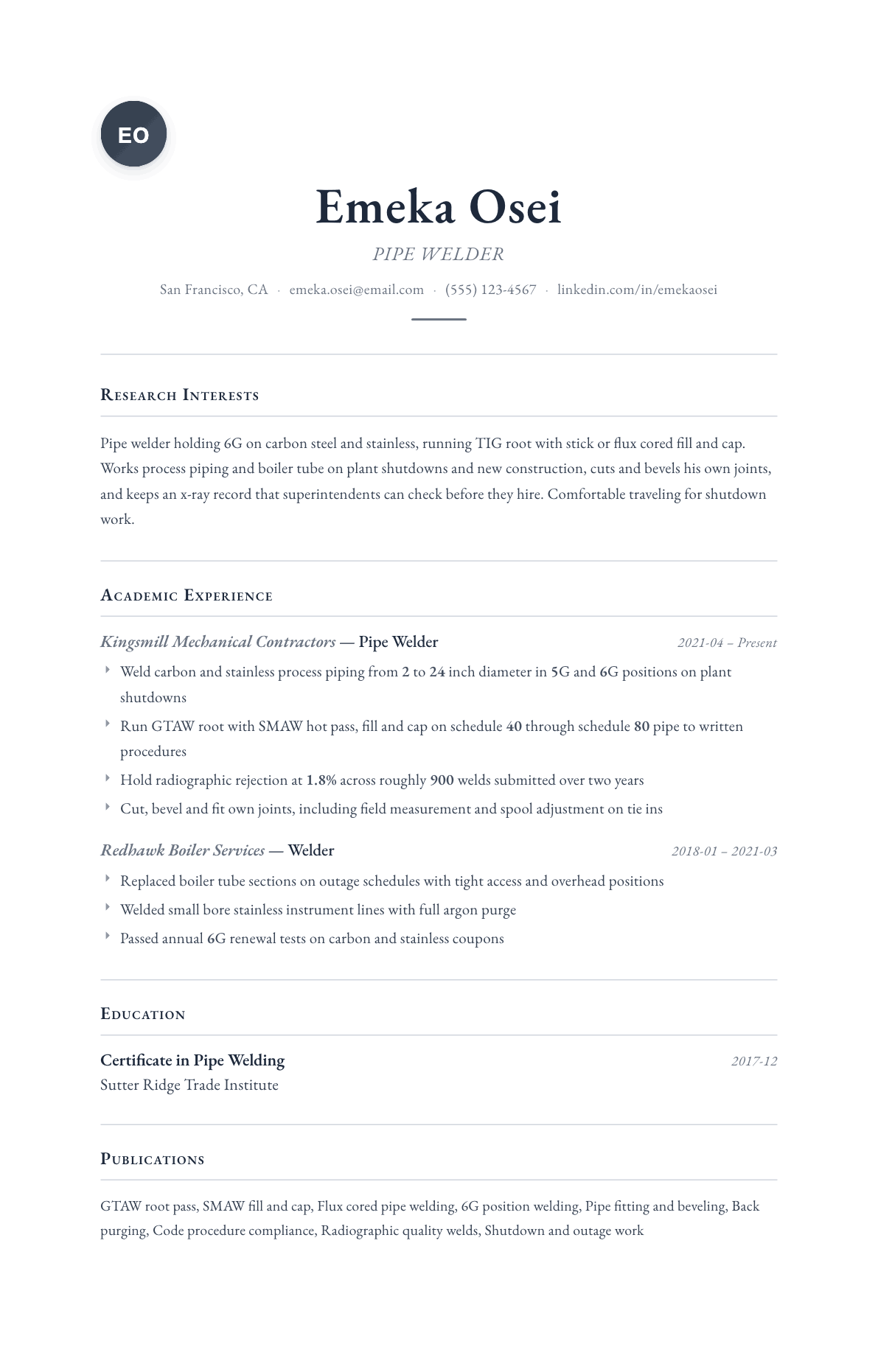
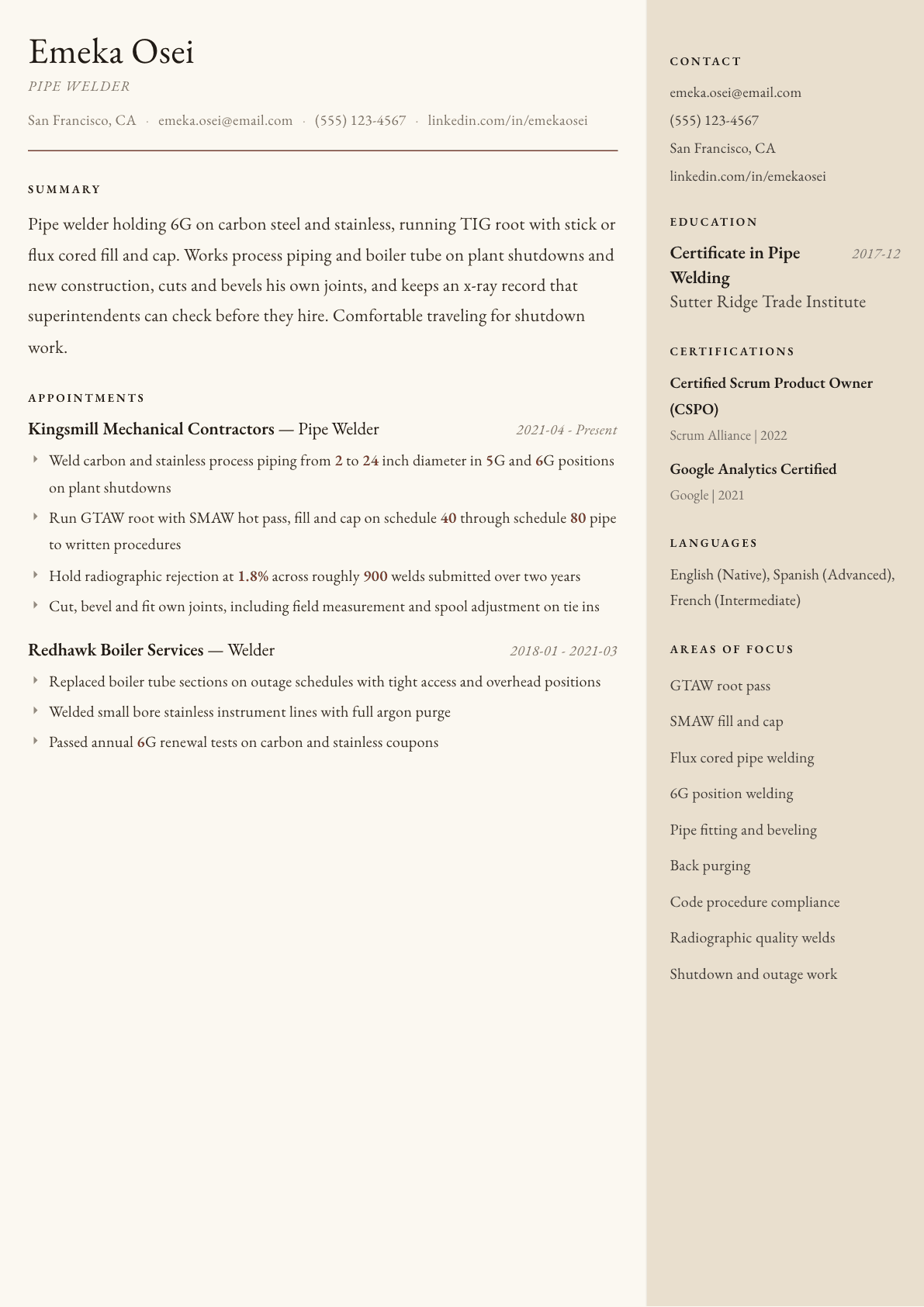
The same pipe welder content laid out in three CVBooster templates, so you can see what the finished document looks like before you write a word.
Example Pipe Welder summary
Pipe welder holding 6G on carbon steel and stainless, running a TIG root with stick hot pass, fill and cap on schedule 40 through schedule 80 process piping from 2 to 24 inch diameter. Fits and bevels his own joints, works plant shutdowns and new construction, and holds radiographic rejection at 1.8% across roughly 900 submitted welds over two years. Available for travel.
Skills to list on a Pipe Welder resume
- GTAW root pass on pipe
- SMAW hot pass, fill and cap
- Flux cored and metal cored pipe welding
- 5G and 6G position welding
- Carbon steel and stainless process piping
- Small bore and boiler tube welding
- Pipe fitting, cutting and beveling
- Argon back purge setup
- Welding procedure and code compliance
- Radiographic and ultrasonic quality standards
- Spool fabrication and tie in fit up
- Rigging and confined space work
- Weld continuity and qualification records
- Shutdown and turnaround execution
What actually gets this resume read
- Lead with the positions you are tested in, because a superintendent reads 6G before he reads anything else on the page.
- State the codes and procedures you have welded to, and the base metals and schedules each qualification covers.
- Give your x-ray or radiographic rejection rate with the number of welds behind it, since that figure gets you hired.
- Say whether you fit and bevel your own joints, because a welder who needs a fitter costs a contractor a second body.
- List shutdown and outage work by plant type, since refinery, power and food plant work each carry their own habits.
- Note your travel availability and whether you hold a valid TWIC or plant site clearance, because that decides the callout.
- Keep a continuity record on the resume so a contractor knows your qualifications are still live rather than expired.
How to write a pipe welder resume
A mechanical contractor hiring a pipe welder reads three things and makes a decision: the positions you are tested in, the codes and procedures you have welded to, and your x-ray record. Everything else on the page is context. Superintendents are staffing a shutdown with a start date they cannot move, and they need welders who will pass a test on Monday and produce sound welds by Tuesday.
That is why the resume has to be blunt. Write 6G on carbon and stainless, name the processes you run for root, hot pass, fill and cap, give the diameters and schedules, and put your radiographic rejection rate with the number of welds behind it. Vague words such as extensive piping experience are read as a candidate hiding something.
This guide covers what a pipe welder resume needs: the qualification block that opens it, the process combinations superintendents recognize, the fit up and rigging work that decides whether you need a second body beside you, and the availability details that determine whether you get the call for a turnaround.
Format: qualifications first, everything else after
One page, and the top third belongs to qualifications. Positions with codes, base metals, process combinations, diameter and schedule range, and the standards you have welded to. A superintendent scanning fifty resumes for a shutdown crew is looking for exactly that block and nothing else on the first pass.
Below it, a continuity and test history line. When you last took a test, on what material and position, and whether your qualifications are current. Qualifications lapse without continuity, and a contractor who has to retest you loses a day, so stating your status plainly is a practical advantage.
- Positions in code form: 2G, 5G and 6G, plus restricted access qualifications such as 6GR if you hold them.
- Process combinations: TIG root with stick fill and cap, all stick, flux cored fill, or metal cored where used.
- Base metals: carbon steel, 304 and 316 stainless, chrome moly alloys, and any nickel alloy work.
- Diameter and schedule range, including small bore instrument lines and heavy wall work.
- Standards and specifications you have welded to, plus the plant or contractor procedures where you can name them.
Summary: positions, processes, x-ray record
Four sentences. Positions and metals you hold, the process stack you run from root to cap, the pipe range, and your radiographic result with the volume behind it. A superintendent can staff you from that paragraph alone, which is exactly the point.
Add your work type in the same block: shutdowns and turnarounds, new construction, plant maintenance, fabrication shop spool work, or a mix. Field work and shop work reward different habits, and a contractor hiring for a two week outage wants someone who has lived through outage pace and scaffolding access before.
Experience: the passes, the fit up and the access
Describe the welding by pass. Which process you run for the root and how you handle the open root gap, whether you purge and how, what you use for hot pass, fill and cap, and how you control the cap profile. Superintendents read the pass description to judge whether you have been on real code work or only on shop coupons.
Then fit up. Whether you cut and bevel your own joints, whether you take field measurements and adjust spools, and how you handle a tie in where nothing lines up. A pipe welder who fits his own work is worth substantially more on a job than one who waits for a fitter, and it is one of the easiest things to state clearly.
Access conditions matter too. Overhead, tight radius, boiler tube panels, scaffolding work, confined space entry and work with mirrors all change the difficulty of the same joint. Naming the conditions you have welded in tells a superintendent whether you can be put anywhere on the job or only on the easy racks.
Quality: x-ray results and how you handle a cut out
Give a radiographic rejection figure with the weld count and the period. That single number is the most valuable line on a pipe welder resume, because contractors pay for repairs and lose schedule to them. A believable figure with volume attached will get you a call ahead of a resume with none.
Say what your common rejection causes were and what changed. Root concavity, incomplete penetration, porosity from a purge that leaked, and slag on a fill pass each point at a different habit. A welder who names his own history and the correction shows the kind of self awareness a quality manager notices immediately.
Mention any other testing your welds went through: ultrasonic, hydrostatic testing, pneumatic testing, positive material identification checks. Those add credibility, and welders who have worked under a full inspection program carry documentation habits that contractors value.
Availability, credentials and the practical details
Put the logistics on the page, because they decide who gets called. Travel availability, whether you own a rig or a welding truck, site access credentials such as a transportation worker identification card, safety council training, drug testing status and union affiliation if you have one. Contractors are solving a staffing problem under time pressure, and every credential you already hold removes a delay.
Add plant and industry experience by type: refinery, power generation, chemical, food and beverage, pharmaceutical, pulp and paper, shipyard work. Each industry has its own habits around permits, cleanliness and documentation, and a superintendent will prefer a welder who already knows the site culture.
For keywords, postings use pipe welding, 6G, code welding, root pass, hot pass, fill and cap, purge, spool fabrication, tie in, shutdown, turnaround, radiographic testing and the standard names themselves. Use them where the work is described so the page reads as a welder rather than as a keyword list.
Pipe Welder resume summary examples
Newly tested
Pipe welding certificate graduate tested in 2G and 5G on carbon steel schedule 40, running stick root, fill and cap and beginning TIG root work. Cuts and bevels own joints. Seeking a helper to welder path on plant maintenance or spool fabrication with travel available.
Journeyman on shutdowns
Pipe welder holding 6G on carbon and stainless, running TIG root with stick hot pass, fill and cap on schedule 40 through schedule 80 from 2 to 24 inch diameter. Holds radiographic rejection at 1.8% across roughly 900 welds over two years, and fits and bevels own joints.
Lead welder on turnarounds
Lead pipe welder on refinery and power turnarounds, qualified on carbon, stainless and chrome moly, running crews of six on tie in schedules. Handles boiler tube panel work in restricted access, coordinates purge setup across a crew, and maintains continuity on four active procedures.
Work experience bullets: before and after
Before: Welded pipe on industrial job sites.
After: Welded carbon and stainless process piping from 2 to 24 inch diameter in 5G and 6G positions on plant shutdowns, working schedule 40 through schedule 80 to written procedures.
Diameter, schedule, positions and work type let a superintendent staff you without a phone call.
Before: Used TIG and stick welding on pipe joints.
After: Ran a gas tungsten arc root with a full argon purge, then stick hot pass, fill and cap, controlling the cap profile to the specified reinforcement on every joint submitted for radiography.
Describing the joint by pass proves code experience where naming two processes does not.
Before: Produced welds that passed x-ray.
After: Held radiographic rejection at 1.8% across roughly 900 welds submitted over two years, with the small remainder driven by root concavity on one restricted access configuration.
A rejection rate with volume, period and honest cause is the number a contractor most wants to see.
Before: Fit pipe before welding.
After: Cut, beveled and fit own joints including field measurement and spool adjustment on tie ins, which removed the need for a dedicated fitter on two of three outage crews.
Independent fit up with the crew impact stated turns a task into a direct saving for the contractor.
Before: Worked on boiler tube repairs during outages.
After: Replaced boiler tube sections on outage schedules in restricted overhead access, welding with mirrors where the panel spacing prevented direct sight of the joint.
The access conditions describe difficulty a superintendent can price, unlike a general repair statement.
Hard skills
- Gas tungsten arc root passes on pipe
- Shielded metal arc hot pass, fill and cap
- Flux cored and metal cored pipe welding
- 5G, 6G and restricted access position welding
- Carbon steel and stainless process piping
- Chrome moly and alloy pipe welding
- Small bore and instrument line welding
- Boiler tube panel replacement
- Pipe cutting, beveling and fit up
- Argon back purge setup and dam building
- Welding procedure and code compliance
- Radiographic and ultrasonic quality standards
- Spool fabrication and tie in measurement
- Rigging, scaffolding and confined space work
- Weld continuity and qualification record keeping
Soft skills
- Working a turnaround schedule without dropping weld quality
- Handling a cut out and repair without argument
- Reading a site permit system and following it exactly
- Coordinating a purge with the welder on the other side of the wall
- Keeping steady hands in awkward access positions
Certifications worth listing
- Certified Welder (American Welding Society)
- ASME Section IX Performance Qualification (Employer qualified to ASME Boiler and Pressure Vessel Code)
- Transportation Worker Identification Credential (TWIC) (Transportation Security Administration)
- Basic Plus Safety Orientation (Association of Reciprocal Safety Councils)
- OSHA 30-Hour Construction (OSHA Outreach Training Program)
Mistakes that cost pipe welder candidates the interview
- Burying the positions you are tested in below your work history, when that block is the entire first pass of the screen.
- Leaving out the radiographic rejection rate, which is the number contractors use to compare pipe welders directly.
- Naming processes without describing the pass sequence, so a superintendent cannot tell code work from shop coupons.
- Failing to say whether you fit and bevel your own joints, which decides whether the contractor needs a second body.
- Omitting site credentials and travel availability, the practical details that determine who gets called for a turnaround.
- Claiming qualifications without continuity, so the contractor discovers at the gate that a retest is required.
Pipe Welder resume questions
How important is 6G on a pipe welder resume?
It is the qualification most contractors screen for first, because it covers fixed position welding at a 45 degree angle and demonstrates you can weld all the way around a joint. If you hold it, put it in the first line of the summary rather than in a certification list at the bottom.
What x-ray rejection rate is considered good?
A low single figure rate with real volume behind it is credible and competitive. What matters more is honesty and context: state the weld count, the period and the joint types, because a rate measured across nine hundred welds carries far more weight than one measured across thirty.
Should I list every plant and contractor I have worked for?
Group short outage work under the contractor who hired you and list the plants and industries served beneath it. That keeps the page readable while showing site range, and superintendents care more about industry type and access conditions than about individual outage names.
How do I write availability for travel and shutdown work?
State it directly near the top: whether you travel, how far, whether you have a rig, and what site credentials you already hold. Contractors staffing an outage under deadline will choose a welder whose logistics are already solved over one they have to work out.
How do I move from structural welding into pipe welding?
Get tested. Take a pipe welding course, qualify in 5G and then 6G on carbon steel, and practice open root work until the root profile is consistent. Then rewrite the resume around your positions and pass results, because structural history alone will not get you onto a code job.
Related resume examples
- Welder Resume example
- TIG Welder Resume example
- MIG Welder Resume example
- Maintenance Mechanic Resume example
- Boilermaker Resume example
- Fabricator Resume example