Political Consultant Resume Examples: what gets the call
Write a Political Consultant Resume That Sells Your Win Record
By Mustafa Tarabya, founder of CVBooster · Published · Updated
Political consultant resume example, keywords and a writing guide covering client races, polling, media strategy, margins and retainer work.
Sample resumes for a political consultant
The same political consultant content laid out in three CVBooster templates, so you can see what the finished document looks like before you write a word.
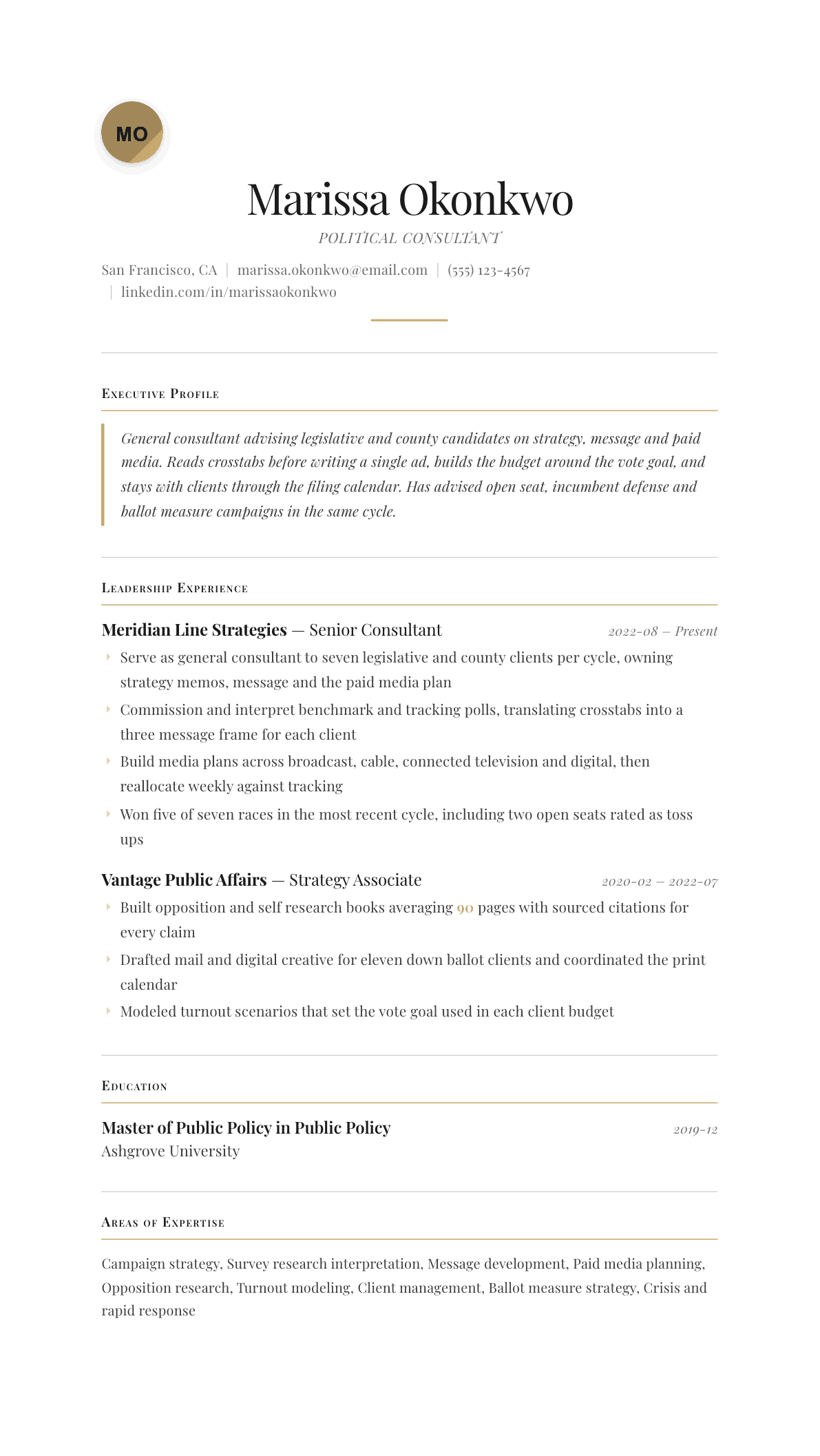
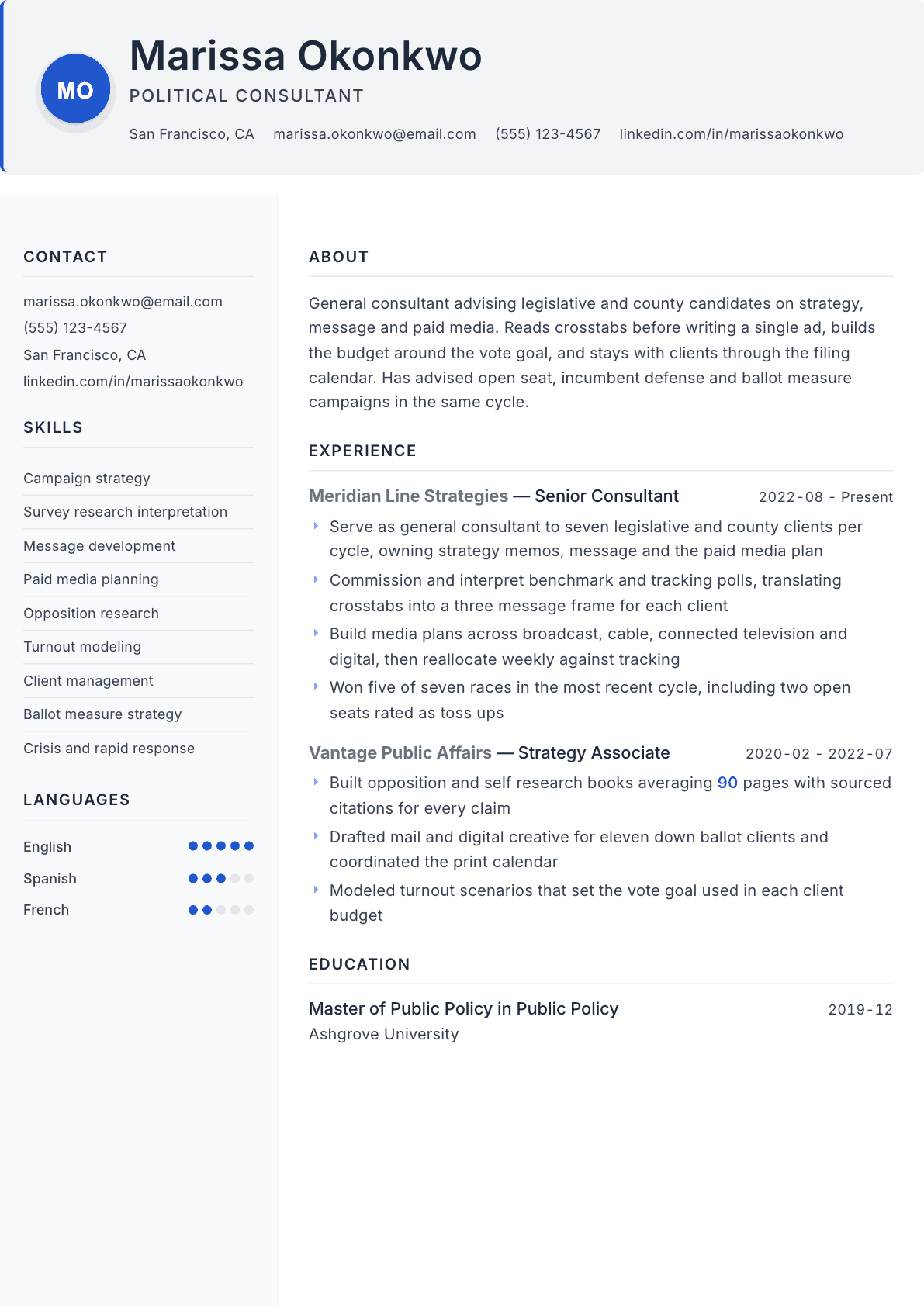
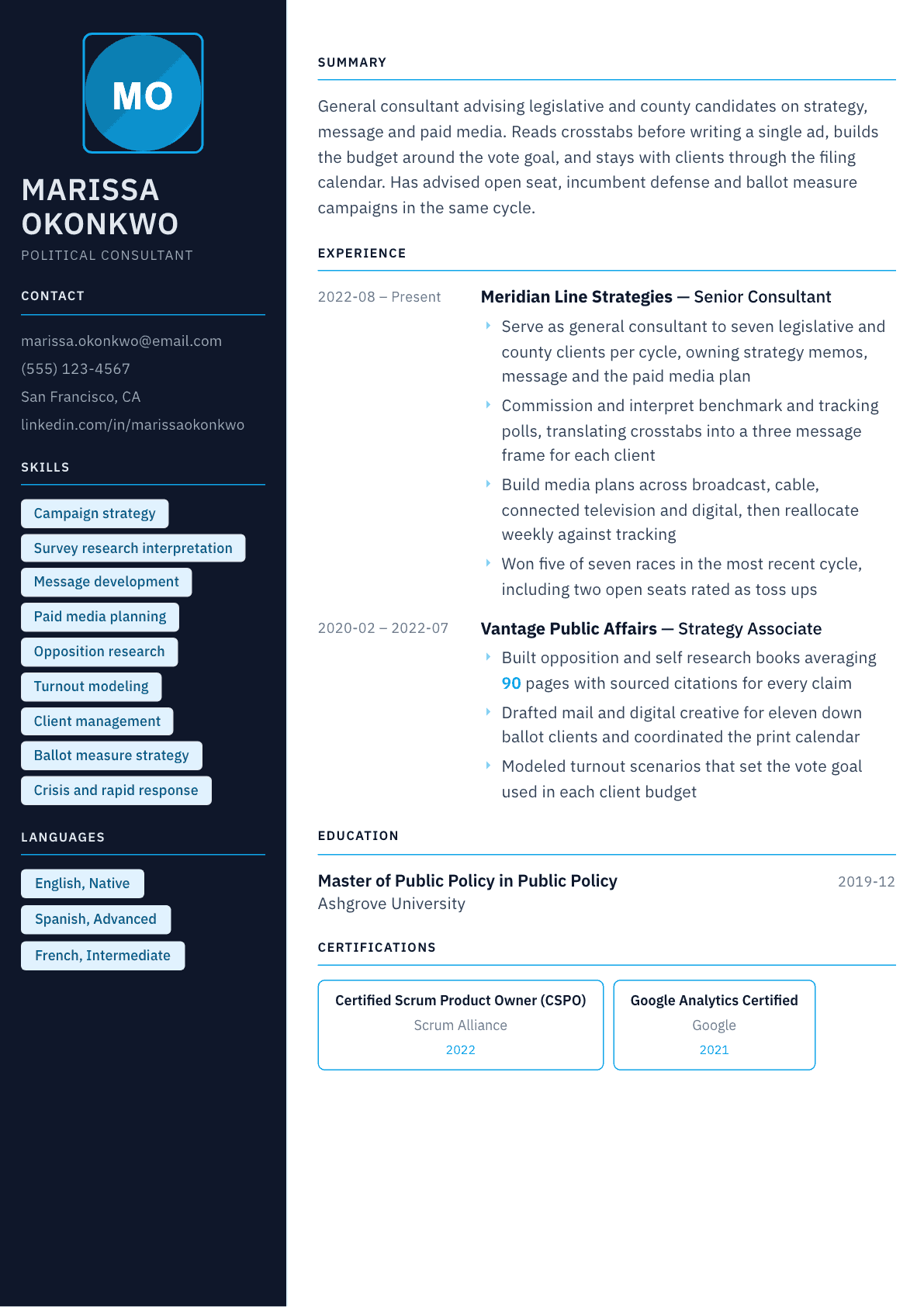
Example Political Consultant summary
Political consultant advising legislative, county and ballot measure clients as general consultant across recent cycles. Sets the vote goal, reads the crosstabs, writes the message frame and builds the paid media plan, then reallocates weekly against tracking. Known for research books clients can defend line by line and for staying with a race through the filing calendar rather than only the ad flight.
Skills to list on a Political Consultant resume
- General consulting and strategy memos
- Benchmark and tracking survey design
- Crosstab interpretation
- Message frame development
- Paid media planning and buying
- Broadcast and connected television
- Direct mail strategy
- Opposition and self research
- Turnout and vote goal modeling
- Ballot measure campaigns
- Debate preparation
- Rapid response and crisis handling
- Independent expenditure rules
- Client and budget management
What actually gets this resume read
- List the races you advised with office, cycle and outcome, because a consultant is hired on a record.
- Say whether you were the general consultant, the media firm or a specialist, since clients read those roles differently.
- Show that you can read polling yourself, naming the survey types and the crosstabs you work from.
- Give the media mix you have bought, including connected television and digital, not just broadcast.
- Name the party committee, caucus or ballot measure coalitions you have worked with, without overstating your seat.
- Keep client confidences intact by describing work at a level any of your clients would recognize as fair.
How to write a political consultant resume
Nobody hires a political consultant on the strength of a resume alone, but a bad one ends the conversation before the referral can do its work. The reader is a firm principal adding capacity, a candidate interviewing generals, or a committee deciding which vendors go on an approved list. Each of them wants your client record, your specialty and evidence that you are worth the retainer.
The common failure is a page that describes a career in politics without ever saying what you sell. Strategy, media, mail, digital, polling, research and management are separate businesses with separate rates, and a consultant who blurs them looks like a generalist in a field that pays for depth.
This guide covers how to present client work, results and specialty on a consultant resume, with summaries at three points in a consulting career, before and after bullets built on the numbers clients ask about, and the questions consultants raise when they leave a firm to hang their own sign.
Format: specialty at the top, client record as the spine
Lead with a specialty line under your name: general consultant, media, mail, digital, survey research, opposition research or campaign management. Then organize the page by client work rather than by employer, because a firm principal reads races, not job titles. Under each firm, list the races you personally advised with office, cycle, your role and the outcome.
Two pages is normal once you have several cycles. A consultant with fifteen client races on the page has earned the second page, provided every line carries a race and a result rather than a description of duties.
- Specialty line under the name, so nobody has to guess which service you actually sell.
- A client record block: office, jurisdiction, cycle, your role, outcome, and margin where it flatters or explains.
- Separate firm employment from independent contracting so a reader knows who held the contract.
- A short block for party committee, caucus, labor or independent expenditure work, which carries different rules.
Summary: what you sell, to whom, at what level
Say the service, the client type and the level of race in the first two lines. A summary that reads as a general consultant to legislative and county candidates with ballot measure experience tells a principal more than three sentences about a passion for civic life ever could.
Then add the differentiator. It might be a region you know cold, a constituency you can reach, a language you produce creative in, or a technical strength like reading crosstabs without a pollster in the room. Firms hire consultants to fill a gap, so name the gap you fill.
Client work: races, roles and results without breaking confidence
Each engagement needs the office, the cycle, your role and the result. Be precise about role, because the difference between the general consultant and a subcontracted mail vendor on the same race is enormous, and any principal reading your page can call and check.
Results need context. A win in a safe seat proves little. A loss in a district your candidate was never expected to hold, with a margin well ahead of baseline partisan performance, proves a great deal. Give the baseline where it helps and leave it off where the number speaks for itself.
Protect client information. Internal polling, donor lists, unaired creative and strategy memos are not yours to publish. Describe the work at the level of method and outcome, and keep specifics for the conversation where a nondisclosure is understood.
Craft evidence: polling, message and the buy
A consultant is paid for judgment, and judgment shows through method. Describe how you move from data to message: the survey instrument you commissioned, the crosstabs you read, the message frames you tested, the frame you chose and why. That paragraph is the closest a resume gets to a work sample.
On paid media, name the mix you have planned and bought: broadcast, cable, connected television, streaming audio, digital video, search and mail. Say how you track and reallocate, since the ability to move money mid-flight is what clients notice and what junior consultants get wrong.
If you do research, describe the book: length, sourcing standard, and whether it was self research, opposition research or a vulnerability study. Research that gets used in an ad has to survive a fact check by a station, and a consultant who has been through that should say so.
- Name the survey types you have commissioned and the sample frames you work with.
- Give the message architecture you built and the frame you chose over the alternatives.
- List the media channels you plan and buy, including the ones you avoid and why.
- State your sourcing standard for research, since documentation quality is the whole product.
Business terms, ethics and keywords
Consulting is a business, so show that you can run one. Retainer and commission structures you have worked under, client counts per cycle, subcontractor management and the disclosure rules that govern vendor payments all belong on the page for anyone at principal level.
Firms also screen for trouble. A consultant who has kept clean separation between candidate work and independent expenditure work, and who understands the coordination rules that separate them, should say so plainly. That single line reassures a reader more than any list of adjectives.
Use the vocabulary the industry writes postings in: general consultant, benchmark, tracking, crosstabs, message frame, media plan, gross rating points, mail flight, persuasion universe, rapid response, debate prep, ballot measure.
Political Consultant resume summary examples
Associate at a firm
Strategy associate at a general consulting firm supporting eleven down ballot clients in the 2024 cycle, building research books, drafting mail and digital creative and modeling turnout scenarios. Reads crosstabs and writes the weekly client memo. Looking to move into direct client advisory work on legislative races.
Senior consultant
General consultant to seven legislative and county clients a cycle, owning strategy, message and the paid media plan from benchmark through election day. Won five of seven races in 2024 including two seats rated as toss-ups, and reallocated buys weekly against tracking rather than at set flight dates.
Firm principal
Principal running a general consulting practice with congressional, statewide and ballot measure clients since 2019. Manages a team of six and a subcontractor bench across media, mail and polling, sets retainer and commission terms, and maintains clean separation between candidate and independent expenditure engagements.
Work experience bullets: before and after
Before: Advised candidates on campaign strategy.
After: Served as general consultant to seven legislative and county clients in a single cycle, owning the strategy memo, the message frame and the paid media plan for each.
Naming the role, the client count and the deliverables makes the engagement concrete instead of decorative.
Before: Used polling to inform messaging.
After: Commissioned a benchmark and three tracking waves, read the crosstabs by region and age, and built a three message frame that moved the ballot test 5 points among independents.
The instruments, the cuts and the movement show a method rather than a claim about being data driven.
Before: Planned and bought media for clients.
After: Built media plans across broadcast, cable, connected television and digital for a county executive race, then shifted 20% of the final flight into streaming after tracking showed the buy underdelivering with voters under 40.
A mid-flight reallocation with a reason and a number is exactly the judgment a client pays a consultant for.
Before: Conducted opposition research.
After: Produced self and opposition research books averaging 90 pages with a primary source citation on every claim, three of which cleared station fact checks during the ad flight.
Length, sourcing standard and surviving a station review prove the research is usable rather than merely thorough.
Before: Helped a client through a difficult news story.
After: Ran rapid response on a two-day story, drafted the client statement, placed two surrogate interviews and kept the issue out of the following week's tracking crosstabs.
The sequence and the measurable end state turn a crisis anecdote into evidence of competence under pressure.
Hard skills
- General consulting and strategy memos
- Benchmark and tracking survey design
- Crosstab and subgroup analysis
- Message frame development and testing
- Paid media planning and buying
- Broadcast, cable and connected television
- Direct mail strategy and flight planning
- Opposition and self research
- Turnout and vote goal modeling
- Ballot measure and issue campaigns
- Debate preparation and surrogate briefings
- Independent expenditure and coordination rules
- Client retainer and budget management
Soft skills
- Telling a client something they paid not to hear
- Holding a message frame when the candidate wants to improvise
- Managing several clients whose deadlines land the same week
- Keeping client confidences across a small industry
- Working with a manager who outranks you on the ground
Mistakes that cost political consultant candidates the interview
- Writing a career narrative without naming the service you sell, which leaves a principal unable to place you.
- Overstating your role on a race where you were a subcontractor, in an industry small enough to verify it in one call.
- Listing only wins, which reads as a curated record rather than a career.
- Publishing internal polling numbers or donor detail that a client never released.
- Describing media work without the channel mix, the tracking method or a single reallocation decision.
- Ignoring the business side entirely when the reader is deciding whether you can carry a retainer book.
Political Consultant resume questions
How do I present client work without breaching confidentiality?
Name the office, the cycle, your role and the public result, and describe method rather than data. Anything a client disclosed publicly is fair to reference. Internal survey numbers, donor information and unaired creative stay off the page entirely.
Should I specialize or present myself as a generalist?
Lead with one specialty and list the adjacent services underneath. Clients and firms buy depth first, then discover the range. A page that claims equal expertise in polling, media, mail and management usually reads as inexperience rather than versatility.
How do I show results when my client lost?
Give the margin against the district baseline, the movement across tracking, or the specific objective you were retained for. A consultant hired to close a name identification gap can show that gap closing even in a race that ended in a loss.
Does non-electoral work belong on a political consultant resume?
Yes, when it is close enough to the craft. Ballot measures, issue advocacy, labor campaigns, corporate public affairs and referendum work all use the same tools, and they show clients that your practice does not go quiet in odd years.
What do firm principals check that candidates do not?
Principals check whether you can bring or hold clients, whether you manage subcontractors and budgets cleanly, and whether you have ever created a compliance or press problem for a firm. Address the first two on the page and be ready for the third in person.
Related resume examples
- Political Campaign Manager Resume example
- Public Affairs Specialist Resume example
- Government Relations Manager Resume example
- Policy Analyst Resume example
- Public Health Director Resume example
- Public Administrator Resume example