Government Relations Manager Resume Examples: free score
Write a Government Relations Manager Resume That Shows Real Access
By Mustafa Tarabya, founder of CVBooster · Published · Updated
Government relations manager resume example with legislative tracking keywords, coalition and testimony tips, and a guide to writing policy wins.
Sample resumes for a government relations manager
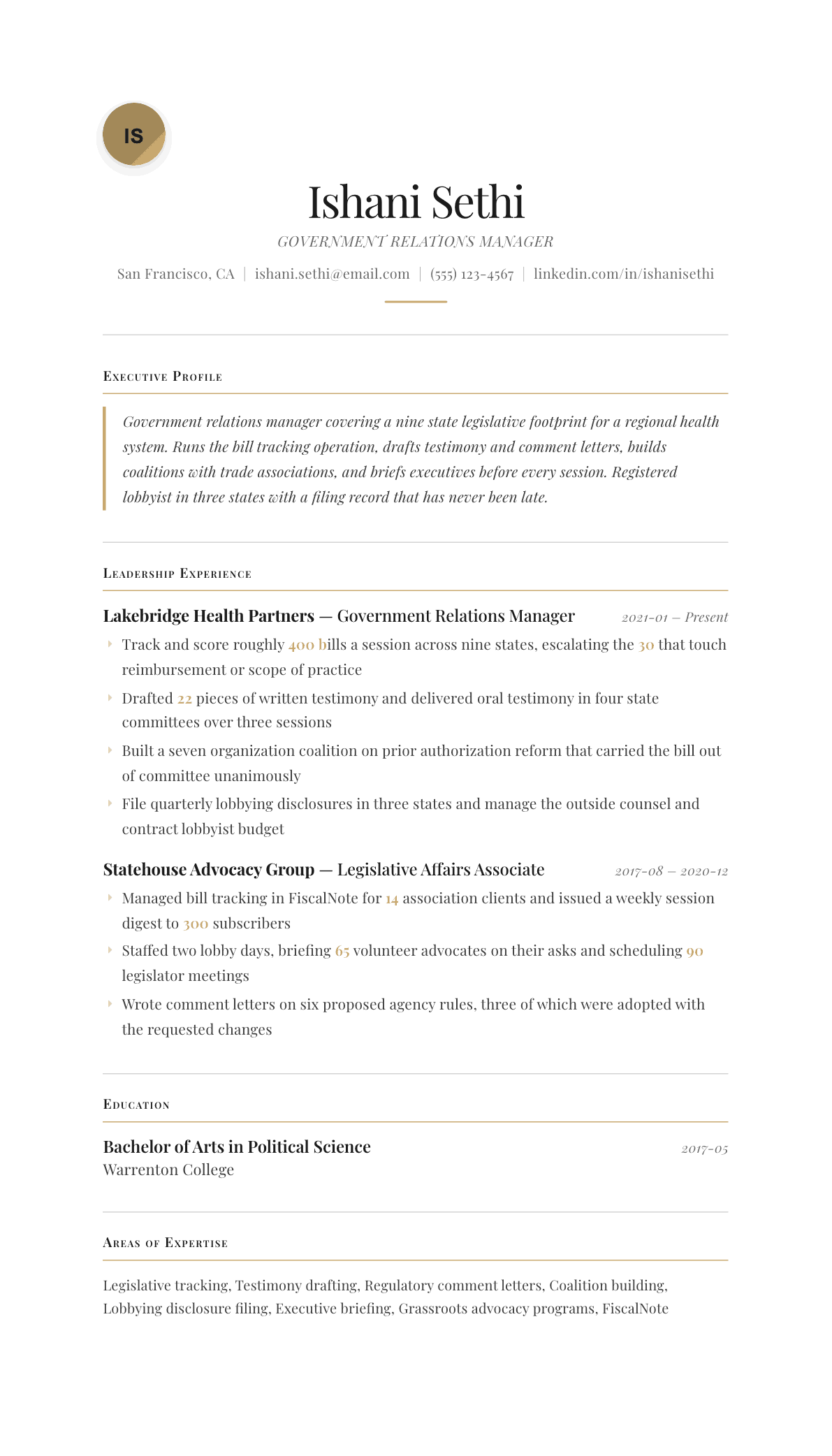
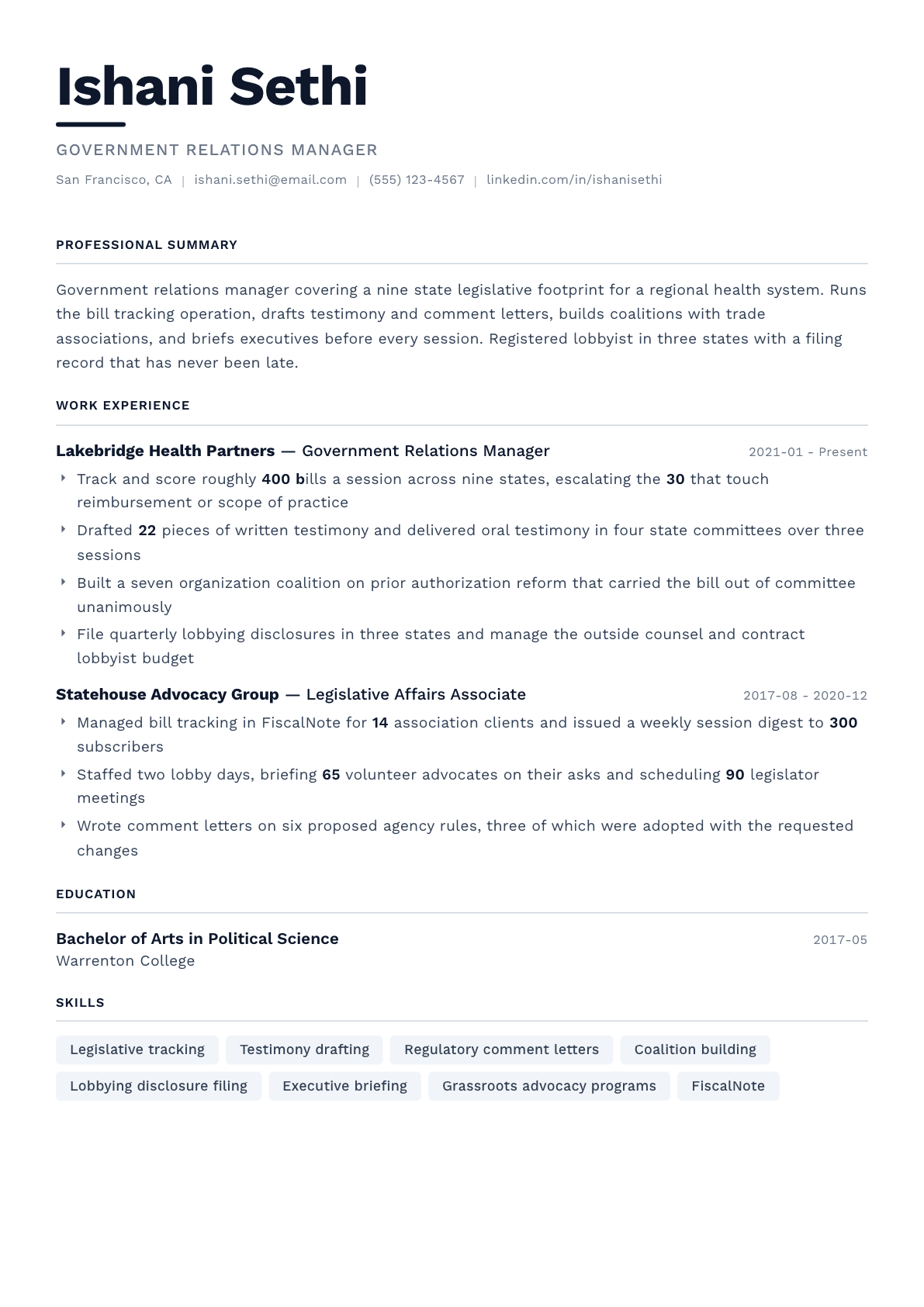
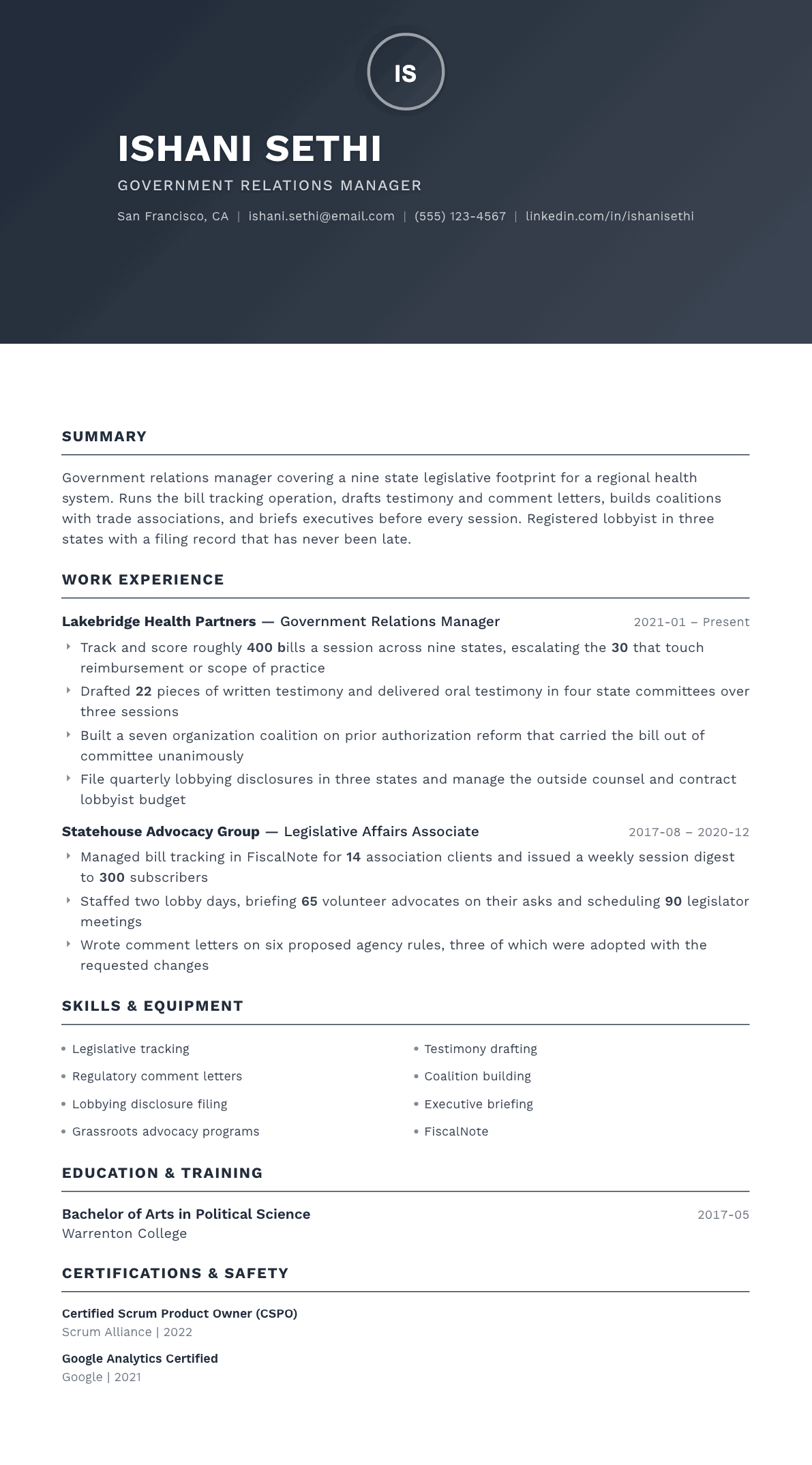
The same government relations manager content laid out in three CVBooster templates, so you can see what the finished document looks like before you write a word.
Example Government Relations Manager summary
Government relations manager covering a multistate legislative footprint for a health system, tracking several hundred bills a session and working the small number that reach reimbursement and scope of practice. Drafts testimony, files comment letters on proposed rules, and builds coalitions with trade associations that carry a bill further than any single employer can. Registered lobbyist with a clean quarterly disclosure record and a standing executive briefing cycle.
Skills to list on a Government Relations Manager resume
- State legislative affairs
- Federal agency relations
- Bill tracking and analysis
- Testimony and briefing memos
- Regulatory comment drafting
- Coalition management
- Lobbying registration and disclosure
- Grassroots advocacy
- Political action committee administration
- Stakeholder mapping
- Executive and board briefing
- Trade association liaison
- Legislative session planning
- Public comment and rulemaking process
What actually gets this resume read
- Name the chambers and agencies you work, because state legislative work and federal agency work are separate hiring lanes.
- Give the size of your bill portfolio per session and how many of those bills you actively worked rather than monitored.
- Say what you have drafted yourself: testimony, comment letters, one pagers, amendment language or a coalition sign on letter.
- Show a policy outcome with the mechanism, such as an amendment adopted, a rule changed or a bill held in committee.
- Put your lobbying registrations and disclosure filing record on the page, since a late filing is a compliance event.
- Describe the coalition work by naming the number of partner groups and what you had to reconcile between them.
- Include the political action committee or grassroots program if you ran one, with the volunteer or donor counts.
How to write a government relations manager resume
Hiring a government relations manager is an act of trust. The person doing it is handing you the company voice in front of legislators, agency staff and coalition partners, and she cannot audit most of your work directly. So she reads your resume for proxies: which chambers and agencies you have worked, how big a bill portfolio you carried, what you have drafted with your own hands, and whether anything measurable changed because you were in the room.
The weakest resumes in this field are the most confident sounding. They talk about building relationships with key stakeholders and advancing the organization policy agenda. Every applicant writes that. The strong ones name the footprint, the session volume, the specific instruments they produced, testimony, comment letters, amendment language, coalition sign on letters, and the outcome each one was attached to, including the bills that were killed rather than passed.
This guide covers how to structure the page for a corporate, association or nonprofit government relations seat, how to describe legislative and regulatory work separately, how to write a win without overclaiming credit, what to say about disclosure compliance, and the questions people ask when they move from a legislative staff job or a contract lobbying firm into an in house role.
Format: footprint, portfolio, instruments, outcomes
Reverse chronological, one page early on and two once you have several sessions and a regulatory record. Directly under each title, give the footprint: the states or the federal chambers and the agencies you covered. A manager who has worked nine state legislatures is a different candidate from one who has worked a single capital deeply, and both are valuable to different employers, so make the reader stop guessing in the first line.
Then the portfolio size per session and the share you actively worked. Tracking four hundred bills is monitoring. Working thirty of them is government relations. Saying both numbers in the same sentence is honest and it demonstrates triage, which is most of the job.
- Footprint line: chambers, states, agencies and any local jurisdictions you covered.
- Bills tracked per session against bills actively worked, with the issue areas named.
- Instruments you drafted yourself: testimony, comment letters, amendment language, one pagers, sign on letters.
- Registrations and disclosure filings, with the jurisdictions and your filing record.
- Coalition work by partner count and what you had to reconcile between them.
Summary: whose interests you carry, where, and on what issues
Three lines. The sector you represent, the geography, the two or three issue areas you own, and one outcome that shows access converting into a result. A government relations manager who covers reimbursement and scope of practice for a health system across a multistate footprint has said more in one clause than a paragraph of relationship language could carry.
Resist listing the officials you know. It reads as fragile, and any hiring manager senior enough to make the offer knows that relationships belong to institutions as much as to individuals. Show the work product instead, and the relationships are implied.
Legislative work: sessions, testimony and how a bill actually moved
Organize the legislative half around the session calendar, because that is how the work is really lived. Pre-session issue scoping and priority setting with the business, bill introduction and tracking, committee strategy, testimony and amendment work, floor and crossover deadlines, then the post session report to the executive team. Writing the year this way proves you have run a full cycle rather than covered someone else during a busy month.
Testimony is the clearest evidence of capability, so count it. How many pieces of written testimony you drafted, how often you delivered it orally, in which committees, and on whose behalf. Add the amendment work, because getting three lines changed in a committee substitute is a real skill and it is invisible unless you name it.
Write the defensive wins too. A bill that dies in committee because your coalition got there early is a result, and hiring managers in this field respect a candidate who says so plainly. Describe the mechanism, the chair conversation, the fiscal note you supplied, the coalition letter, rather than implying single handed authorship of an outcome that had many parents.
Regulatory work, coalitions and grassroots programs
Agency work is a separate discipline and many applicants collapse it into their legislative bullets. Keep it apart. Comment letters on proposed rules, the docket and the comment window, meetings with agency staff, participation in advisory committees, and whether any requested change appeared in the final rule. Employers with a heavy regulatory exposure screen specifically for this and cannot find it if it is buried.
Coalitions are the leverage instrument of the job. Give the number of partner organizations, who convened them, what the joint ask was and where the interests diverged, because managing a coalition is largely managing disagreement between allies. If you have staffed a trade association committee or a working group, name it and say whether you chaired it.
Grassroots and political programs round out the profile. Advocacy days with volunteer counts and meetings scheduled, an advocate list you built and its response rate, a political action committee you administered with its compliance calendar. These are operational facts a hiring manager can check, and they show you can build capacity rather than only spend it.
- Comment letters filed by docket type, with any change adopted in the final rule.
- Agency staff meetings and advisory committee seats held.
- Coalition partner counts, the joint ask, and the position you had to reconcile.
- Advocacy day logistics: advocates briefed, meetings booked, follow up completed.
- Political action committee administration and the disclosure calendar you kept.
Compliance, ethics and the keywords a screener matches
Registration and disclosure is not administrative trivia in this field, it is the thing that ends careers. Put your registrations by jurisdiction on the page and state your filing record, including gift rule training and any ethics compliance you own for the wider business. An employer with exposure across several capitals reads that line as risk reduction.
For screening language, use the terms postings actually use: legislative affairs, public policy, regulatory affairs, rulemaking, comment period, stakeholder engagement, coalition management, grassroots advocacy, political action committee, bill tracking, fiscal note, appropriations, and the tracking platform you work in. Name your tools, since a team running one platform does not want to retrain a manager mid session.
Government Relations Manager resume summary examples
Coming off legislative staff
Former committee staffer with three sessions inside a state senate, drafting bill analyses, briefing members before hearings and managing a committee calendar of 140 bills. Moving to the advocacy side with a working knowledge of how a bill dies quietly. Seeking a first in house government relations seat.
Five years in
Government relations manager covering nine state legislatures for a regional health system, tracking about 400 bills a session and actively working the 30 touching reimbursement and scope of practice. Drafted 22 pieces of written testimony over three sessions and built a seven organization coalition that moved a prior authorization bill out of committee.
Director track
Senior government relations lead with 12 years across state and federal work, managing three contract lobbying firms and an advocate network of 4000 members. Owns the pre-session priority process with the executive team, files disclosures in five jurisdictions, and has placed requested language in two final agency rules.
Work experience bullets: before and after
Before: Built relationships with legislators and staff.
After: Held 90 member and staff meetings across two sessions in nine states, opening every one with the district level operating data that made the ask concrete.
Meeting counts and the content of the ask replace a claim nobody can verify.
Before: Monitored legislation relevant to the company.
After: Tracked about 400 bills a session in FiscalNote, scored them against three business risk criteria, and escalated the 30 that touched reimbursement to the executive team weekly.
A tracking tool plus a scoring rule turns monitoring into an analytical process with an audience.
Before: Helped pass legislation important to our industry.
After: Convened seven organizations behind a prior authorization bill, drafted the sign on letter and the committee testimony, and the bill cleared committee unanimously before crossover.
Naming your instruments and the procedural milestone shows contribution without claiming sole authorship.
Before: Submitted comments on proposed regulations.
After: Filed six comment letters on proposed agency rules over two cycles, three of which produced the requested definitional change in the final rule.
Filing volume paired with adopted changes is the only regulatory outcome a hiring manager can check.
Before: Organized advocacy events for members.
After: Ran two lobby days for 65 volunteer advocates, briefing each group on a single ask and booking 90 legislator meetings with a same week follow up letter.
Logistics numbers and a follow up mechanism prove an operating program rather than an event.
Hard skills
- State legislative affairs
- Federal agency and congressional relations
- Bill tracking and legislative analysis
- Testimony drafting and delivery
- Amendment and bill language drafting
- Regulatory comment letters and rulemaking dockets
- Coalition formation and management
- Lobbying registration and disclosure filing
- Grassroots advocacy program design
- Political action committee administration
- Fiscal note and appropriations analysis
- Executive and board briefing
- Legislative tracking platforms
Soft skills
- Reading a room where nobody says no directly
- Translating operating detail into a member sized ask
- Holding a coalition together through a bad amendment
- Bringing an executive team a loss without spin
- Discretion about conversations that are not yours to repeat
Certifications worth listing
- Certified Association Executive (CAE) (American Society of Association Executives)
- Accreditation in Public Relations (APR) (Universal Accreditation Board)
Mistakes that cost government relations manager candidates the interview
- Opening with relationship language when the reader is looking for footprint, portfolio size and instruments drafted.
- Claiming a bill passed because of you when the resume gives no mechanism the reader can picture.
- Merging legislative and regulatory work into one block, which hides the agency experience some employers hire for.
- Naming individual officials as if they were assets you carry between employers.
- Leaving out registrations and disclosure filings, the compliance detail an employer with multistate exposure checks first.
- Reporting only wins, when defensive outcomes and bills held are half of what this job produces.
- Skipping the tracking platform and the internal reporting cadence, which is the operational half of the role.
Government Relations Manager resume questions
How do I move from legislative staff to an in house government relations job?
Lead with process fluency: bill analysis volume, committee calendars managed, and how members actually decide. Then show you can serve a business by naming an industry you understand and the specific issue areas you would own from day one.
Can I claim credit for a bill that passed?
Claim your instruments, not the outcome. Say what you drafted, who you convened and which procedural step followed, and let the reader connect them. Experienced hiring managers discount sole credit claims because they know how many hands touch a bill.
Should contract lobbying work go on an in house resume?
Yes, and organize it by client sector rather than by firm engagement. In house employers want to see that you can hold one set of interests deeply, so highlight the longest client relationships and the issues you carried across multiple sessions.
How do I show regulatory experience if I have never testified?
Comment letters, docket monitoring, agency staff meetings and advisory committee participation all count. Give the number of letters filed, the rule types they addressed, and whether any requested language reached the final rule.
What belongs on the page about compliance and ethics?
Your registration jurisdictions, your filing record, gift rule and ethics training you have completed, and any internal compliance process you own. One tight block is enough, and its absence is noticed by employers operating in several capitals.
Related resume examples
- Lobbyist Resume example
- Policy Analyst Resume example
- Public Affairs Specialist Resume example
- Public Policy Analyst Resume example
- Advocacy Specialist Resume example
- Legislative Aide Resume example