Solutions Engineer Resume Examples: the lines they read
Build a Solutions Engineer Resume That Wins Technical Deals
By Mustafa Tarabya, founder of CVBooster · Published · Updated
Solutions engineer resume examples, presales keywords and a writing guide covering demos, proofs of concept, security reviews and influenced revenue.
Sample resumes for a solutions engineer
The same solutions engineer content laid out in three CVBooster templates, so you can see what the finished document looks like before you write a word.
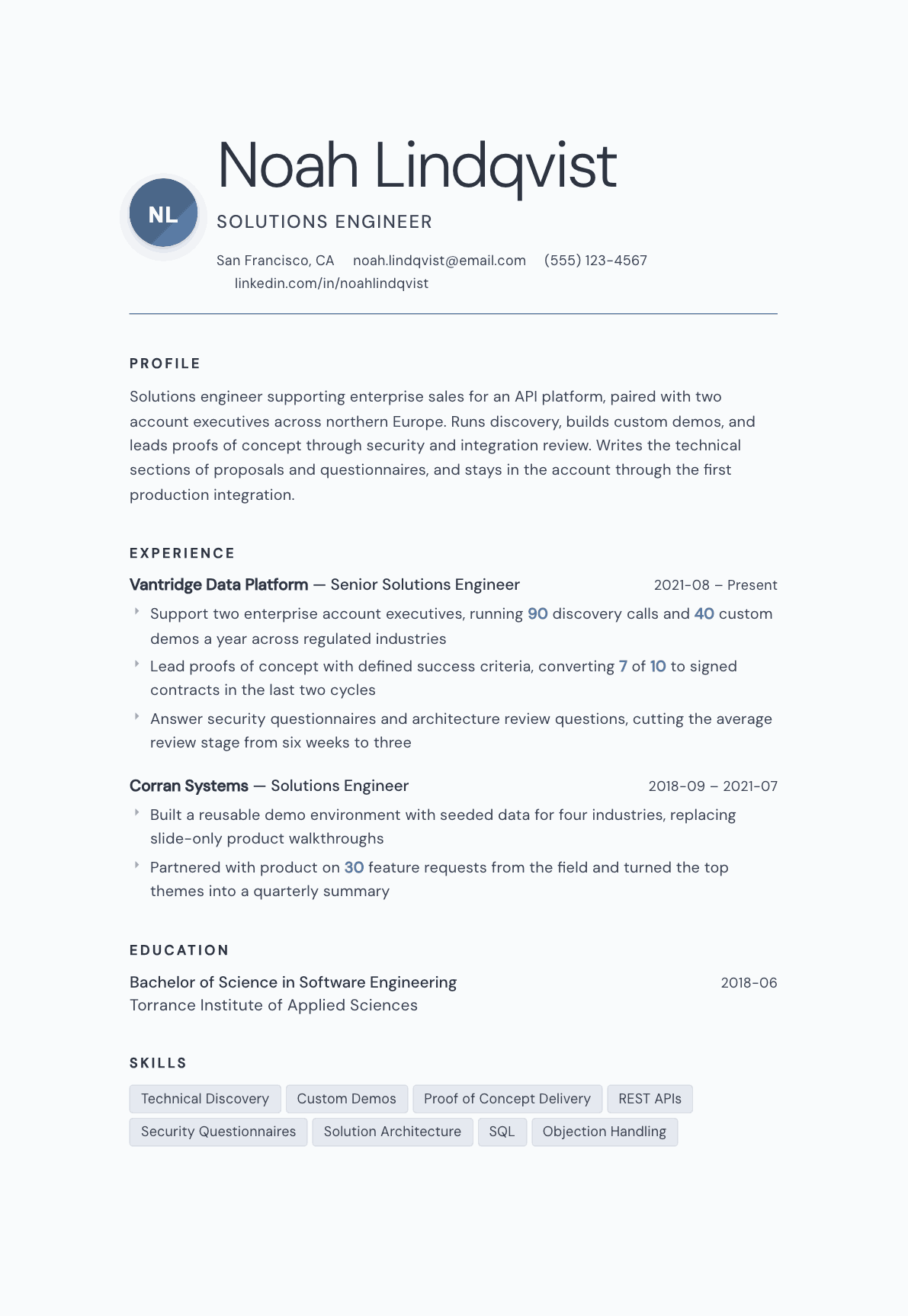
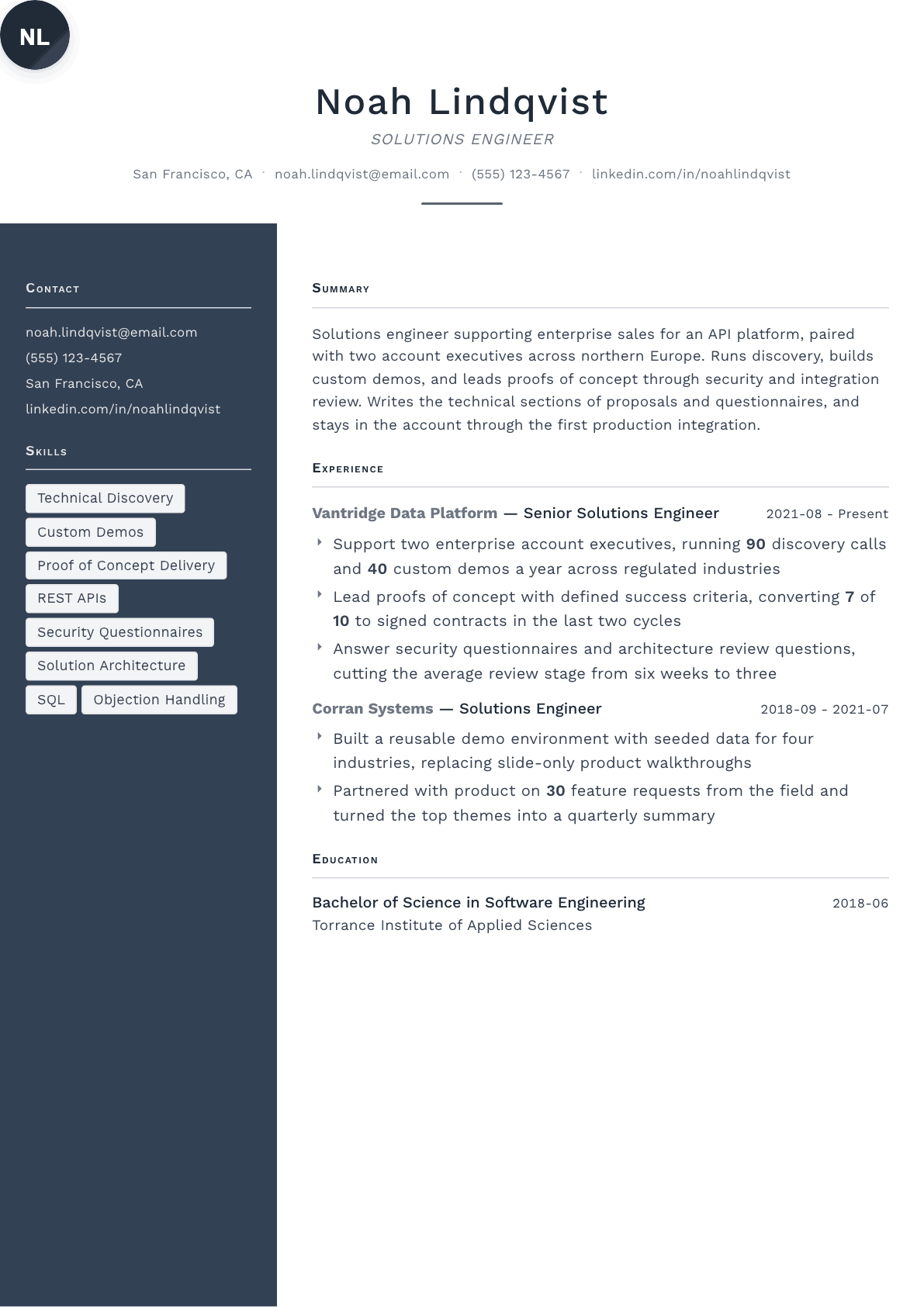
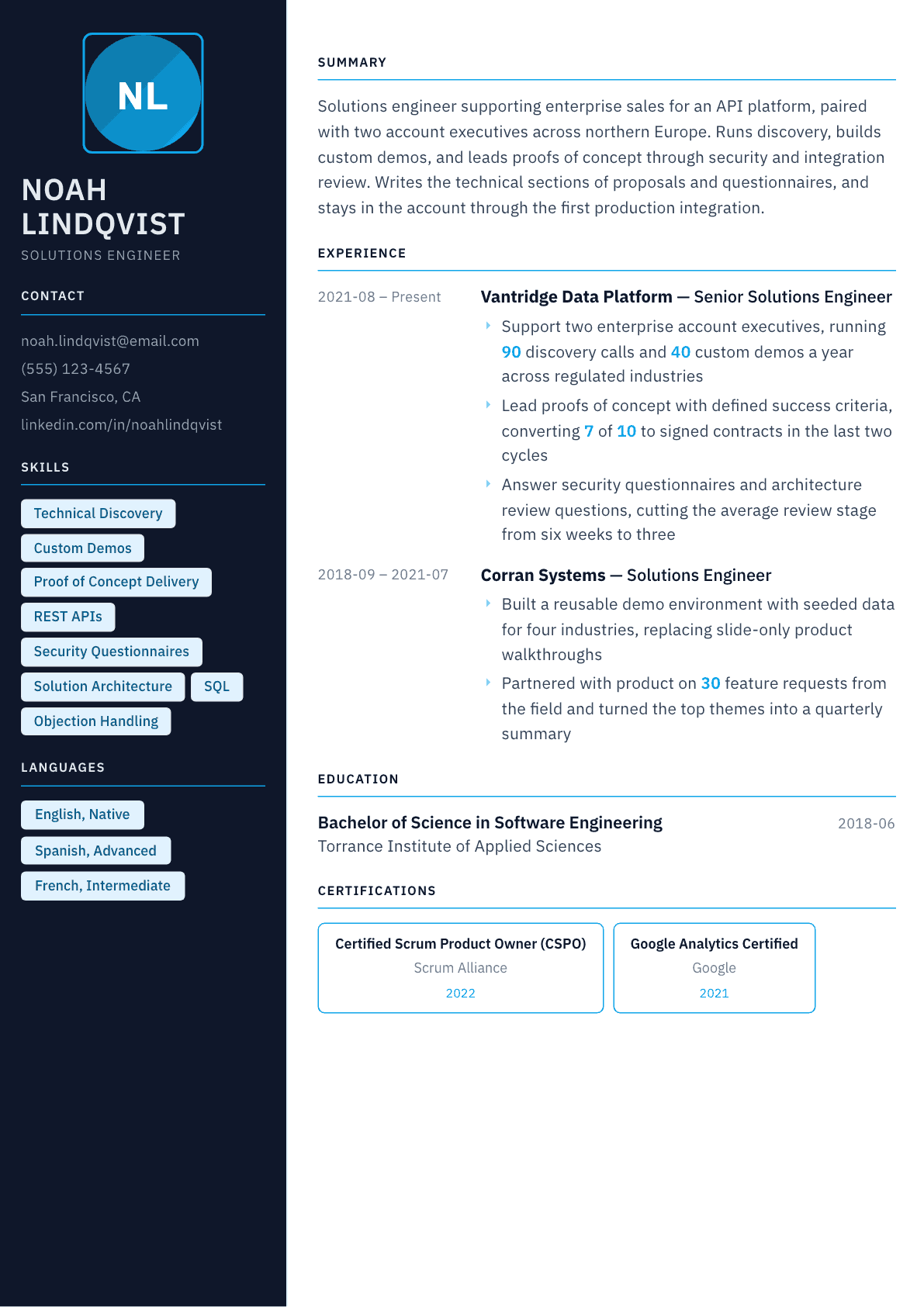
Example Solutions Engineer summary
Solutions engineer with six years supporting enterprise sales for API and data platforms in regulated industries. Runs discovery, builds custom demos on seeded environments, and drives proofs of concept with written success criteria that convert at a high rate. Owns security questionnaires and architecture review, and stays in the account until the first production integration is live.
Skills to list on a Solutions Engineer resume
- Technical Discovery
- Solution Architecture
- Custom Demo Development
- Proof of Concept Management
- REST and GraphQL APIs
- Authentication and SSO
- Security Questionnaires
- SQL
- Cloud Platforms
- Integration Design
- Technical Proposal Writing
- Objection Handling
- Enterprise Sales Support
- Customer Onboarding
- Competitive Positioning
- Product Feedback Loops
What actually gets this resume read
- Show both halves of the job: the technical build and the deal it moved, because presales resumes fail on one or the other.
- Give demo and proof of concept counts with conversion, since that is the closest thing to a quota you carry.
- Name the buyer you sell to, whether platform engineers, security architects or a data leadership team.
- Describe the technical depth you reach: API integration, authentication design, network review or data residency.
- Include the sales motion and deal size band you support so a hiring manager can match you to their segment.
- Mention the feedback loop to product, because good solutions engineers are judged on field intelligence too.
How to write a solutions engineer resume
A solutions engineer resume fails in one of two predictable ways. Either it reads as a sales resume with a technical vocabulary sprinkled on top, or it reads as an engineering resume that happens to mention customers. The role sits precisely between those, and the hiring manager is checking whether you can genuinely stand on both sides.
What she looks for is a deal you influenced through technical work. Not attended the call, not supported the account, but built the proof of concept with written success criteria, answered the security architecture questions, and stayed until the first integration ran in production. That chain is the job.
This guide covers the layout that shows both halves, how to quantify presales work when you do not carry a quota of your own, three example summaries, before and after bullets, and the questions engineers ask when they move from delivery or support into a customer facing technical role.
Format: one page early, two once you support enterprise deals
Reverse chronological, plain single column. The technical block belongs high on the page because presales screens filter on the product surface: API styles, authentication, cloud platforms, data formats and the integration patterns you have implemented for customers.
Under each role add a coverage line: the product you represented, the segment and region, how many account executives you paired with, and the typical technical complexity of a deal. That line lets a reader place you in their own sales motion within seconds.
- Header: name, title, city, phone, email, and cloud or platform certifications on one line.
- Order: summary, technical skills, experience, certifications, education.
- Coverage line per role: product, segment, region, account executives supported, deal complexity.
Summary: what you sell, to whom, and how deep you go
Three lines. Name the product category, the technical buyer you convince, and the depth you reach in a proof of concept. Persuading a platform engineering team is different work from persuading a data leadership group, and both differ again from a security architecture review.
If your background is engineering, say it. Former developers and architects carry credibility in a technical evaluation, and that is often the reason a company opens a solutions engineer role rather than promoting from inside sales.
Experience: discovery, demo, proof of concept, and the close
Discovery bullets should show that you asked the questions that changed the deal. Uncovering an authentication constraint, a data residency requirement or an existing integration that made the standard demo irrelevant is what a good solutions engineer does before building anything.
Demo bullets should describe what you built rather than that you presented. A reusable demo environment with seeded industry data, a live integration against the customer sandbox, or a scripted failure scenario that answered a reliability objection are all concrete artifacts a manager can picture.
Proof of concept bullets carry the most weight. Give the count, the written success criteria you agreed with the customer up front, the technical scope, and the conversion. Solutions engineers who define exit criteria before starting have a much better story to tell than those who ran an open ended trial.
The close and the handover round it out. Security questionnaires answered, architecture review stages cleared, the technical section of a proposal you wrote, and your involvement through the first production integration. Deals that go live cleanly are the ones the account team remembers.
Numbers a solutions engineer can honestly claim
You usually do not carry an individual quota, so use the numbers that are genuinely attributable: demos delivered, proofs of concept run and their conversion, security reviews cleared, review cycle time reduced, and the number of account executives you supported. State influenced revenue only if your company measured it and you can explain the attribution model.
Technical enablement is worth counting too. Demo assets others reuse, documentation you wrote for the field, and the number of colleagues you trained all show scale beyond your own calendar.
- Demos and discovery calls per year, with the segment they were in.
- Proofs of concept run, with written success criteria and the conversion outcome.
- Security questionnaires and architecture reviews cleared, plus any cycle time change.
- Assets built that the wider field team reuses.
Skills and keywords for presales screening
Postings repeat a compact vocabulary: technical discovery, product demonstration, proof of concept, solution architecture, integration, single sign-on, application programming interfaces, security review, competitive positioning and customer onboarding. Attach each to a real deal situation.
Keep the technical claims defensible. A solutions engineer is asked live technical questions in front of a customer, so anything on the page should survive that setting. It is better to show real depth in three areas than shallow familiarity with ten.
Solutions Engineer resume summary examples
Support engineer moving to presales
Support engineer with three years on an integration platform, moving into presales after covering 25 customer implementations. Runs product demos for mid-market prospects, builds sandbox integrations during evaluations, and knows the authentication and error handling questions technical buyers ask first.
Six years, enterprise presales
Solutions engineer with six years supporting enterprise sales for API and data platforms in regulated industries. Runs 90 discovery calls and 40 custom demos a year with two account executives, and converted 7 of 10 recent proofs of concept using written success criteria agreed before any build started.
Principal solutions engineer
Principal solutions engineer with eleven years across data and security platforms, leading technical strategy on the largest accounts in the region. Owns the reference architecture library, mentors four engineers through their first enterprise evaluations, and represents field requirements in quarterly product review.
Work experience bullets: before and after
Before: Presented product demos to prospects.
After: Delivered 40 custom demos a year built on a seeded environment matched to each prospect industry, replacing the generic walkthrough the team had used before.
A custom, industry specific environment is a build, while presenting a demo is attendance.
Before: Ran proof of concept evaluations with customers.
After: Led proofs of concept with written success criteria agreed at kickoff, converting 7 of 10 to signed contracts across the last two cycles.
Agreed exit criteria plus a conversion figure is the strongest evidence a presales candidate can offer.
Before: Answered technical questions during the sales process.
After: Owned security questionnaires and architecture review responses for regulated prospects, cutting the average review stage from six weeks to three.
Compressing a known bottleneck is measurable, attributable and immediately relevant to any enterprise sales team.
Before: Worked closely with account executives.
After: Paired with two enterprise account executives across northern Europe, joining discovery from first call and owning every technical workstream through to the first production integration.
Describing where you enter and where you exit the deal shows the scope of your involvement precisely.
Before: Gave product feedback to the product team.
After: Logged 30 field feature requests, grouped them into four recurring themes, and presented a quarterly summary that put two integration gaps on the roadmap.
Turning scattered requests into themes with a roadmap result shows influence rather than a feedback channel.
Hard skills
- Technical discovery and qualification
- Custom demo environment build
- Proof of concept scoping and delivery
- Solution and integration architecture
- REST and GraphQL interfaces
- Single sign-on and identity federation
- Security questionnaire response
- SQL and data exploration
- Cloud platform fundamentals
- Technical proposal writing
- Competitive technical positioning
- Customer onboarding handover
Soft skills
- Explaining architecture to non-technical buyers
- Objection handling under pressure
- Listening in discovery
- Partnership with account executives
- Presenting to a room of skeptical engineers
- Knowing when to say the product cannot do it
Certifications worth listing
- AWS Certified Solutions Architect, Associate (Amazon Web Services)
- Google Cloud Professional Cloud Architect (Google Cloud)
- Microsoft Certified: Azure Solutions Architect Expert (Microsoft)
- Salesforce Certified Administrator (Salesforce)
Mistakes that cost solutions engineer candidates the interview
- Writing a pure sales resume with pipeline language and no technical artifact anywhere on the page.
- Writing a pure engineering resume that never mentions a customer, a deal stage or a buying committee.
- Claiming revenue credit with no attribution model, which invites an uncomfortable question in the first interview.
- Describing proofs of concept without success criteria, which reads as an open ended trial rather than a managed evaluation.
- Listing ten technologies at shallow depth, when live technical questions expose thin claims quickly.
- Leaving out segment and region, so a hiring manager cannot tell whether you fit their sales motion.
Solutions Engineer resume questions
What is the difference between a solutions engineer and a sales engineer?
Most companies use the two titles for the same presales function. Some reserve solutions engineer for deeper architecture work and post-sale involvement. Mirror the title used in the posting and describe the responsibilities rather than arguing about labels.
How do I quantify presales work without a personal quota?
Count what is genuinely yours: demos delivered, proofs of concept run and converted, security reviews cleared, review cycle time reduced, and assets the wider field team reuses. Those hold up under questioning far better than a claimed revenue number.
Can a developer move into a solutions engineer role?
Yes, and it is a common path. Lead with customer facing work you already do: demos, integration support, technical workshops or onboarding calls. Then show that you understand a sales cycle and where the technical evaluation sits inside it.
Should I include a technical portfolio as a solutions engineer?
A short demo repository or a public integration sample can help, particularly for candidates coming from engineering. Keep it small and well documented, since the reviewer is evaluating your explanation quality as much as your code.
How do I show depth in a security review without breaking confidentiality?
Describe the categories you handled, such as data residency, encryption at rest, access controls and audit logging, along with the review stage timing. Never name the customer or repeat their specific findings on a public document.
Related resume examples
- Solutions Architect Resume example
- IT Consultant Resume example
- Technical Account Manager Resume example
- Implementation Specialist Resume example
- Systems Architect Resume example
- RPA Developer Resume example