Technical Account Manager Resume Examples: free score
Write a Technical Account Manager Resume That Wins Renewals
By Mustafa Tarabya, founder of CVBooster · Published · Updated
A technical account manager resume example with renewal and escalation keywords, a sample career history, and a writing guide for TAM interviews.
Sample resumes for a technical account manager
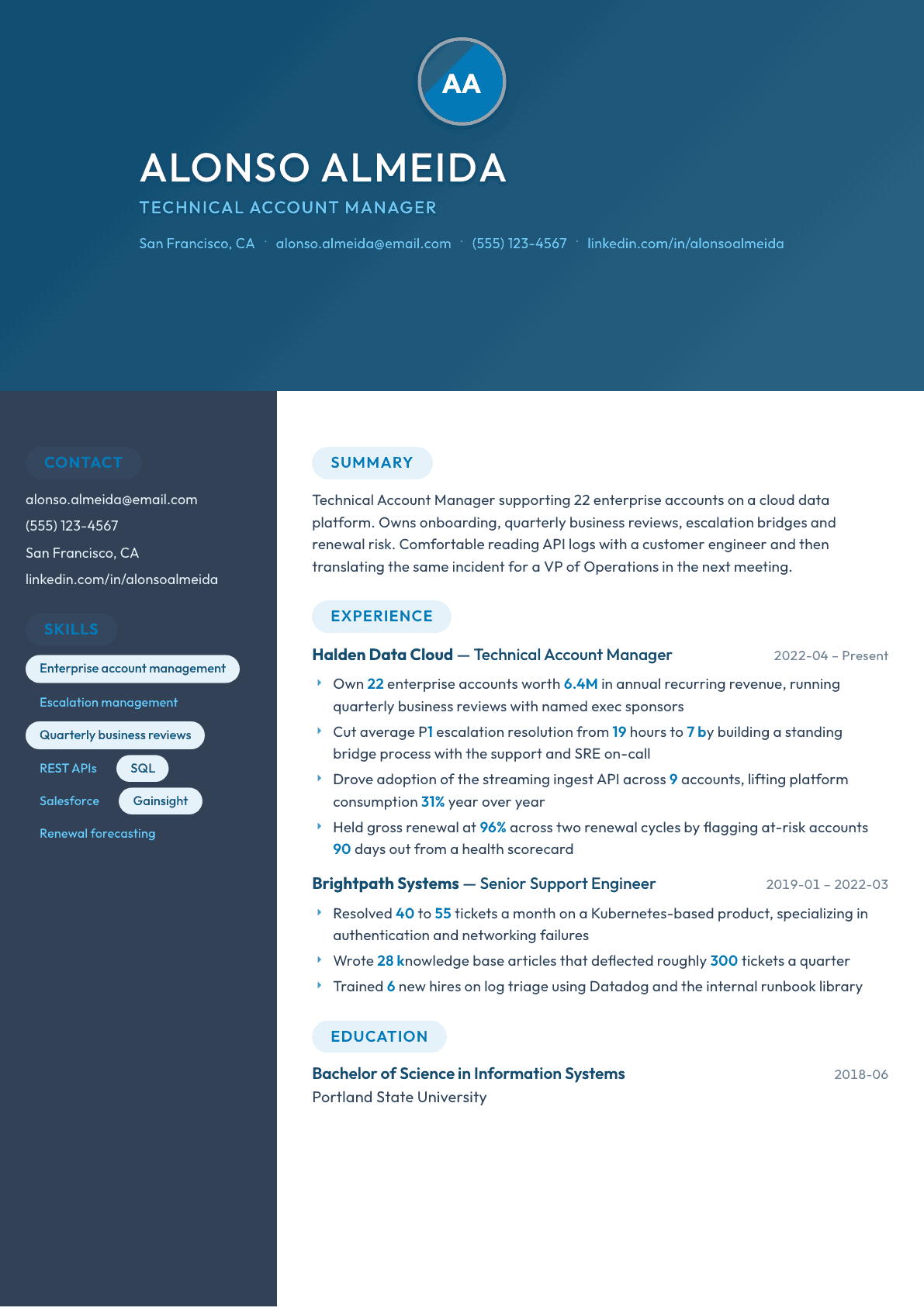
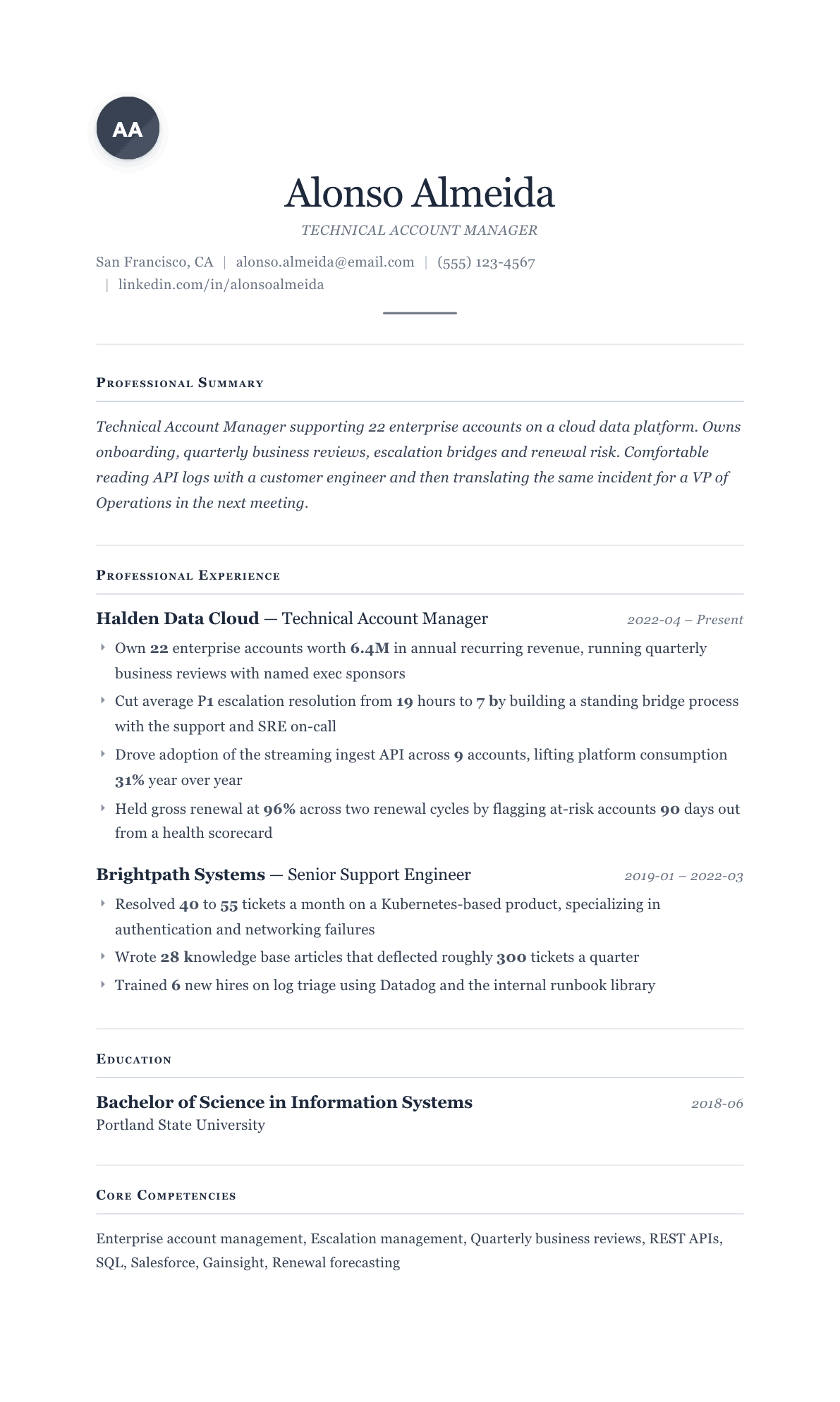
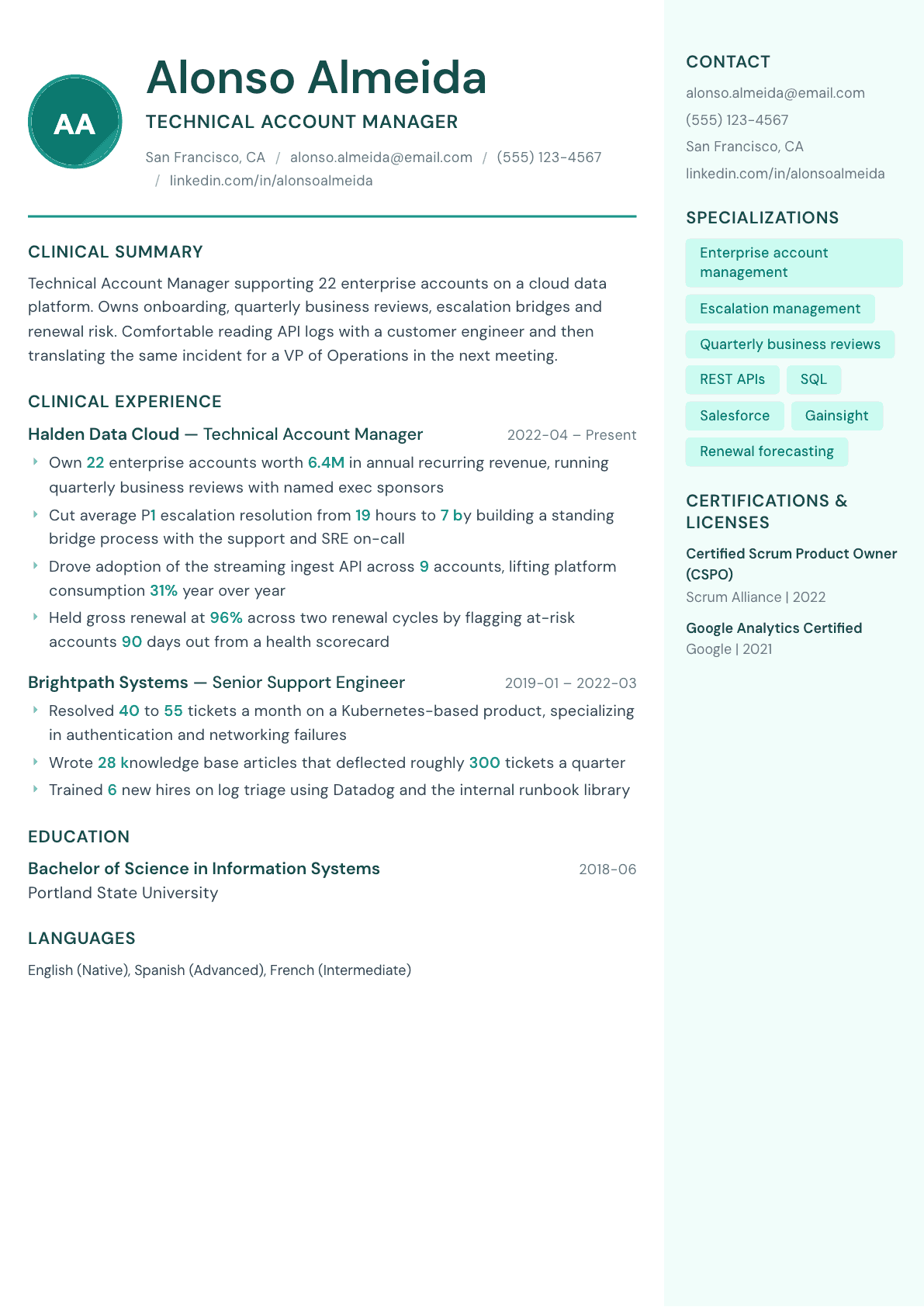
The same technical account manager content laid out in three CVBooster templates, so you can see what the finished document looks like before you write a word.
Example Technical Account Manager summary
Technical Account Manager with five years across enterprise SaaS support and post-sales ownership. Manages a book of 22 accounts, leads escalation bridges with SRE, and runs quarterly business reviews for exec sponsors. Held gross renewal at 96% and grew platform consumption 31% by pairing adoption plans with hands-on API troubleshooting. Looking for a TAM role covering strategic accounts in data infrastructure.
Skills to list on a Technical Account Manager resume
- Enterprise account management
- Escalation management
- Renewal forecasting
- Customer health scoring
- Quarterly business reviews
- Technical onboarding
- REST APIs
- SQL
- Cloud architecture basics
- Salesforce
- Gainsight
- Jira
- Stakeholder management
- Adoption planning
- Root cause communication
What actually gets this resume read
- Name your book of business in every job: how many accounts, what they pay in total, and which segment they sit in.
- Show both halves of the job, the technical depth on one line and the executive conversation on the next.
- Quantify renewal and expansion outcomes, because gross retention and net retention are the numbers a TAM leader hires against.
- Describe escalations as a process you ran, naming the bridge, the stakeholders, and the time to resolution you moved.
- List the product stack you supported by name so a recruiter can match it to the posting in one scan.
- Include the tooling that proves you work like a TAM, such as Salesforce, Gainsight, Jira and a health scoring model.
- Put a line about onboarding and time to first value near the top if the posting mentions adoption or activation.
How to write a technical account manager resume
A technical account manager resume is judged against a question that sounds simple and is not: can this person hold a room with a customer VP on Tuesday and read a stack trace with that customer's engineer on Wednesday. Most applicants prove one side. Support engineers write a ticket-shaped resume full of products and outages with no revenue anywhere. Account managers write a sales-shaped resume full of quota language with nothing that suggests they could open a log file. Both get passed over for the candidate who shows the two halves in the same job.
The hiring manager for a TAM opening is usually a director of customer success or professional services who carries a retention number. She reads the resume for four things in this order: the size and type of your book of business, what happened to those accounts under you, how you behave in an escalation, and whether you know the product category well enough to be credible in week two.
This guide covers the format, the summary, how to write experience that carries both technical and commercial weight, the skills that matter, and the questions people moving into a TAM role ask most.
Format: one page early, two once you have a real book of business
Reverse chronological, no columns in the experience section, and a header that carries your city, phone, email and LinkedIn. Keep it to one page until you have managed accounts for about five years, then a second page is fine if the extra space holds accounts and outcomes rather than more adjectives.
Do not use a functional layout. Post-sales hiring runs on account tenure, and a format that hides dates makes a reviewer wonder whether you were ever in the seat long enough to see a renewal cycle close.
- Header: name, title, location, phone, email, LinkedIn.
- Order: summary, experience, skills grouped into technical and commercial, education, certifications.
- Under each job title, add a one-line scope note: segment, number of accounts, total contract value, region.
Summary: segment, book size, retention, and the technical surface you work on
Three or four lines. Name the segment you cover, how many accounts and what they are worth in total, the retention or expansion outcome you carried, and the technical surface you are fluent in. A reader should finish the summary knowing whether you are a mid-market TAM on a marketing tool or a strategic TAM on a data platform, because those roles share a title and very little else.
Avoid the phrase trusted advisor. Every TAM resume in the pile claims it, so it now reads as filler. Replace it with the specific behavior that earns the label: you run the quarterly business review, you own the escalation bridge, you write the adoption plan the customer actually follows.
Experience: scope line first, then the two halves of the job
Open each role with the scope, because a reviewer cannot evaluate anything until she knows the size of the seat. Something like enterprise segment, twenty-two accounts, combined annual recurring revenue in the low seven figures, North America. Then three to five bullets that alternate between commercial and technical evidence so both are visible in one scan.
The commercial bullets should carry gross retention, net retention, expansion, at-risk saves, or the number of renewals you took through a procurement cycle. Say how you saw risk coming, since forecasting is what separates a TAM from a reactive support contact. A health scorecard, a usage report, a stalled onboarding milestone: name the signal.
The technical bullets should show what you personally did, not what your engineering team did while you scheduled meetings. Reading API error responses with a customer developer, reproducing an integration failure in a sandbox, writing the runbook for a data ingestion setup, and reviewing an architecture diagram before a migration are all real TAM work. Say which of them you did.
Escalations deserve their own bullet. Describe the process you ran, not the incident: who you pulled onto the bridge, how often you updated the customer, what you sent afterward, and what the time to resolution looked like before and after you changed it.
- Scope line under every title: segment, account count, total contract value, region.
- At least one bullet on retention or expansion with a number attached.
- At least one bullet where you touched the product yourself.
- One bullet on escalation process, one on onboarding or time to first value.
Skills: split technical from commercial so neither hides the other
Use two labeled groups. The technical group names the stack you can hold a conversation about: REST APIs, SQL, the cloud provider, the identity protocol, the log tool, whatever the product runs on. The commercial group names the operating tools and rituals: Salesforce, Gainsight or Vitally, renewal forecasting, business reviews, mutual success plans.
Be honest about depth. Listing Kubernetes when you can only define it will end badly in a screen where the interviewer asks what happens when a pod will not schedule. A TAM is allowed to say working knowledge, and the phrase reads as confidence rather than a gap.
Keywords the screener and the tracking system are both looking for
TAM postings recycle a narrow vocabulary: gross retention, net revenue retention, escalation management, quarterly business review, adoption, time to value, executive sponsor, health score, renewal risk, onboarding. Mirror the exact wording from the posting once in the summary and once inside a bullet where it is attached to something you did. Add the product category, because a company selling observability software filters for people who have supported infrastructure buyers.
Technical Account Manager resume summary examples
Moving from support
Support engineer with three years on an enterprise API platform, moving into account ownership after running the named-account escalation queue for eight strategic customers. Comfortable with REST troubleshooting, SQL and OAuth flows, and already leading monthly review calls with customer engineering leads.
Four years a TAM
Technical Account Manager covering twenty-two enterprise accounts on a cloud data platform. Runs quarterly business reviews with named executive sponsors, owns escalation bridges with the SRE on-call rotation, and held gross retention at 96% across two renewal cycles while lifting platform consumption 31%.
Strategic accounts lead
Principal Technical Account Manager for eight strategic accounts, each above seven figures in annual contract value. Built the health scoring model now used across the post-sales organization, led three multi-region migrations alongside professional services, and mentors six TAMs on escalation handling and executive communication.
Work experience bullets: before and after
Before: Managed a portfolio of enterprise customers.
After: Owned twenty-two enterprise accounts across North America, combined annual recurring revenue in the low seven figures, from onboarding through renewal.
Account count, region and contract value let a hiring manager size the seat instead of guessing at it.
Before: Handled customer escalations.
After: Ran P1 escalation bridges with support and the SRE on-call, sending hourly customer updates and a written root cause summary within two business days of resolution.
The reader now sees a repeatable process with named participants and a communication rhythm, not a vague duty.
Before: Helped customers use the product more.
After: Wrote adoption plans tied to each account's stated business goals and drove nine accounts onto the streaming ingest API, lifting consumption 31% year over year.
Adoption becomes measurable when it names the feature, the number of accounts and the usage movement.
Before: Worked with engineering to fix customer issues.
After: Reproduced customer integration failures in a sandbox and filed engineering tickets with request traces and log excerpts, cutting back-and-forth clarification cycles on defect reports.
It shows the candidate did technical work personally rather than acting as a message relay.
Before: Responsible for renewals.
After: Forecast renewal risk ninety days out using a usage and sentiment scorecard, flagging six at-risk accounts early and saving four through executive alignment sessions.
Naming the forecast horizon, the method and the save rate turns an assigned responsibility into evidence of judgment.
Hard skills
- REST API troubleshooting
- SQL
- Cloud platform fundamentals
- Log and trace analysis
- Identity and OAuth flows
- Renewal forecasting
- Customer health scoring
- Onboarding and implementation planning
- Salesforce
- Gainsight
- Jira
- Technical documentation
Soft skills
- Executive communication
- Escalation composure
- Expectation setting
- Cross-functional influence
- Written incident updates
- Prioritization across accounts
Certifications worth listing
- AWS Certified Cloud Practitioner (Amazon Web Services)
- AWS Certified Solutions Architect Associate (Amazon Web Services)
- Microsoft Certified: Azure Fundamentals (Microsoft)
- Google Cloud Digital Leader (Google Cloud)
- ITIL 4 Foundation (PeopleCert)
- Salesforce Certified Administrator (Salesforce)
Mistakes that cost technical account manager candidates the interview
- Writing a support resume with a TAM title on it: all products and outages, no retention, no expansion, no executive contact.
- Claiming trusted advisor and strategic partner without a single bullet that shows what either phrase looked like in practice.
- Leaving out the account count and contract value, which forces the recruiter to assume the smallest possible book.
- Describing escalations as things that happened to you instead of a process you designed and ran.
- Listing every technology the company sells rather than the ones you can survive a technical screen on.
- Skipping onboarding and time to value, which is where most TAM job descriptions place their first responsibility.
Technical Account Manager resume questions
What is the difference between a technical account manager resume and a customer success manager resume?
The customer success resume leads with retention, adoption and relationship outcomes. A technical account manager resume needs those too, plus concrete evidence of hands-on product work: troubleshooting, architecture review, integration support. Without the technical half you are applying for the other job.
How do I move into a technical account manager role from support engineering?
Reframe your named-account work as ownership. Pull out the customers you handled repeatedly, the review calls you ran, the onboarding you guided and any renewal conversation you supported. Then add one line in the summary saying you are moving into account ownership, so the reader is not left guessing.
Should I put revenue numbers on a technical account manager resume?
Yes, and in two forms. Give the total value of the book you managed so the reader can size the seat, and give the retention or expansion result so she can see what happened under your ownership. Use ranges if your employment agreement makes exact figures awkward.
Do I need cloud certifications for a technical account manager job?
They are not required, but a cloud associate certification is the cheapest way to prove baseline technical credibility when your background is commercial rather than engineering. Choose the provider the employer builds on, and put it near the top if your work history is light on hands-on evidence.
How many accounts should I say I manage?
The real number, with the segment attached. Eight strategic accounts and eighty mid-market accounts are both respectable, but they describe completely different jobs. Naming the segment stops a reviewer from reading a small number as underperformance or a large number as shallow coverage.
Related resume examples
- Customer Success Manager Resume example
- Solutions Architect Resume example
- Solutions Engineer Resume example
- Support Engineer Resume example
- Implementation Specialist Resume example
- Engineering Manager Resume example