Solutions Architect Resume Examples: what gets the call
Architect a Solutions Architect Resume That Wins Clients
By Mustafa Tarabya, founder of CVBooster · Published · Updated
Sample resume for a solution architect: a complete engagement entry, platform and domain keywords, certifications and a full writing guide.
Sample resumes for a solutions architect
The same solutions architect content laid out in three CVBooster templates, so you can see what the finished document looks like before you write a word.
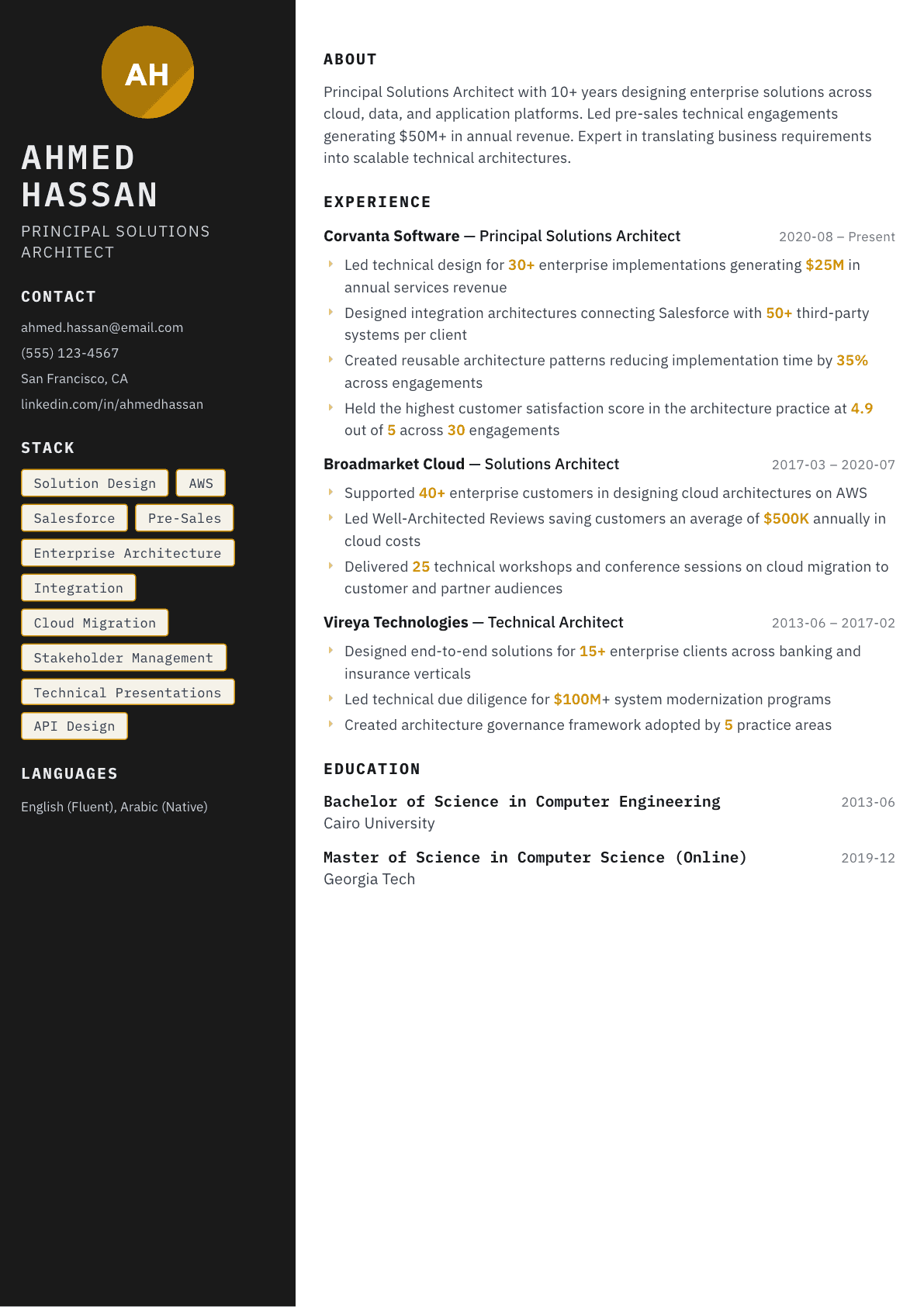
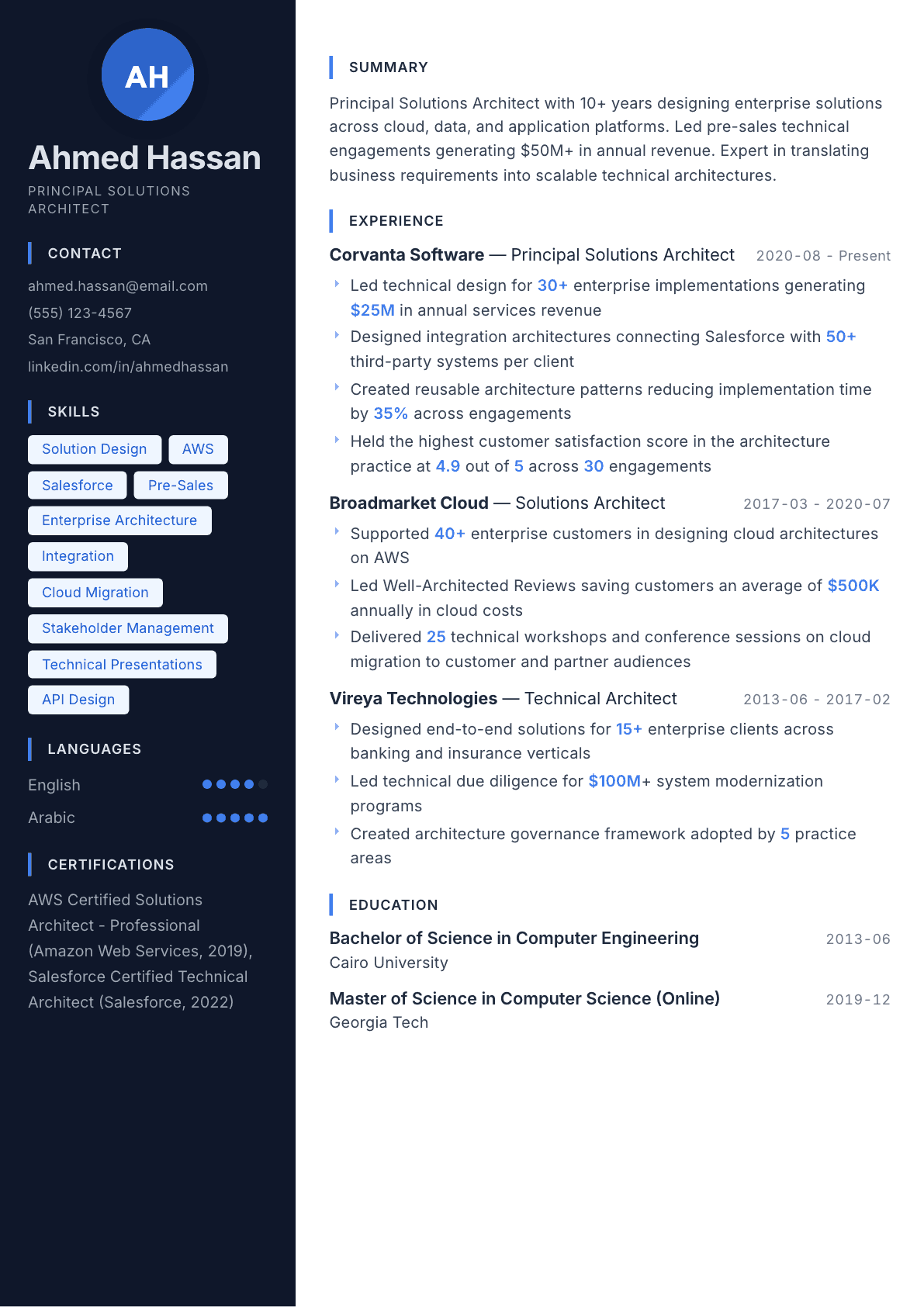
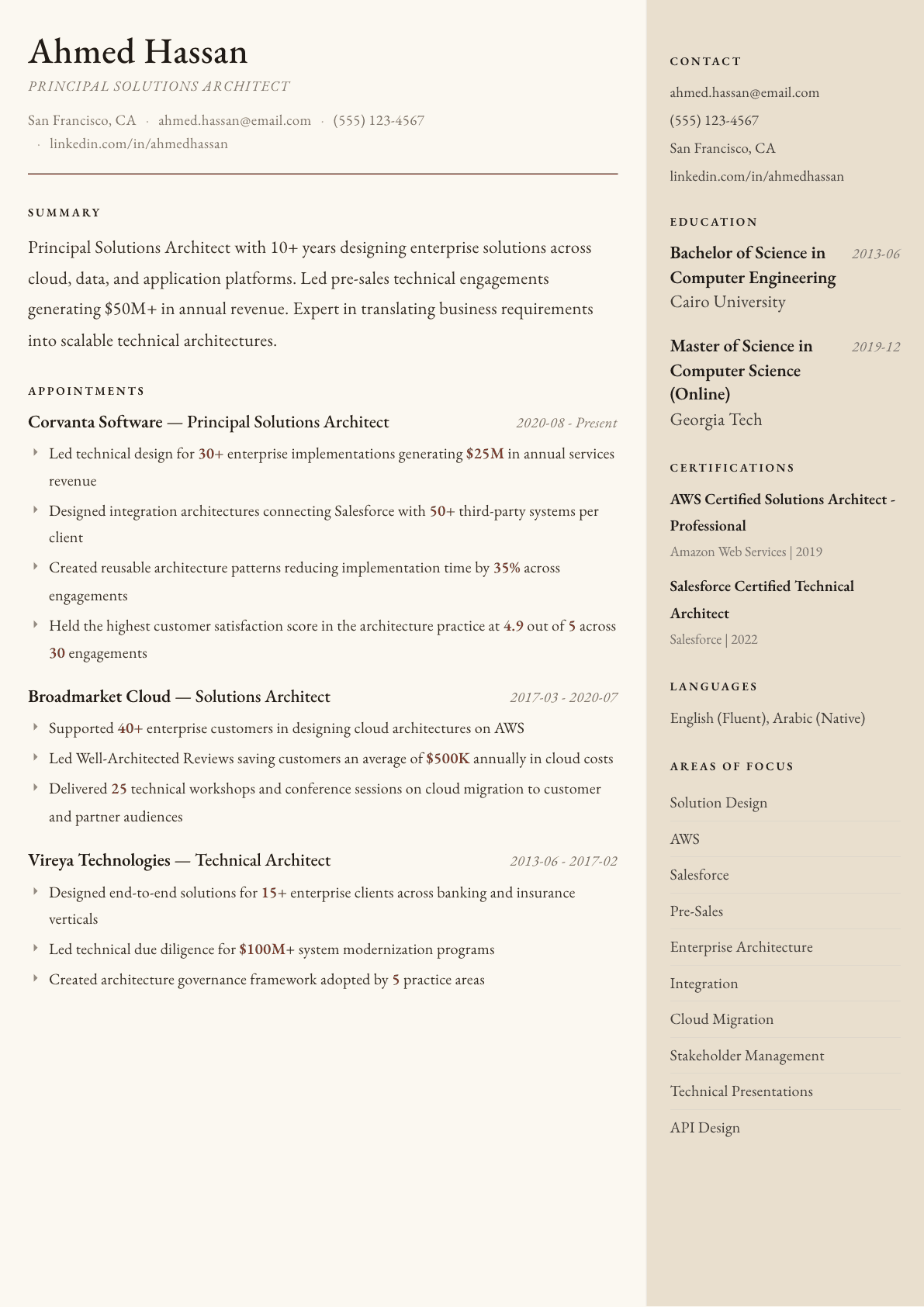
Example Solutions Architect summary
Principal Solutions Architect with 10 years designing enterprise solutions generating $50M+ in revenue. AWS and Salesforce certified with expertise in cloud architecture, integration design, and pre-sales engineering.
Skills to list on a Solutions Architect resume
- Solution Design
- AWS
- Azure
- Salesforce
- Pre-Sales
- Enterprise Architecture
- Integration
- Cloud Migration
- Stakeholder Management
- Technical Presentations
- API Design
- Microservices
- Data Architecture
- Security
What actually gets this resume read
- Quantify revenue impact of your solutions.
- Highlight pre-sales and client-facing experience.
- Show breadth across cloud platforms and integration patterns.
- Include certifications from major platforms.
- Demonstrate ability to bridge business and technical stakeholders.
How to write a solutions architect resume
A solutions architect sits between a customer with a business problem and an engineering organization that has to build the answer. The resume has to prove you are fluent on both sides of that gap. Screeners in this field discard two kinds of file quickly: the pure engineer who has never faced a customer, and the polished presenter who cannot describe a data flow.
What a hiring manager looks for is a repeated pattern of engagements. Which industries, what deal or program size, how many stakeholders, which platforms, what the architecture actually was, and whether the thing you designed went live. A list of technologies without an engagement around it does not distinguish a solutions architect from a senior developer.
This guide covers the section order that works for architecture roles, how to write engagement bullets that survive a technical panel, three summaries from first architect seat to principal, before-and-after bullets, and the questions candidates ask when moving from engineering into architecture.
Solution architect CV example and sample resume: a complete engagement entry
This sample resume for a solution architect is for a pre sales and delivery architect with eight years in cloud work, the last three as an architect. A hiring manager reads for the platforms, the size and type of customer, and what changed for that customer, so the summary names all three. It also works as a solution architect CV example: many global consultancies and vendors ask for a CV, and the content is the same, two pages with the engagements as the unit.
Summary: Solutions architect with eight years in cloud infrastructure and three leading customer engagements on AWS. Designs migration and data platforms for mid market financial services and retail customers, from discovery workshop to signed design. AWS Solutions Architect Professional, comfortable presenting to a CIO and pairing with the delivery team.
Order for a solution architect resume: header, summary, a platform and domain block, engagements under each employer, certifications, then education. Each engagement reads as the bullets below: the customer type, the problem, your design and the result.
- Led discovery and design for a regional bank moving its customer data platform to AWS, covering landing zone, networking and identity.
- Wrote the target architecture and the migration plan, and presented both to the bank architecture board for sign off.
- Supported the sales team on twelve opportunities a year, building proofs of concept and answering security questionnaires.
- Handed each design over to the delivery team with decision records, and stayed on as design authority through go live.
- Cut the bank batch window from overnight to under two hours by moving reporting to a managed data warehouse.
Format: a platform and domain block up top, then engagements
Reverse-chronological with two pages as the norm, because architecture roles are senior and the engagement history is the substance. Directly under the summary, place a block that names your cloud platforms, integration patterns, data technologies and the industries you have worked in. Industry matters more here than in most technical roles, since a posting for financial services architecture is screening for regulatory familiarity as much as for design skill.
Certifications from the major platforms belong high on the page, often right after the summary, because partner status and customer confidence frequently depend on them. Below that, structure experience around engagements rather than a flat list of duties.
- Header: name, architect title, location, email, and any speaking or published reference architecture.
- Order: summary, certifications, platforms and domains, experience, education.
- Name the cloud platform and the integration style in the first three lines of the page.
Experience: write engagements, not responsibilities
For each role, give the reader the shape of the work: the type of customer, how many concurrent engagements you carried, and whether you were pre-sales, delivery, or both. Then describe two or three signature engagements inside that role. A signature engagement names the business problem, the constraint that made it hard, the architecture you proposed, and what happened after go-live.
Constraints are what make an architecture bullet credible. Data residency rules, a mainframe that could not be replaced, a merger deadline, an on-premises network with no outbound access, a peak retail season that froze all change. Naming the constraint proves you designed for reality rather than drawing a reference diagram from a vendor deck.
End the engagement with an outcome the business recognizes: a migration completed, a platform consolidated, a manual process removed, an integration that replaced nightly file transfers with events. Where you worked pre-sales, deal influence is a legitimate outcome, but describe your contribution accurately rather than claiming the whole number.
Pre-sales, delivery and the difference between them
Solutions architect means different things at a software vendor, a consultancy and an enterprise. At a vendor it is mostly pre-sales: discovery calls, demonstrations, proof of concept builds, responses to requests for proposal, and technical objection handling. At a consultancy it is delivery: designing the target state, leading the build team, and defending the design in governance forums. Inside an enterprise it leans toward internal platform standards and vendor evaluation.
Read the posting and lead with the matching flavor. If a vendor role is on the table, the proof of concept you built in a week that unblocked a deal is your strongest bullet. If a consultancy role is on the table, the migration you designed and saw through governance matters more. Carrying both is an advantage only if the reader can see which is which.
- Pre-sales evidence: discovery workshops run, proofs of concept built, proposal responses authored.
- Delivery evidence: target-state designs, architecture decision records, governance approvals, go-lives.
- Enterprise evidence: standards you set, vendor evaluations you led, reference architectures adopted.
Show the architecture, not just the platform name
Naming a cloud provider tells a reviewer very little. Naming the pattern tells them a lot: event-driven integration over a message broker, an API gateway fronting legacy services, a data lakehouse feeding downstream analytics, a hub-and-spoke network topology with centralized egress inspection, an identity federation between two directories after an acquisition.
Include the non-functional side, since that is where architects earn their keep. Availability targets, recovery point and recovery time objectives, throughput ceilings, cost per transaction, and the security controls demanded by the customer's auditors. Candidates who mention only the happy path read as designers who have never had a production incident traced back to their diagram.
Keywords architecture postings reuse
The recurring vocabulary is stable: solution design, enterprise architecture, cloud migration, integration patterns, API design, microservices, stakeholder management, technical presentations, proof of concept, requests for proposal, security architecture and data architecture. Mirror the posting language once in the platform block and once inside an engagement bullet.
Watch the adjacent titles too. Postings for technical architect, cloud architect, principal consultant and customer engineer are often the same job under a different label, and matching that exact title in your summary line helps both the parsing software and the human who reads next.
Solutions Architect resume summary examples
First architect seat
Senior engineer stepping into solutions architecture, with three years designing integrations between a core banking platform and partner APIs. Runs customer discovery workshops, builds proofs of concept on AWS, and holds the Solutions Architect Associate credential. Seeking a customer-facing architecture role in financial services.
Six years in
Solutions architect with six years across retail and logistics, carrying four concurrent engagements. Designed an event-driven order platform that replaced nightly batch transfers between eight systems, and led two AWS migrations covering 120 workloads. Comfortable presenting architecture to both engineering teams and executive sponsors.
Principal architect
Principal solutions architect with twelve years in enterprise cloud and integration work, supporting deals across manufacturing and healthcare. Owns the reference architectures used by 30 field architects, chairs the internal design authority, and has taken 25 designs from discovery through governance to production.
Work experience bullets: before and after
Before: Designed cloud solutions for enterprise clients.
After: Designed the target-state AWS architecture for a logistics client moving 120 workloads off two data centers, including landing zone, network topology and identity federation.
Naming the workload count, the landing zone and the identity work shows an architect who scoped the whole estate rather than one application.
Before: Supported the sales team on technical questions.
After: Ran 40 discovery workshops and built 12 proofs of concept in the pre-sales cycle, converting 9 into signed delivery engagements.
Counted workshops, proofs and conversions turn support into measurable pre-sales contribution.
Before: Integrated multiple systems together.
After: Replaced nightly file transfers between order, inventory and billing systems with an event-driven design on a managed message broker, cutting stock data lag from 14 hours to under a minute.
The before-and-after latency makes the integration pattern concrete instead of a diagram description.
Before: Made sure solutions met security requirements.
After: Designed a data residency model keeping regulated records in-region with tokenized cross-border access, and carried it through the client audit committee without exceptions raised.
A named constraint and a governance outcome prove the design survived scrutiny, which is what architects are hired for.
Before: Created architecture documentation for projects.
After: Authored 18 architecture decision records and a reference blueprint that four delivery teams reused, shortening design phases on later projects by roughly three weeks.
Reuse by other teams is the clearest evidence that your documentation had authority.
Hard skills
- Solution and target-state design
- AWS
- Azure
- Cloud migration planning
- Integration and messaging patterns
- API design and gateways
- Microservices and event-driven architecture
- Data architecture
- Identity and access federation
- Security architecture
- Proof of concept development
- Request for proposal response
- Architecture decision records
- Cost modeling
Soft skills
- Executive presentation
- Customer discovery and listening
- Translating business needs into design
- Negotiating scope with stakeholders
- Technical storytelling
- Governance and design defense
Certifications worth listing
- AWS Certified Solutions Architect, Professional (Amazon Web Services)
- AWS Certified Solutions Architect, Associate (Amazon Web Services)
- Microsoft Certified: Azure Solutions Architect Expert (Microsoft)
- Google Cloud Professional Cloud Architect (Google Cloud)
- TOGAF Enterprise Architecture Practitioner (The Open Group)
- Salesforce Certified Technical Architect (Salesforce)
Mistakes that cost solutions architect candidates the interview
- Writing a senior developer resume with the word architect in the title, and never showing a customer or a stakeholder.
- Listing platforms without a single architecture pattern, so the reader cannot tell what you actually designed.
- Claiming whole deal values as personal achievement rather than describing the technical contribution you made.
- Leaving out the constraints, which makes every design read like a vendor reference diagram.
- Ignoring non-functional requirements such as recovery objectives, throughput limits and audit controls.
- Failing to say whether the design went live, which leaves the reader unsure anything was ever built.
- Burying platform certifications on page two when partner requirements often make them a screening filter.
Solutions Architect resume questions
What is the difference between a solutions architect and an enterprise architect resume?
A solutions architect resume is organized around individual engagements and systems, with design patterns and go-live outcomes. An enterprise architect resume works at portfolio level: standards, capability models, roadmaps and vendor strategy across many systems. Match whichever level the posting describes.
How many certifications should a solutions architect list?
Three to six current ones, weighted toward the platform in the posting. Professional-level cloud credentials and an architecture framework certification carry the most weight. Remove expired credentials, and never list a training course as though it were a certification.
I come from engineering. How do I show I can face customers?
Pull out every instance of client contact you already have: requirements workshops, demonstrations, incident calls with a customer on the line, vendor negotiations, training sessions you delivered. Then write one bullet per role that names the audience and what they decided afterward.
What does a good solution architect resume example look like?
A summary that names your platforms, customer type and years as an architect, a platform and domain block, then engagements written as problem, design and result, as in the sample above. Keep diagrams for the interview, where you can talk through them, rather than putting them inside the resume file.
How do I write about engagements under a non-disclosure agreement?
Describe the client by sector and size rather than by name, keep the architecture generic enough that no proprietary detail leaks, and focus on the pattern and the constraint. Reviewers in consulting and vendor organizations expect this and read it as professional discretion.
Related resume examples
- Systems Architect Resume example
- Cloud Architect Resume example
- IT Consultant Resume example
- Integration Architect Resume example
- Salesforce Administrator Resume example
- Salesforce Developer Resume example