Logistics Manager Resume Examples: the lines they read
Create a Logistics Manager Resume That Delivers on Every Line
By Mustafa Tarabya, founder of CVBooster · Published · Updated
Build a logistics manager resume that highlights warehouse operations, transportation optimization, and distribution excellence with clear cost and efficiency metrics.
Sample resumes for a logistics manager
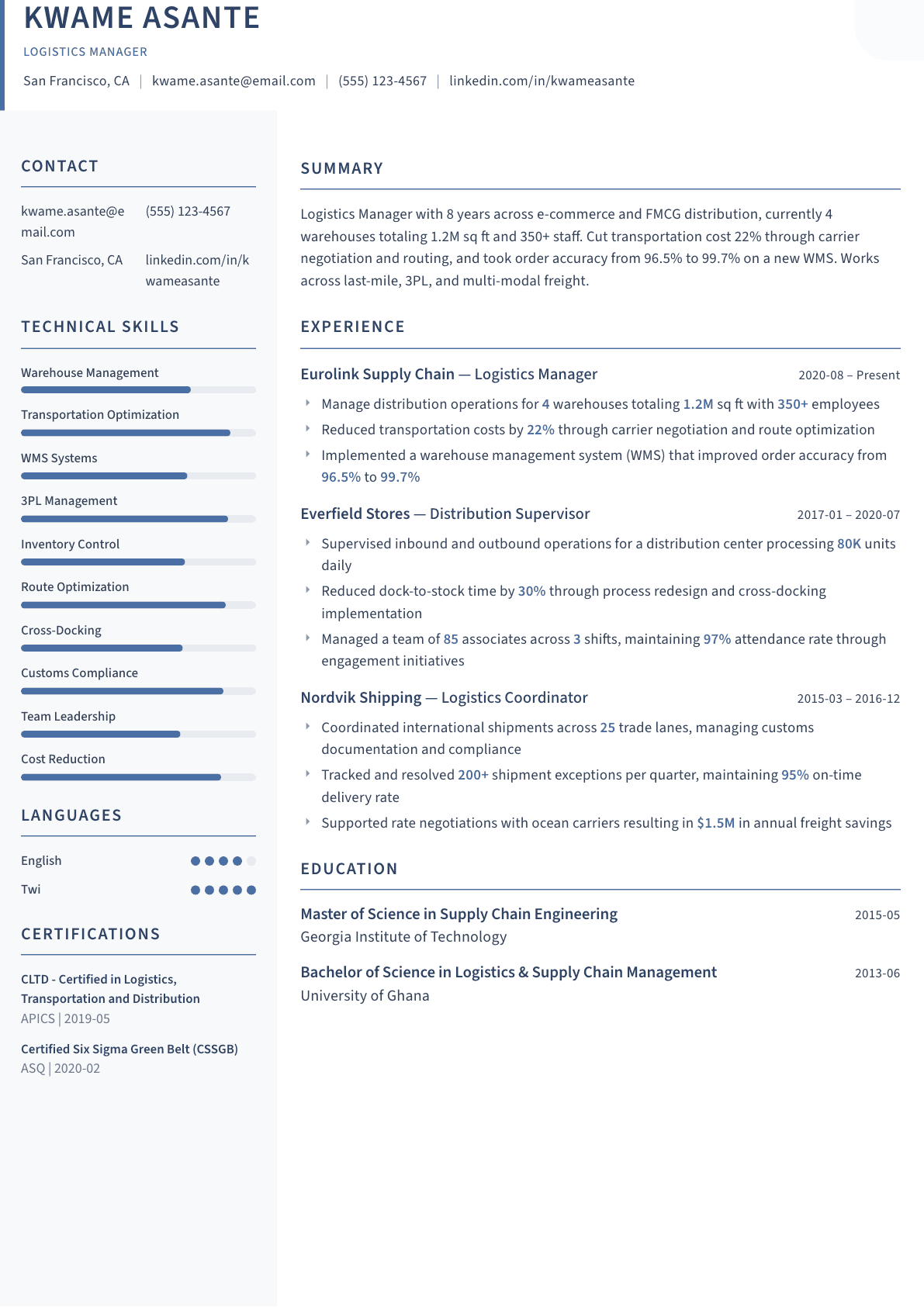
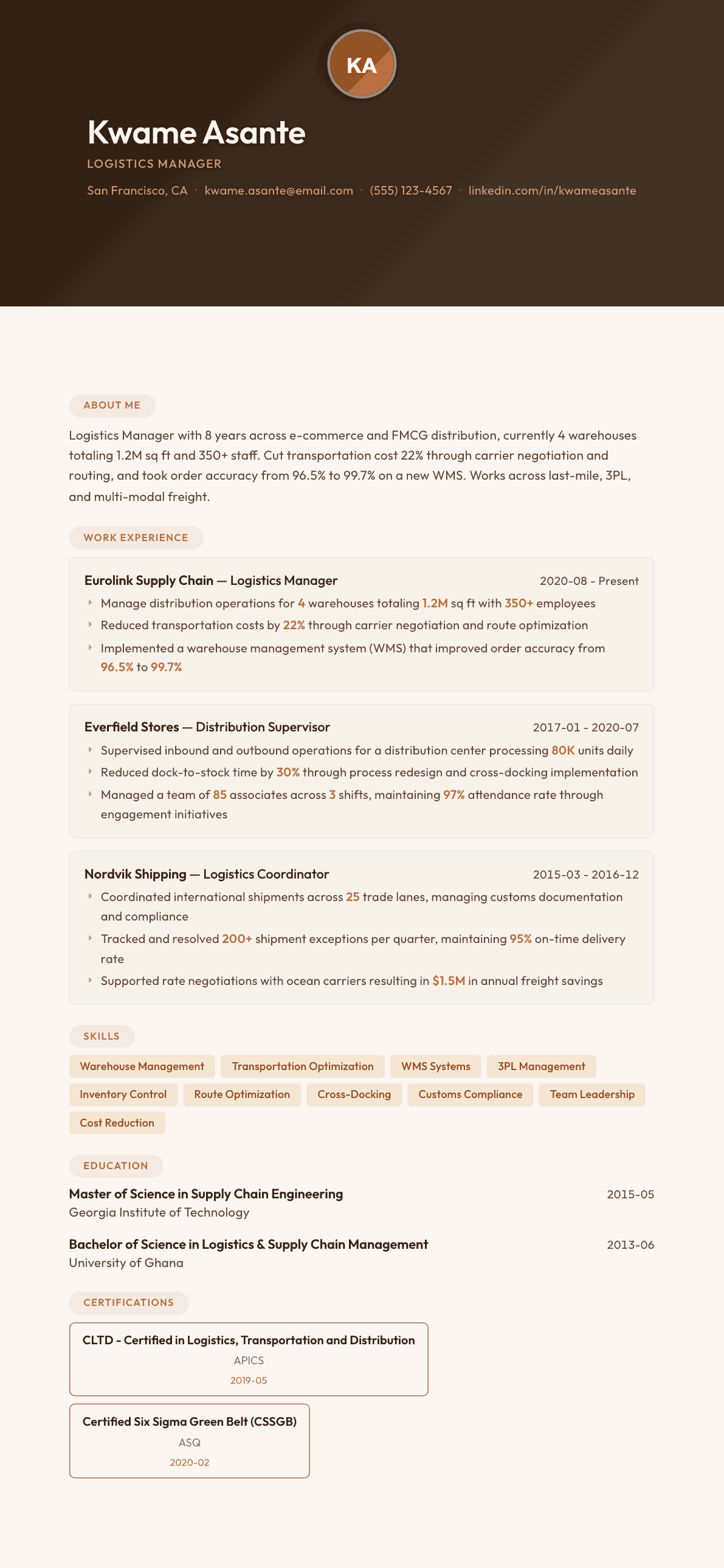
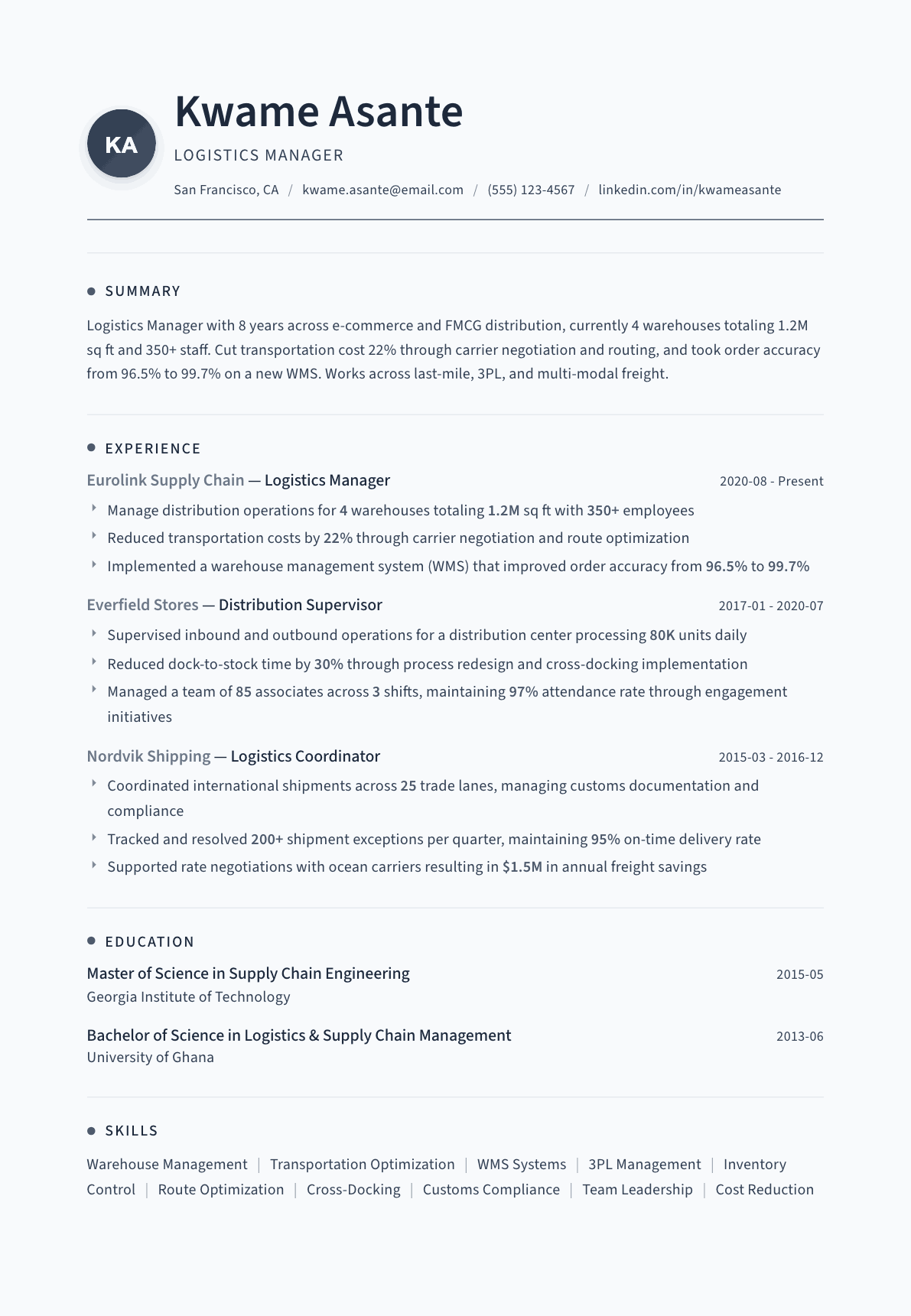
The same logistics manager content laid out in three CVBooster templates, so you can see what the finished document looks like before you write a word.
Example Logistics Manager summary
Logistics Manager with 8 years of experience optimizing distribution and transportation operations across e-commerce and FMCG. Reduced transportation costs by 22% and improved order accuracy to 99.7% through WMS implementation and process redesign. CLTD-certified professional seeking a Director of Logistics role to lead end-to-end distribution strategy.
Skills to list on a Logistics Manager resume
- Warehouse Management
- Transportation Management
- WMS / TMS
- 3PL Management
- Inventory Control
- Route Optimization
- Cross-Docking
- Last-Mile Delivery
- Customs Compliance
- Carrier Negotiation
- Cost Reduction
- Team Leadership
- Lean Operations
What actually gets this resume read
- Quantify warehouse size, throughput volumes, team size, and transportation spend.
- Highlight specific WMS and TMS systems you have used (SAP EWM, Manhattan, Blue Yonder).
- Show cost reductions in freight, warehousing, and last-mile delivery.
- Include experience with 3PL management, carrier negotiations, and customs compliance.
- Demonstrate operational improvements: order accuracy, on-time delivery, dock-to-stock time.
- Certifications like CLTD, CTL, or Six Sigma strengthen your profile.
How to write a logistics manager resume
A logistics manager resume is read by someone who thinks in cost per unit moved and on time performance. The distribution director or supply chain leader screening it wants to know the physical scale you have run, the modes you have managed, the systems you can operate, and whether your improvements came from negotiation, network design, process change or automation. Those are four different capabilities and employers hire against a specific one.
The recurring weakness in these resumes is scale ambiguity. Managed warehouse operations could describe a single cross-dock with nine people or four distribution centers with several hundred. Since almost every logistics metric only means something relative to volume, footprint and headcount, a resume without those numbers gives the reader nothing to judge.
This guide covers the section order a distribution leader expects, how to state network scope, three summary examples from coordinator to network manager, before and after bullets, and the questions logistics professionals ask when they write this file.
Format: scale line first, one to two pages
Reverse chronological, one page under about seven years, two after that. Under each employer, open with a scope line: number of facilities, total square footage, headcount across shifts, daily or annual volume in units, orders or pallets, annual freight spend in a band, the carrier base, and the modes you managed. That line is what a hiring director uses to decide whether to keep reading.
Name the modes explicitly, because they are separate skill sets. Full truckload, less than truckload, parcel, intermodal, ocean, air freight and final mile each carry their own cost structures, carrier relationships and failure modes, and a manager who has run parcel and final mile is not automatically able to run ocean import.
- Header: name, city and state, phone, email, and relocation openness if it is real.
- Order: summary, scope of operations, professional experience, systems and technology, education, certifications.
- Give the sector: e-commerce, grocery and cold chain, automotive, retail replenishment, industrial parts, third party logistics.
- State whether you sat with a shipper, a third party logistics provider, or a carrier, since each buys and sells the service differently.
Summary: network, volume, and where your savings come from
Three lines. Years, the sector, the network you have run, and the cost or service lever you are strongest at. Carrier procurement and rate negotiation, route and network optimization, warehouse productivity and labor management, inventory positioning and slotting, or automation and systems implementation. Employers rarely need all five and usually have one urgent problem.
Put service performance in alongside cost. On time in full, dock to stock time, order accuracy, fill rate, damage and claims rates, and cost per order or per case. A logistics manager who reports only savings makes a reader suspect that service degraded to produce them, so pair the two.
Experience: volume, mechanism, and the metric that moved
Every strong bullet in this field carries a mechanism. Freight cost did not fall because you focused on cost; it fell because you consolidated less than truckload into multi-stop truckloads, moved a lane to intermodal, renegotiated a fuel surcharge basis, changed a carrier mix, or cut expedited freight by fixing an upstream planning problem. Name the mechanism and the reader can judge whether it transfers to their network.
Do the same on the warehouse side. Productivity gains come from slotting by velocity, wave or batch picking changes, labor standards and engineered rates, shift pattern redesign, cross-docking, or conveyor and automation projects. State which one, and give the before and after on units per labor hour or dock to stock time.
Include the people half of the job, since most logistics managers run large hourly workforces. Headcount across shifts, temporary labor ratios, turnover, safety incident rate, and any training or supervisor development you built. Warehouse turnover is a persistent operating problem and evidence that you reduced it is valued as highly as a freight saving.
Systems, compliance and the technical layer
Name the platforms. Warehouse management systems such as Manhattan, Blue Yonder, Korber or the warehouse module of an enterprise suite, transportation management systems, yard management, labor management, and any enterprise resource planning environment you worked inside. State whether you implemented, optimized or operated each one, because implementation experience is separately searched for.
Add compliance and trade content where you have it. Customs entry and classification, incoterms, hazardous materials handling and documentation, food safety requirements in cold chain, hours of service rules for a private fleet, and any audit or certification you carried. These are the details that qualify you for import heavy or regulated operations.
Keywords a screener searches on
Common posting terms are warehouse operations, distribution center management, transportation management, freight procurement, carrier management, third party logistics, inventory control, route optimization, cross-docking, on time delivery, cost per unit, continuous improvement and warehouse management systems. Mirror the terms used in the posting.
Then add the numbers those terms depend on. Volume per day, square footage, headcount, carrier count, lane count and annual freight spend band. In this field the vocabulary is common across every candidate, so the quantities are what actually differentiate one resume from another.
Logistics Manager resume summary examples
Logistics coordinator
Logistics coordinator with 3 years handling domestic and import freight for a retail importer, booking 40 ocean containers a month and managing customs documentation. Cut detention and demurrage charges by 30% by rebuilding the container appointment and drayage scheduling routine.
Distribution center manager
Logistics manager running a distribution center of 320 thousand square feet with 180 associates across 3 shifts and 12 thousand order lines a day. Lifted units per labor hour by 18% through velocity slotting and batch picking, and held order accuracy above 99.5% through a peak season.
Network logistics manager
Network logistics manager with 13 years across e-commerce and grocery, responsible for 4 distribution centers, 600 staff and freight spend in the mid tens of millions. Redesigned the outbound network to add a regional node, cutting average transit by a day and transportation cost per order by 14%.
Work experience bullets: before and after
Before: Managed warehouse operations and staff.
After: Ran a distribution center of 320 thousand square feet with 180 associates across 3 shifts, processing 12 thousand order lines a day for retail replenishment and direct to consumer orders.
Footprint, headcount, shift structure and daily volume let a reader size the operation instead of guessing.
Before: Reduced transportation costs significantly.
After: Cut freight cost per order by 14% by consolidating less than truckload volume into multi-stop truckloads, moving 9 long-haul lanes to intermodal, and rebidding the carrier base across 40 lanes.
Three named mechanisms tell a hiring director whether the same savings are available in their network.
Before: Improved warehouse productivity.
After: Raised units per labor hour from 62 to 73 by reslotting the pick module by velocity, moving to batch picking for single-line orders, and introducing engineered labor standards with weekly performance reviews.
A baseline, a result and the specific operational changes turn productivity into something a reader can verify.
Before: Implemented a new warehouse management system.
After: Led a warehouse management system implementation across 2 sites, ran data cleansing on 40 thousand item records, trained 200 associates, and returned to full pick rates within three weeks of go-live.
Data work, training scale and recovery time show a controlled cutover rather than a project that was merely completed.
Before: Focused on safety and employee retention in the warehouse.
After: Cut recordable incidents by half over two years with a daily pre-shift stretch and hazard review, and reduced associate turnover from 62% to 38% by moving to fixed shift patterns and a structured supervisor training track.
Two named interventions attached to two workforce metrics show that retention and safety were managed, not hoped for.
Hard skills
- Distribution center operations
- Transportation management systems
- Warehouse management systems (Manhattan, Blue Yonder)
- Freight procurement and carrier negotiation
- Route and network optimization
- Inventory control and cycle counting
- Slotting and pick path design
- Labor management and engineered standards
- Cross-docking and flow-through operations
- Import, export and customs documentation
- Third party logistics management
- Cold chain and regulated handling
- Continuous improvement and lean methods
Soft skills
- Leading a large hourly workforce
- Staying calm through peak season
- Negotiating with carriers and vendors
- Escalating a service failure to a customer
- Cross-shift communication
- Coaching frontline supervisors
Certifications worth listing
- Certified in Logistics, Transportation and Distribution (CLTD) (Association for Supply Chain Management)
- Certified Supply Chain Professional (CSCP) (Association for Supply Chain Management)
- Certified in Planning and Inventory Management (CPIM) (Association for Supply Chain Management)
- Certified Six Sigma Green Belt (CSSGB) (American Society for Quality)
- IATA Dangerous Goods Regulations (International Air Transport Association)
- Certified Customs Specialist (CCS) (National Customs Brokers and Forwarders Association of America)
Mistakes that cost logistics manager candidates the interview
- Describing warehouse or transport responsibility with no footprint, headcount or volume attached.
- Reporting cost savings with no service metric beside them, which suggests service was traded away.
- Claiming improvements without the mechanism, so a reader cannot judge whether the result transfers.
- Listing systems without saying whether you implemented, optimized or simply operated them.
- Leaving out the modes you have managed, when parcel, intermodal and ocean import are separate skill sets.
- Omitting workforce metrics such as turnover and safety in a role that is mostly about running people.
- Using a heavily formatted template with columns, which frequently parses out of order in logistics recruiting systems.
Logistics Manager resume questions
How do I show scale on a logistics manager resume?
Give a scope line under each employer with facilities, square footage, headcount by shift, daily volume in orders or units, carrier count and annual freight spend as a band. Every other metric on the page only becomes meaningful once the reader knows the size of the operation.
Which certification is most useful for a logistics manager?
The logistics, transportation and distribution credential maps most directly to the role, while the inventory and supply chain credentials suit planning-heavy positions. A lean or six sigma belt helps for continuous improvement roles, and dangerous goods or customs credentials qualify you for specific operations.
How do I move from a coordinator role into logistics management?
Show ownership rather than execution: a carrier bid you ran, a process you redesigned, temporary staff you supervised, a metric you were accountable for reporting and improving. Managers are hired on evidence of decisions made, not volume of transactions handled.
Should I include peak season performance?
Yes, because peak is where logistics operations are actually tested. Give the volume multiple you absorbed, the temporary labor you onboarded, and the service level you held, since holding accuracy and on time delivery through peak is strong evidence of planning capability.
How do I write this resume for a third party logistics provider?
Add the commercial dimension. Client accounts managed, contractual service level agreements and how you performed against them, open book or gain share arrangements, new business start-ups you implemented, and any account you retained through a rebid.
Related resume examples
- Supply Chain Manager Resume example
- Procurement Manager Resume example
- Operations Manager Resume example
- Logistics Coordinator Resume example
- Distribution Manager Resume example
- Delivery Operations Manager Resume example