Production Planner Resume Examples: the lines they read
Write a Production Planner Resume Built Around Schedule Adherence
By Mustafa Tarabya, founder of CVBooster · Published · Updated
Production planner resume examples with schedule adherence, changeover and capacity detail, plus ATS keywords and a complete writing guide.
Sample resumes for a production planner
The same production planner content laid out in three CVBooster templates, so you can see what the finished document looks like before you write a word.
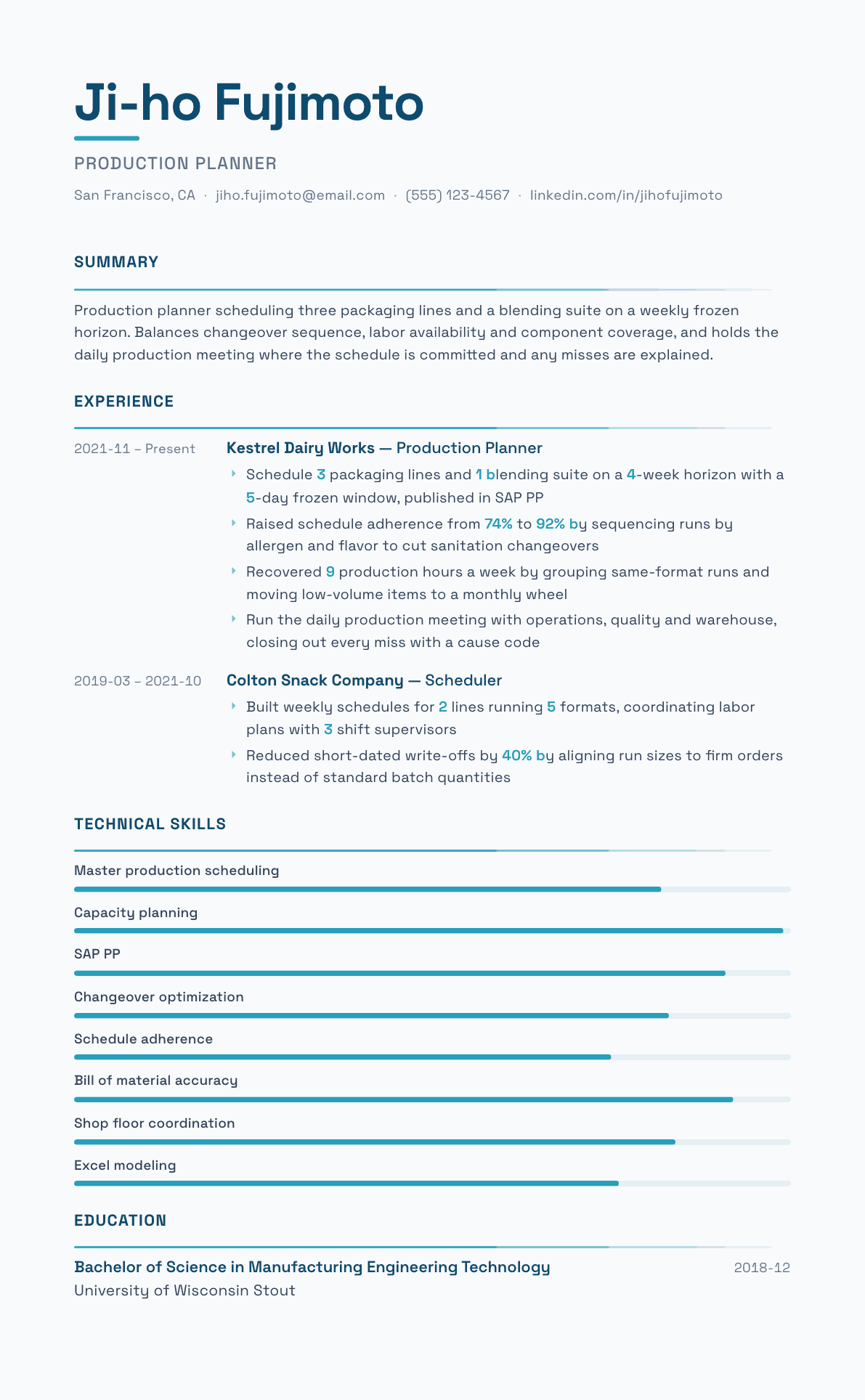
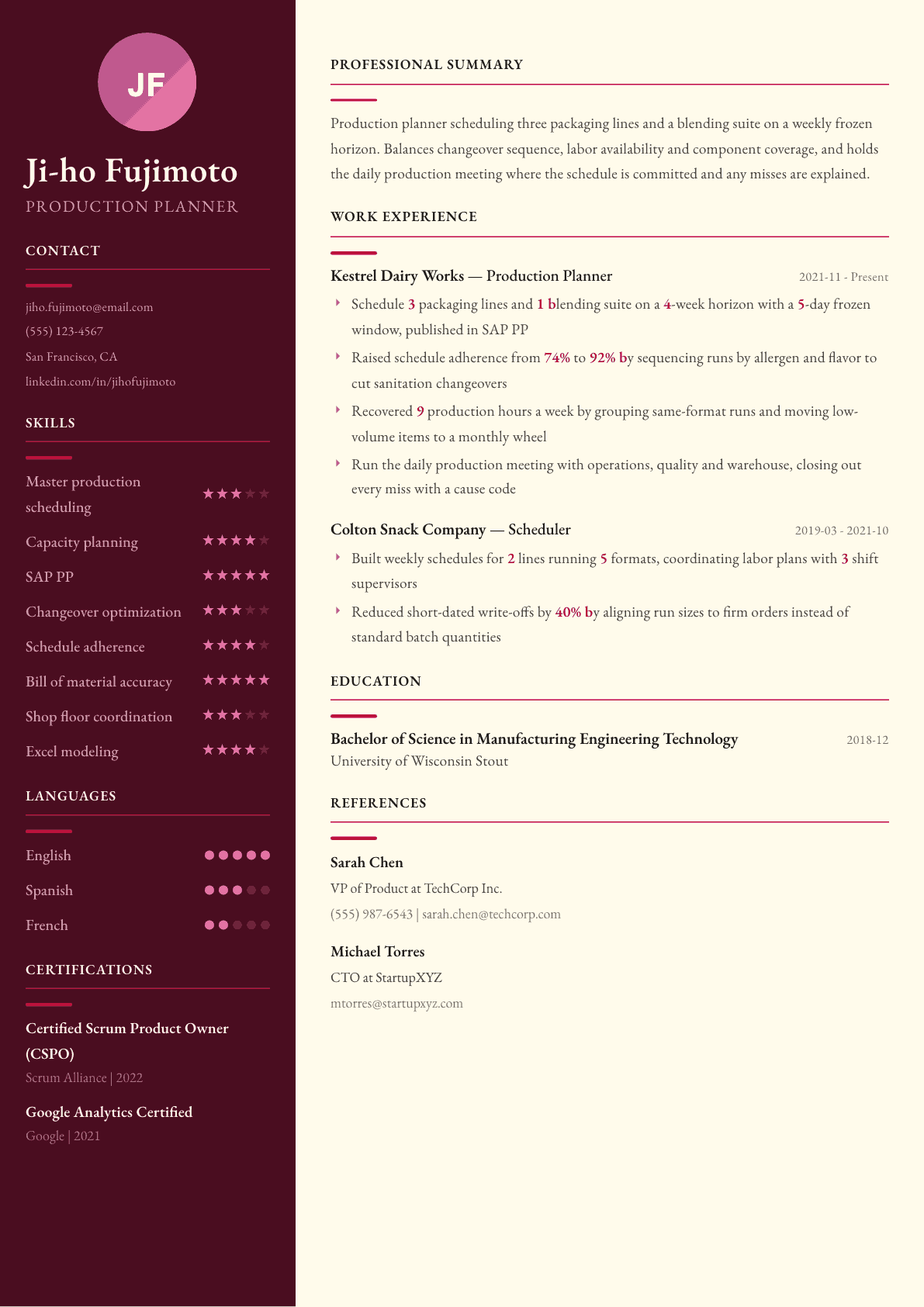
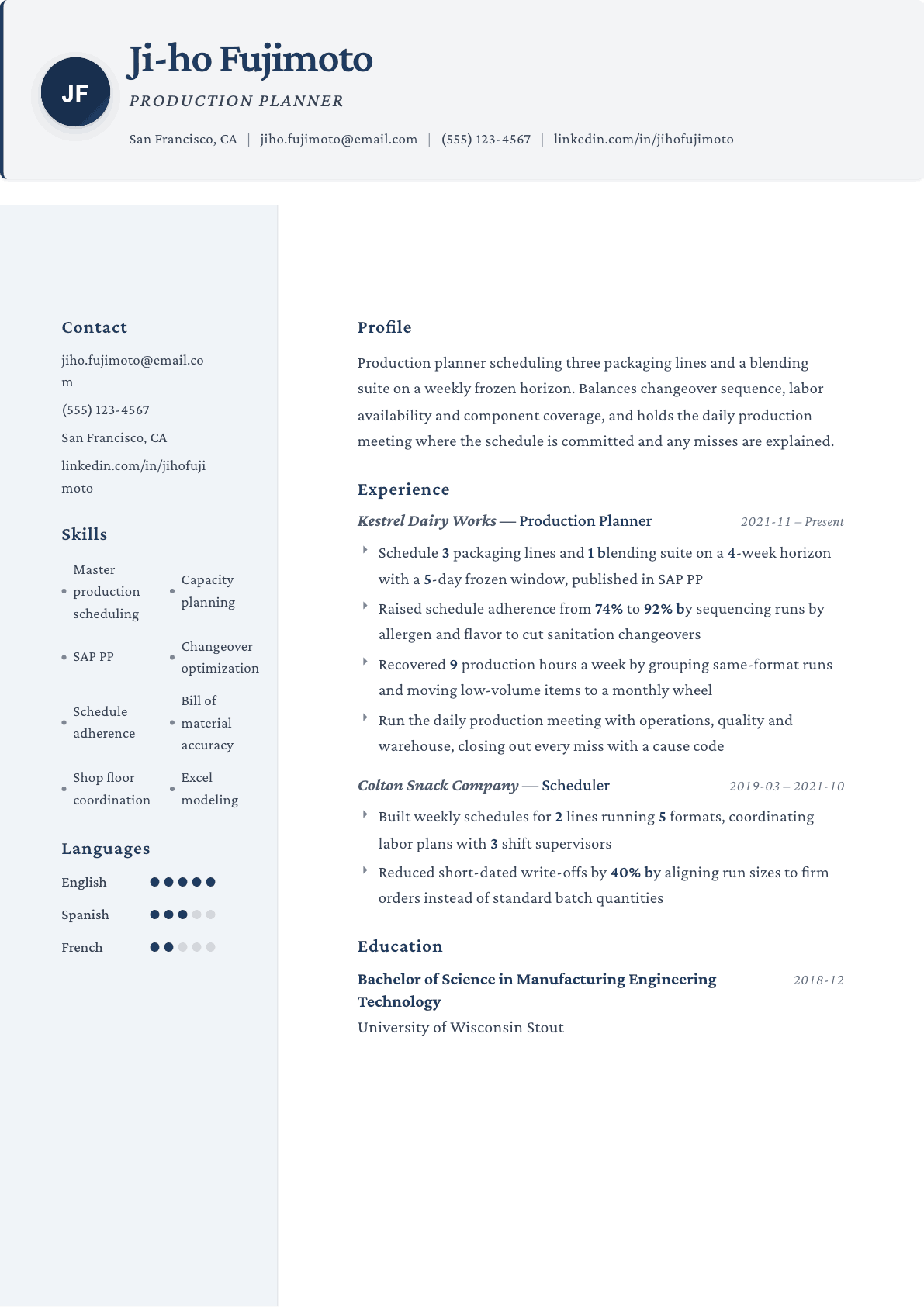
Example Production Planner summary
Production planner with five years scheduling packaging and blending assets in food manufacturing on a weekly frozen horizon. Lifted schedule adherence eighteen points by sequencing runs around allergen and format changeovers, and recovered nine line hours a week without added labor. Owns the daily production meeting and closes every schedule miss with a cause code. Looking for a master scheduler role.
Skills to list on a Production Planner resume
- Master production scheduling
- Finite capacity scheduling
- Changeover sequencing
- Schedule adherence
- Material availability checks
- Bill of material accuracy
- Work order management
- SAP PP
- Oracle Manufacturing
- Lean manufacturing
- Shop floor coordination
- Excel modeling
- Capacity analysis
- Root cause analysis
What actually gets this resume read
- State the asset base you scheduled: how many lines or cells, how many shifts, and what they produce.
- Give schedule adherence or attainment as a figure, because it is the metric every plant manager asks about first.
- Show that you sequenced for changeovers, allergens or tooling, which proves you understand the constraint on the floor.
- Name the planning module, such as SAP PP, Oracle Manufacturing or a finite scheduler like PlanetTogether.
- Include one bullet on how you handled a component shortage, since recovery under pressure is what the interview covers.
- Mention the daily or weekly meeting you ran, because a planner who owns that forum is trusted with the schedule.
How to write a production planner resume
A production planner resume is read by a plant manager or a materials manager who has one worry: whether the schedule you publish on Friday is still the schedule the floor is running on Wednesday. Everything else on the page is secondary to that. The reader wants evidence that you understand the physical constraint of the assets you scheduled, not that you are familiar with production planning as a concept.
That is why the strongest files describe the equipment before they describe the software. Lines, cells, ovens, presses, blending suites, tooling, allergen sequence, sanitation windows, crew size and shift pattern are the vocabulary of the job. A candidate who writes about these fluently has clearly stood on a floor, and a candidate who writes only about work orders and system transactions probably has not.
This guide covers the layout a plant reader expects, how to present schedule adherence and capacity work, three summary examples from a first scheduler role to a master scheduler, before-and-after bullets, and the questions production planners ask when rewriting.
Format: one page, plain layout, asset detail up front
Manufacturing hiring moves quickly and the reader is usually not in an office. Keep the resume to one page unless you have more than roughly eight years across multiple plants, use reverse chronological order, and avoid columns because plant applicant tracking systems parse them badly.
Open each job with a plant profile line: what the site makes, how many lines or cells, how many shifts and the planning horizon you published. That single line does what four vague bullets cannot, which is tell the reader what kind of scheduling problem you were solving.
- Header: name, city and state, phone, email, and the manufacturing environment such as food, pharmaceutical or metal fabrication.
- Section order: summary, plant systems, professional experience, education, certifications.
- Add a safety or quality line if your site ran under a formal standard, since regulated plants screen for that familiarity.
Summary: assets, horizon, adherence, and the meeting you own
Three lines. Name the assets you scheduled, the horizon and frozen window you worked to, the schedule adherence you held, and the daily or weekly forum you ran. A production planner who chairs the daily production meeting has authority on the floor, and that fact belongs in the first three lines rather than buried on page two.
If you scheduled in a regulated environment, put it in the summary. Batch records, changeover validation, allergen segregation and shelf life rules change the scheduling problem enough that pharmaceutical and food employers treat that experience as a separate category.
Experience: sequence, capacity and recovery
The best bullets describe sequencing decisions. Grouping runs by format to avoid a tooling change, ordering by allergen so a full sanitation is needed once a week instead of daily, batching color runs light to dark, or building a monthly wheel for low-volume items are all decisions that release capacity without capital. Say what you sequenced by and how many hours it recovered.
Then show capacity work. A planner who has built a load-versus-capacity view by line, flagged the weeks that would not fit, and negotiated either overtime, a build-ahead or a customer date change is doing master scheduling whether or not the title said so. Describe that loop explicitly, including who you had to convince.
Give one bullet to a recovery. A component that did not land, a line that went down mid-run, a rush order that had to be absorbed. Explain the resequence you built and what it protected. Every production planner interview goes there, so answer it on the page first.
- State schedule adherence or attainment as a figure and say how the plant defined it, since definitions vary between sites.
- Quantify changeover time saved in hours per week rather than as a general reduction claim.
- Name the constraint that governed your plan: labor, tooling, a bottleneck asset, sanitation, or component supply.
Systems, data and credentials
Name the module rather than only the ERP: SAP PP, Oracle Manufacturing, Dynamics 365 Supply Chain or a finite capacity scheduler such as PlanetTogether or Preactor. If your plant ran a manufacturing execution system, say which one, because the interface between the schedule and the floor is where most planner questions land. Add the Excel depth that every planner actually uses and any SQL or reporting work.
Credentials that matter here are the CPIM from the Association for Supply Chain Management, which covers master scheduling directly, and a Lean Six Sigma belt if your plant ran formal improvement projects.
Keywords in production planning postings
Master production schedule, capacity planning, schedule adherence, changeover reduction, work order management, material availability, bill of materials accuracy, routings, cycle time, takt, frozen horizon and rough cut capacity. Include the ones you have used, and add the manufacturing standard your site worked under if there was one.
Production Planner resume summary examples
First scheduler role
Production scheduler with two years building weekly plans for two packaging lines running five formats, coordinating labor with three shift supervisors. Cut short-dated write-offs by 40% by sizing runs to firm orders rather than standard batch quantities, and maintained routings and bills of material in the plant ERP.
Four years in
Production planner scheduling three packaging lines and a blending suite on a four-week horizon with a five-day frozen window in SAP PP. Raised schedule adherence from 74% to 92% by sequencing runs around allergen and format changeovers, and recovered nine line hours a week without adding labor.
Master scheduler
Master scheduler for a two-plant network, owning the rough cut capacity view, the frozen horizon policy and the build-ahead strategy for seasonal peaks. Runs the weekly constraint review with operations, maintenance and materials, and mentors two site schedulers through their first full seasonal cycle.
Work experience bullets: before and after
Before: Created production schedules for the plant.
After: Scheduled 3 packaging lines and 1 blending suite on a 4-week horizon with a 5-day frozen window, publishing the plan in SAP PP every Thursday.
Assets, horizon, frozen window and cadence describe the actual scheduling problem instead of naming the task.
Before: Improved adherence to the production schedule.
After: Raised schedule adherence from 74% to 92% over three quarters by sequencing runs by allergen and format to collapse daily sanitation into a weekly full wash.
The sequencing rule explains why adherence moved, which is what a plant manager will ask about in the interview.
Before: Reduced changeover time between runs.
After: Recovered 9 line hours a week by grouping same-format runs and moving 30 low-volume items onto a monthly production wheel.
Hours per week is the unit a plant thinks in, and the wheel names the mechanism rather than gesturing at efficiency.
Before: Worked with purchasing when materials were short.
After: Resequenced a full week within four hours after a film shortage, protecting all 12 customer ship dates by pulling forward runs with confirmed component coverage.
A timed recovery with a protected outcome proves judgment under pressure that a coordination statement cannot.
Before: Attended daily production meetings.
After: Ran the daily production meeting with operations, quality and warehouse, closing every schedule miss with a cause code and a corrective owner.
Running the meeting and closing misses with cause codes shows ownership and a feedback loop, not attendance.
Hard skills
- Master production scheduling
- Rough cut capacity planning
- Finite capacity scheduling
- Changeover and sequence optimization
- Schedule adherence measurement
- Work order release and management
- Bill of material and routing accuracy
- Material availability checks
- SAP PP
- Oracle Manufacturing
- Lean manufacturing methods
- Root cause and corrective action
Soft skills
- Floor credibility with supervisors
- Calm resequencing under disruption
- Negotiation with commercial teams
- Clear daily communication
- Attention to constraint detail
- Coaching new schedulers
Certifications worth listing
- Certified in Planning and Inventory Management (CPIM) (Association for Supply Chain Management)
- Certified Supply Chain Professional (CSCP) (Association for Supply Chain Management)
- Certified Six Sigma Green Belt (CSSGB) (American Society for Quality)
Mistakes that cost production planner candidates the interview
- Writing about work orders and transactions without ever naming the physical assets that constrained the plan.
- Giving a schedule adherence number without saying how the plant measured it, since some sites count the day and others count the sequence.
- Leaving out the frozen horizon policy, which is the single rule that decides how much chaos a planner absorbs each week.
- Presenting changeover work as a general efficiency claim instead of hours recovered per week on a named asset.
- Ignoring material availability, when in most plants the schedule breaks because a component did not arrive rather than because the plan was wrong.
- Skipping the daily meeting entirely, which leaves the reader unsure whether the floor treated the published plan as binding.
Production Planner resume questions
What is the difference between a production planner and a master scheduler?
A production planner usually works inside a fixed capacity picture and sequences what has already been committed. A master scheduler sets that capacity picture, decides the frozen horizon and negotiates the commitments themselves. If you have done both, name the master scheduling work explicitly.
How do I show scheduling skill without a formal scheduling system?
Describe the logic you built. A planner who maintained a spreadsheet load model by line, with crew availability, run rates and changeover matrices, is scheduling properly. Name the inputs and the review cycle, then list any ERP transactions you used to release and confirm orders.
Should I list the products my plant made?
Yes, at category level. Food, injectable pharmaceutical, automotive stamping and printed packaging create different constraints around sanitation, validation, tooling and setup. Employers screen on that similarity, so name the category rather than a specific brand or customer.
How much detail should I give about lean projects?
One or two bullets at most, and only where you owned the outcome. A kaizen event you facilitated on changeover reduction with a measured hour saving is worth the space. Attendance at events, or a belt with no attached project, belongs in the certification line instead.
Is production planning experience transferable between industries?
Largely yes, because sequencing, capacity and material coverage behave the same way everywhere. The gap is regulatory: a planner moving into pharmaceutical or medical device work should expect questions about batch records and validated changeovers, so address that experience directly if you have any.
Related resume examples
- Operations Manager Resume example
- Warehouse Supervisor Resume example
- Supply Planner Resume example
- Distribution Manager Resume example
- Demand Planner Resume example
- Supply Chain Coordinator Resume example