Demand Planner Resume Examples: the lines they read
Build a Demand Planner Resume That Proves Forecast Accuracy
By Mustafa Tarabya, founder of CVBooster · Published · Updated
Demand planner resume examples with forecast accuracy and bias metrics, planning system keywords, and a step-by-step guide to every section.
Sample resumes for a demand planner
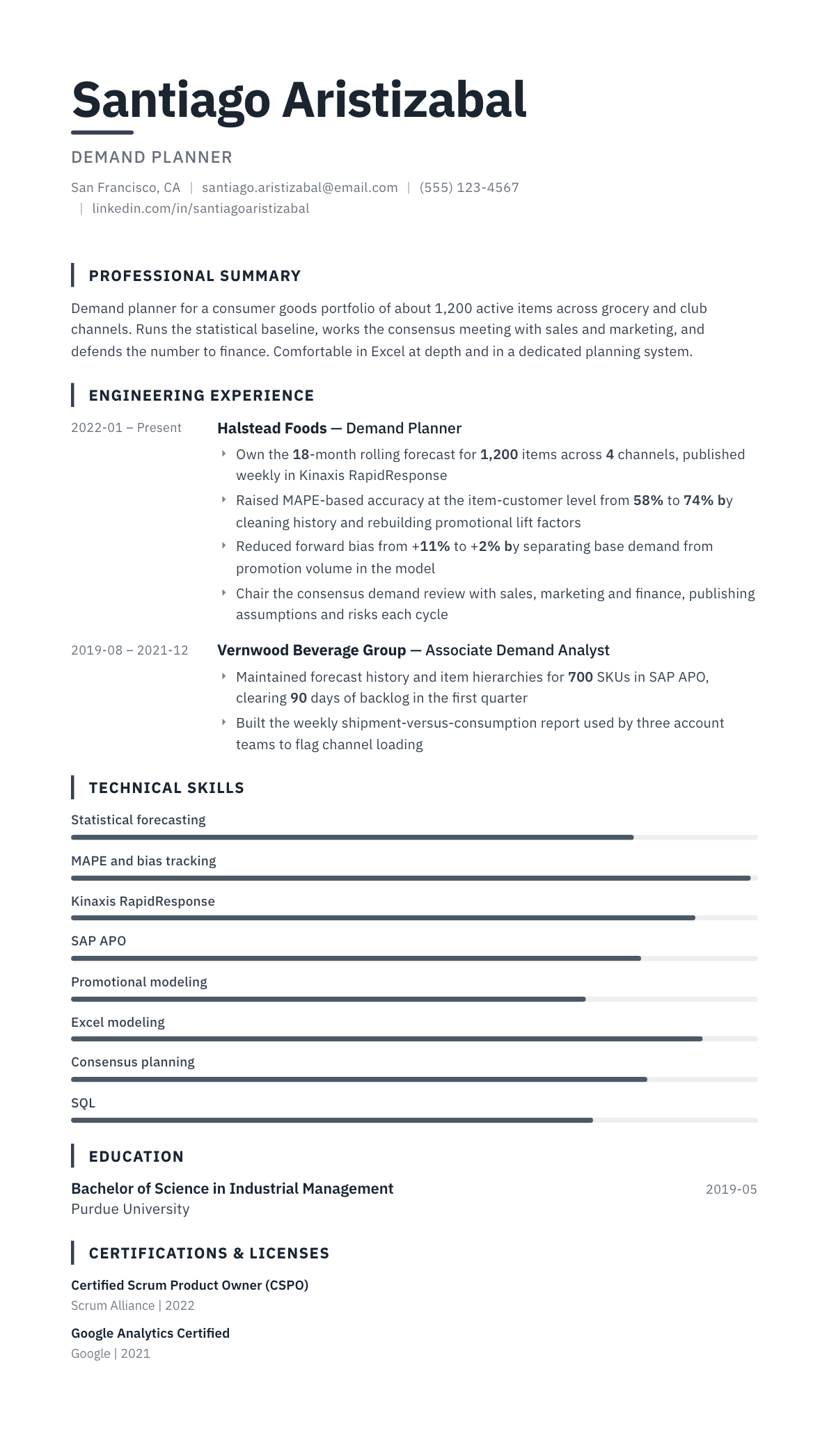
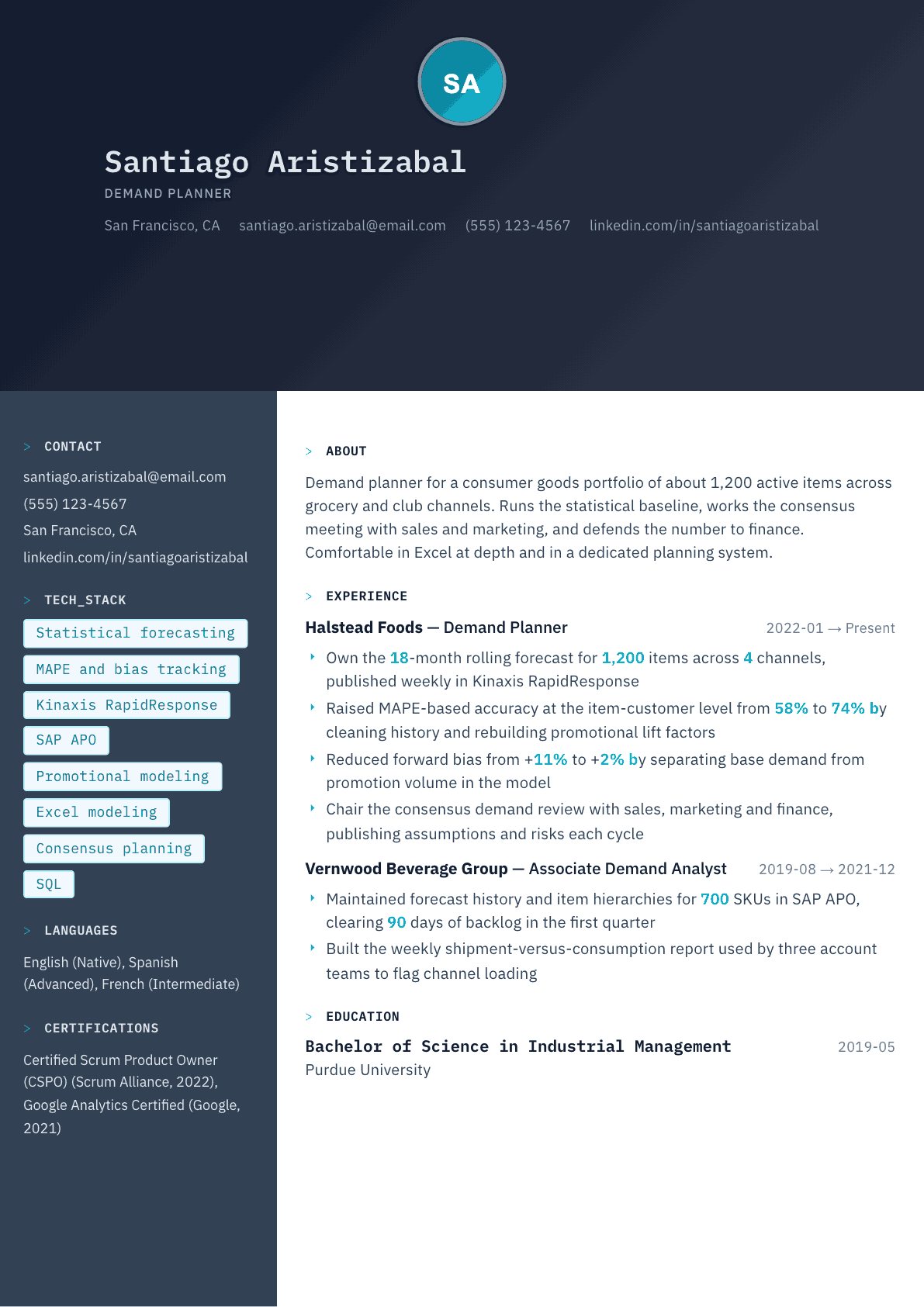
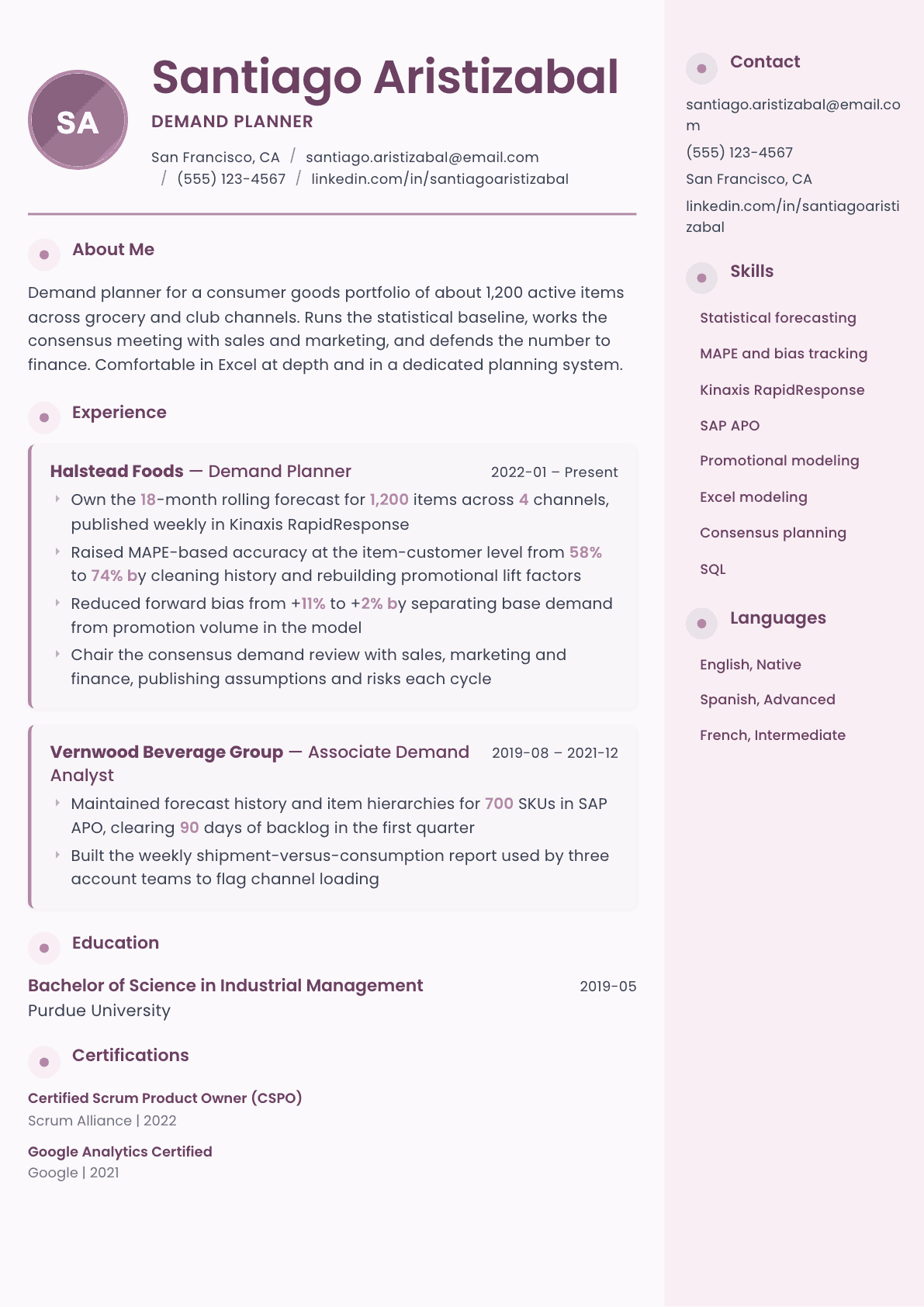
The same demand planner content laid out in three CVBooster templates, so you can see what the finished document looks like before you write a word.
Example Demand Planner summary
Demand planner with four years forecasting a consumer goods portfolio of more than a thousand items across grocery and club channels. Rebuilt promotional lift logic to lift item-customer accuracy sixteen points and pull forward bias close to zero. Chairs the monthly consensus review and translates the number into inventory targets planners can act on. Seeking a senior demand planning seat in a branded manufacturer.
Skills to list on a Demand Planner resume
- Statistical forecasting
- Demand review facilitation
- MAPE and WMAPE
- Forecast bias analysis
- Promotional lift modeling
- New product forecasting
- Kinaxis RapidResponse
- SAP APO
- Oracle Demantra
- Advanced Excel
- SQL
- Power BI
- Inventory targets
- Sales and operations planning
What actually gets this resume read
- Lead with the number of items and locations you forecast, because portfolio size is how managers judge scope.
- Report accuracy the way your field does: MAPE, WMAPE or forecast value add, plus the level you measured it at.
- State the bias you carried and the direction, since a planner who never mentions bias looks untested.
- Name the planning system and the ERP behind it, because both appear as literal search terms in postings.
- Show that you ran or chaired a consensus meeting, which is the difference between an analyst and a planner.
- Include one bullet on new product forecasting or phase-in and phase-out, a gap on most planner resumes.
How to write a demand planner resume
The person hiring a demand planner is trying to answer one question from your resume: can this candidate defend a number in a room full of people who each want it moved. Sales wants the forecast high, finance wants it conservative, operations wants it stable. A demand planner who cannot show how they held a position against that pressure is an analyst with a forecasting tool, and the manager reading your file knows the difference.
So the resume has to carry two kinds of proof. The first is technical: portfolio size, forecast level, the statistical methods you actually configured, the accuracy and bias you carried and how you measured them. The second is procedural: whether you ran the consensus review, published assumptions, and handled new product introductions and discontinuations rather than only maintaining a baseline someone else built.
What follows is the section order a planning manager reads in, how to state accuracy so it means something, three summaries from a first planning job to a lead seat, before-and-after bullets, and the questions planners raise most often when they rewrite.
Format: one page early, two once you own a portfolio
Keep it reverse chronological and text-first. Planning teams run their screens through an applicant tracking system that reads plain layouts far better than two-column designs, and a table of accuracy figures inside a graphic will be dropped entirely.
Put a short technical block near the top listing the planning system, the ERP and the analysis tools. That gives the automated screen its match and gives the human reader a fast read on whether you have worked in a real planning environment or in spreadsheets alone.
- Header: name, city and state, phone, email, and the categories or channels you forecast.
- Section order: summary, systems and tools, professional experience, education, certifications.
- Skip a separate projects section unless you led a system implementation or a segmentation redesign.
Summary: portfolio, level, accuracy, and the forum you run
Three lines. Say how many items and locations you forecast, the channels, the accuracy measure you carry and the level it is measured at, and whether you chair the consensus review. A summary that says experienced demand planning professional with strong analytical skills tells the reader nothing they could not have assumed from the job title.
The level matters more than most candidates realize. Accuracy at total company for a month is a different achievement from accuracy at item and customer for a week, and any planning manager will read the two very differently. Always state the level beside the figure.
Experience: the model, the meeting, and what you changed
Open each role with the portfolio: item count, location or customer count, channels and the horizon you publish. Then write bullets that separate the mechanical work from the judgment work. Cleaning history, correcting outliers and maintaining hierarchies is table stakes; rebuilding promotional lift logic, splitting base from incremental volume, or introducing a segmentation that assigns different models to different demand patterns is the work that gets people hired.
Give one bullet to the consensus process. Name who sits in the room, what you publish before it and what you do when sales submits a number your statistics cannot support. Planning managers are hiring someone who will hold that line, and this is the only place on the resume where that shows.
Include new product forecasting and phase-out handling if you have touched them. Most planner resumes cover the steady-state portfolio and stop, so a candidate who can describe an analog-based launch forecast and a runout plan stands out immediately.
- State accuracy with the metric, the level and the period: item-customer weekly, or item-location monthly.
- Report bias with direction, since a planner who never mentions bias reads as someone who has not been measured.
- Name the demand drivers you modeled: promotions, seasonality, pricing changes, distribution gains, weather.
Systems, analysis tools and certifications
List the planning system by product name, whether that is Kinaxis RapidResponse, SAP APO or IBP, Oracle Demantra, Blue Yonder or a homegrown tool, and say which modules you configured rather than only used. Add the ERP behind it and the analysis layer: advanced Excel, SQL, Power BI or Tableau. Planning teams increasingly screen on SQL because the history extract is where most accuracy work starts.
The recognized credentials come from the Association for Supply Chain Management and the Institute of Business Forecasting and Planning. A CPIM signals planning fundamentals, and the CPF is the credential specific to forecasting work.
Keywords planning postings repeat
The vocabulary is narrow and worth mirroring exactly: demand planning, statistical forecasting, forecast accuracy, forecast bias, consensus forecast, sales and operations planning, promotional forecasting, new product introduction, item hierarchy, and the planning system name. Use each once where it is true, then let the bullets carry the evidence.
Demand Planner resume summary examples
First planning role
Demand analyst with two years maintaining forecast history, item hierarchies and outlier corrections for a 700-SKU beverage portfolio in SAP APO. Built the weekly shipment against consumption report used by three account teams, and cleared a 90-day data backlog in one quarter. Ready for full ownership of a forecast portfolio.
Four years in
Demand planner owning an 18-month rolling forecast for 1,200 items across grocery, club and e-commerce channels in Kinaxis RapidResponse. Raised item-customer accuracy from 58% to 74% by separating base demand from promotional lift, and pulled forward bias from +11% to +2%. Chairs the monthly consensus demand review.
Lead planner
Lead demand planner for a branded portfolio of roughly 3,000 items, supervising three planners and owning the statistical model library, segmentation rules and launch forecasting method. Redesigned model assignment by demand pattern, improved forecast value add across the portfolio, and presents the demand position in the executive planning cycle.
Work experience bullets: before and after
Before: Created monthly forecasts for the product portfolio.
After: Published an 18-month rolling forecast for 1,200 items across 4 channels each week, with a statistical baseline reviewed against sales input before release.
Portfolio size, horizon, channels and cadence turn a generic duty into a scope statement a manager can size.
Before: Improved forecast accuracy significantly.
After: Raised item-customer forecast accuracy from 58% to 74% over six months by cleaning three years of promotional history and rebuilding lift factors by account.
The level, the movement and the mechanism make the result checkable instead of a claim about being good at forecasting.
Before: Worked with sales and marketing on the forecast.
After: Chaired the monthly consensus demand review with sales, marketing and finance, publishing assumptions, risks and the gap to plan two days ahead of the meeting.
Naming the attendees and the pre-read shows ownership of the process rather than attendance at someone else's meeting.
Before: Reduced forecast bias in the portfolio.
After: Cut forward bias from +11% to +2% by splitting base demand from promotional volume and correcting for channel loading in the last week of each period.
Direction plus cause tells a planning manager you understand why the number was wrong, not only that it improved.
Before: Handled forecasts for new product launches.
After: Built launch forecasts for 40 new items a year using analog selection and distribution build curves, then reforecast at week four against actual scan data.
The method and the correction loop demonstrate a repeatable approach rather than a one-time guess at a launch number.
Hard skills
- Statistical forecasting methods
- Forecast accuracy and bias measurement
- Forecast value add analysis
- Promotional lift modeling
- New product and analog forecasting
- Demand segmentation
- Kinaxis RapidResponse
- SAP APO and IBP
- Oracle Demantra
- SQL and data extraction
- Power BI and Tableau
- Advanced Excel modeling
Soft skills
- Holding a position under commercial pressure
- Facilitation of cross-functional reviews
- Clear written assumptions
- Curiosity about demand drivers
- Attention to data quality
- Stakeholder management
Certifications worth listing
- Certified in Planning and Inventory Management (CPIM) (Association for Supply Chain Management)
- Certified Supply Chain Professional (CSCP) (Association for Supply Chain Management)
- Certified Professional Forecaster (CPF) (Institute of Business Forecasting and Planning)
Mistakes that cost demand planner candidates the interview
- Quoting an accuracy figure with no level attached, which makes it impossible to judge and easy to dismiss as flattering aggregation.
- Never mentioning bias, leaving the impression that nobody ever measured whether the forecast leaned high or low.
- Describing the planning system as a tool you used without naming which modules or models you configured yourself.
- Listing Excel as the only analysis skill when most planning teams now screen for SQL or a reporting platform.
- Leaving out new product introduction and discontinuation work, which is where launch-heavy businesses feel the most pain.
- Writing bullets about attending the consensus meeting rather than owning the number that went into it.
Demand Planner resume questions
Which accuracy metric should I put on my resume?
Use the one your company reported, and state it with the level and period. Weighted mean absolute percentage error at item and location for a monthly bucket is a specific, defensible claim, while forecast accuracy improved is not. If two measures were tracked, give the harder one.
How do I show demand planning experience if I only worked in spreadsheets?
Say so plainly and then show depth. A planner who built a working model with seasonality, moving averages and error tracking in Excel has real forecasting judgment. Name the methods you applied and add any exposure to a planning tool through training or a pilot.
Is a CPIM worth it for a demand planning role?
It helps for roles that touch both demand and supply, because it covers inventory policy and master scheduling alongside forecasting. If your target is purely demand side, the Certified Professional Forecaster credential from the Institute of Business Forecasting and Planning is the more direct signal.
Should I list the number of SKUs I forecast?
Yes, and pair it with the location or customer count, because a thousand items at one warehouse is a much smaller problem than a thousand items across forty customers. Those two numbers together define the size of the forecasting job better than any other pair.
How do I write a demand planner resume when moving from a supply role?
Lead with the parts that overlap: reading demand signals, working exception logic, managing item data and sitting in the planning cycle. Then name any forecast work you did informally, such as building a consumption view or challenging a sales number, and put the statistical tools you know in the technical block.
Related resume examples
- Supply Chain Analyst Resume example
- Logistics Coordinator Resume example
- Supply Planner Resume example
- Supply Chain Director Resume example
- Supply Chain Specialist Resume example
- Inventory Analyst Resume example