Supply Planner Resume Examples: the lines they read
Craft a Supply Planner Resume That Shows Service and Coverage
By Mustafa Tarabya, founder of CVBooster · Published · Updated
Supply planner resume examples covering MRP settings, coverage targets and service levels, with keywords and a full section-by-section writing guide.
Sample resumes for a supply planner
The same supply planner content laid out in three CVBooster templates, so you can see what the finished document looks like before you write a word.
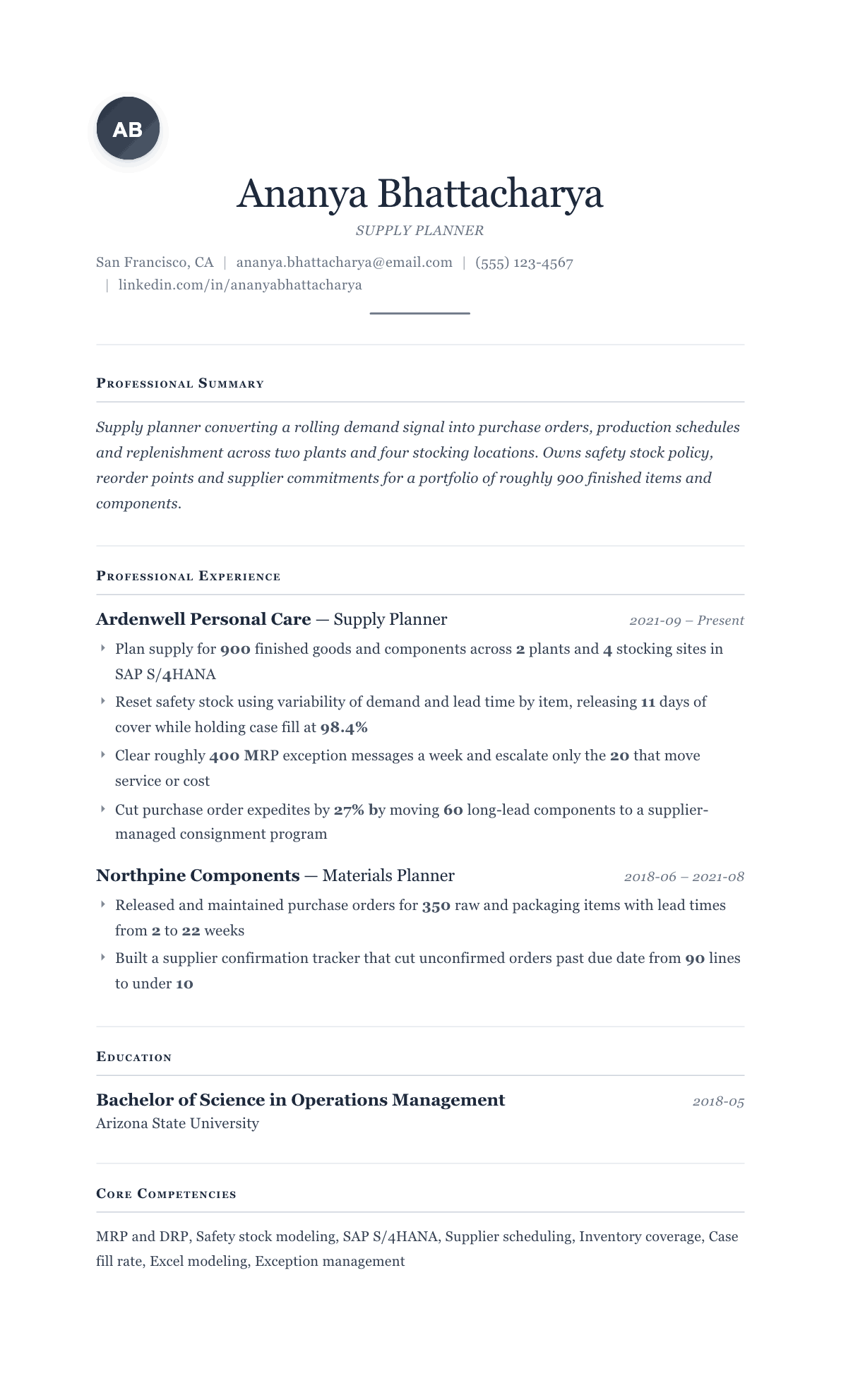
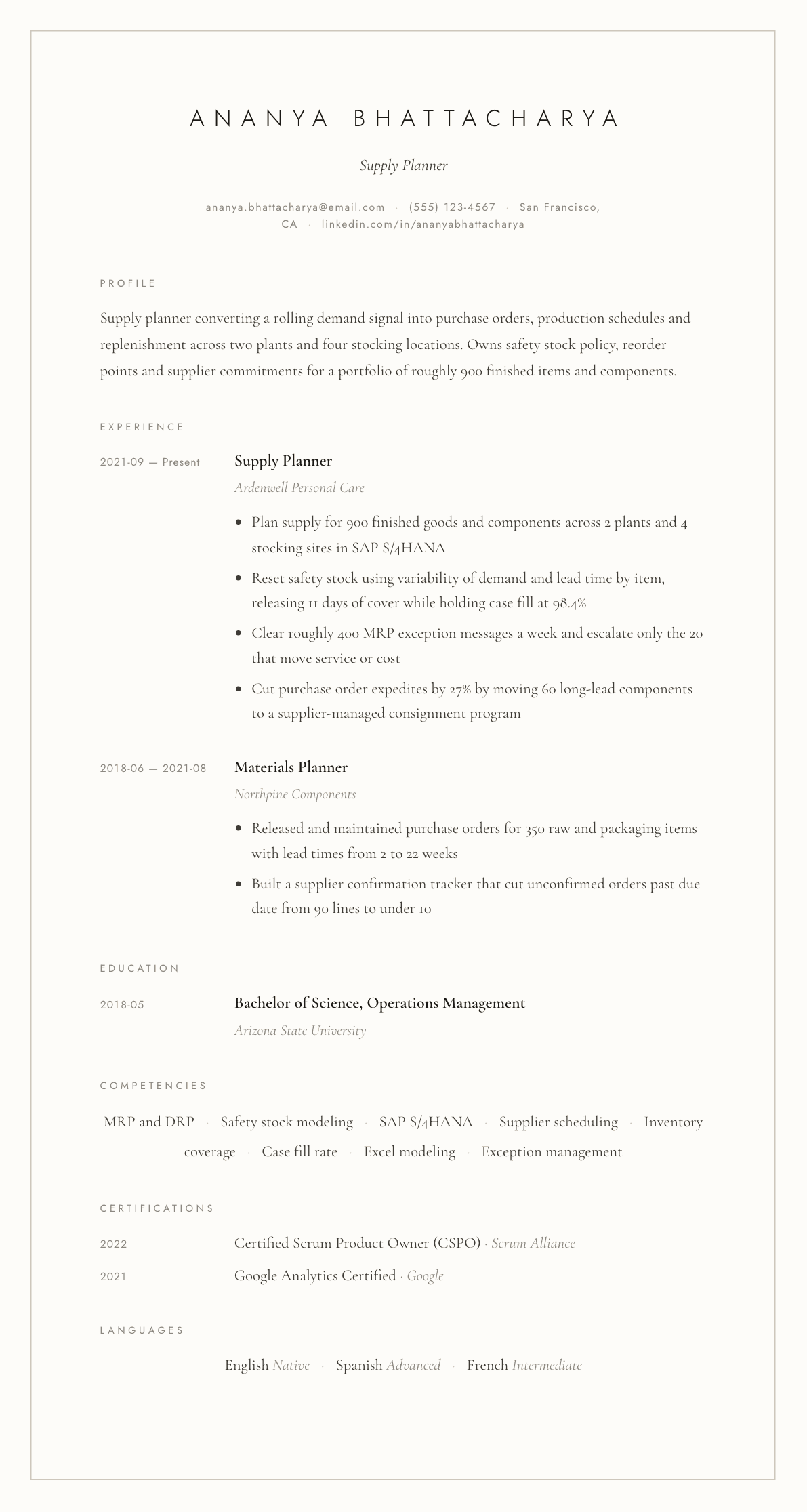
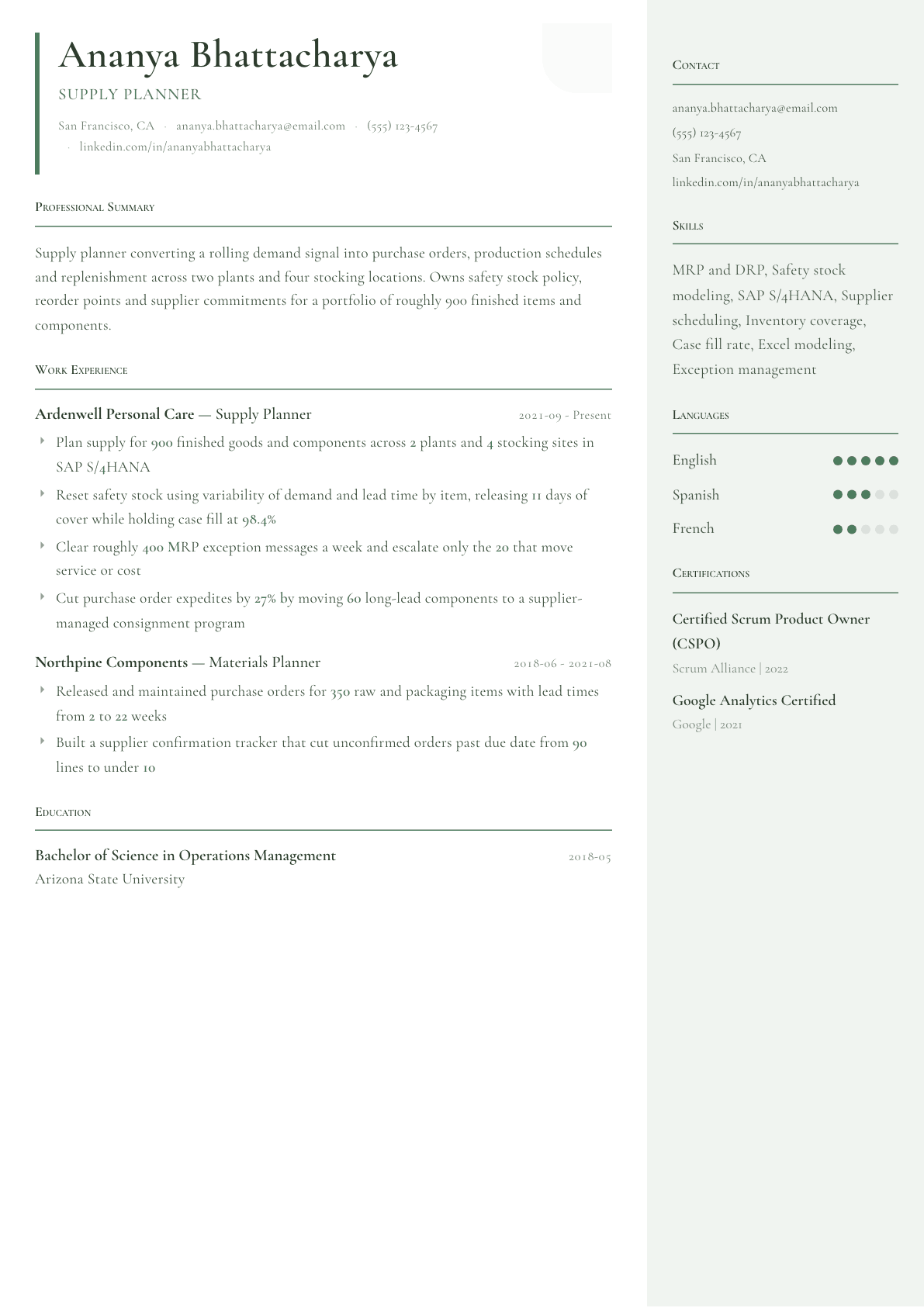
Example Supply Planner summary
Supply planner with five years turning demand plans into executable purchase and production orders across two plants and four stocking locations. Reset safety stock by item variability to release nearly two weeks of coverage while holding case fill above ninety-eight. Works MRP exceptions daily in SAP S/4HANA and holds suppliers to confirmed dates. Targeting a senior planning role in regulated manufacturing.
Skills to list on a Supply Planner resume
- Material requirements planning
- Distribution requirements planning
- Safety stock policy
- Reorder point calculation
- Purchase order management
- Supplier scheduling
- Inventory coverage analysis
- Case fill rate
- SAP S/4HANA
- Oracle Fusion SCM
- Excel modeling
- Exception management
- Lead time analysis
- Vendor managed inventory
What actually gets this resume read
- Say what you plan: finished goods, components, or both, and across how many plants and stocking locations.
- Give the service measure your plant used, whether case fill, line fill or on-time in-full, with the level you held.
- Show that you set safety stock and reorder points yourself rather than inheriting parameters someone else tuned.
- Quantify exception load, because a planner clearing hundreds of MRP messages weekly is a different job than one clearing ten.
- Name the ERP module by version, since SAP S/4HANA, Oracle Fusion and Dynamics 365 are matched literally by recruiters.
- Add one bullet on supplier collaboration such as consignment, vendor managed inventory or capacity commitments.
How to write a supply planner resume
Supply planning is the job of turning a demand number into orders that a factory and a supplier can actually execute. The manager screening your resume is checking whether you have made those calls yourself: whether you set the safety stock, released the purchase orders, chased the confirmations, and decided which of two shortages to solve first when both could not be covered.
The resumes that fail here read like system documentation. They list MRP, ERP and inventory management as skills and never say what the candidate did with them. The resumes that work state the portfolio, the network, the parameters the planner owned, and the service level held while inventory moved in the right direction.
This guide walks through each section in the order a planning manager reads it, with example summaries for a materials planner, an established supply planner and a lead, before-and-after bullets drawn from real planning work, and answers to the questions that come up when planners rewrite their resumes.
Format: one page under five years, two after that
Reverse chronological, plain layout, no graphics. Manufacturing and distribution employers run high-volume screens, and a two-column template will scramble the dates on a planner resume as readily as on any other. Keep one clean font and let the numbers do the work.
Add a compact systems line under the summary naming the ERP, the planning module and the reporting tool. That is where the keyword match lands, and it saves the reader from hunting through bullets for the environment you worked in.
- Header: name, city and state, phone, email, and the type of goods you plan such as finished goods, components or raw materials.
- Section order: summary, systems, professional experience, education, then certifications last.
- Keep bullet counts even: four to five for the current role, two to three for earlier ones.
Summary: portfolio, network, service, and the parameters you own
Three lines that answer four questions. What do you plan and how many items, across how many plants and stocking locations, what service level did you hold, and which parameters were yours to set. A supply planner who owns safety stock, reorder points and order policy is doing a materially different job from one who executes whatever the system suggests, and only the resume can say which.
If your portfolio includes long lead time items, say so. Planning a component with a twenty-two week lead time and a volatile demand signal is the hardest version of the job, and hiring managers in electronics, chemicals and capital equipment screen for exactly that experience.
Experience: exceptions, parameters, and the shortages you prevented
Start each role with the portfolio line, then write bullets around three themes. First, the planning parameters you set and the method behind them: safety stock by demand and lead time variability rather than a flat number of weeks, reorder points recalculated on a cycle, order policy chosen by item value and volume. Second, exception management: how many MRP messages you cleared a week and how you decided which mattered. Third, supplier execution: confirmations, past due lines, capacity commitments and any collaborative program you ran.
Quantify the service you held alongside any inventory reduction. Releasing days of cover is easy if you are willing to miss orders, so a case fill or line fill figure next to the reduction is what makes the achievement credible. Planning managers have all seen an inventory win that turned into an expedite bill the following quarter.
Give one bullet to a recovery. A shortage you caught early, a supplier failure you covered through resourcing, an allocation you built when supply could not meet demand. That bullet tells the interviewer more about your judgment than any parameter change on the page.
- State the lead time range across your portfolio, since it defines how far ahead your decisions have to be right.
- Name the order policy types you used: lot for lot, fixed order quantity, min-max, period order quantity.
- Distinguish planning for a plant from planning for a distribution network; the constraints are not the same.
Systems, data skill and certifications
Name the ERP with its generation, because SAP S/4HANA, Oracle Fusion SCM, Microsoft Dynamics 365 and Infor are matched as strings. Say which planning transactions you lived in and whether you worked in a bolt-on advanced planning system on top of the ERP. Add Excel depth and any SQL or reporting work, since supply planners increasingly build their own coverage and aging views.
The credentials that carry weight are the CPIM from the Association for Supply Chain Management, which is the standard qualification for planning and inventory work, and the CSCP for a broader end-to-end view. A Lean Six Sigma belt fits well in plant environments.
Keywords that appear in almost every posting
Material requirements planning, distribution requirements planning, safety stock, reorder point, order policy, purchase order management, supplier scheduling, inventory turns, days of supply, case fill rate, exception messages and master data. Mirror the ones that are true for you in the systems block and prove them in bullets. Terms you cannot defend in an interview should not appear at all.
Supply Planner resume summary examples
Materials planner
Materials planner with two years releasing and maintaining purchase orders for 350 raw and packaging items with lead times from 2 to 22 weeks. Built a supplier confirmation tracker that cut unconfirmed past due lines from 90 to under 10, and supported two plants through a peak season without a line stoppage.
Five years in
Supply planner covering 900 finished goods and components across two plants and four stocking sites in SAP S/4HANA. Reset safety stock by demand and lead time variability to release 11 days of cover while holding case fill at 98.4%, and works roughly 400 exception messages a week down to the twenty that matter.
Lead supply planner
Lead supply planner for a regulated manufacturer, supervising three planners and owning inventory policy, order strategy and supplier capacity commitments across six sites. Rebuilt segmentation so critical and long lead components carry different coverage rules, and represents supply in the monthly executive planning cycle.
Work experience bullets: before and after
Before: Managed inventory levels and purchase orders.
After: Planned supply for 900 finished goods and components across 2 plants and 4 stocking sites, releasing and maintaining roughly 120 purchase orders a week in SAP S/4HANA.
Item count, network and order volume convert a duty statement into a measurable workload a manager recognizes.
Before: Reduced inventory while maintaining service.
After: Reset safety stock using demand and lead time variability by item, releasing 11 days of cover while case fill held at 98.4% through the following two quarters.
The method plus a sustained service figure proves the reduction was designed rather than borrowed from next quarter.
Before: Worked MRP exception messages daily.
After: Triaged roughly 400 weekly MRP exceptions into a fixed rule set, escalating only the 20 that affected service or cost and clearing the rest through parameter corrections.
Volume plus a triage rule shows a system for the work instead of an endless queue the planner simply endures.
Before: Improved supplier delivery performance.
After: Moved 60 long lead components onto supplier managed consignment with weekly capacity confirmations, cutting expedited purchase orders by 27% year over year.
A named program and a countable outcome replace a vague improvement claim with a decision the planner drove.
Before: Handled component shortages when they occurred.
After: Covered a supplier plant closure by qualifying a second source in 5 weeks and building a customer allocation plan that protected the top 15 accounts with no line stoppage.
A recovery bullet with a timeline and a protection rule shows judgment under pressure, which parameters alone never demonstrate.
Hard skills
- Material requirements planning
- Distribution requirements planning
- Safety stock and reorder point modeling
- Order policy selection
- Purchase order lifecycle management
- Supplier scheduling and confirmations
- Inventory coverage and aging analysis
- Case fill and line fill measurement
- SAP S/4HANA planning transactions
- Oracle Fusion SCM
- Master data governance
- Advanced Excel and SQL
Soft skills
- Prioritization across competing shortages
- Supplier communication
- Escalation judgment
- Persistence on open commitments
- Cross-functional coordination with plants
- Clear handover documentation
Certifications worth listing
- Certified in Planning and Inventory Management (CPIM) (Association for Supply Chain Management)
- Certified Supply Chain Professional (CSCP) (Association for Supply Chain Management)
- Certified Professional in Supply Management (CPSM) (Institute for Supply Management)
Mistakes that cost supply planner candidates the interview
- Listing MRP and ERP as skills without ever saying what you decided inside them, which reads as system exposure rather than planning ownership.
- Claiming an inventory reduction with no service measure beside it, the fastest way to invite a skeptical follow-up question.
- Leaving out lead times, so a reader cannot tell whether you planned two-week domestic items or six-month imported components.
- Ignoring master data work even though item settings, lot sizes and planning calendars cause most of the exceptions planners chase.
- Describing supplier relationships in general terms instead of naming confirmations, capacity agreements or consignment programs.
- Using the same bullets for a plant materials role and a distribution replenishment role when the two jobs solve different constraints.
Supply Planner resume questions
What is the difference between a supply planner and a materials planner on a resume?
Materials planning usually covers inbound components for a plant, while supply planning covers the whole flow into finished stock across a network. If you have done both, say so explicitly in the summary, because employers use the titles inconsistently and will not assume the wider scope.
Should I list how many purchase orders I released?
Yes, as a weekly or monthly figure, because it sizes the transactional load. Pair it with the supplier count and the lead time range so the reader can tell whether the volume came from many small orders or a handful of complex long lead commitments.
How do I show safety stock work without sounding theoretical?
Name the inputs and the review cycle. Saying you recalculated safety stock quarterly from demand variability, lead time variability and a target service level, then measured the effect on days of cover and fill rate, shows applied practice rather than textbook familiarity.
Do I need a CPIM to get a supply planning job?
Not to get hired, but it removes a filter in larger manufacturers and is frequently listed as preferred. If you are early in your career and competing against candidates with plant experience, the CPIM from the Association for Supply Chain Management is the most efficient way to close that gap.
How should I handle a period where service dropped?
Do not hide it, and do not lead with it. If a supplier failure or a demand spike broke fill rate, write the recovery as the bullet: what you resourced, how you allocated, and what changed in the policy afterward so it could not repeat the same way.
Related resume examples
- Supply Chain Analyst Resume example
- Warehouse Manager Resume example
- Demand Planner Resume example
- Production Planner Resume example
- Inventory Analyst Resume example
- Supply Chain Specialist Resume example