Ramp Agent Resume Examples: free ATS score and gap list
Build a Ramp Agent Resume That Gets You on the Airfield
By Mustafa Tarabya, founder of CVBooster · Published · Updated
Ramp agent resume examples covering turn times, ground equipment, safety training and badging, with airline keywords and a complete writing guide.
Sample resumes for a ramp agent
The same ramp agent content laid out in three CVBooster templates, so you can see what the finished document looks like before you write a word.
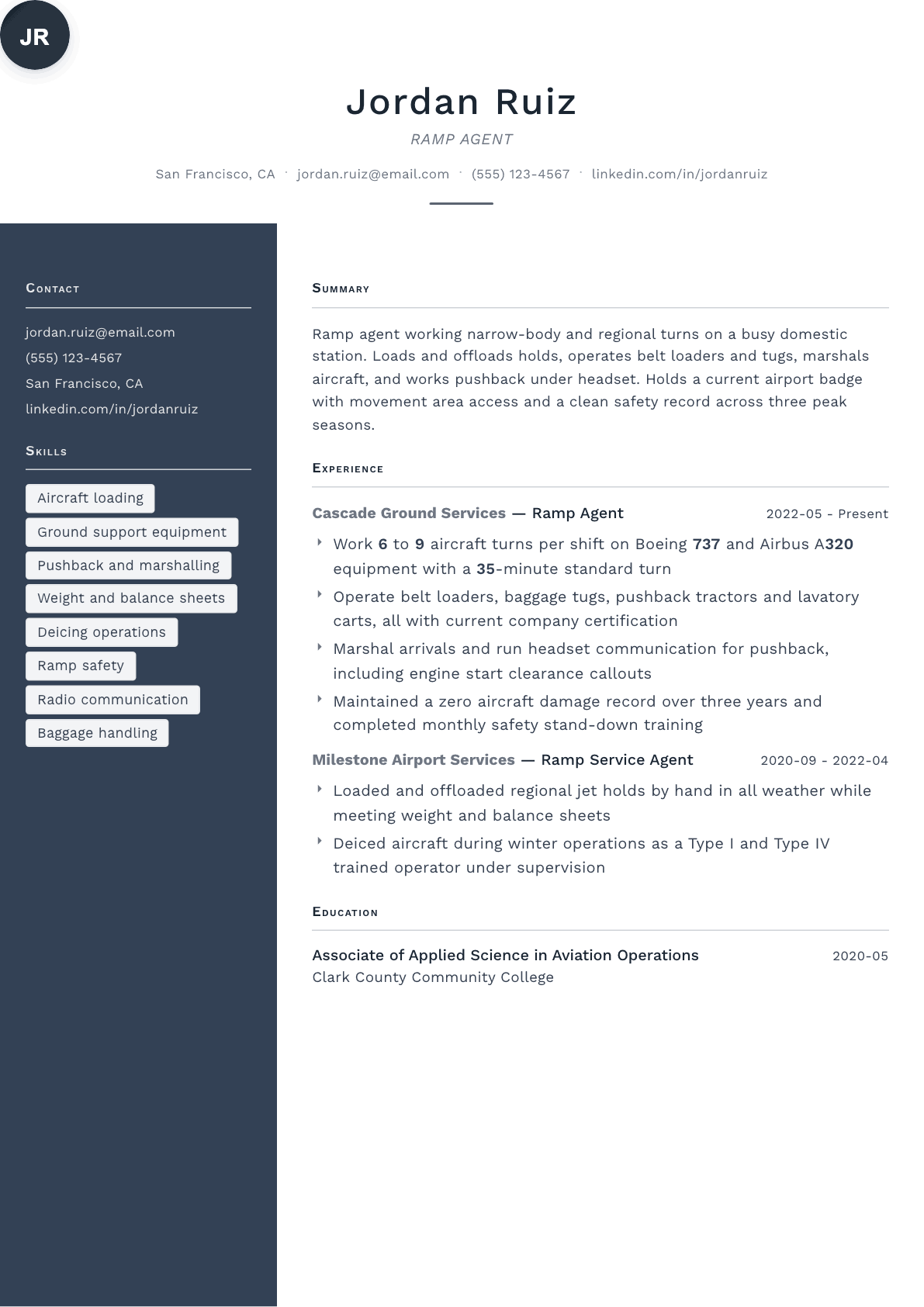
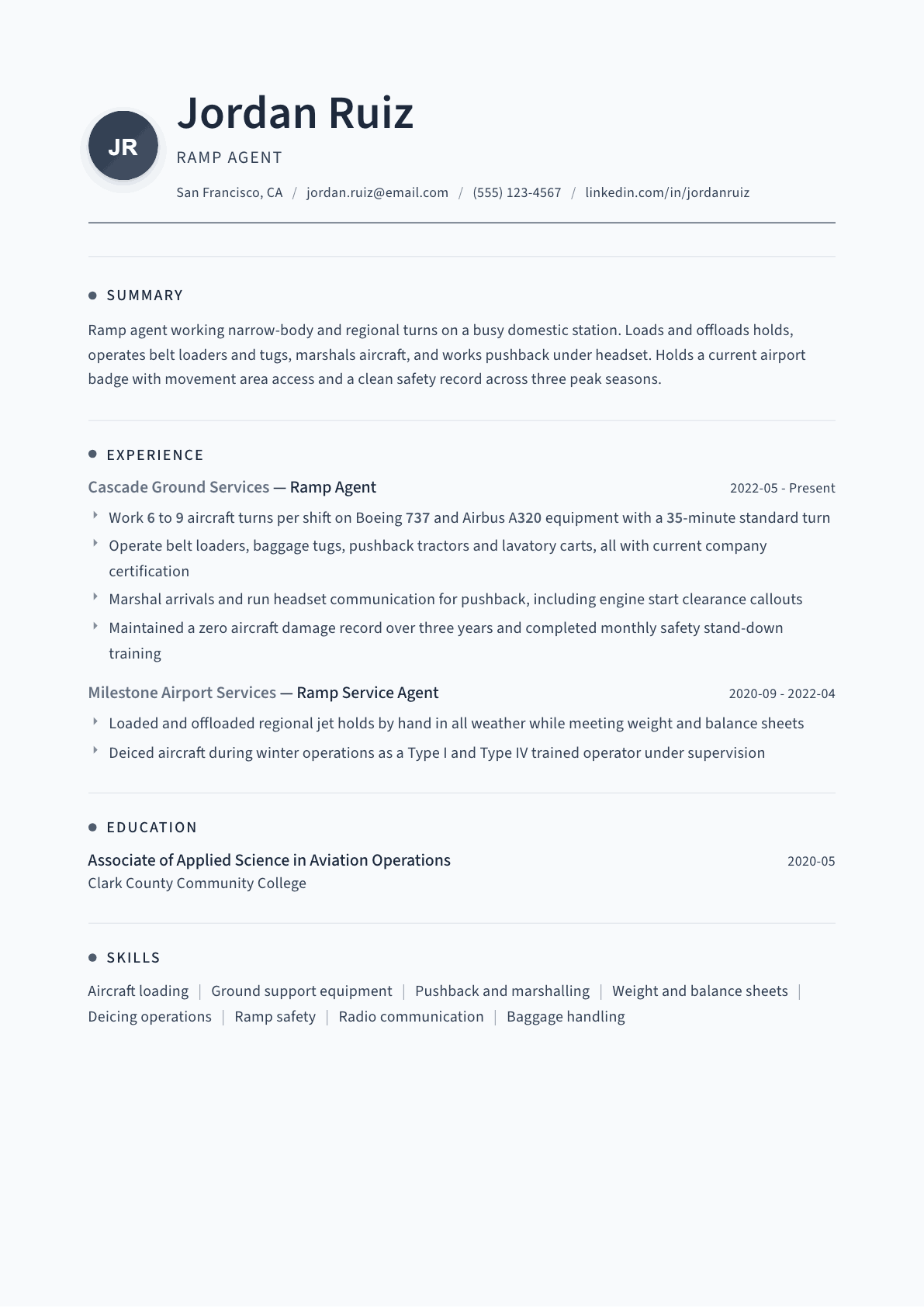
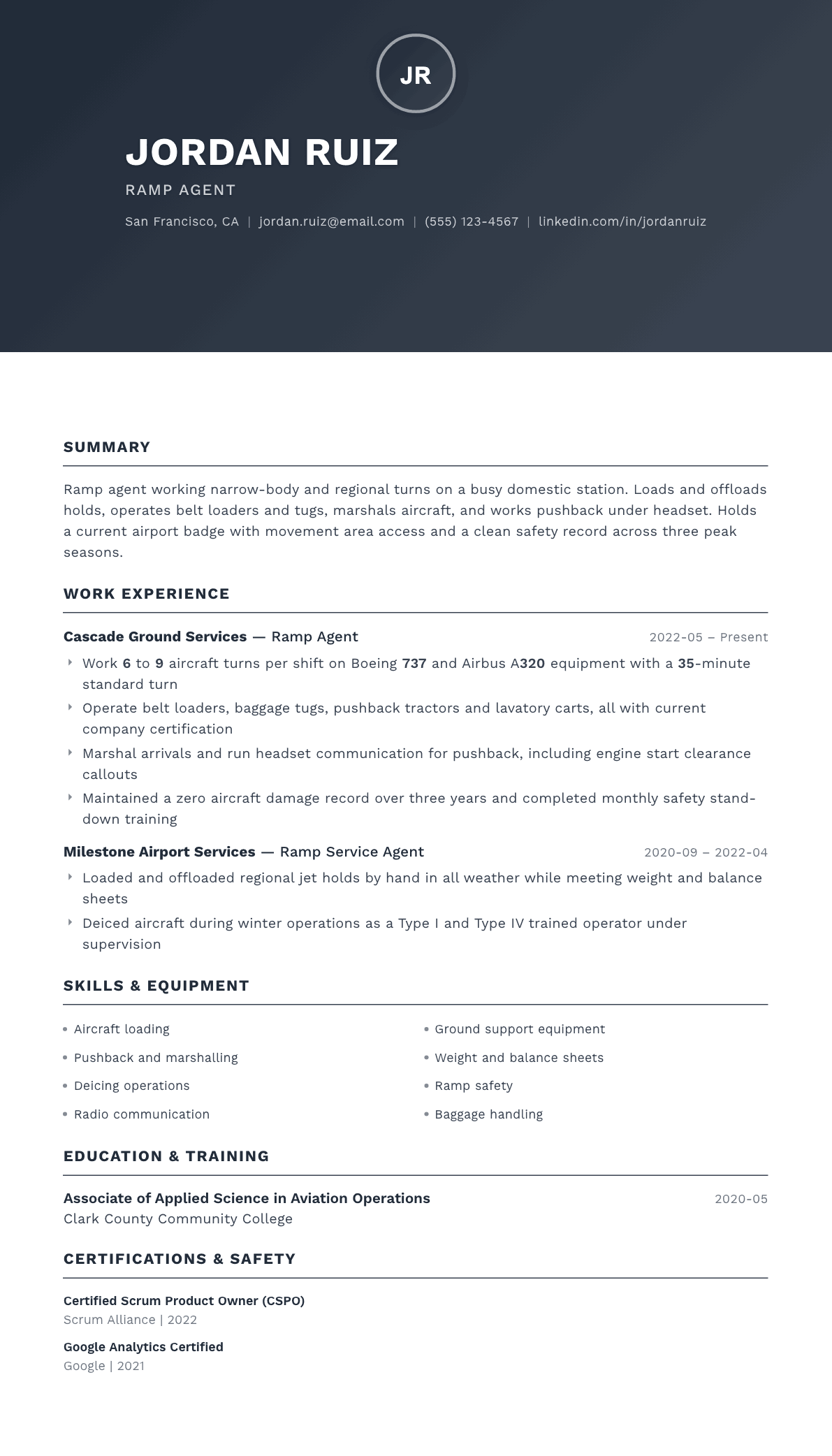
Example Ramp Agent summary
Ramp agent with three years working narrow-body and regional turns on a domestic station, holding a current airport badge with movement area driving authorization. Certified on belt loaders, tugs and pushback tractors, trained in Type I and Type IV deicing, and damage free across three peak seasons. Available for overnight and holiday coverage. Seeking a ramp lead position with a mainline carrier.
Skills to list on a Ramp Agent resume
- Aircraft loading and offloading
- Ground support equipment operation
- Belt loader and baggage tug
- Aircraft pushback
- Marshalling and hand signals
- Weight and balance documentation
- Deicing operations
- Ramp safety procedures
- Foreign object debris control
- Radio and headset communication
- Cargo and mail handling
- Airport security compliance
What actually gets this resume read
- Put your airport badge, movement area access and driver authorization near the top, because stations screen on them first.
- Name every piece of ground support equipment you are certified on, from belt loaders and tugs to pushback tractors.
- State the aircraft types you have worked, since narrow-body, wide-body and regional turns are different jobs.
- Give the turn time you worked to, because that single number tells a station manager your pace.
- Lead with safety: damage-free record, safety stand-downs, foreign object debris walks and ramp incident reporting.
- Mention availability plainly, since overnight, weekend and holiday coverage is the constraint most stations hire against.
How to write a ramp agent resume
A ramp agent resume is screened by a station manager who has open shifts to fill and a safety record to protect. That combination produces a very specific reading order. First, can this person be badged and cleared to drive on the movement area. Second, what equipment are they already certified on, because a candidate who arrives trained on belt loaders and pushback tractors reaches full productivity in days rather than weeks. Third, are they available for the shifts nobody wants.
Airfield work also carries a risk profile that no office job does. Aircraft damage, ground equipment collisions and personal injuries are expensive and reportable, so a clean record is a genuine qualification and belongs on the page in plain words. Candidates leave it off because it feels like an absence rather than an achievement, which is a mistake.
This guide walks through what a station manager checks first, how to present badging and equipment certifications, three summary examples from a first ground handling job to a ramp lead, before-and-after bullets, and the questions ramp crews ask when writing a resume for an airline or a handling company.
Format: one page, credentials visible before the bullets
One page, reverse chronological, plain text. Ground handling recruiters process high volumes of applications and read fast. Put a short credentials line directly under your contact details covering the airport badge and its access level, driver authorization, and whether you can pass a background check and drug screen without issue.
Work history should be complete with no unexplained gaps, because airport employment requires a verifiable history for the badging process. A gap you do not explain on the resume becomes a question in the background check anyway, so account for it briefly.
- Header: name, city and state, phone, email, and the airport code where you currently hold or last held a badge.
- Section order: summary, certifications and clearances, work experience, training, education.
- State availability plainly: overnight, early morning, weekends, holidays, and whether you can work outdoors year round.
Summary: station, aircraft, equipment, safety record
Three lines. The kind of station you have worked, the aircraft types you have turned, the ground support equipment you are certified on, and your safety record. A ramp agent summary that lists these four things answers almost everything a station manager needs before the phone screen.
Name the aircraft by family rather than by airline. Narrow-body work on Boeing 737 and Airbus A320 equipment, regional jet work on CRJ or Embraer aircraft, and wide-body work with containerized cargo are three different skill sets, and stations hire against the fleet they actually serve.
Experience: turns, equipment and the safety loop
Lead with throughput. How many turns per shift, at what standard turn time, and on what equipment. A ramp agent working six to nine turns a shift against a thirty-five minute standard is describing a pace that a station manager can immediately picture, and that single detail carries more weight than three sentences about teamwork.
Then list what you actually operate, using the equipment names the industry uses: belt loaders, baggage tugs, pushback tractors and tow bars, container loaders, ground power units, air start units, lavatory and water service carts, and deicing rigs. Say the certification is current, because expired training means a station has to retrain you before you can work a line.
Cover the safety loop explicitly. Foreign object debris walks, aircraft danger zone awareness, wing walking and marshalling standards, cone and chock discipline, safety stand-downs and incident reporting. A candidate who describes these as routine practice reads as someone who has been properly trained, not merely present on a ramp.
- Mention headset communication and pushback procedures separately, since not every agent is qualified for them.
- Include weight and balance documentation and load sheet handling if you have done it, as it is a step above general loading.
- Note any deicing training by fluid type, because winter operations staffing is a seasonal hiring priority.
Badging, training and physical requirements
The badge is the gate. Say whether you hold a current airport identification badge, whether it includes movement area driving authorization, and whether you have completed security threat assessment and background checks. If your badge lapsed when you left a station, say that you previously held one and are eligible to be rebadged, because eligibility is what the recruiter is actually assessing.
List employer-delivered training by name where you can: aircraft-specific loading, ground support equipment operation, hazardous materials awareness for acceptance and handling, and safety management system familiarity. Add the physical elements honestly, including lifting capability, working in extreme weather and tolerance for high noise environments, since those are real conditions of the job rather than preferences.
Keywords ground handling postings use
Ramp agent, ground handling, aircraft turn, ground support equipment, belt loader, baggage tug, pushback, marshalling, wing walking, weight and balance, load sheet, deicing, foreign object debris, danger zone, airport badge and secure area access. Use the terms your station used and keep them consistent with the equipment list.
Ramp Agent resume summary examples
New to the airfield
Warehouse and freight handler seeking a ramp agent position, with three years of physically demanding outdoor work and a forklift certification. Comfortable with early morning starts, weekend coverage and lifting to 70 pounds repeatedly. Eligible for an airport badge with a clean background and driving record.
Three years on the ramp
Ramp agent working 6 to 9 narrow-body turns per shift on Boeing 737 and Airbus A320 aircraft against a 35-minute standard. Certified current on belt loaders, baggage tugs and pushback tractors, trained on Type I and Type IV deicing, and damage free across three peak winter seasons.
Ramp lead
Ramp lead directing a crew of eight across mixed narrow-body and regional operations, assigning equipment, running the turn brief and signing off load sheets. Trains new agents on danger zone awareness and pushback procedures, and has led the station through two audits with no findings on ground operations.
Work experience bullets: before and after
Before: Loaded and unloaded aircraft baggage.
After: Worked 6 to 9 aircraft turns per shift on Boeing 737 and Airbus A320 equipment, loading and offloading holds against a 35-minute standard turn time.
Turn count, aircraft type and standard turn time tell a station manager your pace and the fleet you already know.
Before: Operated ground equipment on the ramp.
After: Operated belt loaders, baggage tugs, pushback tractors and lavatory service carts under current company certification, completing pre-use inspections on every unit.
Naming each machine plus current certification and daily checks turns generic equipment use into a hire-ready qualification.
Before: Followed safety procedures at all times.
After: Maintained a zero aircraft damage record over three years, completed monthly safety stand-downs and led foreign object debris walks before every first departure.
A record over a stated period plus named practices makes safety verifiable rather than a promise anyone can write.
Before: Helped with aircraft pushback.
After: Ran headset communication with the flight deck for pushback, including brake release and engine start callouts, and marshalled arrivals into gate using standard hand signals.
Headset and marshalling qualifications are separate sign-offs, so naming them shows a higher level of ramp authorization.
Before: Worked in bad weather when needed.
After: Performed Type I and Type IV deicing during winter operations under supervision, and worked full outdoor shifts through freezing conditions with no attendance issues.
Fluid types and an attendance statement address the two things stations worry about most during a winter season.
Hard skills
- Aircraft loading and offloading
- Belt loader operation
- Baggage tug operation
- Pushback tractor and tow bar handling
- Marshalling and standard hand signals
- Headset communication with flight deck
- Weight and balance documentation
- Deicing operations
- Ground power and air start units
- Foreign object debris control
- Hazardous materials awareness
- Airport security compliance
Soft skills
- Situational awareness around aircraft
- Working to a clock
- Crew communication in high noise
- Reliability on unpopular shifts
- Physical stamina
- Following procedure without shortcuts
Certifications worth listing
- Airport Identification Badge with movement area driving authorization (Airport authority where employed)
- IATA Ground Operations Training (International Air Transport Association)
- Dangerous Goods Regulations Awareness (International Air Transport Association)
- Powered Industrial Truck Operator Certification (Employer certification under the OSHA powered industrial truck standard)
Mistakes that cost ramp agent candidates the interview
- Leaving badge status off the resume, which is the first thing a station manager looks for and the slowest thing to obtain.
- Listing equipment generically as ground support equipment rather than naming each machine you are signed off to operate.
- Omitting a safety record, so a reader cannot tell whether you have ever been involved in an aircraft damage event.
- Being vague about availability when overnight, weekend and holiday coverage is the actual reason the position is open.
- Leaving unexplained gaps in the work history, which stall the badging process even when the rest of the file is strong.
- Writing about customer service in general terms instead of ramp-specific work, which reads as an application for the wrong role.
Ramp Agent resume questions
Do I need experience to get hired as a ramp agent?
Not usually. Stations hire on reliability, physical capability and badge eligibility, then train equipment in house. Lead with warehouse, freight, construction or military experience that shows outdoor physical work, and be explicit that you can pass a background check.
How important is the airport badge on my resume?
It is the single most valuable line if you already hold one, because badging takes weeks and includes a security threat assessment. State the access level and whether it covers driving on the movement area, since that authorization is what lets you work equipment airside.
Should I list the aircraft types I have worked?
Yes. Narrow-body, regional and wide-body operations differ in loading method, equipment and crew size, and stations hire against their own fleet. Name the families you have turned rather than the airline, since carrier names tell the reader far less than aircraft do.
How do I show I can handle the physical demands?
Be concrete. State the lifting weight you handle repeatedly, the shift length you work, and your record of working outdoors through summer heat and winter conditions. Attendance across a full winter season is more convincing than any adjective about being hardworking.
Can ramp experience lead to other aviation jobs?
Yes, and the resume should support that path. Ramp leads move into station supervision, load control, cargo operations and training roles, so document any sign-off authority, new hire training you delivered, and audits or investigations you took part in.
Related resume examples
- Flight Attendant Resume example
- Warehouse Worker Resume example
- Baggage Handler Resume example
- Airline Customer Service Agent Resume example
- Railroad Conductor Resume example
- Drone Pilot Resume example