Baggage Handler Resume Examples: the lines they read
Write a Baggage Handler Resume That Clears Airline Screening
By Mustafa Tarabya, founder of CVBooster · Published · Updated
Baggage handler resume examples with bag volumes, equipment certifications, safety record and badging, plus keywords and a step-by-step guide.
Sample resumes for a baggage handler
The same baggage handler content laid out in three CVBooster templates, so you can see what the finished document looks like before you write a word.
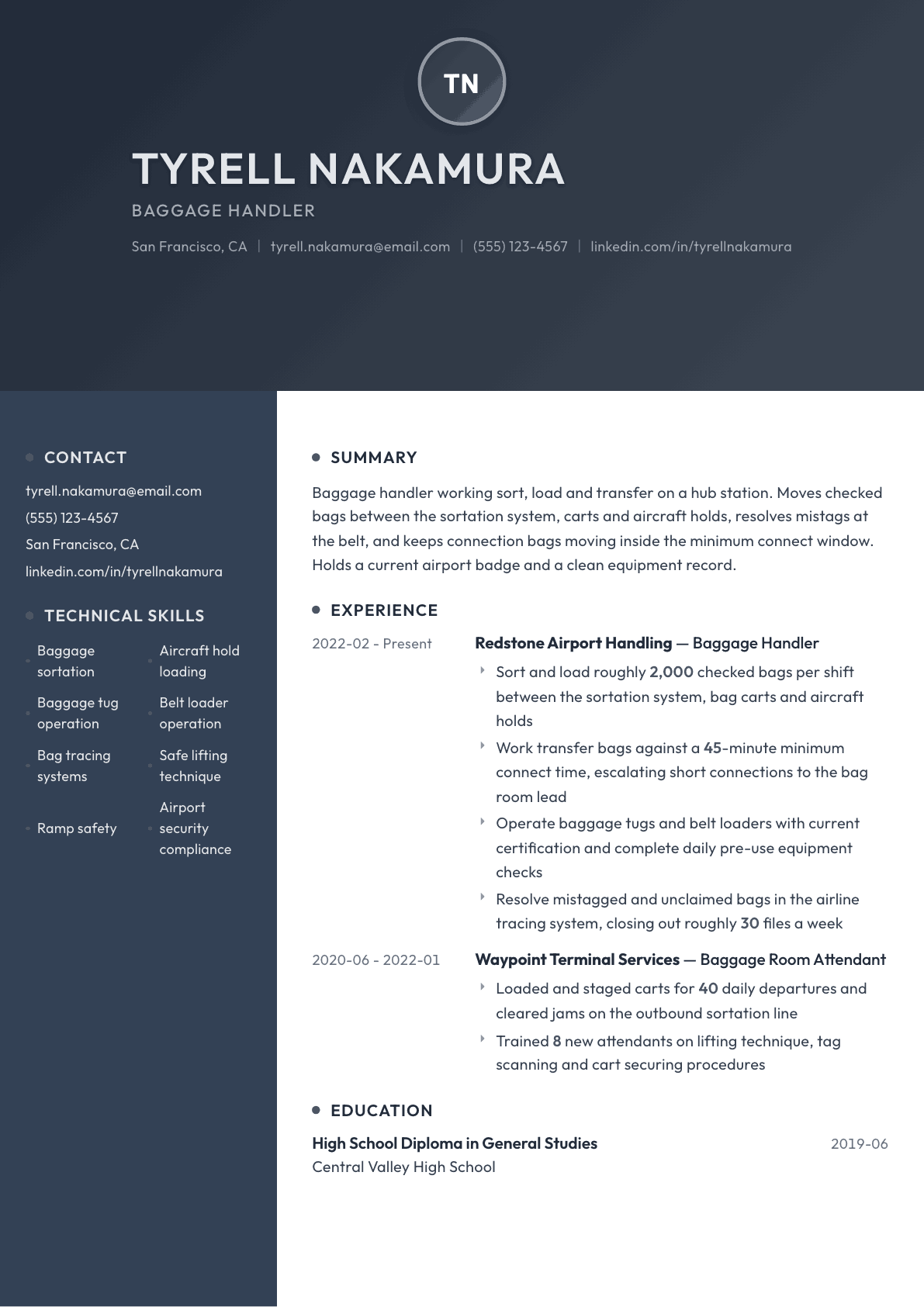
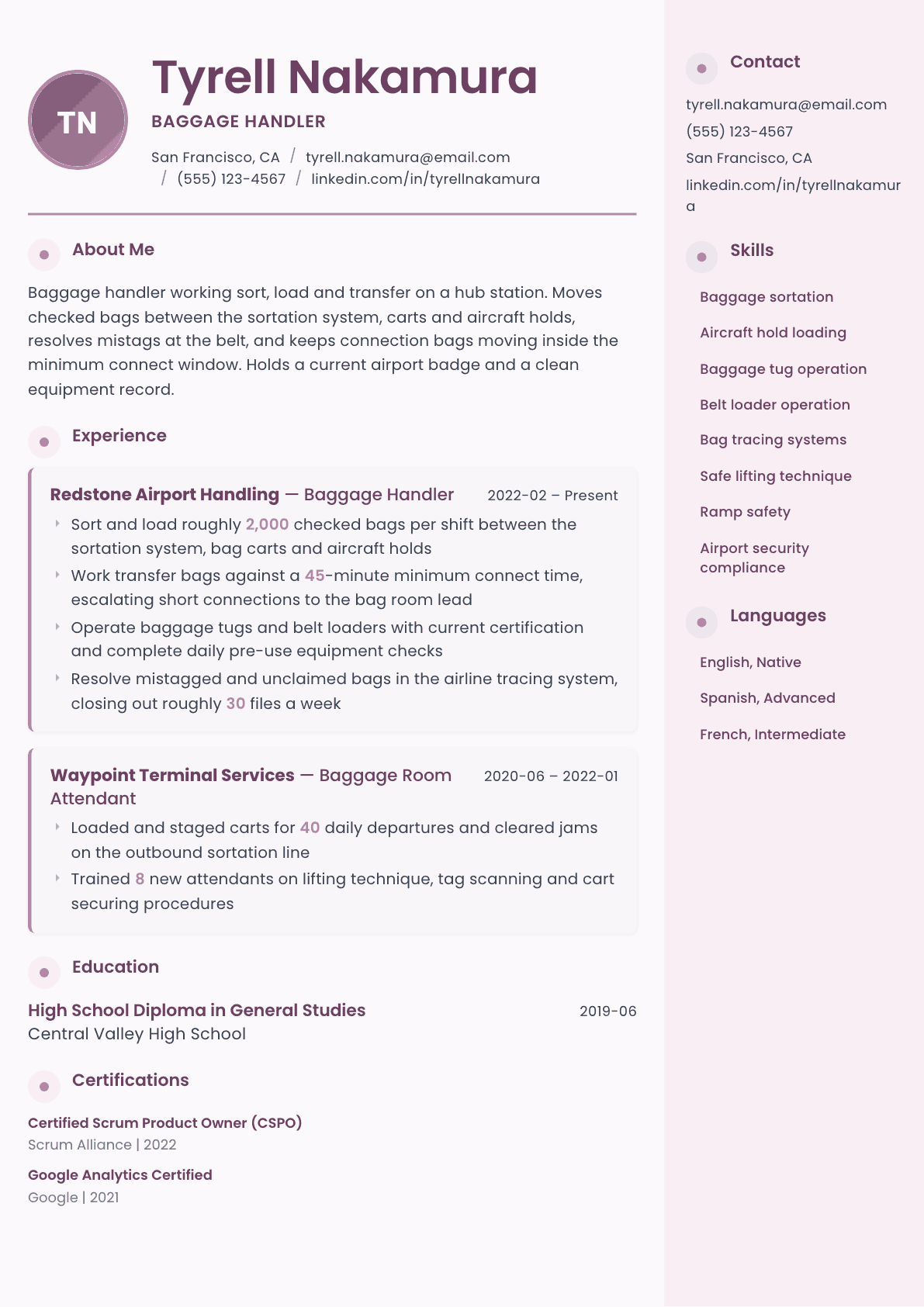
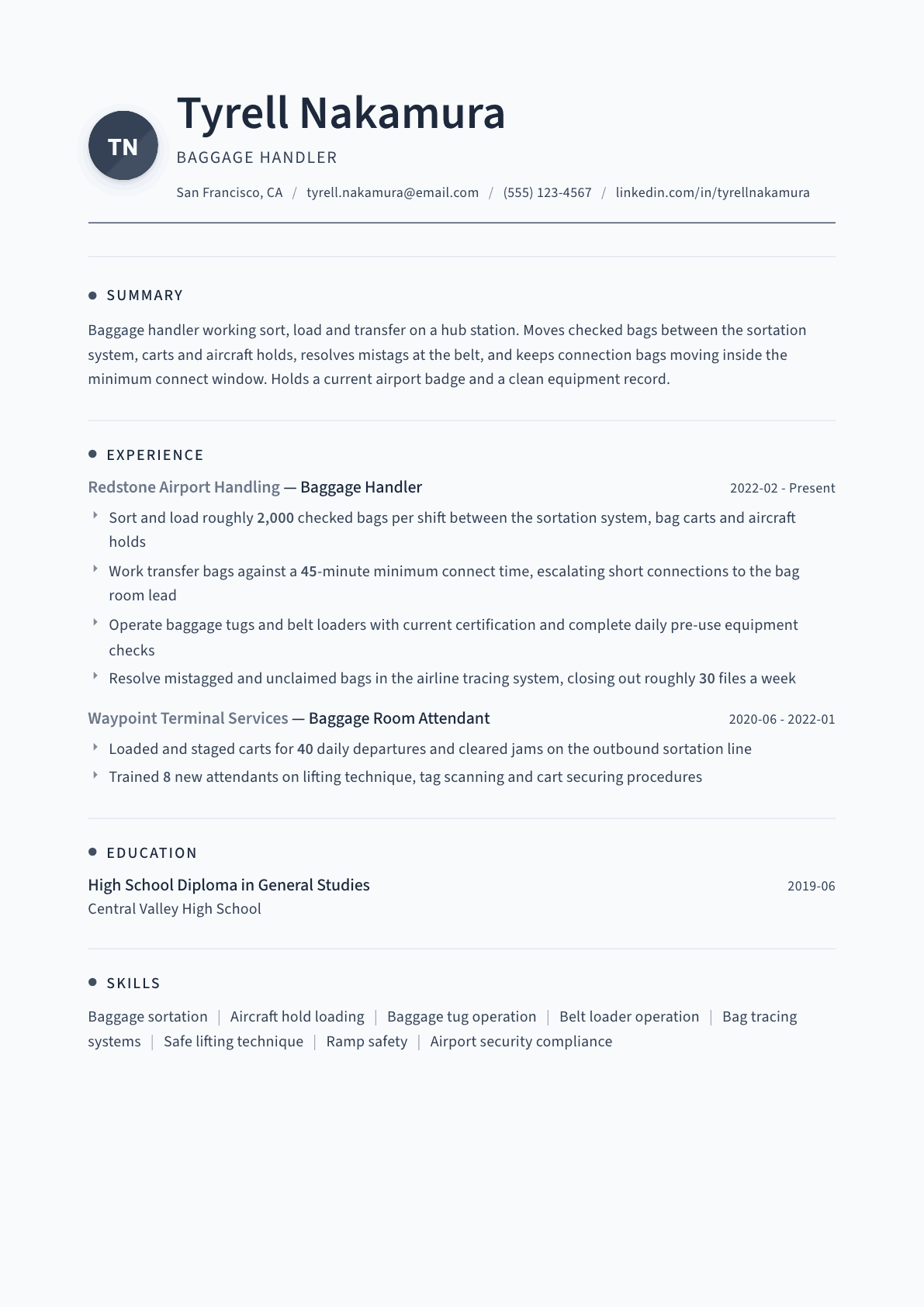
Example Baggage Handler summary
Baggage handler with four years on hub and outstation ground crews, moving several thousand checked bags a shift between sortation, carts and aircraft holds. Certified on baggage tugs and belt loaders, trained in safe lifting, and experienced resolving mistagged and mishandled bags in an airline tracing system. Holds a current airport badge. Seeking a bag room lead role with a ground handling operator.
Skills to list on a Baggage Handler resume
- Baggage sortation systems
- Aircraft hold loading
- Baggage tug operation
- Belt loader operation
- Bag tag scanning
- Baggage tracing and claims
- Minimum connect time handling
- Safe lifting and manual handling
- Ramp safety procedures
- Airport security compliance
- Cart staging and securing
- Team communication
What actually gets this resume read
- Put badge status, background check clearance and any driver authorization in the header where a recruiter sees them.
- Give bag volume per shift and the number of departures you supported, because that is how stations size experience.
- Name the equipment you are certified on and say the certification is current, not simply that you used the machine.
- Include the minimum connect time you worked against, which proves you understand what makes a bag late.
- Show physical reliability with attendance, weather coverage and a lifting record instead of a vague claim.
- Add bag tracing system experience if you have it, since resolving mishandled bags is a step above pure loading.
How to write a baggage handler resume
Baggage handling is measured in bags that arrive with their passenger and bags that do not. Every hiring decision in a bag room traces back to that one number, so the person reading your resume is looking for signs that you understand why a bag goes missing: a tag that never scanned, a cart that left before a late connection, a container loaded to the wrong hold, a jam nobody cleared. A candidate who can talk about those causes is worth more than one who simply says they lifted heavy items.
The second thing the reader checks is clearance. Airport work requires a badge, a background check and a security threat assessment, and each of those takes time. A candidate who already holds a badge, or who can clearly state that they are eligible for one, moves ahead of a stronger applicant whose history will slow the process down.
This guide covers what a bag room supervisor reads for, how to present volume, equipment and tracing experience, three summaries from an entry applicant to a bag room lead, before-and-after bullets, and the questions handlers ask when applying to airlines and ground service providers.
Format: one page, clearances and availability up front
One page is right for this role at almost any level of experience. Reverse chronological, plain text, no graphics. Directly under your contact block, put a short line covering badge status, background check clearance, driver authorization if you have it, and shift availability. Those four facts determine whether a supervisor calls you.
Account for every period in your work history. Airport employment verification looks back across several years, and an unexplained gap will surface during badging even if the resume glosses over it. A single honest line about a break is far better than a hole in the timeline.
- Header: name, city and state, phone, email, and the airport where you hold or last held a badge.
- Section order: summary, clearances and certifications, work experience, training, education.
- State the shifts you can cover, since bag rooms run through the night and staffing overnight is the hardest problem the supervisor has.
Summary: volume, station type, equipment, record
Three lines covering bags handled per shift, the type of station, the equipment you are certified on, and your reliability record. A hub bag room with transfer flows and a tight connection window is a different environment from an outstation handling a handful of daily departures, so name which one you have worked.
If you have worked mishandled baggage tracing, put it in the summary. Moving from pure loading into tracing and claims is the first step toward a lead role, and supervisors treat that experience as evidence you understand the process end to end rather than only the physical part of it.
Experience: throughput, connections and tracing
Give volume as bags per shift and departures supported. Those two numbers do the work that adjectives cannot, because they tell a supervisor whether you have sustained a heavy pace or handled a light schedule. Add the flow you worked: outbound sort, transfer, arrivals, or the bag room feeding the sortation system.
Then describe connection handling. Working transfer bags against a published minimum connect time, identifying short connections early, and escalating rather than letting a bag ride to the next station is the core judgment of the job. Say what the connect window was and what you did when a bag would not make it.
Cover tracing if you have done it. Resolving mistagged bags, searching the sortation area for strays, creating and closing files in an airline tracing system, and reuniting delayed bags with passengers are all specific tasks that lift a resume above the pile. State roughly how many files you closed in a typical week.
- Name the equipment you are certified on and confirm the certification is current, not historic.
- Include jam clearing and belt safety procedures, since sortation stoppages are the most common bag room disruption.
- Mention any work with oversized, fragile, firearm or hazardous items, which require separate handling procedures.
Training, physical demands and safety
List the training your employer delivered by name: baggage system operation, tug and belt loader certification, manual handling and lifting technique, dangerous goods awareness, and airport security awareness. If you were trained to load aircraft holds directly, say so, because that qualification overlaps with ramp work and widens the roles you can be offered.
Be direct about the physical side. Repeated lifting throughout a full shift, working in an unconditioned bag room or outdoors in any weather, and standing for long periods are the actual conditions. A statement about your attendance record through a peak season is the most persuasive way to show you can sustain it.
Keywords airline and handler postings use
Baggage handler, baggage handling, bag room, sortation system, bag tag scanning, transfer baggage, minimum connect time, mishandled baggage, baggage tracing, belt loader, baggage tug, aircraft hold loading, manual handling, ramp safety and airport security. Include the ones you have genuinely worked with and keep them consistent with your equipment list.
Baggage Handler resume summary examples
First airport role
Warehouse associate applying for a baggage handler position, with two years of high-volume sorting and loading work and a clean attendance record across 18 months of overnight shifts. Comfortable lifting to 70 pounds repeatedly for a full shift, and eligible for an airport badge with no background concerns.
Three years in the bag room
Baggage handler sorting and loading roughly 2,000 checked bags per shift between the sortation system, carts and aircraft holds at a hub station. Works transfer bags against a 45-minute connect window, holds current tug and belt loader certification, and closes about 30 tracing files a week.
Bag room lead
Bag room lead directing a crew of ten across outbound sort and transfer flows, assigning positions by departure bank and holding the connection escalation process. Trains new handlers on scanning discipline, lifting technique and cart securing, and reports mishandled baggage causes to the station manager weekly.
Work experience bullets: before and after
Before: Loaded and sorted passenger baggage.
After: Sorted and loaded roughly 2,000 checked bags per shift between the sortation system, bag carts and aircraft holds across 40 daily departures.
Bag volume, the flows involved and departure count give the supervisor a pace to compare against their own operation.
Before: Made sure connecting bags got to the right flight.
After: Worked transfer bags against a 45-minute minimum connect time, flagging short connections to the bag room lead before the departure bank closed.
A named connect window and an escalation point show the judgment behind the task rather than the intention.
Before: Used baggage equipment on the ramp.
After: Operated baggage tugs and belt loaders under current certification, completing daily pre-use inspections and reporting two equipment defects that removed unsafe units from service.
Current certification, inspections and a reported defect together demonstrate the safety habits stations screen hardest for.
Before: Helped with lost baggage issues.
After: Resolved mistagged and unclaimed bags in the airline tracing system, closing roughly 30 files a week and searching the sort area for strays before each shift handover.
File volume and the handover search describe a process the handler ran, not occasional help with a problem.
Before: Trained new employees on the job.
After: Trained 8 new attendants on tag scanning, lifting technique and cart securing, and signed each off before they worked an unsupervised position.
A trainee count and a sign-off responsibility show delegated authority, which is what moves a handler toward a lead role.
Hard skills
- Baggage sortation system operation
- Bag tag scanning discipline
- Transfer and connection handling
- Aircraft hold loading
- Baggage tug operation
- Belt loader operation
- Baggage tracing and file closure
- Cart staging and securing
- Jam clearing and belt safety
- Manual handling technique
- Dangerous goods awareness
- Airport security compliance
Soft skills
- Sustained pace through a full shift
- Attention to tag detail
- Clear radio communication
- Dependability on overnight shifts
- Teamwork under time pressure
- Care with passenger property
Certifications worth listing
- Airport Identification Badge (Airport authority where employed)
- Dangerous Goods Regulations Awareness (International Air Transport Association)
- IATA Ground Operations Training (International Air Transport Association)
Mistakes that cost baggage handler candidates the interview
- Writing only about lifting, which describes the least skilled part of the job and none of the judgment that prevents a mishandled bag.
- Leaving badge and background clearance off the page, when those are the slowest steps between an offer and a first shift.
- Failing to give bag volume or departure counts, so a supervisor cannot compare your pace against their own operation.
- Ignoring connection handling entirely, even though transfer flow is where most bags are lost at a hub station.
- Listing equipment without saying whether the certification is current, which forces the reader to assume it lapsed.
- Being vague about availability when the open shifts are almost always overnight, weekend and holiday coverage.
Baggage Handler resume questions
What is the difference between a baggage handler and a ramp agent?
Baggage handling focuses on the bag flow through the sort area, carts and holds, while ramp work covers the whole aircraft turn including pushback, marshalling and servicing. The roles overlap heavily and many stations combine them, so name every task you have actually performed.
Do I need experience to be hired as a baggage handler?
Rarely. Employers hire on reliability, physical capability and clearance eligibility, then train in house. Warehouse, parcel sorting, freight or grocery distribution experience translates directly, so lead with volume, shift patterns and attendance from those roles.
How do I show reliability on a resume?
Use facts rather than adjectives. State the length of overnight or early shift patterns you sustained, your attendance through a peak season, and how long you stayed in each role. Consistency across a full year of unpopular shifts is the strongest signal available to you.
Should I mention baggage tracing experience?
Yes, prominently. Tracing means you have worked the process that follows a failure, understand how bags are matched to passengers, and can use an airline system rather than only physical equipment. That experience is the usual route into lead and supervisory positions.
What disqualifies someone from airport baggage work?
Requirements vary by employer and airport authority, but a badge depends on a background check and security threat assessment, and a verifiable employment history is part of that. If you have a concern, ask the recruiter directly rather than leaving the resume timeline incomplete.
Related resume examples
- Warehouse Worker Resume example
- Truck Driver Resume example
- Ramp Agent Resume example
- Shipping Clerk Resume example
- Air Traffic Controller Resume example
- Distribution Manager Resume example