Railroad Conductor Resume Examples: the lines they read
Write a Railroad Conductor Resume That Survives the Safety Screen
By Mustafa Tarabya, founder of CVBooster · Published · Updated
Railroad conductor resume example with certification, switching and air brake test bullets, rules knowledge, keywords and a full writing guide.
Sample resumes for a railroad conductor
The same railroad conductor content laid out in three CVBooster templates, so you can see what the finished document looks like before you write a word.
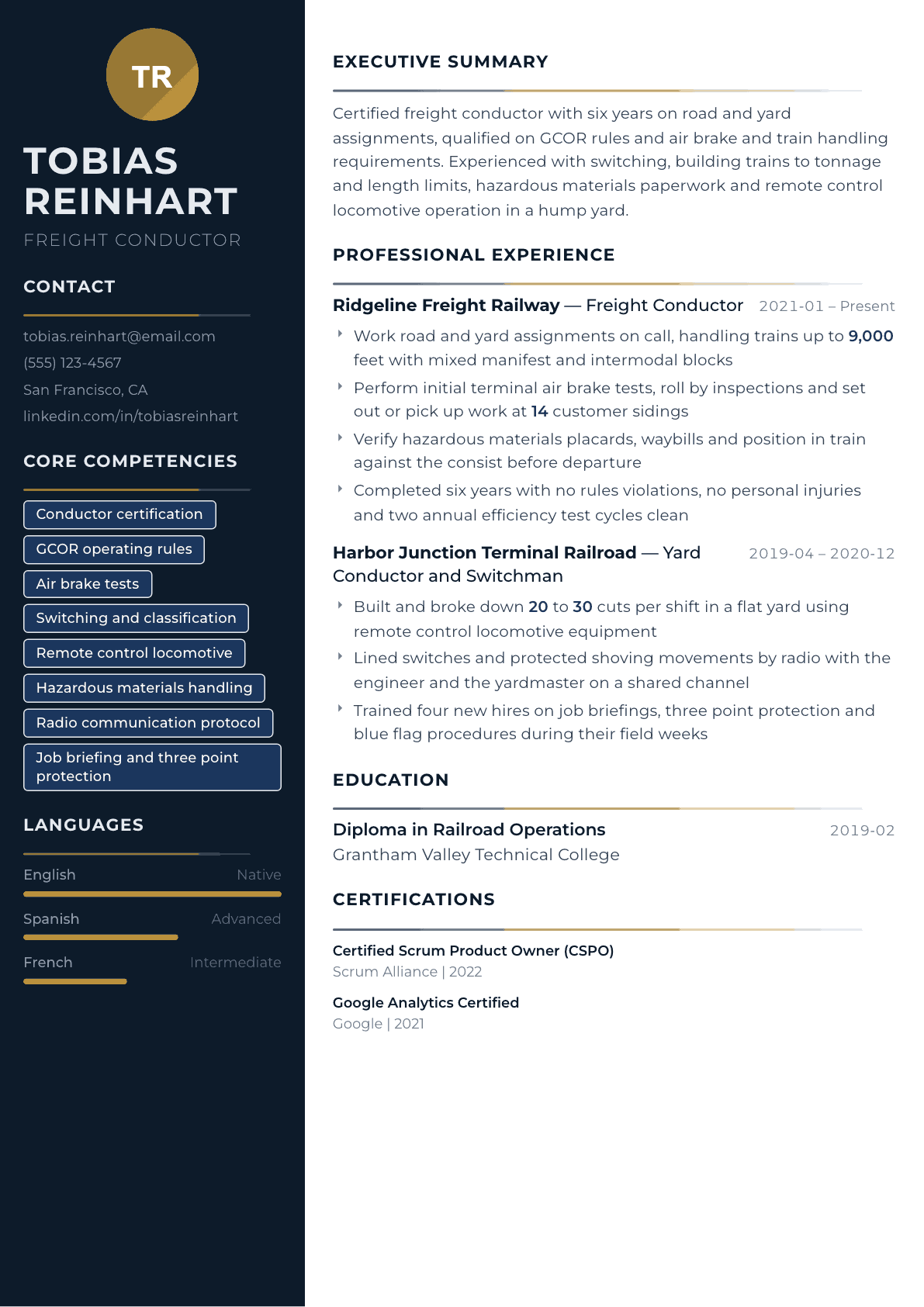
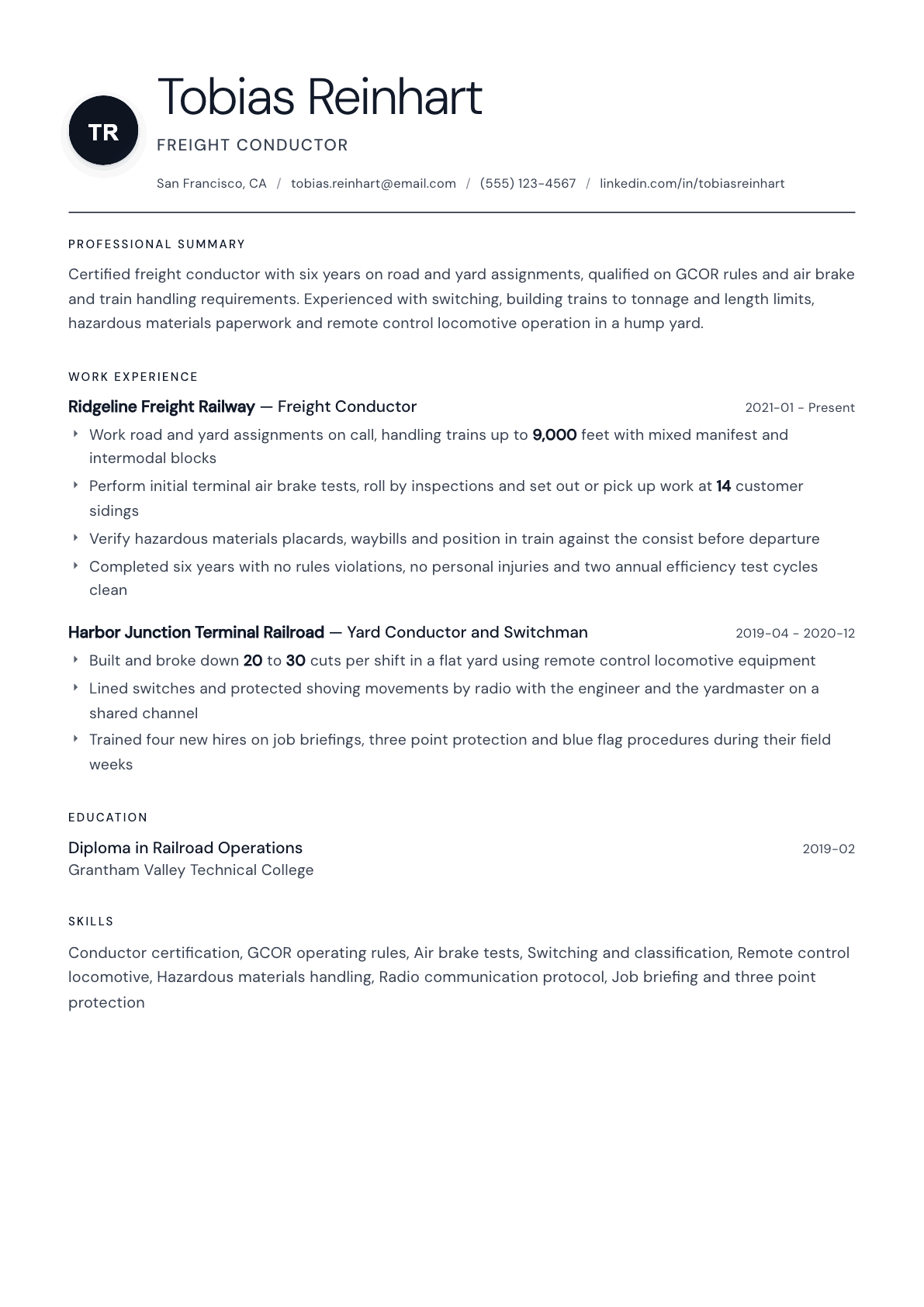
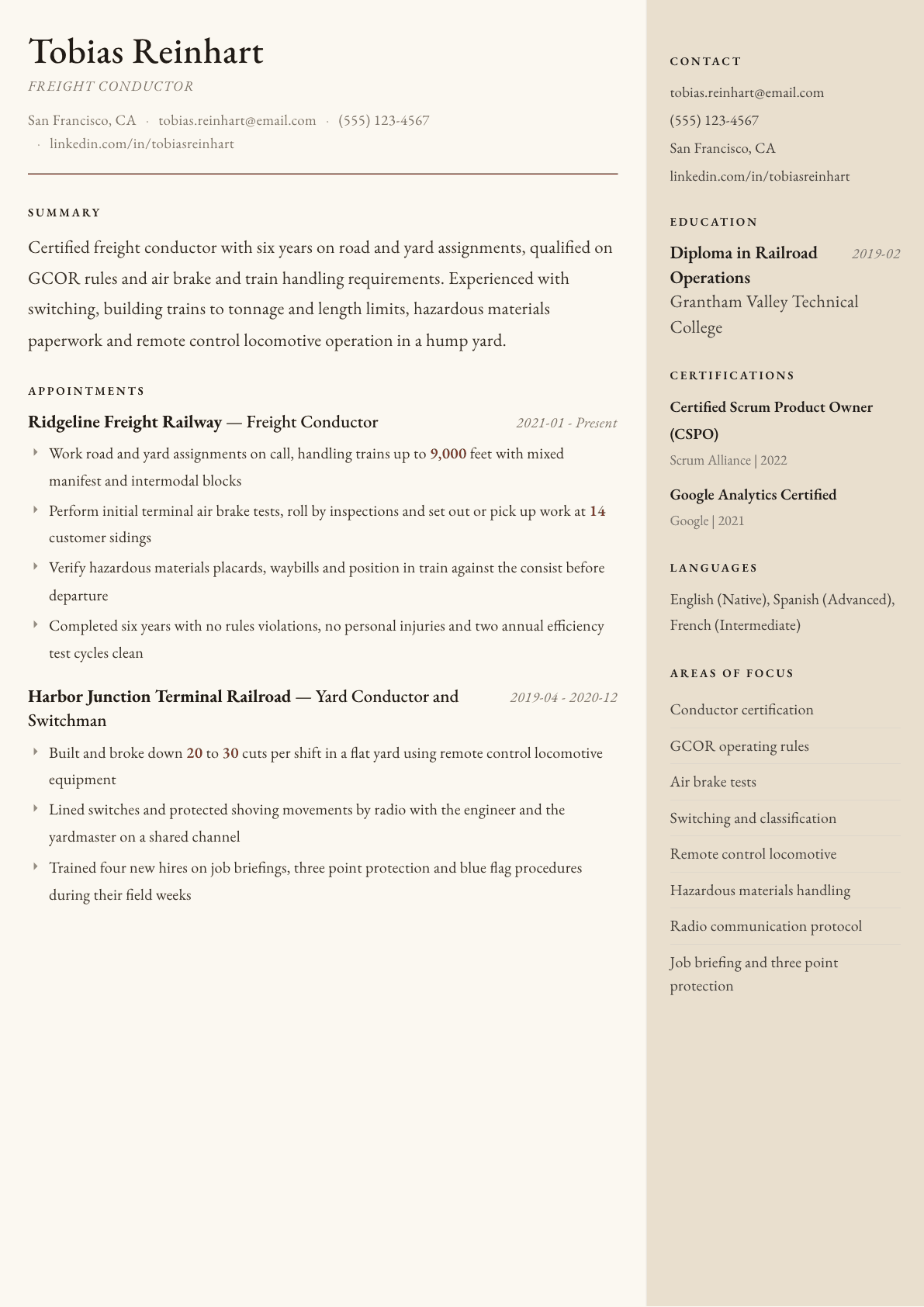
Example Railroad Conductor summary
Certified freight conductor with six years on road and yard assignments, qualified on GCOR rules and current on air brake and train handling requirements. Builds trains to tonnage and length limits, performs initial terminal air brake tests, and verifies hazardous materials paperwork against the consist before departure. Six years with no rules violations, no personal injuries and clean efficiency test cycles.
Skills to list on a Railroad Conductor resume
- Conductor certification
- GCOR and timetable rules
- Initial terminal air brake test
- Train building to tonnage and length
- Switching and classification
- Remote control locomotive operation
- Hazardous materials documentation
- Radio and hand signal communication
- Roll by and equipment inspection
- Three point protection
- Blue flag procedures
- Job briefings
- Track warrant and authority handling
- Derail and switch inspection
What actually gets this resume read
- Name your conductor certification and the rule book you are qualified on, since railroads test on the exact book.
- Show whether your time is road, yard or both, because the two assignments hire on very different skill sets.
- Quantify the work: train length, car counts, cuts per shift, customer sidings served and tonnage handled.
- State your safety record directly, including injury free years, rules violations and efficiency test outcomes.
- List hazardous materials training, remote control locomotive qualification and any territory you are qualified on.
- Show you can live with the schedule: on call boards, extra board time, and away from home terminal rest rules.
How to write a railroad conductor resume
Railroads hire for rule compliance and attendance before anything else. A trainmaster reading a conductor application is asking two questions: will this person follow the operating rules exactly when nobody is watching, and will this person answer the phone at three in the morning when the board calls. A resume that shows a clean rules record and a history of showing up beats one that shows variety.
The work itself is misunderstood by people writing about it for the first time. A conductor is not a passenger greeter on a freight railroad. The conductor is in charge of the train, owns the paperwork, protects the movement on the ground, verifies the hazardous materials against the consist, and makes the switching plan happen. Write the resume as the person responsible for the train, because that is the legal reality.
This guide covers certification and rules qualification, how to write road and yard experience, what a railroad checks in your safety record, the training worth listing, and the questions that come up for people entering the industry from trucking, the military or the yard.
Format: certification first, then rules, then the work
One page for most conductors, two if you carry supervisory or training history. Header, certification and qualifications block, experience, training, education, then a short availability statement. No graphics, because these files go through a standard applicant tracking system and then to a trainmaster who prints them.
Availability deserves its own line. Say plainly that you can work an on call board, take away from home terminal rest, and cover nights, weekends and holidays. Railroads lose new hires to the schedule constantly and a candidate who states the schedule out loud is easier to trust.
- Certification: conductor certification with the issuing railroad and the current status.
- Rules: the operating rule book you are qualified on, the timetable and special instructions, and any territory qualification.
- Endorsements: hazardous materials training, remote control locomotive qualification and any air brake and train handling qualification.
Experience: road, yard, and the difference between them
Say which assignments you worked, because a railroad staffing a yard job and a railroad staffing a road pool are looking for different people. Road work means long trains, track authority, set out and pick up at customer sidings, and hours of service planning. Yard work means switching volume, shoving movements, classification and constant radio traffic with the yardmaster.
Then quantify. Train length and tonnage, car counts, cuts per shift, number of customer sidings served, how many industries you switched, how many crews you worked with. A trainmaster reads those numbers as an estimate of how much supervision you will need in week one.
Show the parts of the job that carry legal weight. Initial terminal air brake tests, roll by inspections, verifying placards and waybills against the consist, protecting a shoving movement, blue flag protection, securing equipment with the required hand brakes. Those are the tasks investigations examine, and writing them tells a railroad you know which parts of your day are auditable.
- Name the rule book and any special instruction sets you have been qualified on.
- Name the equipment: remote control locomotive systems, end of train devices, derails, retarders in a hump yard.
- Name the record: rules violations, personal injuries, efficiency test outcomes and years without a decertification event.
Safety record and the parts a railroad verifies
Conductor certification can be suspended or revoked for specific rule violations, and the hiring railroad will ask about your certification history. State your record plainly: years without a violation, efficiency test cycles passed, injury free time, and any event with what changed afterward. An honest line about a decertification you served and returned from reads far better than a silence the background check fills in.
Attendance is the other verified item. Give the availability rate you held on an extra board, missed calls, and any attendance recognition. Railroads track this precisely and treat it as the leading indicator of whether a new conductor will still be there in a year.
Coming from outside the industry
Trucking, military logistics, heavy equipment, warehouse and industrial work all transfer well, but only when translated. What a railroad wants to see from those backgrounds is rule following under fatigue, radio discipline, working around moving equipment, and a clean safety and driving record. Write those, not the industry specific tasks.
Then answer the schedule question before it is asked. Say that you understand the on call board, the seniority system, the away from home terminal rest and the reality that the first years mean nights and holidays. Hiring officers screen for candidates who arrive without illusions.
Railroad Conductor resume summary examples
Entering the industry
Conductor trainee candidate with six years of long haul truck driving, a clean motor vehicle record and hazardous materials endorsement experience. Comfortable with rule based work, night operations and radio communication, and prepared for an on call board with away from home terminal rest.
Six years on the road
Certified freight conductor with six years on road and yard assignments, qualified on the general code of operating rules and current on air brake and train handling requirements. Builds trains to tonnage and length limits, performs initial terminal air brake tests, and holds six years with no rules violations.
Conductor and trainer
Senior conductor with twelve years across manifest, intermodal and local service, qualified on four subdivisions and serving as a field trainer for new hires. Has led job briefings for crews on complex industry work, mentored fourteen trainees to certification, and maintained a clean efficiency test record throughout.
Work experience bullets: before and after
Before: Worked as a conductor on freight trains.
After: Work road and yard assignments on an on call board, handling manifest and intermodal trains up to 9,000 feet with mixed blocks over two subdivisions.
Assignment type, train length and territory tell a trainmaster what you can walk onto without retraining.
Before: Performed brake tests and inspections.
After: Perform initial terminal air brake tests, roll by inspections and set out or pick up work at 14 customer sidings, documenting each test on the required paperwork.
Naming the specific tests and the siding count shows familiarity with the legally auditable parts of the job.
Before: Handled hazardous materials shipments.
After: Verify hazardous materials placards, waybills and position in train against the consist before departure, and hold the movement when a document and a placard disagree.
Describing the check and the stop decision proves rules discipline instead of familiarity with a word.
Before: Did switching in the yard.
After: Built and broke down 20 to 30 cuts a shift in a flat yard on remote control locomotive equipment, lining switches and protecting shoving movements by radio with the yardmaster.
A per shift volume plus the protection method is exactly how a yardmaster measures a switchman.
Before: Trained new employees.
After: Trained four new hires during their field weeks on job briefings, three point protection and blue flag procedures, and signed off their task evaluations with the trainmaster.
The training content and the sign off show a formal role rather than an informal helping hand.
Hard skills
- Conductor certification
- Operating rules and timetable qualification
- Initial terminal air brake tests
- Train building to tonnage and length limits
- Switching and car classification
- Remote control locomotive operation
- Hazardous materials documentation checks
- Radio and hand signal communication
- Roll by and equipment inspection
- Three point protection and blue flag procedures
- Track authority and warrant handling
- Securement and hand brake requirements
Soft skills
- Rule discipline without supervision
- Attendance on an on call board
- Clear job briefings
- Crew coordination under time pressure
- Alertness on night assignments
- Willingness to stop an unsafe move
Certifications worth listing
- Conductor Certification (Federal Railroad Administration)
- Hazardous Materials Transportation Training (Pipeline and Hazardous Materials Safety Administration)
- Roadway Worker Protection (Federal Railroad Administration)
- Commercial Driver License with Hazardous Materials Endorsement (State Department of Motor Vehicles)
Mistakes that cost railroad conductor candidates the interview
- Writing the job as customer service when a freight conductor is legally in charge of the train and its paperwork.
- Leaving out the rule book you are qualified on, which is the first technical question a hiring railroad asks.
- Failing to state availability for an on call board, nights, weekends and away from home rest.
- Omitting the certification and safety record when the railroad will request it during the background check anyway.
- Giving no volumes, so a trainmaster cannot tell a low density branch job from a busy classification yard.
- Ignoring hazardous materials and securement duties, which are the tasks investigations focus on.
- Presenting outside experience in its own industry language instead of translating it into rule compliance and safety terms.
Railroad Conductor resume questions
What is the difference between a conductor and an engineer on a resume?
The conductor is in charge of the train, the paperwork and the ground work, while the engineer operates the locomotive. If you have done both, separate the years clearly, because a railroad counts time in each craft differently when placing you.
Do I need railroad experience to apply for a conductor job?
No. Railroads run their own conductor training programs and hire from trucking, the military, warehouse and industrial backgrounds. What they screen for is a clean safety and driving record, rule following under fatigue, and genuine willingness to work an unpredictable schedule.
How do I describe territory qualification on a resume?
Name the subdivisions or districts you are qualified on and note that qualification covers physical characteristics, speed restrictions and signal aspects. A railroad hiring in the same region reads that as time saved before you can work an assignment.
Should I mention a rules violation on my resume?
Address any certification suspension or revocation briefly and factually with what you did afterward, since the hiring railroad will obtain your certification history. Minor coaching events do not belong on the page, but a decertification you served does.
What should a conductor put in the skills section?
Rules qualification, air brake tests, switching, remote control locomotive operation, hazardous materials checks, radio protocol, three point protection and securement requirements. Keep it to things a trainmaster could quiz you on rather than general workplace qualities.
Related resume examples
- Locomotive Engineer Resume example
- Truck Driver Resume example
- Logistics Coordinator Resume example
- Crane Operator Resume example
- Dispatcher Resume example
- Ramp Agent Resume example