Drone Pilot Resume Examples: free ATS score and gap list
Create a Drone Pilot Resume That Proves Certification and Deliverables
By Mustafa Tarabya, founder of CVBooster · Published · Updated
Drone pilot resume example with Part 107 details, airframes, sensor payloads, mapping software, keywords and a guide to writing mission bullets.
Sample resumes for a drone pilot
The same drone pilot content laid out in three CVBooster templates, so you can see what the finished document looks like before you write a word.
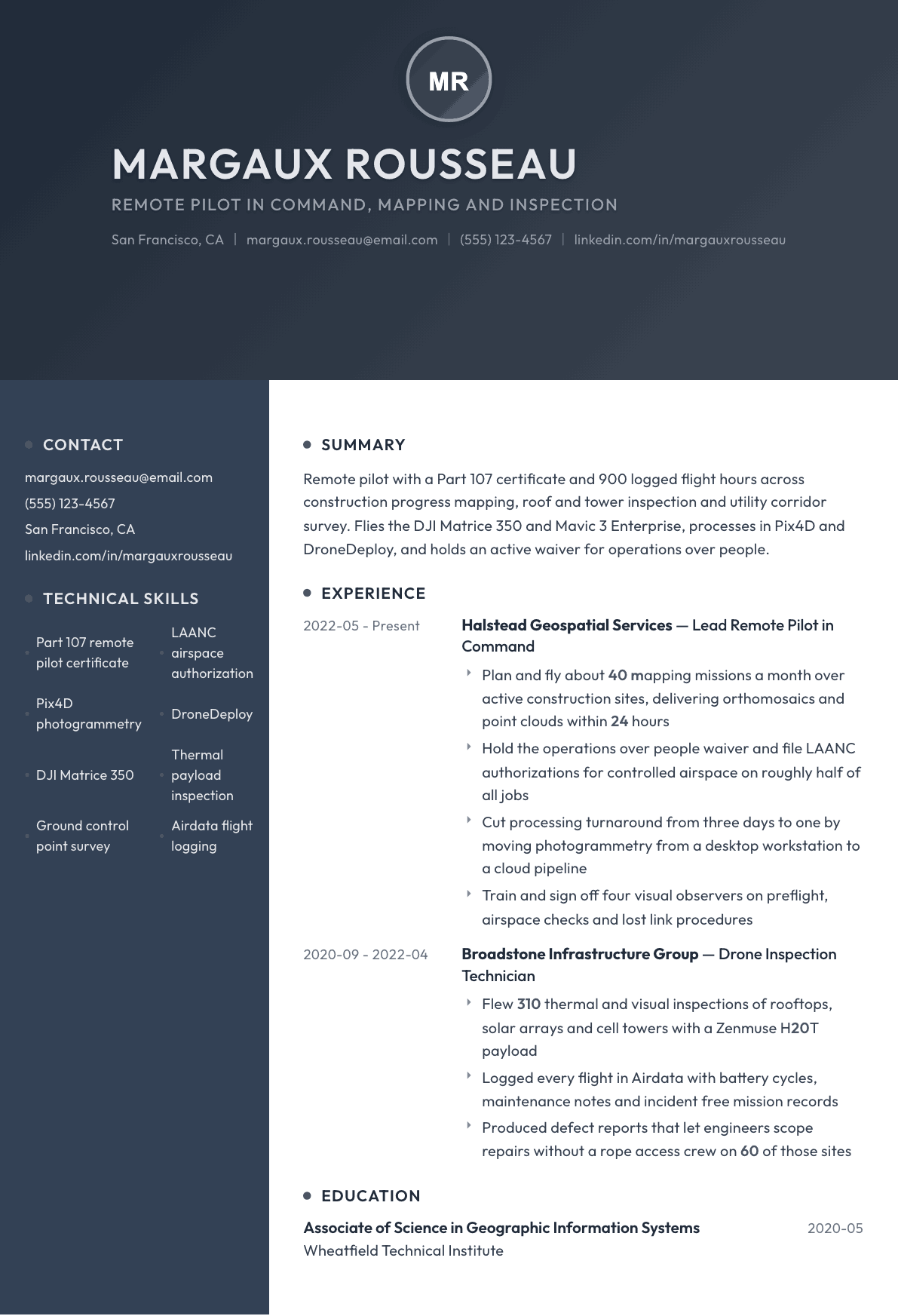
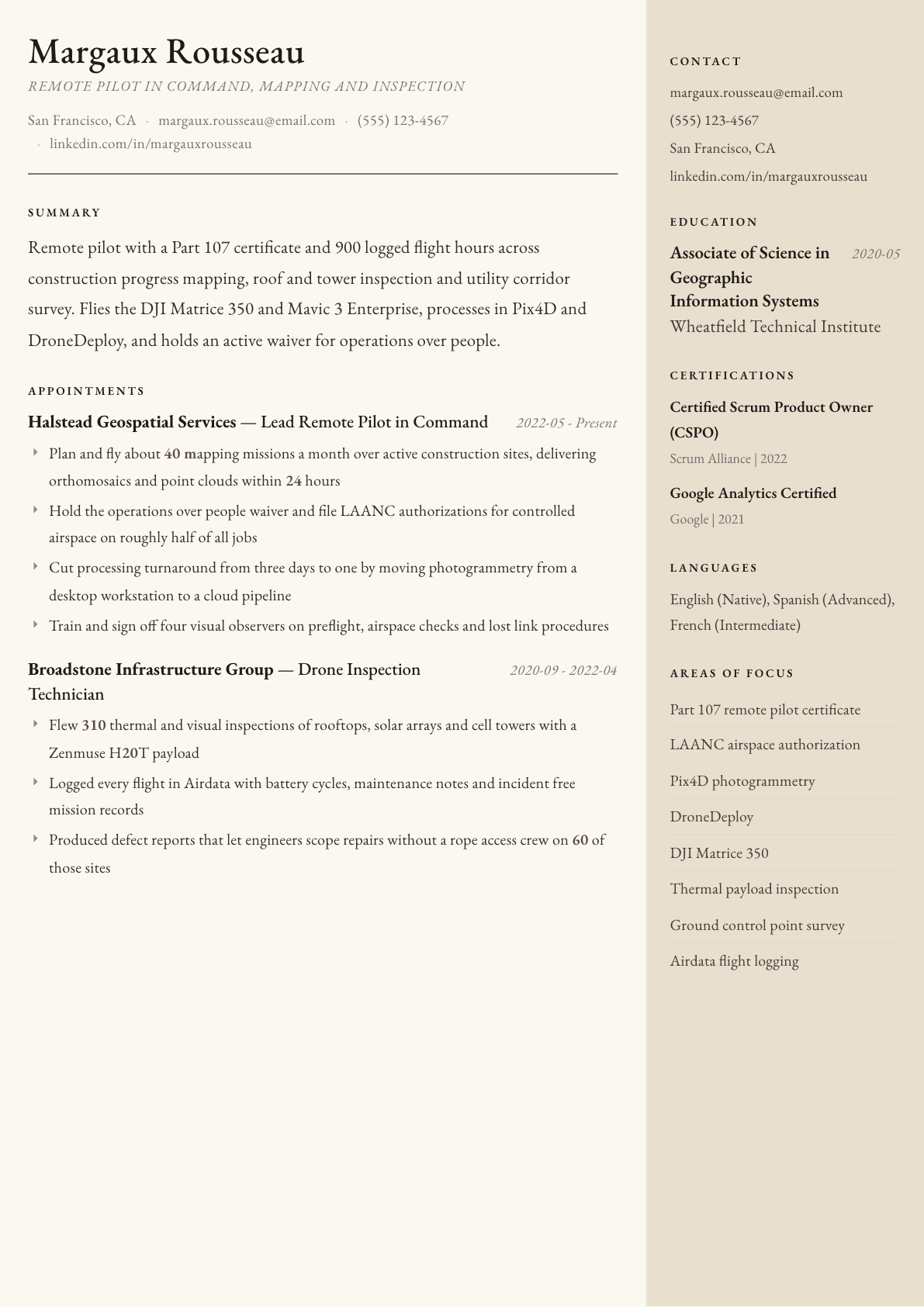
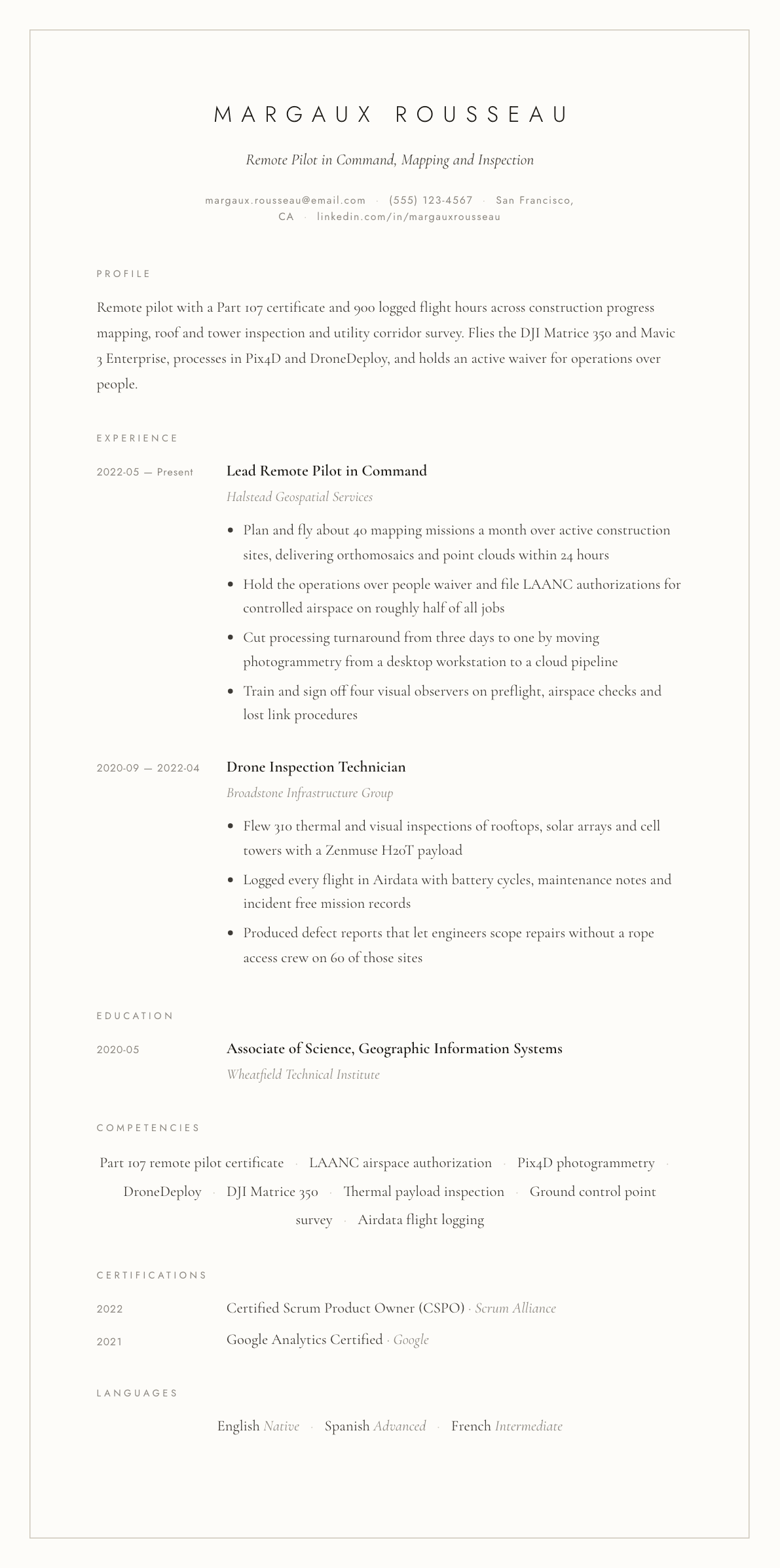
Example Drone Pilot summary
Remote pilot in command with a Part 107 certificate and 900 logged hours flying construction mapping, solar and tower inspection missions. Operates the DJI Matrice 350 and Mavic 3 Enterprise with thermal and RTK payloads, and processes deliverables in Pix4D and DroneDeploy. Holds an active operations over people waiver, files LAANC on controlled airspace jobs, and trains visual observers on lost link procedures.
Skills to list on a Drone Pilot resume
- Part 107 remote pilot certificate
- LAANC authorization
- Waiver and airspace research
- Photogrammetry mapping
- Lidar data capture
- Thermal and multispectral payloads
- Pix4D
- DroneDeploy
- Ground control point placement
- RTK and PPK workflows
- Preflight and lost link procedures
- Visual observer coordination
- Battery and airframe maintenance logging
- Volumetric stockpile measurement
What actually gets this resume read
- Lead with the Part 107 certificate number line, the issue date, and any active waiver such as operations over people.
- List the airframes and payloads you actually fly, because clients hire against a sensor and a resolution, not a brand.
- Show the deliverable in every bullet: orthomosaic, digital surface model, thermal report or volumetric measurement.
- Name the processing software and the accuracy you hold, including whether you set ground control points or fly RTK.
- Log hours in a tool such as Airdata and quote the number, since most clients ask for insured and documented hours.
- Add insurance coverage and any site safety cards, because construction and utility clients gate access on them.
How to write a drone pilot resume
Almost nobody hires a drone pilot to fly a drone. They hire someone to produce a deliverable that used to require a lift, a rope crew or a survey team: an orthomosaic a project manager can measure on, a thermal report an engineer can scope repairs from, a stockpile volume an accountant can sign off. The resumes that stall are the ones that describe the aircraft. The resumes that work describe the file that lands in the client folder afterward.
The second thing the reader checks is whether you can legally and safely be on their site. That means the remote pilot certificate, the airspace authorizations you can obtain, the waivers you hold, your insurance, and whether you keep a real flight log. Construction, utility and public safety clients gate access on paperwork long before they look at your imagery.
This guide covers the certificate and waiver block, how to write mission bullets that name the deliverable, which platforms and payloads to list, how to present processing and accuracy, and the questions that come up when a pilot moves from hobby flying into paid work.
Format: certificate block, then platforms, then missions
One page for most drone pilots, two only if you carry a long client list or a research background. Put the remote pilot certificate, the waivers and the insurance at the top, then a short platforms and payloads block, then experience, then software, then education.
Keep the layout single column and plain. Many of these jobs are posted by construction and utility firms that run resumes through a standard applicant tracking system, and a portfolio grid pasted into the document parses into nonsense.
- Header: name, location, phone, email, remote pilot certificate with issue date, and a link free note that a portfolio is available.
- Waivers and authorizations: operations over people, night operations if you hold a waiver rather than the standard rule, and your usual airspace authorization route.
- Insurance: coverage level in general terms and the fact that a certificate of insurance can be issued to a client on request.
Platforms, payloads and what they let you sell
List the airframes you actually fly and the payloads you fly on them, because a client is buying a sensor and a resolution rather than a brand. A pilot with a thermal payload sells roof and solar inspection. A pilot with a survey grade camera and a real time kinematic module sells mapping a surveyor can accept. Those are different businesses and the resume should say which one you are in.
Add the flight hours you have logged and the tool you log them in. Airdata and similar logging platforms produce a record of battery cycles, maintenance and incidents, and quoting a logged hour figure signals that you keep records a client auditor could read.
Experience: mission count, airspace, deliverable, turnaround
Every bullet should carry four things: how many missions, in what airspace, producing what deliverable, in what turnaround. A drone pilot who flies 40 mapping missions a month over active construction and delivers orthomosaics and point clouds inside a day has just told a project manager everything he needed to know.
Name the accuracy discipline. Say whether you set ground control points, fly real time kinematic or post process, and what horizontal and vertical accuracy you hold to. Say who checks the result. A mapping claim with no accuracy method behind it will not survive a conversation with a surveyor.
Show the safety and airspace side too: preflight checks, airspace research, lost link procedures, visual observer briefings, and how you handle a site with cranes, energized lines or public access. Clients with a safety department read that section closely.
- Mapping: area covered per flight, ground sample distance, control point method, processing software, deliverable format.
- Inspection: asset type, payload, defect reporting format, and what the flight replaced such as rope access or a lift.
- Public safety or media: response type, coordination with incident command, and any tactical or broadcast delivery requirement.
Software, processing and the parts clients pay for
Separate flight software from processing software. Flight planning and mission apps show you can fly a repeatable grid, but the processing stack is where the value sits. Name the photogrammetry package, the point cloud tools, the geographic information system you export to, and the client platform you publish into.
If you have moved processing to a faster pipeline, say so with the before and after turnaround. Clients care about the day the deliverable arrives more than about the software that produced it, and a turnaround improvement is the easiest business result a drone pilot can prove.
Keywords and the credibility line
Postings for this work reuse a short list of terms: remote pilot in command, Part 107, airspace authorization, waiver, orthomosaic, digital surface model, point cloud, ground control point, thermal inspection, volumetric measurement, visual observer. Place each once where it is honestly earned.
Then add the credibility line that separates a paid pilot from a hobbyist: logged hours, insurance, a written standard operating procedure, and a maintenance log for the airframes. Those four items are what a procurement officer verifies before a purchase order is issued.
Drone Pilot resume summary examples
Newly certificated
Remote pilot with a Part 107 certificate earned in 2025 and 120 logged flight hours on the DJI Mavic 3 Enterprise, producing site progress photography and basic orthomosaics in DroneDeploy. Comfortable filing airspace authorizations, running preflight checks and briefing a visual observer before every mission.
Mapping and inspection pilot
Remote pilot in command with 900 logged hours across construction mapping, solar and tower inspection. Flies the DJI Matrice 350 with thermal and real time kinematic payloads and processes in Pix4D. Holds an active operations over people waiver and delivers orthomosaics and point clouds within one day.
Program lead
Drone program lead with 2,600 logged hours who built an in house unmanned aircraft unit from a single airframe to a five pilot team. Owns the standard operating procedure, the training and sign off pathway, the maintenance log and the airspace waiver portfolio for work across four states.
Work experience bullets: before and after
Before: Flew drone missions for construction clients.
After: Planned and flew about 40 mapping missions a month over active construction sites, delivering orthomosaics and point clouds to the project team within 24 hours of the flight.
Mission volume, site type, deliverable and turnaround describe a service a client can buy rather than a hobby.
Before: Familiar with airspace rules and authorizations.
After: Filed airspace authorizations for roughly half of all jobs and held the operations over people waiver that let the crew fly active sites without clearing the ground below.
Saying what the waiver made possible converts a compliance line into commercial capability.
Before: Used photogrammetry software to process images.
After: Moved photogrammetry from a desktop workstation to a cloud pipeline, cutting deliverable turnaround from three days to one across the whole client list.
A before and after turnaround is the clearest business outcome a mapping pilot can show.
Before: Performed inspections of roofs and towers.
After: Flew 310 thermal and visual inspections of rooftops, solar arrays and cell towers with a combined thermal and zoom payload, producing defect reports engineers scoped repairs from.
The inspection count, the payload and the downstream use prove the imagery was actually acted on.
Before: Trained other team members.
After: Trained and signed off four visual observers on preflight sequence, airspace checks, lost link procedure and how to call a hazard on an open radio channel.
Listing the training content shows a documented pathway rather than an afternoon of showing someone the controller.
Hard skills
- Part 107 remote pilot operations
- Airspace authorization and waiver research
- Photogrammetry mission planning
- Ground control point placement
- Real time kinematic and post processed workflows
- Thermal and multispectral payload operation
- Lidar data capture
- Pix4D and DroneDeploy processing
- Point cloud and digital surface model export
- Volumetric stockpile measurement
- Airframe maintenance and battery cycle logging
- Lost link and emergency procedures
Soft skills
- Client briefing before a site visit
- Visual observer coordination
- Written defect reporting
- Site safety awareness
- Scheduling around weather windows
- Explaining data to non technical stakeholders
Certifications worth listing
- Remote Pilot Certificate with Small UAS Rating (Part 107) (Federal Aviation Administration)
- Certified Thermographer Level I (Infrared Training Center)
- OSHA 10-Hour Construction Safety (Occupational Safety and Health Administration)
Mistakes that cost drone pilot candidates the interview
- Describing the aircraft instead of the deliverable, which leaves a project manager unsure what he would be buying.
- Claiming survey accuracy without naming ground control, real time kinematic or a post processing method.
- Leaving out insurance, when a certificate of insurance is the first thing a client site office asks for.
- Quoting flight hours with no logging tool behind them, so the figure cannot be verified during onboarding.
- Listing consumer camera drones for jobs that require an enterprise airframe and a specific payload.
- Skipping the standard operating procedure and maintenance log, which are what separate a business from a side interest.
- Pasting a portfolio grid into the resume file, which parses badly and pushes the certificate block off the page.
Drone Pilot resume questions
Do I need the Part 107 certificate before applying for drone work?
Yes for any paid or commercial flight in the United States. Put the certificate and its issue date at the top of the resume, because a hiring manager cannot legally put you on a job site without it and will filter on that line first.
How do I show flight hours if nobody asked me to log them?
Start logging now in a platform that records flights, battery cycles and maintenance, then import what you can reconstruct from mission records and media timestamps. Quote only the figure your log supports, since clients with audit requirements will ask to see it.
What belongs in a drone pilot portfolio versus the resume?
The resume carries the certificate, waivers, platforms, mission counts and deliverable types. The portfolio carries the actual imagery, maps and reports. Mention that a portfolio exists and bring it to the interview rather than embedding images in the document.
How do I move from photography work into mapping or inspection?
Learn a processing package, fly practice grids with ground control on a site you can access legally, and produce a real orthomosaic with a stated accuracy. Then write the resume around that deliverable, and add a thermography or safety credential to make the transition credible.
Should I list waivers I applied for but did not receive?
No. List only active authorizations and waivers with what they permit. You can say separately that you routinely file airspace authorizations and understand the waiver application process, which shows capability without claiming permission you do not hold.
Related resume examples
- Commercial Pilot Resume example
- Pilot Resume example
- Aircraft Mechanic Resume example
- Logistics Coordinator Resume example
- Flight Instructor Resume example
- Airline Pilot Resume example