Internship Applicant Resume Examples: what gets the call
Write an Internship Applicant Resume the Campus Recruiter Scores Well
By Mustafa Tarabya, founder of CVBooster · Published · Updated
Internship applicant resume example with coursework, projects and a keyword list, plus a guide to cohort deadlines and recruiter rubrics.
Sample resumes for a internship applicant
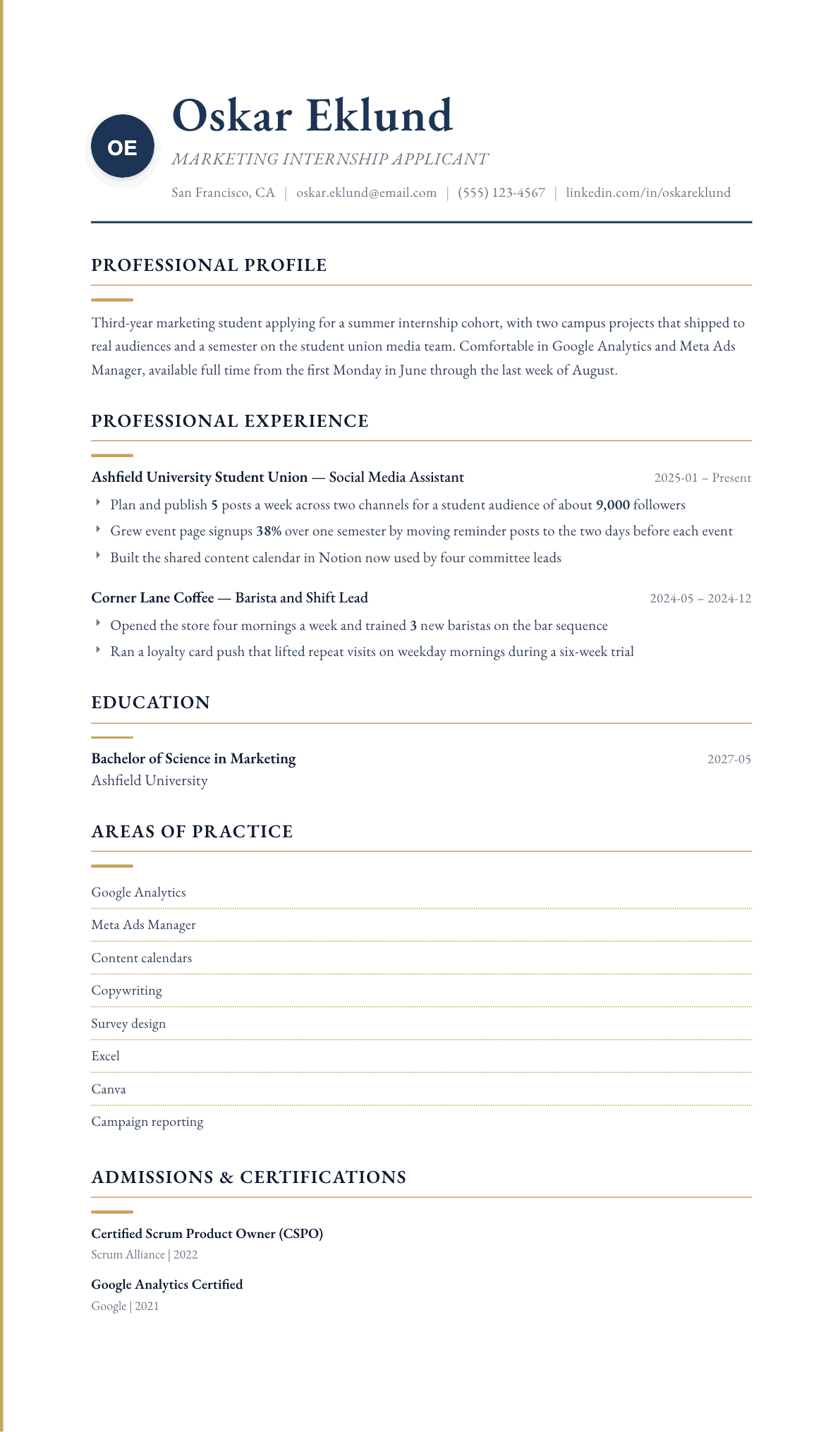
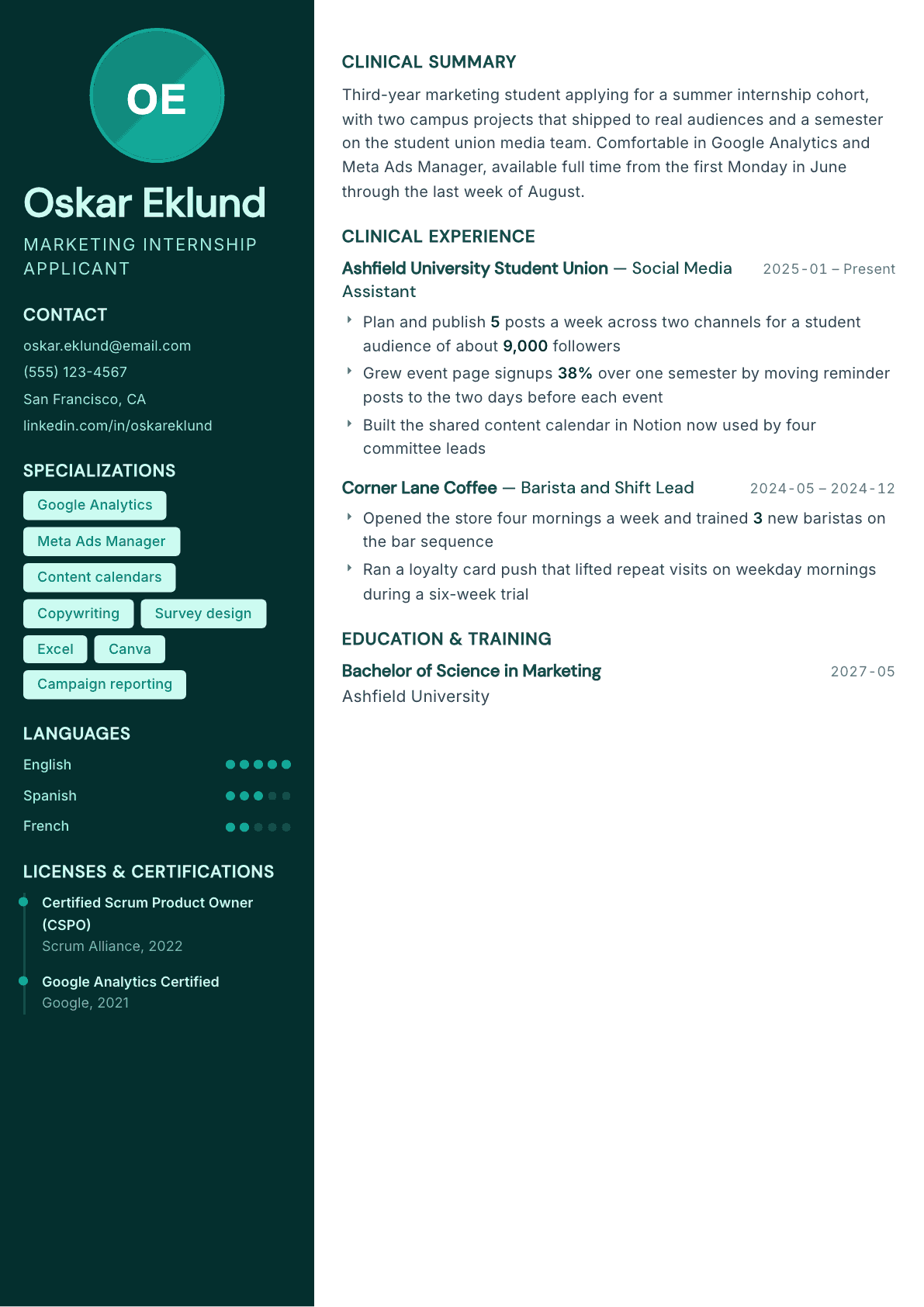
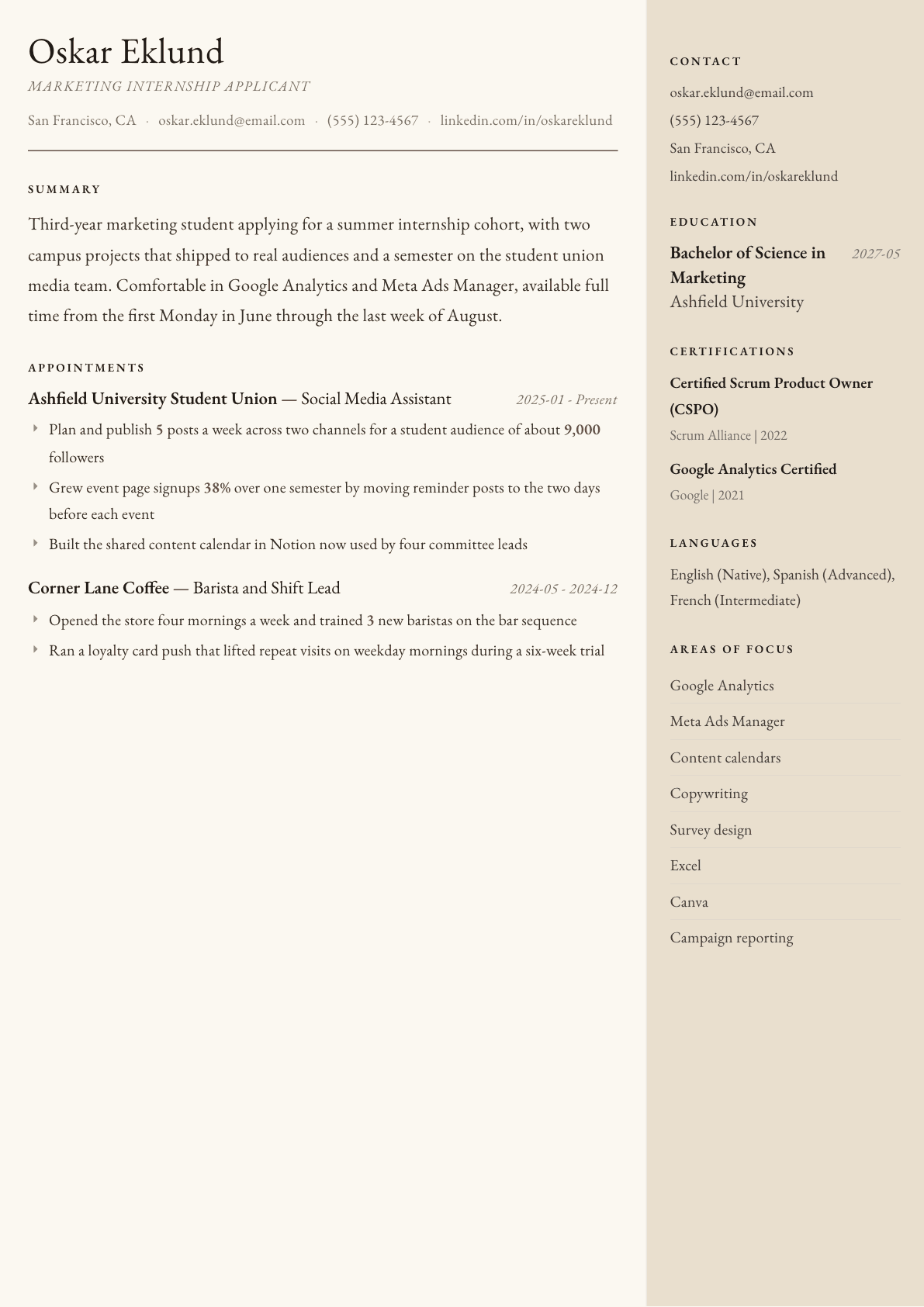
The same internship applicant content laid out in three CVBooster templates, so you can see what the finished document looks like before you write a word.
Example Internship Applicant summary
Third-year marketing student applying for a summer internship cohort, free full time from the first Monday in June through late August. Runs a two-channel campus account for a student audience, built the content calendar four committee leads now use, and grew event signups over a single semester. Works fluently in Google Analytics, Meta Ads Manager and Excel, and can relocate for the season.
Skills to list on a Internship Applicant resume
- Relevant coursework selection
- Class project write-ups
- Campus leadership roles
- Google Analytics
- Excel and spreadsheets
- Presentation and pitch decks
- Survey and research basics
- Data cleaning
- Written communication
- Team project coordination
- Deadline management
- Portfolio and work samples
- Interview case preparation
What actually gets this resume read
- State your graduation month and the exact internship window you are free, because cohorts run on fixed dates.
- Put relevant coursework only if the course names match the posting, and drop the introductory ones.
- Give every class project an outcome and an audience, not just the assignment title and the tools used.
- Name the software you can open on day one, since an internship is too short to train you from zero.
- List campus roles as real jobs with hours and results, because a recruiter counts them as work experience.
- Say whether you need housing or can relocate, which decides whether some site teams can take you at all.
How to write a internship applicant resume
An internship application is scored, not read. Large employers run their summer cohorts through a rubric: graduation year within the eligible band, major on the approved list, minimum grade threshold, one or two technical requirements, then a short human pass on projects and campus involvement. A campus recruiter may look at several hundred resumes in a week, and she is deciding in seconds whether you clear the gate.
That has two consequences. The eligibility facts have to be findable instantly, at the top, in the same words the posting uses. And the part a human actually judges, your projects, has to show something you built or measured rather than a course you sat through. Every internship applicant has taken the class. Almost none of them describe what came out of it.
This guide covers the header facts a rubric checks, how to write coursework and class projects so they read as work, what campus roles are worth, and the timing questions every internship applicant gets wrong at least once.
Format: education on top, one page, the eligibility facts visible
For an internship the education section goes above experience, which is the opposite of every other resume you will write. The recruiter is checking your school, your major, your expected graduation month and your grade point average before anything else, and those four facts should sit in the first block on the page.
One page, no exceptions, and no photograph. Use the section order the rubric follows: education, then projects or experience depending on which is stronger, then skills, then involvement. Leave out a summary statement unless you are applying across fields and need one line to say which internship you want.
- Expected graduation month and year, because eligibility bands are written in graduation years.
- Grade point average when it clears the threshold in the posting, on the scale your school uses.
- The internship window you are free, stated as start and end weeks rather than as a summer.
- A note on relocation or housing, since some site teams cannot host an intern who cannot move.
Coursework: name only the courses that answer the posting
A relevant coursework line is worth including when the course titles match the technical requirements in the posting, and worthless when it lists everything you have taken. Three or four upper-level course names that map onto the skills the team needs will do more than a block of twelve that includes introductory requirements everyone in your year completed.
Better still, attach a deliverable to the course rather than the course to a list. Econometrics matters much less than the regression you ran on real housing data for that econometrics class and what the result implied. Course titles show enrollment, outputs show ability, and a recruiter has learned to trust only the second.
Projects: the section that actually gets you the interview
Give each project four things: what problem it addressed, what you personally built, the tools you used, and what happened when someone tried it. Team size belongs there too, because a recruiter wants to know whether you owned a piece or watched a group.
The word that separates a strong project from a weak one is used. A dashboard three committee leads now open every week, a script that replaced a workbook someone maintained by hand, an app tested with a hundred classmates for three weeks: these are outcomes. A course project with a grade attached and no user is a course project, and the interviewer will treat it that way.
Include a link line for work that can be looked at, and make sure it opens without a login. Recruiters click these more often for internships than for full-time roles, precisely because there is so little work history to judge instead.
- One line stating the problem, in plain language a recruiter outside your major will follow.
- Your specific contribution, separate from what the group produced.
- The stack or method by name, matching the words in the posting where they overlap.
- What the outcome was: a measurement, a user count, a decision it changed.
Campus roles, part-time work and what counts as experience
Treat a campus role as a job. Running a student union media account, sitting as treasurer of a society, working the help desk in the library or leading orientation week all involve deadlines, budgets, other people and results. Write them with hours per week and an outcome, and a recruiter will count them as experience because they are.
Unrelated paid work deserves a place too, and applicants cut it far too readily. A recruiter reading a barista job that mentions opening a store alone and training three new staff sees someone who has been trusted with responsibility by an employer. That is a signal she cannot get from any class project.
What she is looking for across the whole page is evidence of initiative outside a syllabus. Something you started, ran, fixed or handed over. That is the trait an internship rubric cannot measure directly and the human pass is trying to find.
Timing, tailoring and the words the posting uses
Internship recruiting runs a year ahead of itself. Summer cohorts at large employers open in early autumn and interview through the winter, with offers landing long before spring. A resume finished in March is competing for whatever is left. Have a version ready before the first career fair of the academic year.
Tailor by reordering, not by rewriting. Keep one master file with every project and role, then for each posting move the two most relevant items to the top and mirror the technical vocabulary exactly: the language, the framework, the analysis package, the certification. Applicant tracking filters match strings, and a synonym is a miss.
Internship Applicant resume summary examples
First-year applicant
First-year business student applying for an early insight internship, free full time from June through mid August. Runs the treasury for a 60-member society, built its first budget tracker in Excel, and completed a data fundamentals certificate. Comfortable presenting to a committee and available to relocate for the season.
Third-year applicant
Third-year marketing student applying for a summer internship cohort, free from the first Monday in June through late August. Runs a two-channel campus account, built the content calendar four committee leads now use, and grew event signups over one semester. Works in Google Analytics, Meta Ads Manager and Excel.
Returning intern seeking a second placement
Penultimate-year student returning for a second internship after a summer on a corporate analytics team, where a reporting script replaced a manual weekly workbook. Graduating the following May, free from late May through August, and targeting a placement that converts to a full-time offer. Fluent in SQL and Python.
Work experience bullets: before and after
Before: Completed a group project for a marketing class.
After: Led a 4-person class project that surveyed 210 students on campus dining, and presented three menu recommendations the dining director adopted for the following term.
A team size, a sample and an adopted recommendation make it a piece of work rather than an assignment.
Before: Member of the student union media team.
After: Plan and publish 5 posts a week across two channels for a student audience of about 9,000 followers, and built the shared content calendar now used by four committee leads.
Frequency, audience and a tool other people adopted show ownership instead of membership.
Before: Familiar with Google Analytics.
After: Used Google Analytics to trace a 38% rise in event signups to reminder posts published two days before each event, then moved the whole calendar to that timing.
It replaces a claim of familiarity with a decision you made using the tool.
Before: Worked as a barista during the school year.
After: Opened the store four mornings a week around a full course load and trained 3 new baristas on the bar sequence within my first six months.
Opening alone and training others are trust signals no class project can provide.
Before: Good with Excel and data.
After: Cleaned and merged three semesters of society membership records in Excel, cutting duplicate entries by 240 before the annual budget submission.
A concrete cleanup with a count is checkable, where being good with data is not.
Hard skills
- Relevant coursework selection
- Class project documentation
- Excel and spreadsheet modeling
- Google Analytics
- SQL basics
- Survey design and analysis
- Presentation and pitch decks
- Data cleaning
- Portfolio and work samples
- Applicant tracking keyword matching
- Case interview preparation
- Budget tracking for student groups
Soft skills
- Initiative outside the syllabus
- Working to a cohort deadline
- Explaining technical work to a non-specialist
- Team project coordination
- Asking for feedback and using it
- Networking at career fairs
Certifications worth listing
- Microsoft Office Specialist: Excel Associate (Microsoft)
- Google Data Analytics Certificate (Google)
Mistakes that cost internship applicant candidates the interview
- Burying the expected graduation month, which is the first field an eligibility rubric checks and the fastest way to be filtered out.
- Listing twelve course titles including introductory requirements every student in the year completed.
- Describing projects by their assignment brief instead of by what was built and who used it.
- Cutting unrelated paid work, which removes the only proof that an employer has already trusted you.
- Applying in spring for summer cohorts that opened in autumn and closed before the winter break.
- Rewriting the resume from scratch for each posting instead of reordering a master file and matching its vocabulary.
- Adding a portfolio link that requires a login, so the recruiter who clicks it sees a permission screen.
Internship Applicant resume questions
Should I put my grade point average on an internship resume?
Include it when it meets or beats the threshold the posting names, and leave it off when it does not. Some employers screen on it mechanically, so omitting a strong score costs you. A low score is better addressed by a strong project section than by an explanation.
What goes first when I have no internship experience yet?
Education, then projects. Projects are where an applicant with no work history competes on equal terms, provided each one names what you built, the tools you used and what happened when a real person tried it. Campus roles and paid work follow after.
How early do internship applications actually open?
Many large employers open summer cohorts around the start of the academic year and finish interviewing well before spring. Smaller companies and public agencies recruit closer to the season. Track both calendars, because they reward completely different application timing.
Can I apply for an internship in a field I have not studied?
Often yes, if you can show applied evidence rather than an interest. A finance internship will consider a history major who has run a society budget and completed a modeling course. Lead with the work, name the target internship in one line, and let the projects argue for you.
Is a cover letter needed for an internship application?
Include one whenever the form allows it, and keep it under a page. Use it to say which internship, why that team specifically, and what you would bring in the first month. Recruiters use cover letters as a tiebreaker between candidates whose rubric scores match.