Restaurant Manager Resume Examples: the lines they read
Build a Restaurant Manager Resume That Serves Up Results
By Mustafa Tarabya, founder of CVBooster · Published · Updated
A restaurant manager resume example plus restaurant resume samples for hosts, line cooks, servers and bartenders, with sales, labor and food safety bullets.
Sample resumes for a restaurant manager
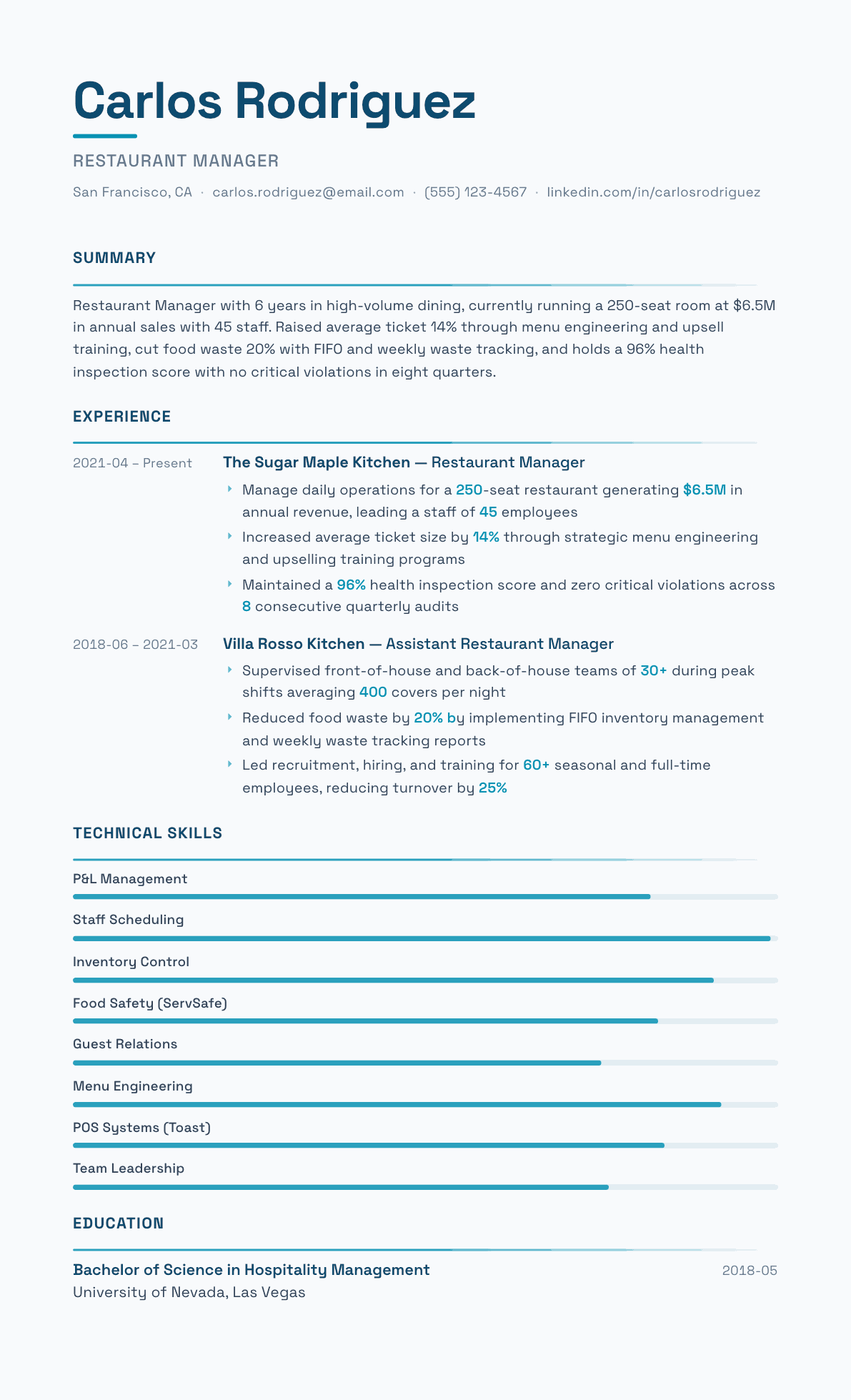
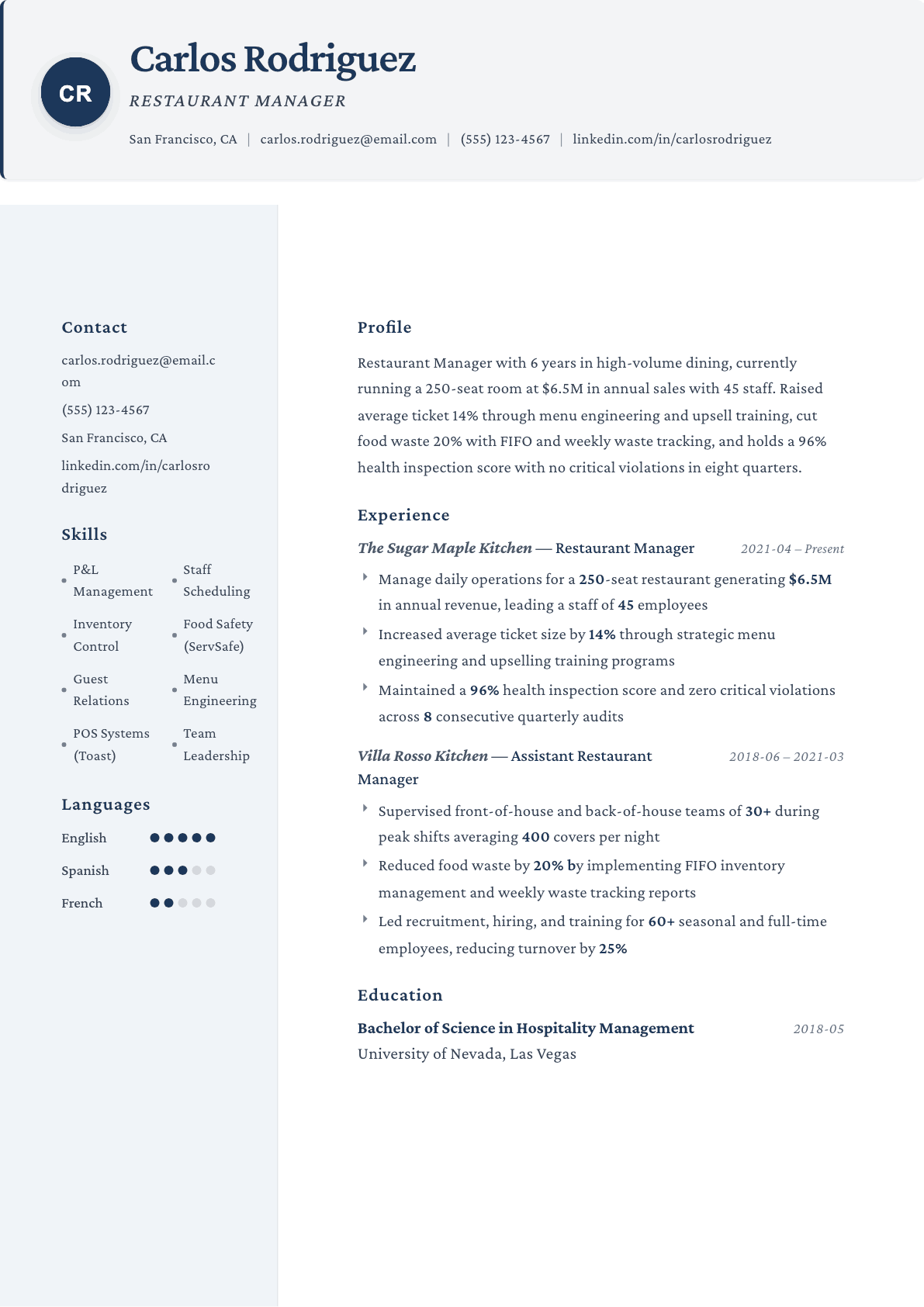
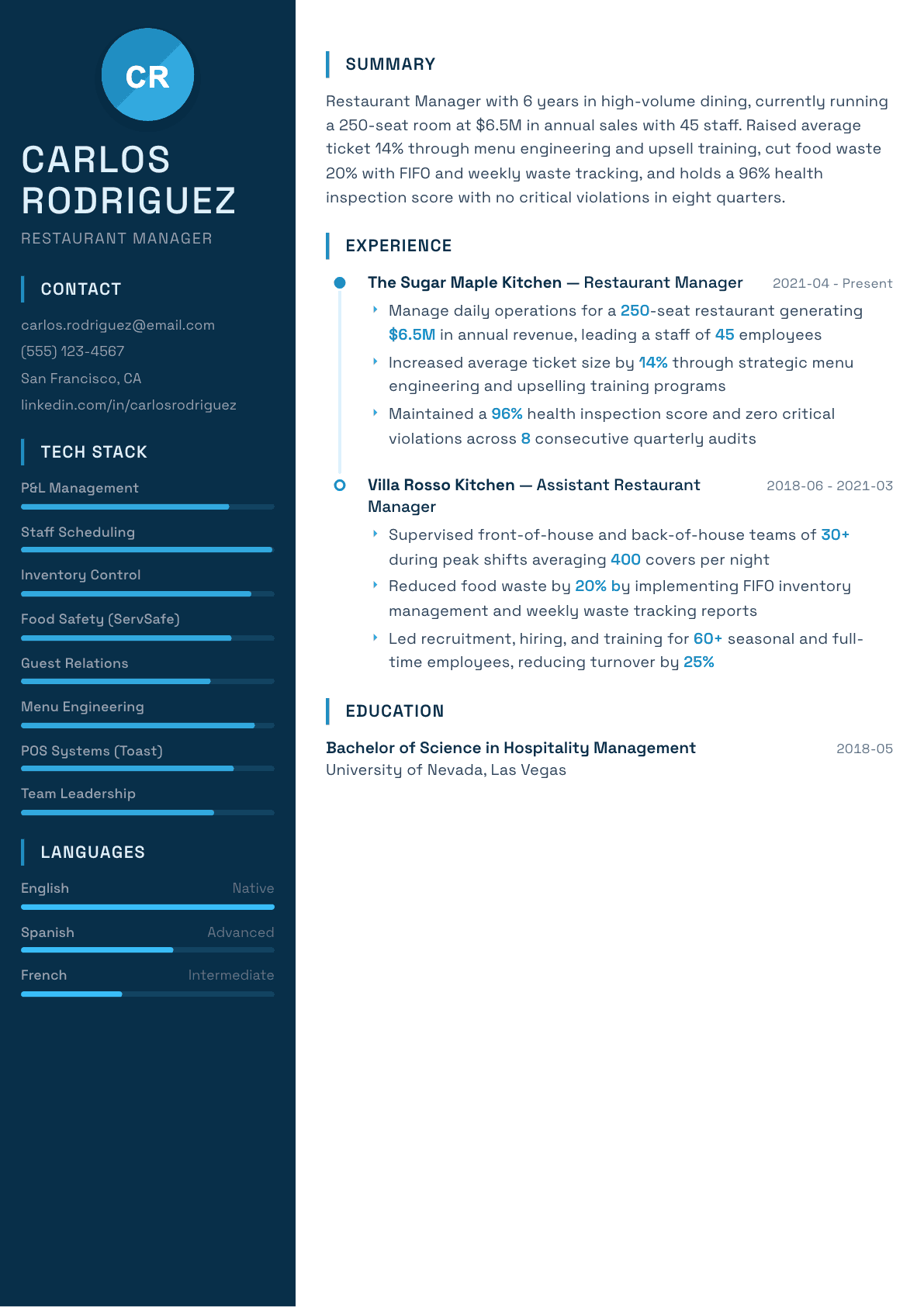
The same restaurant manager content laid out in three CVBooster templates, so you can see what the finished document looks like before you write a word.
Example Restaurant Manager summary
Restaurant manager, 6 years, 250 seats, $6.5M in annual sales and 45 employees, with full P&L including food and labor cost. ServSafe certified, average ticket up 14% on menu engineering, turnover down 25% after rebuilding hiring and training, and eight straight audits with no critical violations.
Skills to list on a Restaurant Manager resume
- P&L Management
- Staff Scheduling & Labor Optimization
- Inventory Control & FIFO
- Food Safety (ServSafe)
- Guest Relations
- Menu Engineering
- POS Systems (Toast / Square)
- Team Leadership
- Recruitment & Training
- Health & Safety Compliance
- Vendor Negotiations
- Cost Control
What actually gets this resume read
- Quantify revenue and cost metrics: annual sales, food cost percentages, labor cost ratios, or average ticket size improvements.
- Highlight food safety certifications prominently: ServSafe Manager, alcohol service permits, or HACCP training.
- Showcase team management with numbers: staff size, turnover reduction, or employees trained and promoted.
- Include P&L responsibility with dollar amounts to demonstrate business acumen beyond day-to-day operations.
- Mention guest satisfaction metrics: Google/Yelp ratings, mystery shopper scores, or NPS improvements.
- Describe your experience with restaurant technology: POS systems (Toast, Square, Aloha), reservation platforms (OpenTable), or scheduling tools (7shifts, HotSchedules).
How to write a restaurant manager resume
A restaurant manager resume lands on the desk of an owner, a director of operations or a multi-unit franchisee who is usually hiring because a store is bleeding: labor is over, turnover is high, the reviews slipped, or the last manager left in the middle of a season. They are scanning for evidence that you have fixed that exact problem somewhere else.
The resume that gets called back describes the restaurant before it describes the manager. Concept and service style, seat count, average covers, day parts, alcohol program, annual sales volume band, team size across front and back of house, and whether the unit is corporate, franchised or independent. A 90-seat neighborhood bistro, a high-volume casual chain unit and a hotel outlet are three different jobs, and the reader has to know which one you have run.
What follows is the section order operators expect, how to write bullets around cost lines and guest metrics, the numbers a director of operations checks, three summaries for different stages, and the mistakes that make an experienced manager look like an assistant. If a hotel group or an international operator asks for a curriculum vitae instead, the restaurant manager CV uses the same sections, with fuller detail under each unit and room for a second page.
Restaurant resume examples for every job in the building
If you came for a restaurant resume example and you are not the manager, the rule is the same at every station: name the concept, the volume and the part of the shift you owned. A host, a line cook and a manager are judged on different numbers, so the summary lines below are written for each one.
Host: Host at a 180 seat casual dining restaurant, seating 400 to 500 guests on Friday and Saturday nights, running the waitlist and reservations, and balancing sections across eight servers.
Line cook: Line cook with three years on the grill and saute stations of a scratch kitchen doing 300 covers a night. Food handler certified, holds ticket times through the rush and preps to par from the station list.
Server: Server with four years in casual and upscale dining, carrying a five table section and selling wine by the glass and desserts on every table. Alcohol server certified.
Bartender: Bartender at a 120 seat restaurant bar, mixing the full cocktail list to spec, checking ID on every order and balancing the cash drawer at close.
Manager: General manager of a 160 seat full service restaurant with multimillion dollar annual sales and 55 staff. Holds food and labor cost to budget, trains every new manager on the opening and closing checklists, and passed every health inspection on the first visit. ServSafe Manager certified.
Whatever the job, a restaurant resume carries the same five things, listed below.
- The concept and seat count of every restaurant you list.
- Your volume: covers, tables, tickets or sales per shift.
- The station, section or shift you owned.
- Food handler, alcohol server or food protection manager certification.
- The POS and reservation systems you used.
Format: one page, unit profile under every title
One page unless you have run multiple units or held a district role. Reverse chronological, simple layout, no columns. Restaurant groups and franchisees run applications through hiring platforms that parse plain text well and decorative templates badly.
Under each title, write the unit profile: concept, service style, seat count, covers on an average and a peak night, sales volume band, day parts served, liquor license status, and team size split between front of house and kitchen. Then the bullets.
- Header: name, city and state, phone, email, and food safety certification if it is current.
- Order: summary, restaurant experience with unit profiles, systems and certifications, education.
- A manager moving from assistant to general manager should name the shifts and functions they already ran alone: opening, closing, ordering, scheduling, cash.
Summary: concept, volume, and the line you control best
Three lines that answer what kind of restaurant, how big, and what you are good at. Pick the strength that matches the posting: cost control, service scores, hiring and retention, opening new units, or turning around a failing store. An operator hiring for a turnaround does not care that you like people.
If you are changing segments, name the transferable part. A casual dining manager moving to fine dining should point at wine service, reservations and check average work rather than assuming the reader will make the leap.
Experience: run the profit and loss on paper
The first bullet under each management title should be the money bullet. Sales volume, food cost, beverage cost, labor cost against target, controllable profit, and how each moved while you held the store. An operator reads those lines the way a hospital reads a license.
Then service and volume. Covers per shift, peak turns, check average and how you moved it through menu engineering or server training, wait times and table turn time, off premise and delivery mix, and catering or private events if the unit did them. Attach the tool you used, because the mechanism is what transfers.
Then people, because staffing is the reason most of these jobs open. Hiring volume, onboarding, hourly turnover and the movement you achieved, managers you developed, scheduling to a forecast, and overtime control. Add health and safety: inspection scores, critical violations, alcohol service compliance and incident handling.
Systems, food safety and compliance
Name the technology by product. Point of sale platforms, scheduling and labor tools, inventory and recipe costing systems, reservation and waitlist platforms, delivery aggregator dashboards, and the reporting suite you pulled the numbers from. These are literal keyword matches in most restaurant hiring platforms.
Food safety belongs high on the page. A current food protection manager certification, alcohol service training, and hazard analysis experience are hard requirements at most groups, and health inspection results are a legitimate achievement worth quoting.
- Point of sale and back office: Toast, Square, Aloha, Micros, and the reporting tools attached to them.
- Labor and inventory: scheduling platforms, inventory counts and variance reports, recipe costing and par ordering.
- Compliance: food protection manager certification, alcohol service training, allergen procedures, temperature and cooling logs.
The numbers a director of operations checks
Quote lines from the profit and loss statement, the guest feedback tools and the labor system. Say the target you were held to, not just the result, because a food cost figure without a target is unreadable to somebody in a different concept.
- Sales against budget and prior year, check average, and same-store sales movement.
- Food and beverage cost against theoretical, inventory variance, and waste.
- Labor cost as a share of sales, hours per guest, and overtime.
- Guest metrics: review platform ratings, mystery shopper scores, complaint rates and comment card themes.
- Health inspection score, critical violations, and any alcohol compliance checks passed.
- Hourly and management turnover, time to fill, and internal promotions.
Restaurant Manager resume summary examples
Assistant manager
Assistant restaurant manager with three years at a 180-seat casual dining unit, running opening and closing shifts alone, placing produce and dairy orders, and building the weekly server schedule against the forecast. Certified food protection manager who held a 98% health inspection score across four consecutive audits.
General manager, single unit
Restaurant general manager for a 250-seat unit averaging 400 covers a night with a full bar and a staff of 45. Holds food cost within a point of theoretical, cut hourly turnover by 25% through a restructured onboarding, and raised check average by 14% with menu engineering and upsell training.
Multi-unit operator
Multi-unit manager for four restaurants with combined weekly sales above budget for eight straight periods, developing six general managers and opening two new locations. Owns hiring, cost lines and guest scores across the group, and rebuilt one failing unit to positive controllable profit within two quarters.
Work experience bullets: before and after
Before: Managed daily restaurant operations and staff.
After: Ran a 250-seat unit with a full bar and 45 employees across front and back of house, covering scheduling, ordering, cash handling and the weekly profit and loss review with the owner.
The unit size, team split and the specific functions show the scope of the job rather than repeating the title.
Before: Reduced food costs.
After: Brought food cost from 33% to 28.5% against a 29% target by moving to weekly counts, rebuilding par levels from actual usage and holding a daily line check on portioning.
A starting point, a target and the three habits behind the change give an operator something to trust.
Before: Hired and trained staff.
After: Hired and onboarded 60 hourly employees across two seasons with a structured four-shift training path, cutting 90-day hourly turnover by 25% and filling three shift lead roles internally.
Volume, method and a retention outcome are what a director of operations is actually screening for.
Before: Kept the restaurant clean and passed health inspections.
After: Held a 96% average health inspection score with zero critical violations across eight quarterly audits, running daily temperature logs, a cooling procedure check and a monthly self-audit against the county checklist.
The score, the streak and the routines behind it turn a baseline expectation into a management record.
Before: Improved customer satisfaction and online reviews.
After: Lifted the unit rating on the two main review platforms from 3.8 to 4.5 over a year by responding to every review within 48 hours and retraining the service sequence around table touch points.
The movement, the timeframe and the two concrete practices make the improvement checkable.
Hard skills
- Profit and loss management
- Food and beverage cost control
- Inventory counts and variance analysis
- Labor scheduling to forecast
- Menu engineering and pricing
- Point of sale administration
- Vendor ordering and negotiation
- Food safety and HACCP procedures
- Alcohol service compliance
- Catering and private events
- Off premise and delivery channel management
- Recruiting and onboarding hourly staff
Soft skills
- Shift leadership under volume
- Guest recovery at the table
- Coaching servers and line cooks
- Conflict resolution between front and back of house
- Calm decision making during rushes
- Holding standards without losing the team
Certifications worth listing
- ServSafe Food Protection Manager (National Restaurant Association)
- ServSafe Alcohol (National Restaurant Association)
- Foodservice Management Professional (FMP) (National Restaurant Association)
- TIPS Alcohol Server and Manager Training (Health Communications, Inc.)
Mistakes that cost restaurant manager candidates the interview
- Describing the job instead of the store. Managed operations and led a team could belong to anyone with the title.
- Leaving out seat count, covers and sales volume, so the operator cannot size the units you have run.
- Avoiding cost lines. A restaurant manager who never mentions food cost or labor cost reads as a shift supervisor.
- Quoting a cost figure with no target attached, which is meaningless across concepts with different margins.
- Omitting the point of sale and scheduling systems, which are direct keyword matches in restaurant hiring platforms.
- Hiding turnover work when staffing is the reason most of these positions are open in the first place.
Restaurant Manager resume questions
How do I write a restaurant manager resume for a fine dining job with casual dining experience?
Name the move in the summary and lead your bullets with the closest work: check average growth, wine and cocktail program involvement, reservations and pacing, service sequence training, and any private dining or tasting menu experience. Then keep the cost control record, which transfers directly.
Should I put sales volume on my resume?
Yes, in a band if the exact figure is confidential. Annual or weekly volume is how operators compare units, and a manager who ran a high volume store gets read differently from one who ran a small independent, even when the job titles look the same.
What should a restaurant resume include?
The concept and seat count of every restaurant you worked in, the volume you handled, the station or section you owned, your food handler or alcohol server certification, and the POS system. The restaurant resume examples above give the summary line for a host, line cook, server, bartender and manager.
Is a food safety certification required on the resume?
Almost always. A current food protection manager certification is a legal or company requirement in most jurisdictions and concepts, so list it with the issuing body and keep it visible near the top rather than at the very bottom of the page.
How do I explain leaving several restaurants in a short time?
Restaurant tenure is short and operators know it, so give each unit a reason in one clause where it is honest: a closure, a concept change, an ownership sale, a seasonal operation. Then let the cost and guest results carry the rest of the page.
Related resume examples
- Store Manager Resume example
- Operations Manager Resume example
- Customer Service Resume example
- Food and Beverage Manager Resume example
- Food & Beverage Director Resume example
- Cafe Manager Resume example