Cafe Manager Resume Examples: free ATS score and gap list
Build a Cafe Manager Resume That Shows Real Shift Command
By Mustafa Tarabya, founder of CVBooster · Published · Updated
A cafe manager resume example with keywords, sample bullets, and advice on proving drink quality, waste control and morning rush throughput.
Sample resumes for a cafe manager
The same cafe manager content laid out in three CVBooster templates, so you can see what the finished document looks like before you write a word.
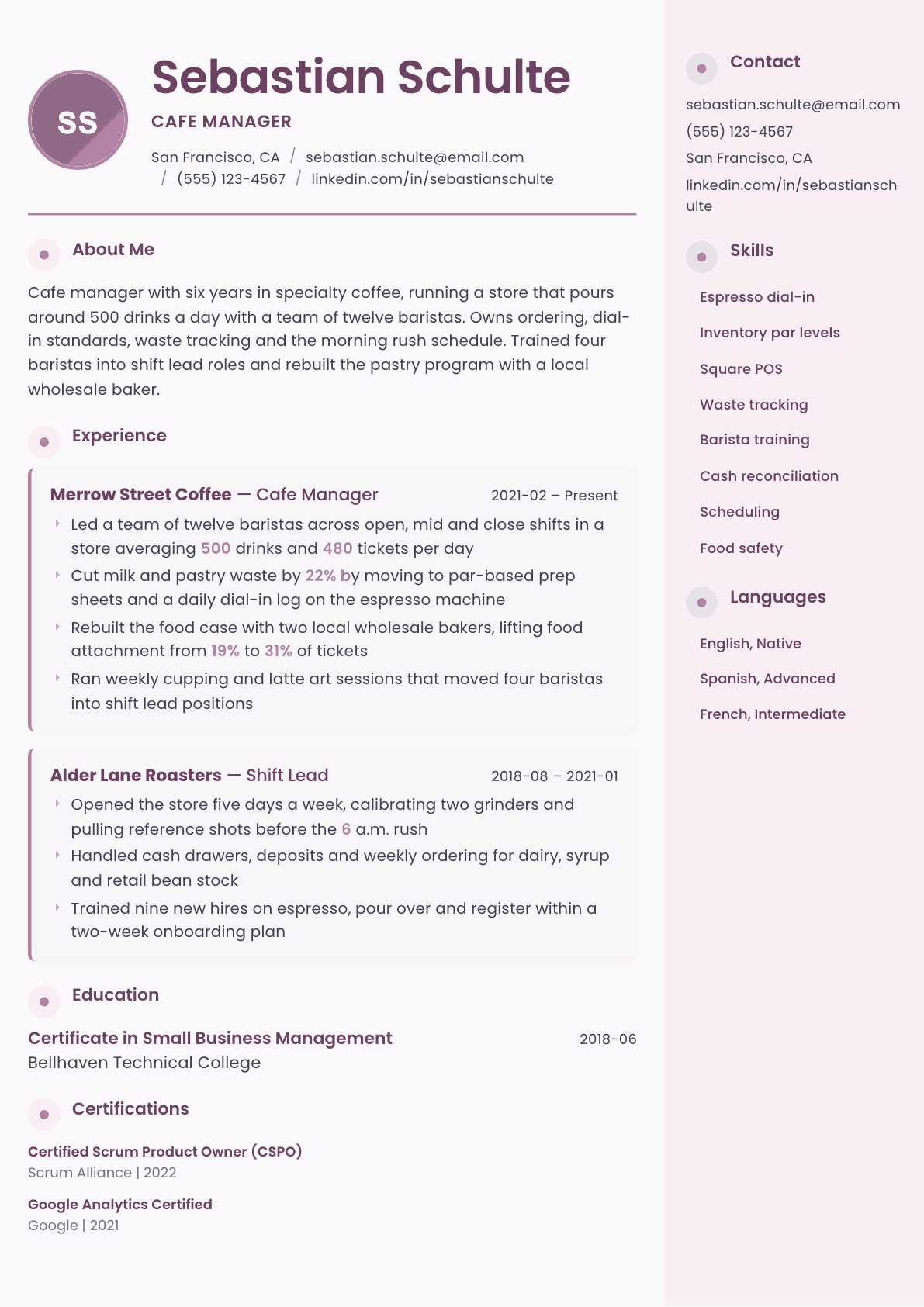
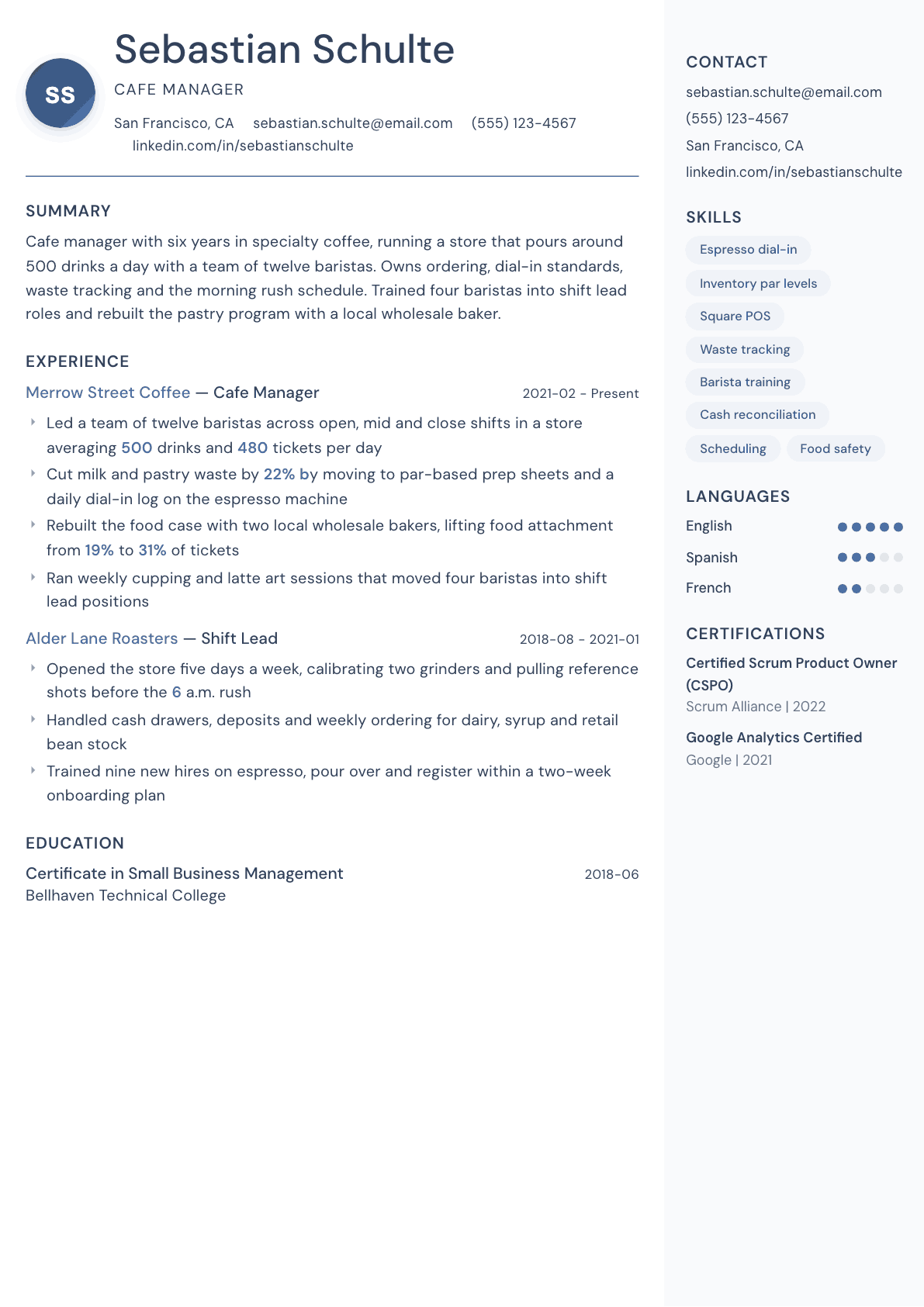
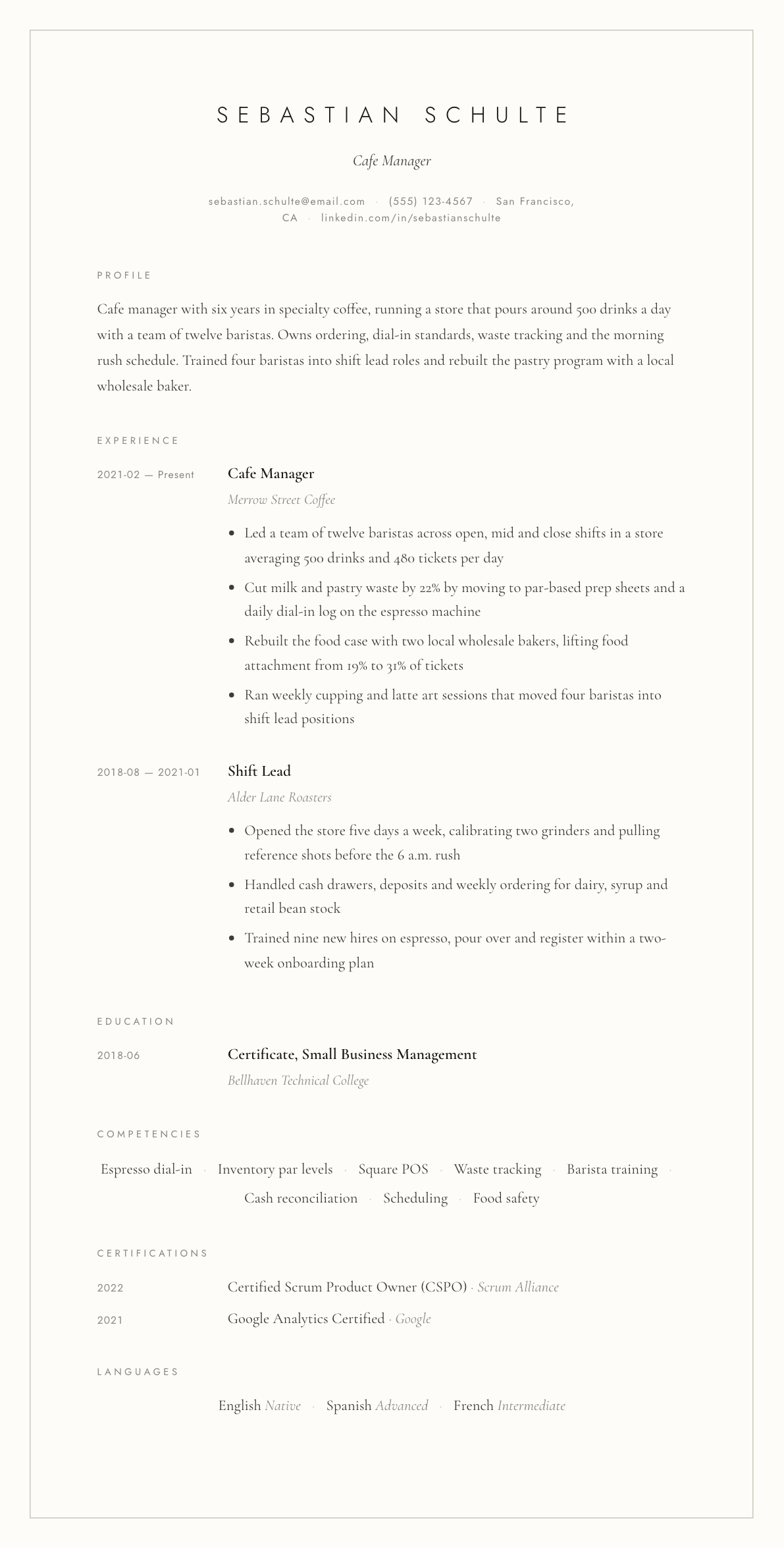
Example Cafe Manager summary
Cafe manager with six years in specialty coffee and two years leading a twelve-person team. Runs a store pouring around 500 drinks a day, owns ordering and par levels for dairy, beans and pastry, and keeps quality steady with a daily dial-in log. Cut waste by more than a fifth and moved four baristas into lead roles. Looking for a district or multi-store position.
Skills to list on a Cafe Manager resume
- Espresso calibration
- Coffee quality control
- Inventory and par ordering
- Waste and shrink control
- Barista training
- Shift scheduling
- Cash handling
- POS administration
- Food safety compliance
- Vendor relationships
- Customer recovery
- Retail merchandising
- Labor cost control
What actually gets this resume read
- Give the store volume in drinks or tickets per day, because that number sets the scale of everything else.
- Show that you own product quality: dial-in logs, grinder calibration, and how you keep taste consistent across shifts.
- Quantify waste and cost work, since a cafe manager is judged on dairy, pastry and retail shrink.
- List the point of sale, scheduling and ordering systems by name so the screener can match the posting.
- Prove you build people: how many baristas you trained, and how many moved up to shift lead.
- Mention food handler certification and any local health permit responsibilities in their own line.
How to write a cafe manager resume
The person hiring a cafe manager has usually run a bar himself and knows exactly how the shift feels between seven and ten in the morning. He is not reading for polish. He is reading for volume, for whether you can hold drink quality when three baristas are on and the queue reaches the door, and for whether the dairy, pastry and retail bags at the end of the week turn into sales or into waste.
That means the two numbers that carry a cafe manager resume are the daily drink or ticket count and the waste line. Volume tells the reader what pace you are used to. Waste tells him whether you order to a forecast or by feel. Everything else on the page, from the dial-in routine to the training ladder, exists to explain how you hold both at once.
This guide covers the section order specialty coffee operators expect, how to write about product quality without sounding like a hobbyist, three worked summaries, and the rewrites that turn shift descriptions into evidence of a manager who protects margin and taste at the same time.
Format: one page until you manage more than one store
Single column, one page, reverse chronological. Cafe hiring moves fast and often happens in the store between rushes, so the reader needs the store size, the volume and the systems inside the first ten seconds. Two pages only once you have a district, multiple sites or a roastery relationship to describe.
Put a one-line store descriptor under each job title: seats, daily drink count, whether there is a kitchen, and how many staff you led. A cafe pouring 500 drinks a day with a full food program is a different job from a 40-seat neighborhood shop, and the reader cannot tell them apart without that line.
- Header: name, city and state, phone, email, and whether you hold a food handler card.
- Sections in this order: summary, experience, coffee and quality, systems, certifications, education.
- Keep a short coffee section for roaster relationships, competition entries and cupping work.
- Move education below experience unless you have a hospitality degree and under a year of leading a team.
Summary: volume, team size, and one quality habit
Three lines. Name the store volume in drinks or tickets a day, the size of the team, the years in specialty coffee, and one habit that shows you own product quality rather than delegating it. A summary that promises passion for coffee is true of everyone who applies and separates nobody.
If you are moving from barista or shift lead into management, say so and name the parts of the manager job you already do. Ordering, scheduling and cash reconciliation are usually shared with leads long before the title changes, and that is the evidence the reader needs.
Experience: the rush, the product, the cost lines
Lead each job with throughput. Drinks per day, tickets in the morning peak, and the number of bar positions running at once tell an operator whether you have managed a real rush or a slow room. Follow with the quality routine: dial-in log, grinder adjustments across the day, shot timing checks, and what happens when a bag of a new roast lands.
Then the cost bullets, because a cafe manager is judged on dairy, pastry and retail shrink far more than on latte art. Show par levels, order frequency, and what you did about the categories that were bleeding. Pastry waste falling because you started ordering against last year weekday counts is a manager decision, not a lucky week.
Close each job with people. How many baristas you trained, how you certified them on bar, and how many moved up to shift lead. Cafe groups promote from inside, so a manager who builds leads is worth more than one who simply covers shifts.
- State the daily drink count and the peak hour, not just that the store was busy.
- Describe the dial-in routine by frequency and trigger, including grinder changes when humidity moves.
- Give waste as a direction with the ordering change behind it.
- Name the training path: bar certification steps, sign-off, and who does the sign-off.
Systems and quality vocabulary the posting uses
Name the point of sale, the scheduling app, the ordering portal and any inventory tool. Cafe groups run on a small set of them, and a screener matching the posting to your file will look for the exact product name rather than a description of it.
Use the vocabulary of the trade precisely, because sloppy usage is obvious to anyone who has worked a bar. Dose, yield, extraction time, refractometer readings, par levels, dial-in, calibration, cupping and roast date all mean something specific. Use them where they are true and skip the ones you never touched.
Food handler certification belongs in its own line with the issuing health authority. If you carried responsibility for a health permit, an allergen matrix or a milk rotation log, say so, because those duties separate a manager from a senior barista.
Keywords and how to place them
Cafe manager postings repeat a tight set of phrases: barista training, inventory par levels, waste control, shift scheduling, cash handling, food safety, vendor ordering, labor cost and customer recovery. Place each true one twice, once in the skills block where the software finds it and once inside a bullet where a human sees it demonstrated.
Avoid a keyword wall. A cafe manager resume is short by design, so a stuffed skills list eats the space that should carry the volume and the waste numbers, which are the only lines the hiring operator will remember an hour later.
Cafe Manager resume summary examples
Shift lead stepping up
Shift lead with three years in specialty coffee at a store pouring around 300 drinks a day, already owning opening counts, dairy ordering and the weekend schedule for six baristas. Runs the daily dial-in log and trained four new hires to bar certification. Ready for a first cafe manager role.
Six years, one store
Cafe manager with six years in specialty coffee, leading twelve staff at a store serving about 500 drinks a day with a full pastry and retail bean program. Owns par levels, vendor ordering and the quality log, cut waste by more than a fifth, and moved four baristas into lead roles.
Multi-store lead
Multi-store cafe manager overseeing four locations, 38 staff and a shared commissary bake, accountable for labor, waste and quality consistency across every bar. Built the training ladder and the weekly calibration audit now used group wide, and opened two of the four stores from build-out to first service.
Work experience bullets: before and after
Before: Managed a busy coffee shop and its staff.
After: Managed a twelve-person team at a cafe serving roughly 500 drinks a day, running three bar positions through a two-hour morning peak.
Drink count, team size and the shape of the peak tell an operator the pace you are used to holding.
Before: Responsible for ordering and inventory.
After: Set par levels for beans, dairy and pastry against weekday sales history and placed three orders a week, cutting dairy and pastry waste by 22% in a quarter.
Ordering rhythm plus a forecast basis explains the waste result instead of leaving it as a claim.
Before: Trained new baristas.
After: Trained nine baristas through a four-stage bar certification covering dose and yield, milk texture, ticket sequencing and customer recovery, with a sign-off shift before solo bar.
A named training structure with a sign-off gate proves a repeatable system rather than casual coaching.
Before: Kept drink quality consistent.
After: Logged dial-in shots at open, mid-morning and after each grinder change, and pulled calibration checks twice a shift so espresso stayed inside the target yield window across all three baristas.
Quality becomes verifiable once the reader sees the frequency, the trigger and the target.
Before: Handled cash and daily reports.
After: Reconciled two tills and a mobile order channel nightly, closed the day in the point of sale, and prepared the deposit and sales summary for the owner with no unexplained variance over a year.
Naming the channels and the outcome turns a routine duty into a statement about accuracy.
Hard skills
- Espresso dial-in and calibration
- Grinder adjustment
- Milk texturing standards
- Par level ordering
- Waste and shrink control
- Barista training and certification
- Shift scheduling
- Labor cost control
- Point of sale administration
- Cash reconciliation
- Food safety and allergen handling
- Retail bean merchandising
- Vendor and roaster relationships
Soft skills
- Calm under a queue
- Coaching on bar
- Customer recovery
- Schedule fairness
- Clear handover
- Attention to detail
Certifications worth listing
- ServSafe Food Handler (National Restaurant Association)
- ServSafe Food Protection Manager Certification (National Restaurant Association)
- Coffee Skills Program: Barista Skills (Specialty Coffee Association)
- Coffee Skills Program: Brewing (Specialty Coffee Association)
- Coffee Skills Program: Sensory Skills (Specialty Coffee Association)
Mistakes that cost cafe manager candidates the interview
- Describing the store as busy without giving the daily drink count that proves it.
- Writing about latte art and competitions while leaving waste, labor and ordering off the page.
- Listing coffee vocabulary you have never used, which an interviewer exposes in two questions.
- Omitting the team size, so the reader cannot tell a solo bar from a twelve-person roster.
- Burying the food handler card at the bottom when local rules make it a screening requirement.
- Sending the same file to an independent shop and a growing group, when one wants craft and the other wants systems.
Cafe Manager resume questions
How much coffee technique belongs on a cafe manager resume?
Enough to prove you own quality and no more. One bullet on the dial-in routine and one on how you certify baristas is plenty. The rest of the page should carry ordering, labor, waste and people, because those are what the manager title is paid for.
What number should a cafe manager lead with?
Daily drinks or tickets, because it sets the scale of everything else on the page. If your store measures in transactions rather than drinks, say so plainly and add the peak hour count, so the reader can picture the rush you have actually worked.
Do I need a food handler card before applying?
Most jurisdictions require it for anyone touching food, and many require a manager-level food protection certificate on shift. Having it already makes you hireable this week rather than next month, so list it with the issuing authority and the expiry date.
How do I move from barista to cafe manager on paper?
Name the manager tasks you already carry as a lead: counts, ordering, deposits, scheduling and training. Give each one a number or a frequency. A barista who ordered dairy weekly for a year has more management evidence than a title change would suggest.
Should I list the roasters and coffees I have worked with?
Yes, in a short coffee section, because roaster relationships signal the segment you come from. Keep it to the roasters, the brew methods you have run on bar and any cupping or competition work, and leave personal tasting notes out of the resume entirely.
Related resume examples
- Barista Resume example
- Restaurant Manager Resume example
- Bakery Manager Resume example
- Food Service Manager Resume example
- Food and Beverage Manager Resume example
- Restaurant Owner Resume example