Food & Beverage Director Resume Examples: free ATS score
Build a Food & Beverage Director Resume That Drives Revenue
By Mustafa Tarabya, founder of CVBooster · Published · Updated
Create an executive-level F&B Director resume demonstrating multi-outlet management, revenue optimization, concept development, and hospitality leadership.
Sample resumes for a food & beverage director
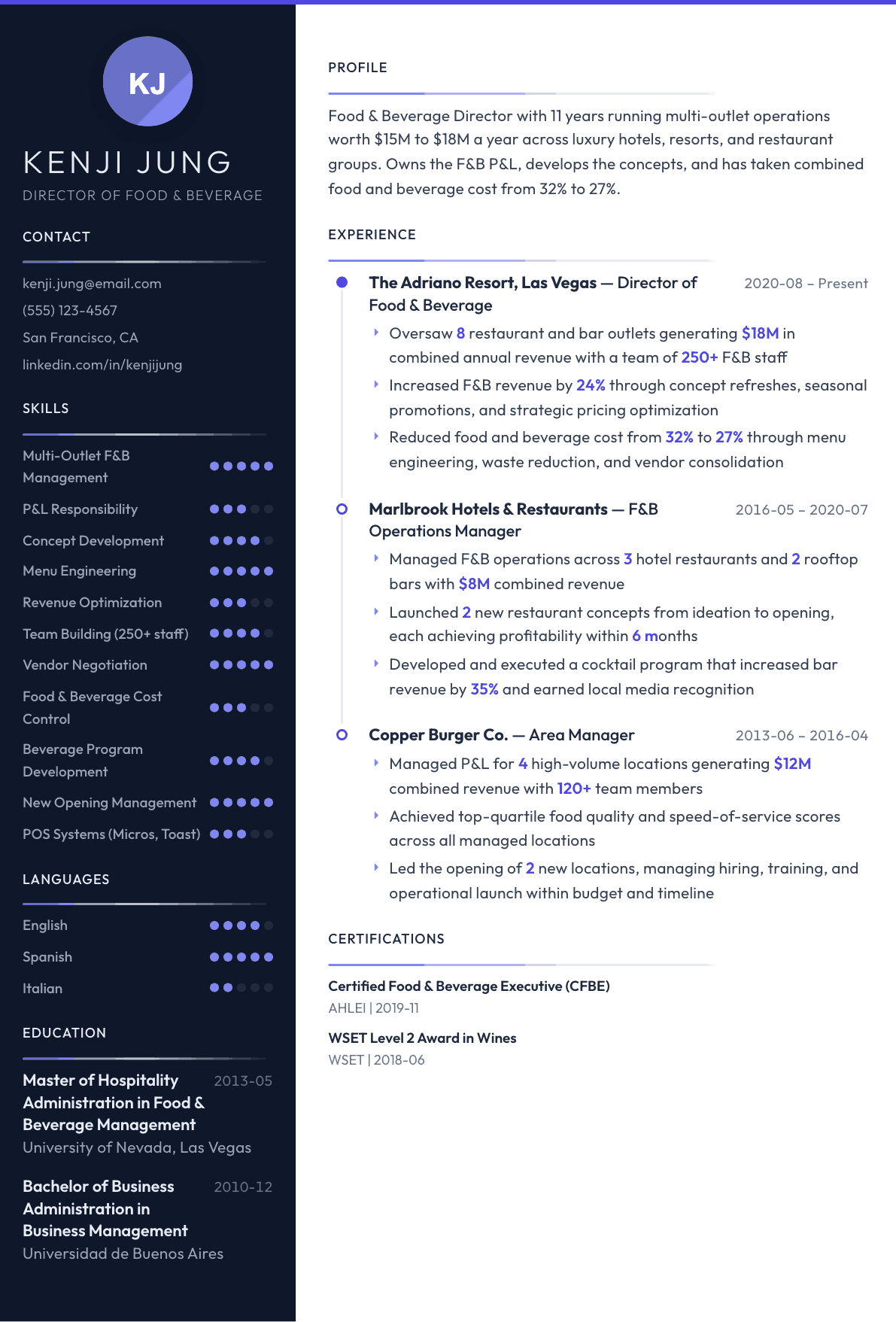
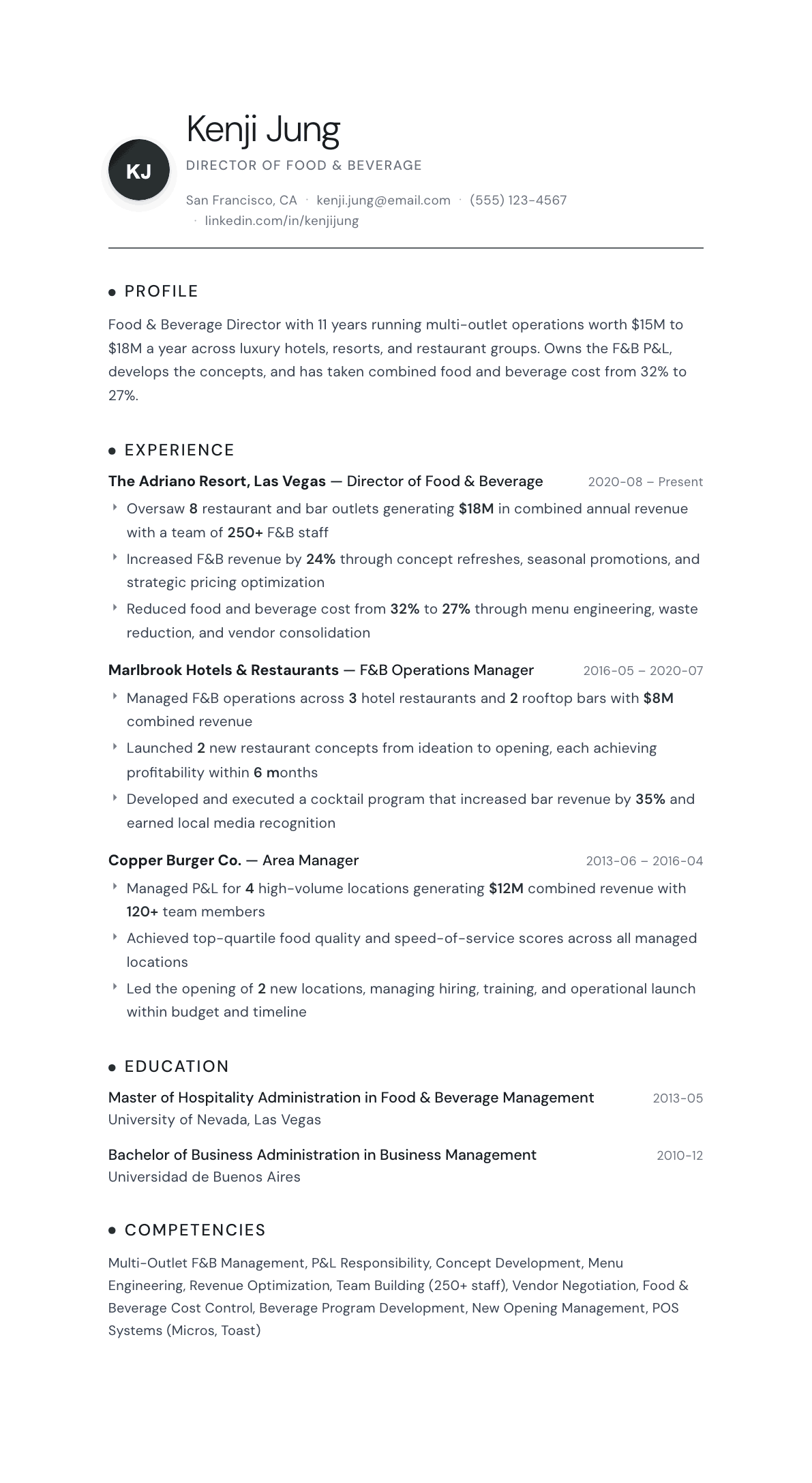
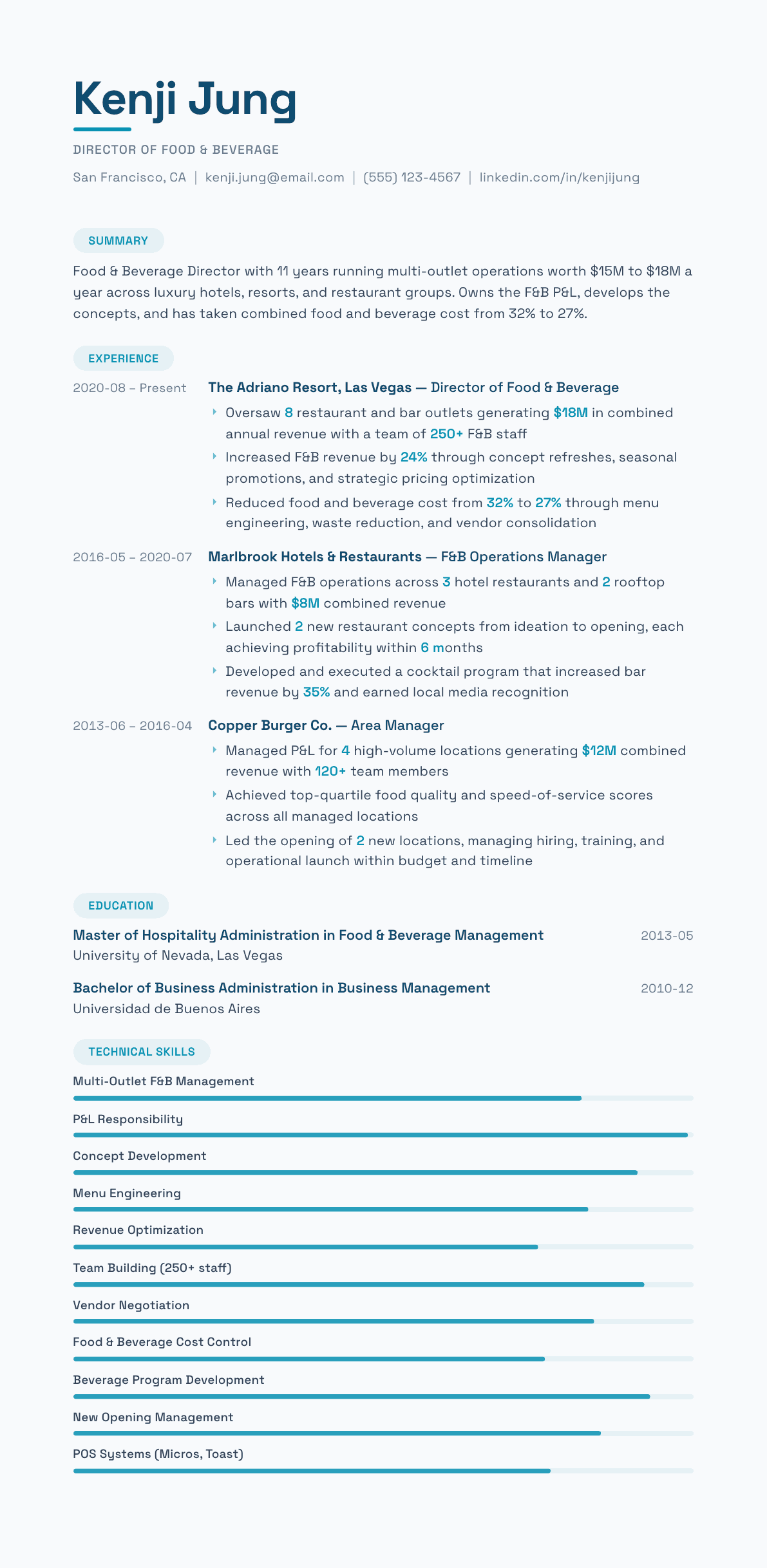
The same food & beverage director content laid out in three CVBooster templates, so you can see what the finished document looks like before you write a word.
Example Food & Beverage Director summary
Strategic Food & Beverage Director with 11 years leading multi-outlet operations generating $18M+ annual revenue. Grew F&B revenue by 24%, reduced costs from 32% to 27%, and launched 2 profitable restaurant concepts. Expert in menu engineering, team development, and concept innovation. CFBE certified with experience across luxury hotels, resorts, and restaurant groups.
Skills to list on a Food & Beverage Director resume
- Multi-Outlet F&B Management
- P&L Management
- Concept Development
- Menu Engineering
- Revenue Optimization
- Food & Beverage Cost Control
- Team Building & Development
- Vendor & Supply Chain Management
- Beverage Program Design
- New Restaurant Openings
- POS Systems
- Health & Safety Compliance
- Guest Experience
- Banquet & Catering Operations
- Financial Reporting
What actually gets this resume read
- Lead with total revenue managed, outlet count, and team size to establish scope of leadership.
- Quantify cost optimization: food cost percentages, beverage cost improvements, and vendor savings.
- Highlight concept development or restaurant opening experience with profitability timelines.
- Include menu engineering accomplishments with specific revenue or margin impacts.
- Demonstrate guest experience innovation through program launches, seasonal events, or media recognition.
- Mention POS and inventory systems (Micros, Toast, MarketMan) to show operational technology fluency.
How to write a food & beverage director resume
A food and beverage director resume is read by a general manager, an area vice president or an ownership group, and the reader is running a profit and loss statement in their head while they scan it. The job is not restaurants, it is the business of restaurants: revenue by outlet, cost of goods by category, labor against a productivity standard, and the guest scores that tell them whether the margin was bought at the expense of the experience.
The role lives in different environments that hire on different evidence. Hotels and resorts add banquets, in-room dining, pool and bar outlets and a rooms division reporting line. Restaurant groups add unit economics and openings. Clubs add membership dynamics. Cruise, casino and stadium operations add volume no restaurant ever sees. Say which one you come from, because the operating rhythms are not interchangeable.
This guide covers how to write the document for a profit and loss reader, with example summaries for a first director role, a multi-outlet director and a regional or corporate leader, before and after bullets that convert responsibilities into financial results, and the questions operators ask when they step up from a single restaurant.
Format: two pages, with an operating profile above every job
Two pages. Reverse chronological. Every position opens with the operation you ran: property or group type, number of outlets by concept, total seats and banquet square footage, annual food and beverage revenue scale, headcount, and your reporting line. A hiring principal reads that block to judge whether your last operation is bigger or smaller than theirs, and everything else is context.
Add a short results block near the top summarizing your three strongest financial and guest outcomes across your career. Directors are hired on a track record of moving numbers, and a skimming reader should meet those numbers before page two.
- Header: name, credentials, city and state, phone, email.
- Order: summary, career results, experience with operating profiles, certifications, education.
- State whether you carried full profit and loss ownership or departmental cost responsibility only.
Summary: outlets, revenue, headcount and the numbers you moved
Four lines. Number of outlets and their concepts, annual food and beverage revenue scale, total headcount, and the two or three metrics you have measurably improved. This is a finance-literate audience, so lead with cost of goods, labor productivity, revenue per available seat or capture rate rather than with words about excellence.
Name the segment you know. Luxury resort, select service hotel, independent restaurant group, private club, contract food service, casino or stadium. Each has a different revenue mix and a different labor model, and an operator hiring for one is quietly discounting experience from another.
Experience: profit and loss, revenue, cost and people
Start with the profit and loss. Revenue by outlet and the growth you produced. Food cost and beverage cost separately, since they move on different levers. Labor cost, overtime and productivity measured against covers or against revenue per labor hour. Departmental profit and the flow-through you achieved when revenue rose. Capital spend you planned and defended.
Then revenue generation. Concept development and refreshes. Menu engineering and pricing strategy across outlets. Beverage program design and its margin contribution. Outlet hours and day-part strategy, especially breakfast and late night where hotels leak money. Banquet and group capture. Delivery, retail and grab-and-go where the property supports it. Marketing and promotion partnerships that filled a slow period.
Then people and standards, which is where a director either scales or does not. Total headcount, the leadership team reporting to you, turnover and the retention work behind it, management development and internal promotions, and the training program you own. Add guest metrics: satisfaction scores, review ratings, mystery shop results and food quality audits, plus the health inspection record across all outlets.
Openings, concepts and turnarounds
The events that justify a director salary are openings, concept launches and turnarounds. Give each one its own treatment: what the operation looked like when you took it, what you changed, how long it took, and where the numbers landed. A turnaround with a before and after is the most persuasive item you can put on this resume.
For openings, describe the pre-opening scope you personally owned: concept and menu development with the chef, equipment and furniture specification, licensing and permitting, hiring and training plans, systems configuration, and the opening date you hit. For concept work, say whether the concept was yours or a brand standard you executed, because the two are different jobs.
- Name the systems: point of sale, inventory and purchasing, scheduling, reservations, reporting.
- Note union environments and any collective bargaining agreement you have operated under.
- Include liquor licensing and compliance responsibility where you held it.
Credentials and financial literacy signals
Food protection manager and alcohol service certification are baseline. Hotel industry credentials from the American Hotel and Lodging Educational Institute, particularly the food and beverage executive designation, read directly to this audience. A hospitality or business degree is common but not decisive at this level.
What is decisive is showing that you speak finance. Reference budget building and forecasting cadence, monthly profit and loss review with ownership, variance explanation, capital requests and return expectations. A director who cannot defend a variance line to an owner is a director who gets managed rather than trusted.
Food & Beverage Director resume summary examples
First director role
Restaurant general manager of 5 years moving into a director role, having run a 200-seat outlet and a bar with combined revenue in the mid seven figures, 60 staff and full cost responsibility. Held food cost at 28% and beverage at 20%, and opened one location on schedule.
Multi-outlet director
Food and beverage director for a luxury hotel with three restaurants, two bars, in-room dining and banquets, 250 staff and eight figure annual revenue. Grew F&B revenue by 24% through concept refreshes and day-part strategy while bringing combined cost of goods from 32% to 27%.
Regional or corporate
Regional food and beverage leader for eight properties, accountable for departmental profit, brand standards and every opening in the region. Led two concept launches to profitability inside their first year, standardized menu engineering across the portfolio, and developed four outlet managers into directors.
Work experience bullets: before and after
Before: Oversaw food and beverage operations for the hotel.
After: Directed eight restaurant, bar and banquet outlets with 250 team members and eight figure combined annual revenue, reporting to the general manager and owning the departmental profit and loss.
Outlet count, headcount, revenue scale and profit ownership define the job, where oversaw defines nothing.
Before: Increased food and beverage revenue.
After: Grew food and beverage revenue by 24% over two years through two concept refreshes, a rebuilt breakfast day-part and a seasonal promotional calendar tied to the group booking pace.
Naming the three revenue levers shows a strategy rather than a favorable year.
Before: Reduced costs across the department.
After: Brought combined food and beverage cost from 32% to 27% through menu engineering by contribution margin, vendor consolidation to two primary distributors and a weekly waste audit across all outlets.
The mechanism behind a cost movement is what tells an owner it will happen again at their property.
Before: Opened new restaurant concepts.
After: Launched two restaurant concepts from ideation through licensing, hiring and first service, each reaching operating profitability within six months of opening.
A time-to-profitability figure is the only opening claim an ownership group treats as evidence.
Before: Focused on guest satisfaction and service quality.
After: Lifted outlet guest satisfaction into the top quartile of the brand while holding speed of service standards, and passed three years of health inspections across all outlets with no critical violations.
Pairing the guest score with the compliance record proves the margin work did not damage the operation.
Hard skills
- Food and beverage profit and loss ownership
- Budgeting and forecasting
- Cost of goods control by category
- Labor productivity and scheduling standards
- Menu engineering and pricing
- Concept development and refresh
- Restaurant and outlet openings
- Banquet and group capture
- Beverage program and licensing compliance
- Purchasing and vendor contracting
- Point of sale and inventory systems
- Guest satisfaction and brand standard audits
Soft skills
- Ownership and stakeholder communication
- Developing managers
- Negotiation with suppliers
- Decision making on incomplete data
- Standards leadership across outlets
- Retention-focused management
Certifications worth listing
- Certified Food and Beverage Executive (CFBE) (American Hotel & Lodging Educational Institute)
- Certified Hotel Administrator (CHA) (American Hotel & Lodging Educational Institute)
- ServSafe Food Protection Manager (National Restaurant Association)
- ServSafe Alcohol (National Restaurant Association)
- Foodservice Management Professional (FMP) (National Restaurant Association)
Mistakes that cost food & beverage director candidates the interview
- Writing a restaurant manager resume with a director title, all service language and no profit and loss.
- Omitting outlet count, seats, revenue scale and headcount, which are the only facts that establish your level.
- Reporting cost improvements with no explanation of what produced them.
- Ignoring labor entirely, when it is the line ownership questions first in every review.
- Leaving out openings and turnarounds, which are the events that justify hiring a director rather than promoting a manager.
- Claiming guest score improvements without the compliance and quality audit record that shows the operation stayed sound.
Food & Beverage Director resume questions
What financial detail belongs on a food and beverage director resume?
Revenue scale by outlet, food and beverage cost percentages separately, labor cost or productivity, departmental profit and flow-through, and capital spend you planned. State whether you owned the profit and loss or only departmental costs, because owners read those very differently.
How do I move from restaurant general manager to F&B director?
Lead with cost ownership, revenue growth, headcount and any second outlet, bar or private dining you also ran. The gap a hotel sees is banquets and multi-outlet coordination, so name any group, catering or banquet volume you have touched, however small.
Should I include guest satisfaction scores?
Yes, and name the measurement system by type rather than quoting an internal index nobody outside your company recognizes. Pair the score with a quality or inspection result so the reader can see you improved margin without hollowing out the operation.
How do I present a turnaround on my resume?
Give the condition you inherited, the specific changes you made, the time it took and where the numbers landed. A before and after with a timeline is the single most persuasive item on a director resume, because turnarounds are what ownership groups actually hire for.
Does hotel experience transfer to a restaurant group and back?
Partly. Hotels bring banquets, in-room dining and a rooms division relationship. Restaurant groups bring unit economics and marketing-driven traffic. Name the half you have and address the half you do not rather than letting a reader assume you have neither.
Related resume examples
- Executive Chef Resume example
- Hotel General Manager Resume example
- Restaurant Manager Resume example
- Food and Beverage Manager Resume example
- Banquet Manager Resume example
- Restaurant Owner Resume example