Store Owner Resume Examples: free ATS score and gap list
Turn Store Owner Experience Into a Resume Employers Read
By Mustafa Tarabya, founder of CVBooster · Published · Updated
Store owner resume examples and a writing guide that translate independent retail ownership into the language corporate hiring managers score.
Sample resumes for a store owner
The same store owner content laid out in three CVBooster templates, so you can see what the finished document looks like before you write a word.
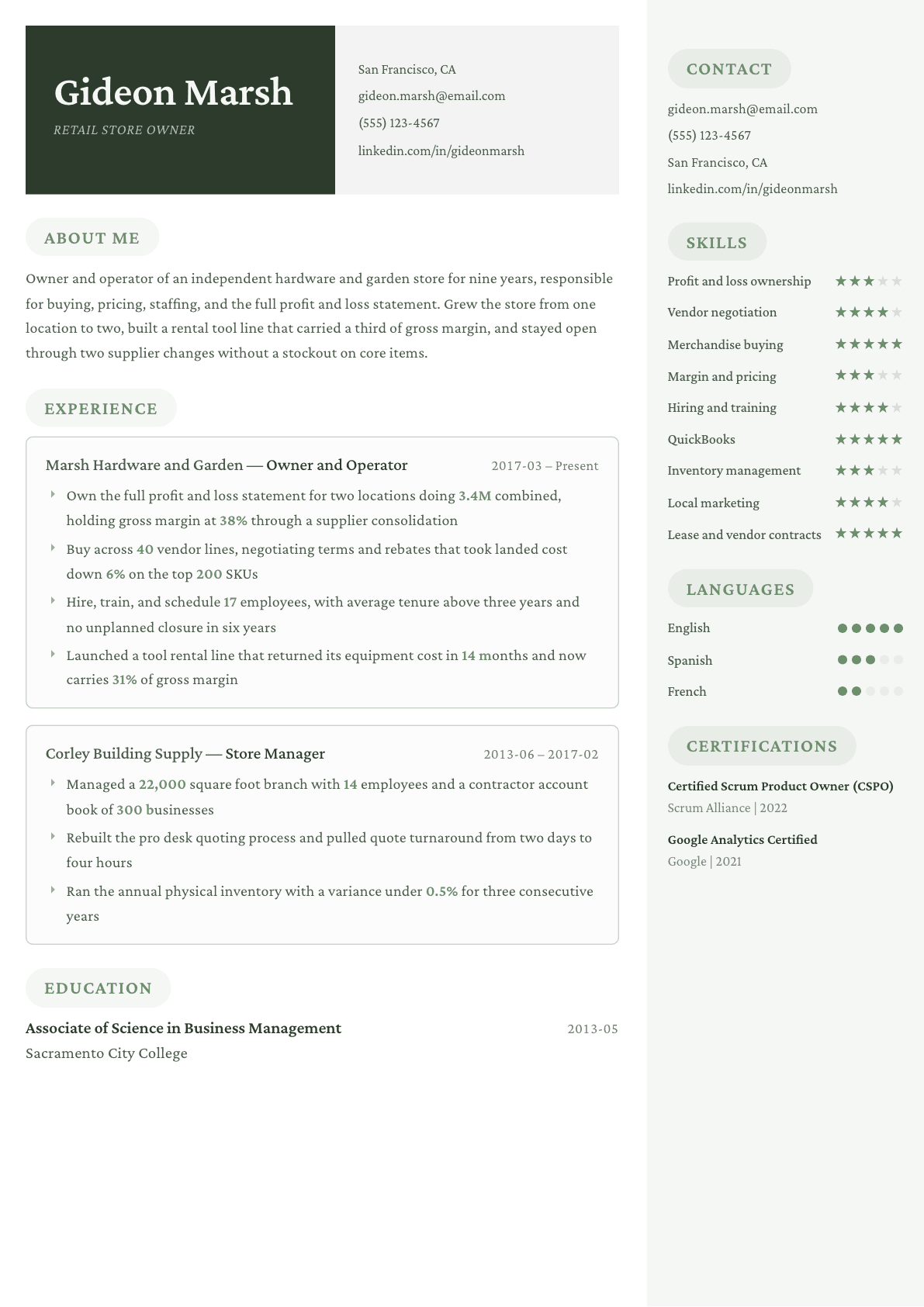
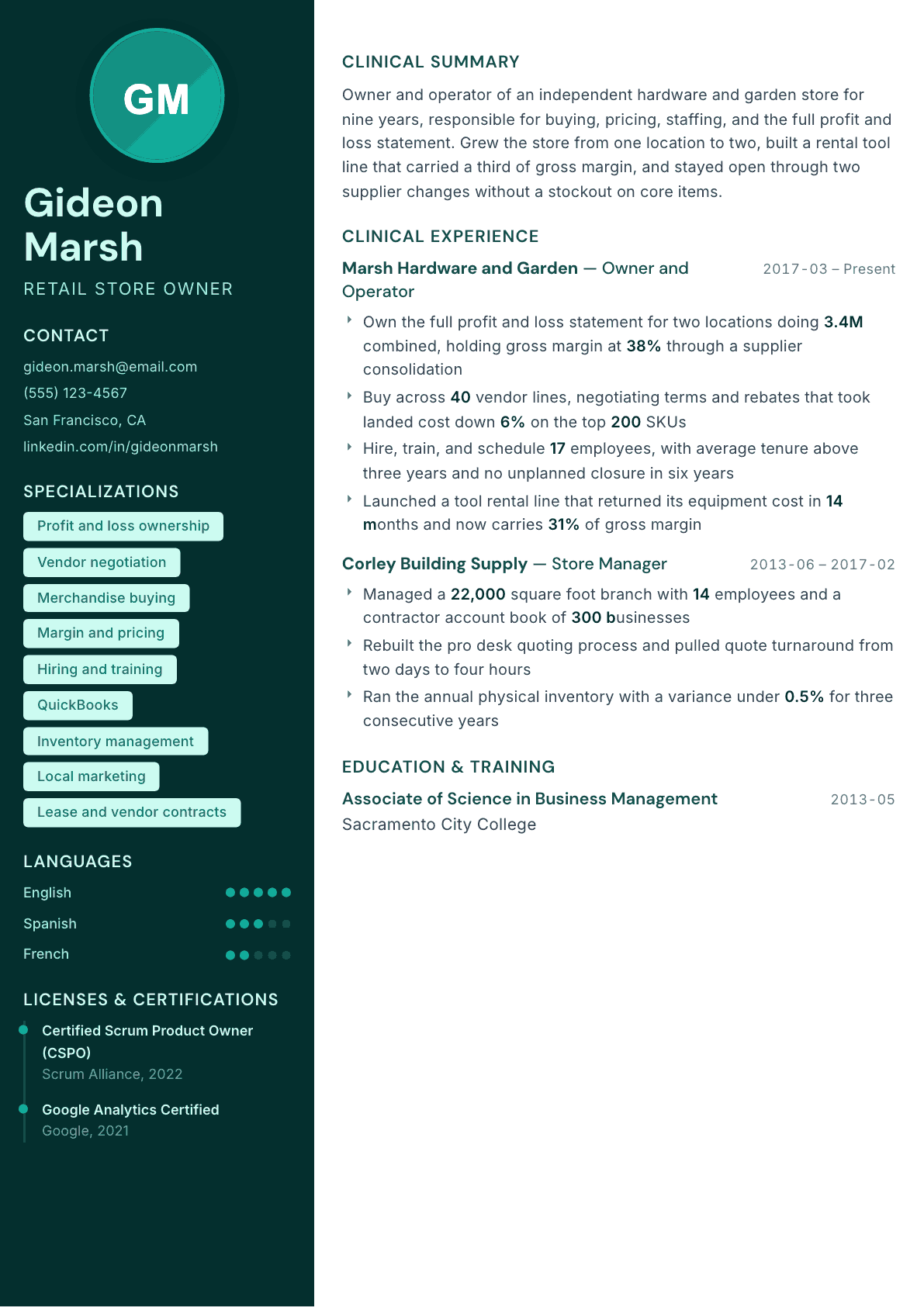
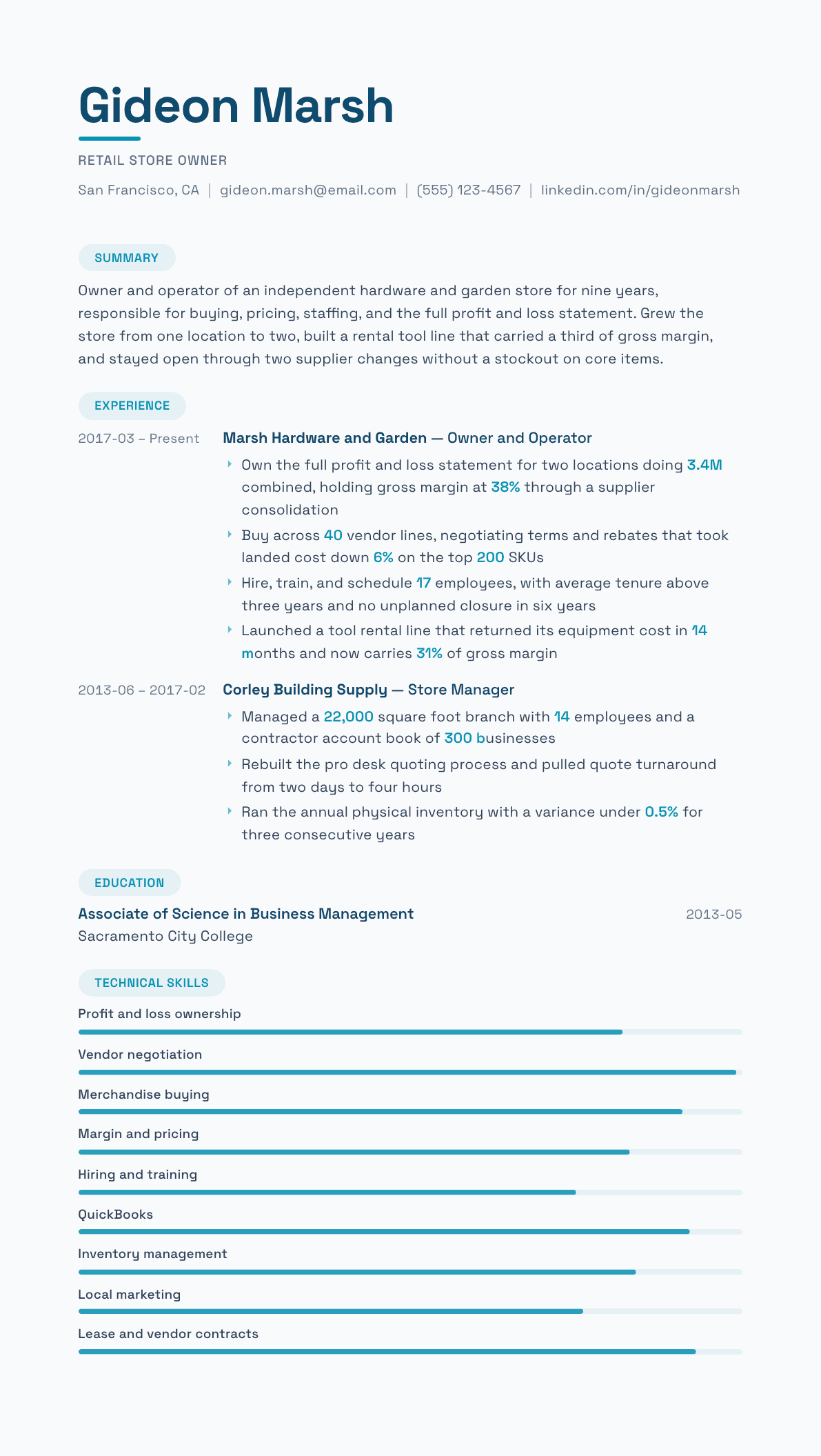
Example Store Owner summary
Independent store owner with nine years running a two-location hardware and garden business doing 3.4M a year. Owns buying across 40 vendor lines, holds gross margin at 38%, and employs 17 people with average tenure above three years. Looking to bring hands-on operating experience to a multi-unit retail leadership role.
Skills to list on a Store Owner resume
- Profit and loss management
- Merchandise buying
- Vendor negotiation
- Pricing and margin strategy
- Inventory management
- Hiring and onboarding
- Staff scheduling
- Cash flow management
- QuickBooks
- Point of sale administration
- Local marketing
- Customer retention
- Store operations
- Physical inventory
What actually gets this resume read
- Translate ownership into corporate terms: profit and loss, buying, staffing, and store operations, not just running a business.
- Give the store size, the category, the headcount, and the revenue band so a reader can judge scope.
- Show margin and inventory numbers, because those are the two things a district or category interviewer probes.
- Say why you are moving now, briefly and factually, in the summary rather than leaving the reader to guess.
- List the systems you ran, from the point of sale to the accounting package, since owners often built them alone.
- Do not bury staffing under buying: hiring, scheduling, and turnover carry the most weight in a store leadership hire.
How to write a store owner resume
A store owner resume has an unusual problem: the writer has done more than most applicants and gets screened out anyway. Recruiters see owner and start guessing. Will this person take direction? Are they applying because the business failed? Did they actually run buying and payroll, or did a spouse and an accountant do it? The resume has to answer all three before the reader forms an opinion.
The fix is translation. Ownership breaks down into functions a corporate reader already scores: profit and loss responsibility, merchandise buying, vendor negotiation, pricing and margin, staffing, inventory, and store operations. Written that way, a nine year independent operator outranks a candidate who managed one department of a chain.
This guide sets out the section order for an owner resume, how to size the business in one line, three summary examples for different exits, before and after bullets that convert owner language into hiring language, and the questions independent operators ask when they move back into employment.
Format: lead with the business, not the title
Use reverse chronological order and treat the business as an employer entry. Company name, your title as owner and operator, dates, then a scope line: category, number of locations, square footage or format, headcount, and revenue band. Without that line the reader cannot tell a market stall from a two store hardware operation.
Two pages is acceptable here if you held earlier employed roles worth showing. A prior job at a chain is valuable evidence that you can work inside someone else's system, so keep it rather than cutting it for space.
- Scope line format: category, locations, headcount, revenue band, years operating.
- Keep the legal structure and registration details off the page; they add nothing to a hiring decision.
- If the business is still open, say whether you are selling, stepping back, or hiring a manager to replace yourself.
Summary: what you owned and why you are moving
Say the category, the years, the scale, and two operating results in the first two lines. Then close with a direct sentence about the move. Silence about why an owner is applying is the single biggest reason these resumes stall, because the reader assumes the worst and never asks.
Keep the reason factual and short. Selling the business, closing a lease, relocating, or wanting a larger operation to work in are all ordinary and easy to say. What is not persuasive is a paragraph of feelings about entrepreneurship or a claim that you want a simpler life.
Experience: convert ownership into the four functions employers score
Buying comes first for merchant roles. Number of vendor lines, categories bought, terms negotiated, landed cost movement, and how you handled a supplier failure. These bullets are what qualify an owner for a buyer, category, or multi-unit position rather than a first line supervisor job.
Then margin and inventory. Gross margin held or moved, markdown discipline, turns, and physical inventory variance. Owners usually have better numbers here than chain candidates because they lived with the consequences, so do not leave them implied.
Then people and operations. Headcount, tenure, hiring and training, scheduling, and any store you opened, remodeled, or closed cleanly. Finish with the systems you administered, since owners typically selected and configured the point of sale and accounting stack themselves, which is a real credential.
Handle the awkward parts directly
If the business closed, write the reason in one clause: lease ended, area redeveloped, category declined, partnership dissolved. A closure explained in six words reads as judgment. A closure hidden behind vague dates reads as a problem.
If revenue was small, do not inflate it. Use the operating detail instead: vendor count, categories, turns, headcount, and the number of years you stayed open. Longevity in independent retail is itself evidence, and an interviewer will respect a modest, honest number far more than a suspiciously round one.
Skills and keywords a corporate screener searches for
Mirror the posting vocabulary. Profit and loss management, merchandise planning, open to buy, vendor negotiation, gross margin, inventory turns, shrink, staff scheduling, and store operations are the phrases that get an owner past a keyword screen and into a conversation. Name your point of sale and accounting systems too, because chains want to know what you can be dropped into.
Skip founder vocabulary that means nothing in a store hiring process. Bootstrapped, hustle, and wearing many hats describe effort rather than results, and they push the reader back toward the stereotype you are trying to correct.
Store Owner resume summary examples
Three years, first business
Owner of a single location gift and stationery shop for three years, buying across 22 vendor lines, setting pricing and markdowns, and employing four part time staff. Held gross margin above 45% and kept physical inventory variance under one point. Selling the store and moving into multi-unit retail.
Nine years, two locations
Owner and operator of a two location hardware and garden business doing 3.4M a year with 17 employees. Buys across 40 vendor lines, held gross margin at 38% through a supplier consolidation, and built a rental line carrying 31% of gross margin. Looking for a district or category leadership role.
Fifteen years, sold the business
Founded and sold a four store specialty grocery chain built over fifteen years to 30 employees and 9M in sales. Owned buying, private label development, site selection, and two remodels, and handed over a business with inventory variance under half a point. Seeking a regional operations role.
Work experience bullets: before and after
Before: Owned and operated a retail store.
After: Owned and operated a two location hardware and garden business doing 3.4M in combined sales with 17 employees across nine years.
Locations, category, revenue band, headcount, and duration give the reader the scope that the word owner hides.
Before: Bought products from suppliers for the store.
After: Bought across 40 vendor lines, negotiating terms and volume rebates that took landed cost down 6% on the top 200 items.
Vendor count and a cost result turn buying from a chore into merchant experience a category manager recognizes.
Before: Kept the business profitable every year.
After: Held gross margin at 38% through a supplier consolidation and two price increases, with no year of negative operating profit.
A margin figure and the events it survived are far more credible than a general claim of profitability.
Before: Hired and managed staff.
After: Hired, trained, and scheduled 17 employees with average tenure above three years and no unplanned closure across six years.
Tenure and continuous trading prove staffing stability, which is what an employer is actually buying.
Before: Used accounting and inventory software.
After: Selected and administered the point of sale and QuickBooks stack, running monthly reconciliations and an annual count with variance under half a point.
Owning the system setup and the count result shows financial control rather than data entry.
Hard skills
- Profit and loss ownership
- Merchandise buying and assortment planning
- Vendor negotiation and terms
- Pricing and gross margin management
- Inventory turns and open to buy
- Physical inventory and variance control
- Payroll and staff scheduling
- Cash flow forecasting
- Point of sale and QuickBooks administration
- Lease and supplier contract review
- Local marketing and community events
- Store opening and remodel management
Soft skills
- Commercial judgment
- Negotiation
- Hiring instinct
- Customer relationship building
- Composure in a cash squeeze
- Adaptability inside someone else's process
Certifications worth listing
- QuickBooks Certified User (Certiport)
- RISE Up Business of Retail: Operations and Profit (National Retail Federation Foundation)
- ServSafe Food Protection Manager (National Restaurant Association)
Mistakes that cost store owner candidates the interview
- Writing the entry as a business description instead of a job, so the reader never learns which functions you personally ran.
- Leaving out why you are applying, which lets a recruiter assume the store failed and move to the next file.
- Using founder vocabulary such as bootstrapped or wearing many hats in place of margin, turns, and headcount.
- Cutting earlier employed roles for space, when they are the proof that you can work inside another company's structure.
- Rounding revenue to a suspiciously clean figure rather than giving an honest band with the operating detail behind it.
- Applying only to senior titles because you were the owner, instead of matching the scope you can evidence with numbers.
Store Owner resume questions
Will employers think I am overqualified or hard to manage as a former store owner?
Some will, so answer it on the page. Keep an earlier employed role visible, name the systems and processes you followed, and say in the summary what kind of team you want to join. Evidence that you have worked inside someone else's structure removes most of the concern.
How do I list my own business as an employer?
Use the trading name as the company, owner and operator as the title, and real month and year dates. Add a scope line with category, locations, headcount, and revenue band so the reader can size it immediately, then write bullets by function rather than by story.
Should I say the store closed?
Yes, in one clause. Lease ended, the anchor tenant left, the category declined, or you sold to a buyer are all normal outcomes in independent retail. A short factual reason reads as judgment, while an unexplained end date invites a worse assumption than the truth.
What roles should a former store owner target?
Store manager, multi-unit or district roles, category and buying positions, and operations manager jobs all map directly to owner work. Match the scope you can prove with numbers rather than the seniority the title implies, and lead each application with the function that posting scores hardest.
Do I include my business revenue if it was modest?
Give a band rather than hide it, and surround it with operating detail such as vendor lines, categories, headcount, turns, and the years you stayed open. Continuous trading through several economic cycles carries weight with retail leaders regardless of the size of the number.