Retoucher Resume Examples: free ATS score and gap list
Write a Retoucher Resume That Survives a Portfolio Test
By Mustafa Tarabya, founder of CVBooster · Published · Updated
Retoucher resume example covering beauty, product and composite work, color management, throughput, keywords and a full writing guide.
Sample resumes for a retoucher
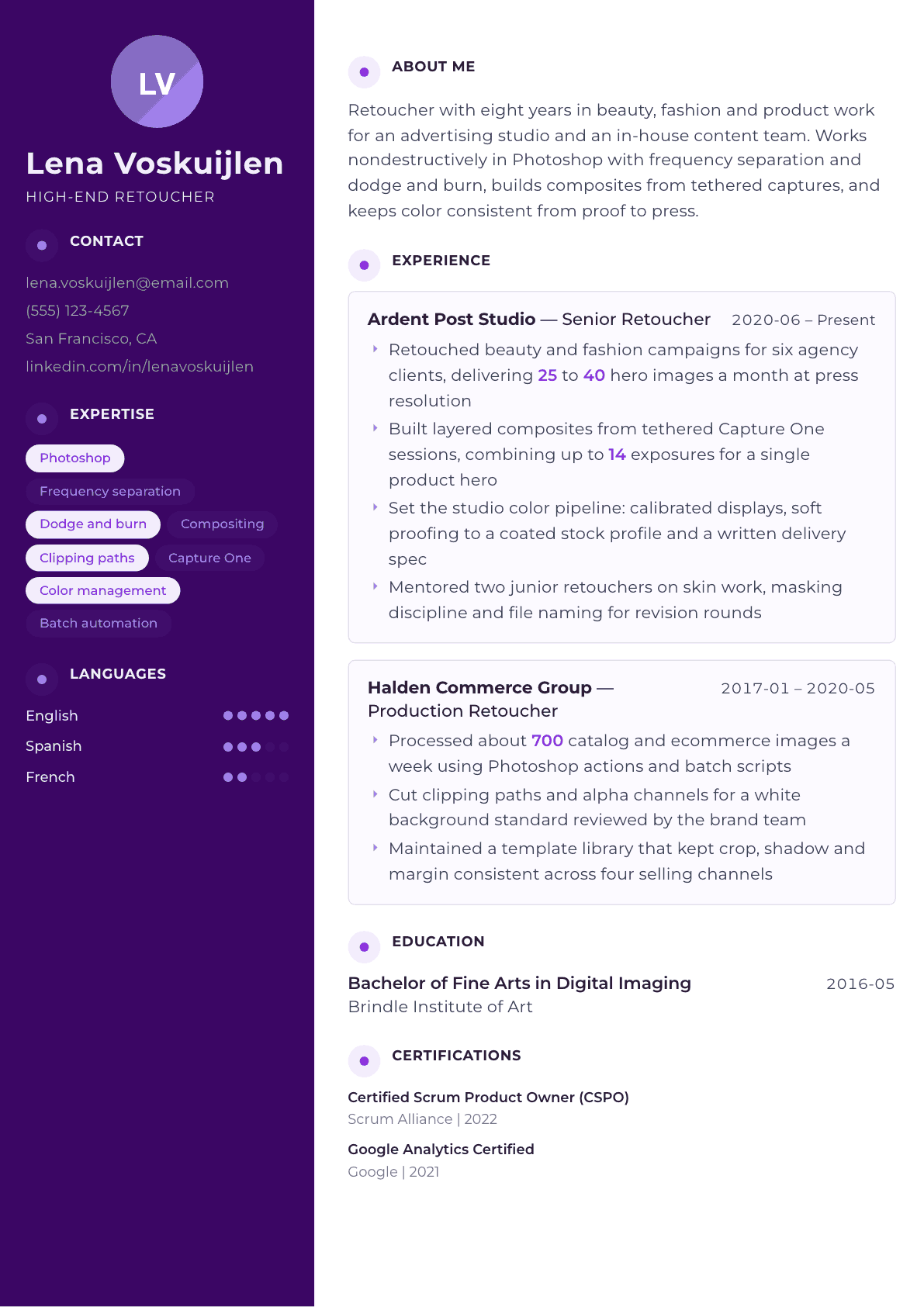
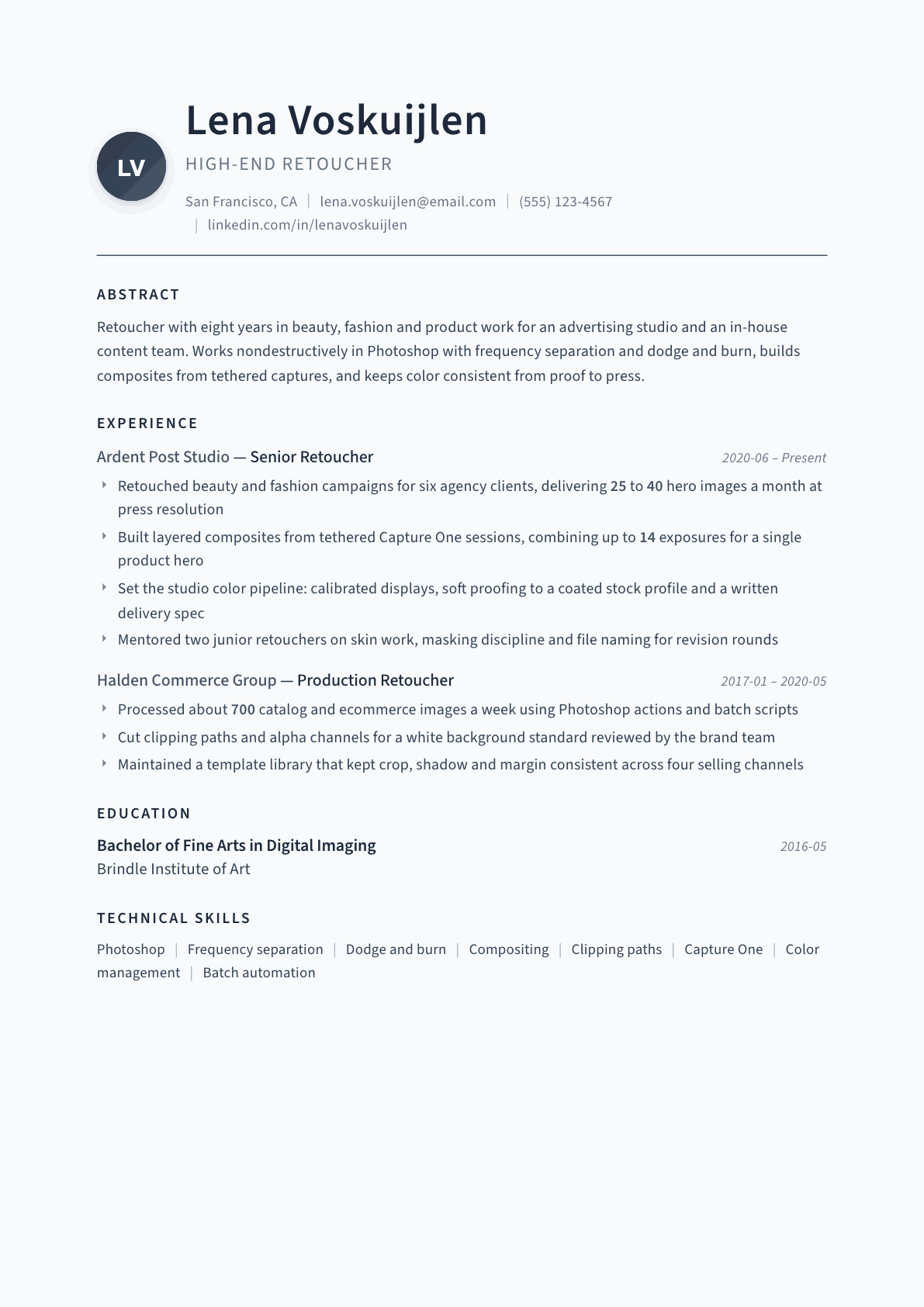
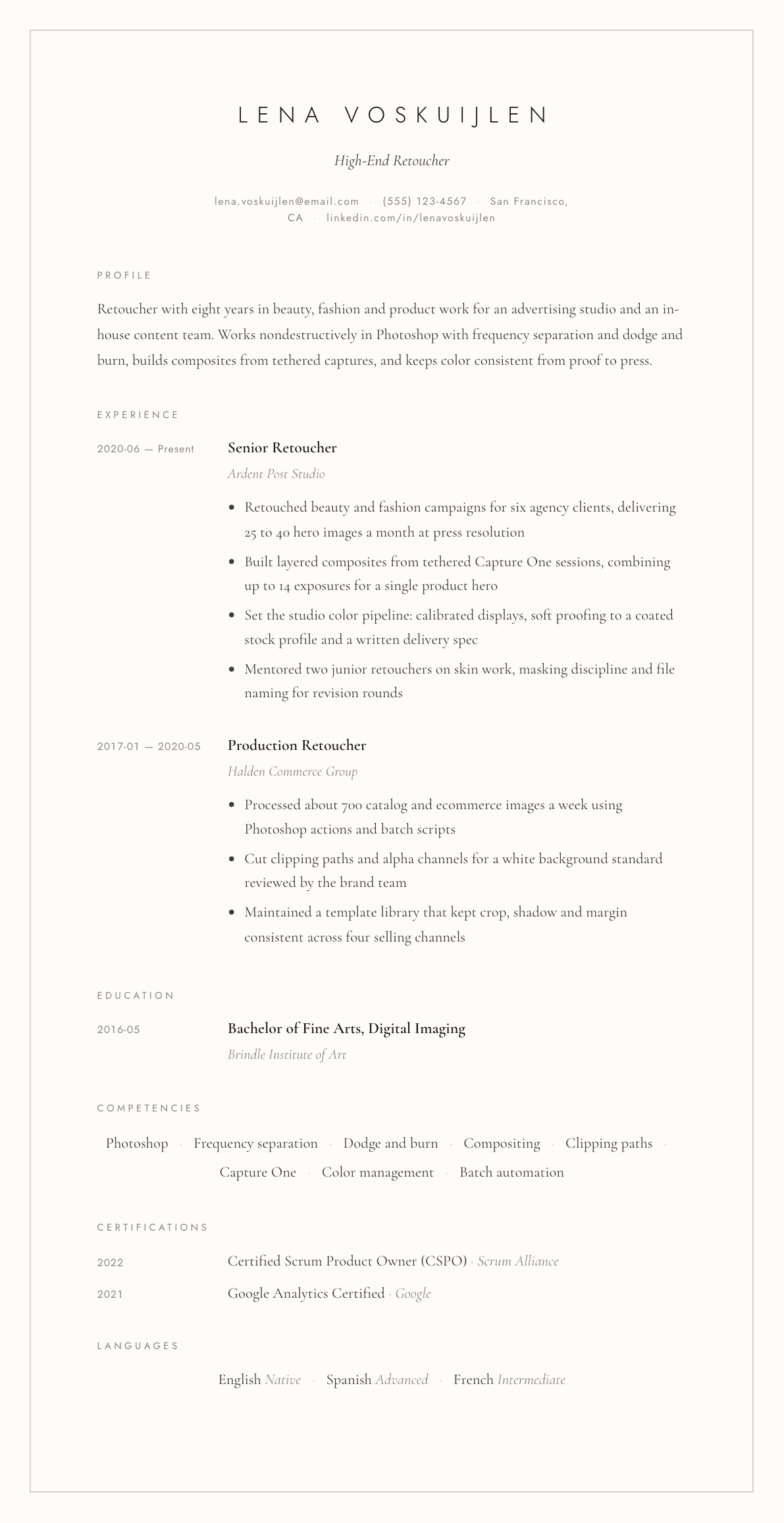
The same retoucher content laid out in three CVBooster templates, so you can see what the finished document looks like before you write a word.
Example Retoucher summary
Retoucher with eight years across beauty, fashion and high volume product work. Builds nondestructive Photoshop files with frequency separation, dodge and burn and clean masking, and composites multi exposure captures into a single believable hero image. Owns color from calibrated display through soft proof to delivered press file, and keeps revision rounds fast with a strict naming and layer standard.
Skills to list on a Retoucher resume
- Photoshop
- Frequency separation
- Dodge and burn
- Skin retouching
- Compositing
- Masking and clipping paths
- Capture One
- Camera raw processing
- Color management
- Soft proofing
- Batch automation
- Layer and file discipline
- Print preflight
- Revision tracking
What actually gets this resume read
- Split your experience into beauty, product and composite work, because studios hire for one of those lanes at a time.
- Give throughput honestly: images per day for production work and hours per image for high-end beauty are different claims.
- Name your nondestructive techniques, since a hiring retoucher wants to see layer discipline rather than a slider preset.
- Show color management experience: display calibration, ICC profiles, soft proofing and the press or web target you delivered to.
- Say how you handle revision rounds and file naming, because client feedback cycles are where studio time gets lost.
- Expect a paid test file, so keep a before and after set in your portfolio with the original raw included.
How to write a retoucher resume
Retouching hiring ends with a test file. A studio sends a raw frame, you send back a layered document, and somebody opens the layer stack to see how you got there. Everything on your resume is therefore a claim that will shortly be checked, which is a good reason to describe technique precisely and throughput honestly.
The field splits into lanes that rarely overlap. High end beauty and fashion is slow, subtle and measured in hours per image. Ecommerce and catalog production is fast, standardized and measured in images per day. Compositing and still life sits between them, built from tethered captures and stacked exposures. A studio is hiring for one lane at a time, and a resume that blurs all three suggests you have not committed to any.
This guide covers how to structure a retoucher resume around lanes, how to write about nondestructive technique so it reads as discipline rather than jargon, what color management detail actually persuades, and how to present before and after work without giving away a client's unreleased campaign.
Format: one page, portfolio first, no decorative layout
One page is right for almost every retoucher. The portfolio is the application; the resume exists to establish the lane, the volume and the workflow. Put the portfolio address in the header and make sure at least one item shows the original capture beside the delivered file, because a finished image alone proves nothing about who did the work.
Keep the document itself plain. A retoucher presenting a heavily designed resume invites the reader to judge the design rather than the imaging, and the design is not what is being hired.
- Header: name, city, phone, email, portfolio address, and whether you work on site, remotely or both.
- Sections: summary, experience grouped by lane, technical skills, color and delivery, education.
- Say plainly whether you are available for overflow and rush work, since studio demand is spiky.
Summary: lane, years, technique, color responsibility
Name the lane in the first clause: beauty and fashion, product and still life, ecommerce production, or composite work. Then the years, the core techniques you build files with, and whether you owned color from calibrated display through to the delivered file.
Color ownership is the detail that moves a retoucher from production to senior. Anyone can match a reference on their own monitor. Being trusted to set the studio pipeline, soft proof to a press profile and sign off a delivery specification is a different level of responsibility, and it belongs in the summary if you have carried it.
Experience: throughput stated in the right units
Use the unit that matches the lane. High end beauty is honestly expressed as hero images per month or hours per image. Ecommerce production is images per week with the standard you worked to. Mixing the units, or claiming a beauty hero count that only makes sense as catalog throughput, is the fastest way to lose a reader who does this work themselves.
For composite work, give the input count. Combining fourteen exposures from a tethered session into one product hero is a real description of the job, covering focus stacking, reflection control, separate lighting passes and the masking discipline that holds it together.
Describe your layer practice as a system rather than a list of techniques. Frequency separation and dodge and burn on their own are table stakes. What distinguishes an applicant is naming the file structure: grouped adjustment stacks, named layers, non flattened deliverables, and a revision naming scheme a client can follow across three rounds of notes.
If you built automation, quantify what it removed. Actions, batch scripts and templates that hold crop, shadow and margin consistent across selling channels are the difference between a production department that scales and one that drowns in a seasonal peak.
Color management and delivery
Give the chain: display calibration and how often, the working space, soft proofing to a coated or uncoated stock profile, and the delivery specification you handed over. For digital work, the target profile and the export settings you standardized. This paragraph is short and it does more to establish seniority than any amount of technique vocabulary.
Add preflight if you have print experience. Resolution at final size, bleed, ink limits and separations are the failures that get a file rejected at the printer, and a retoucher who catches them before delivery saves a reshoot.
Portfolio and the test file
Expect a paid or unpaid test. Keep your portfolio ready to support it: a small set of before and after pairs with the untouched raw included, at least one skin heavy beauty file, one product file with a clean path, and one composite where the seams are worth examining.
Be careful with unreleased client work. Ask before publishing, and where you cannot, show a self directed piece built to the same brief. A studio takes an embargo breach as a signal about how you will treat their own campaigns.
Retoucher resume summary examples
Production retoucher, first two years
Production retoucher with two years in ecommerce imaging, processing roughly 500 catalog images a week with Photoshop actions and batch scripts. Cuts clean clipping paths and alpha channels to a white background standard, and keeps crop, shadow and margin consistent through a template library across three selling channels.
Five years, mixed lanes
Retoucher with five years across product, still life and light beauty work for an in house content team. Builds nondestructive Photoshop files with frequency separation, dodge and burn and tracked masking, composites tethered Capture One sessions, and delivers 25 to 40 press resolution images a month against a written revision schedule.
Senior retoucher and color owner
Senior retoucher with eight years in beauty, fashion and advertising post, delivering hero images for six agency clients. Owns the studio color pipeline: calibrated displays, soft proofing to a coated stock profile and a written delivery specification. Mentors two junior retouchers on skin work, masking and file discipline.
Work experience bullets: before and after
Before: Retouched images for advertising clients.
After: Retouched beauty and fashion campaigns for six agency clients, delivering 25 to 40 hero images a month at press resolution through two rounds of client notes.
Lane, client count, monthly volume and revision rounds make the workload and the standard concrete.
Before: Created composite images from studio shoots.
After: Built layered composites from tethered Capture One sessions, combining up to fourteen exposures into a single product hero with separate passes for reflections, edges and label detail.
The input count and the named passes describe the actual construction rather than the finished look.
Before: Handled color for the studio.
After: Set the studio color pipeline: display calibration on a fixed schedule, soft proofing to a coated stock profile, and a written delivery specification adopted by every retoucher on the floor.
Naming the steps and the adoption shows ownership of a system, not just correct settings on one machine.
Before: Processed a high volume of catalog images.
After: Processed roughly 700 catalog and ecommerce images a week using Photoshop actions and batch scripts, with a manual quality pass on every hero and a sampled check on the rest.
Adding the quality pass answers the obvious objection that speed at that volume means unreviewed output.
Before: Trained junior team members.
After: Mentored two junior retouchers on skin work, masking discipline and a file naming scheme that kept three revision rounds traceable without duplicated documents.
The named subjects show what you are considered expert in and connect training to a real studio problem.
Hard skills
- Photoshop
- Frequency separation
- Dodge and burn
- Skin retouching
- Compositing and focus stacking
- Masking and clipping paths
- Capture One
- Camera raw processing
- Color management and calibration
- Soft proofing
- Actions and batch automation
- Layer and file discipline
- Print preflight
- Revision tracking
Soft skills
- Attention to detail over long sessions
- Taking art direction
- Consistency across a series
- Deadline discipline
- Clear revision communication
- Discretion with unreleased work
Mistakes that cost retoucher candidates the interview
- Claiming every lane at once, which suggests a portfolio that is broad and shallow in a field that hires for depth.
- Quoting production throughput next to high end beauty work, so a reader who does this job cannot reconcile the numbers.
- Showing only finished images without an untouched capture beside at least one of them.
- Listing techniques as vocabulary while saying nothing about layer structure, naming or how a revision round is handled.
- Skipping color management entirely and then being asked in the interview which profile you soft proofed to.
- Publishing an unreleased client campaign in a portfolio without permission, which reads as a risk rather than a credential.
- Building a decorative resume that competes with the portfolio for the reader's attention.
Retoucher resume questions
Should I expect a test file when applying for a retouching job?
Almost always. A studio sends a raw capture and reviews your layered return, checking masking edges, skin texture retention and whether the file stayed nondestructive. Ask whether the test is paid and whether the image is client work before you begin.
How do I state throughput without exaggerating?
Use the unit that matches the work. Production imaging is honestly measured in images per week, high end beauty in hours per image or heroes per month. Give the quality control step alongside the number so speed does not read as carelessness.
Do I need Capture One as well as Photoshop?
For studio and tethered work, yes, because sessions arrive as raw captures and the studio expects you to work inside their existing session structure. For pure post production on supplied files, Photoshop plus a raw processor is usually sufficient.
How should I show composite work in a portfolio?
Include the component captures beside the final image, or an animation stepping through the build. Reviewers want to see how the layers were assembled and where the seams are, because the construction is what proves the skill.
Is a fine arts degree useful for a retoucher?
It helps with color, form and lighting literacy and it is worth listing, but no studio hires on the degree. Portfolio depth in a chosen lane, plus a clean test file, decides the outcome of nearly every retouching application.