Colorist Resume Examples: free score, then the gap list
Build a Colorist Resume Around Grades and Pipeline Skill
By Mustafa Tarabya, founder of CVBooster · Published · Updated
Colorist resume example with grading credits, node workflow, color science and delivery specs, plus keywords and a writing guide.
Sample resumes for a colorist
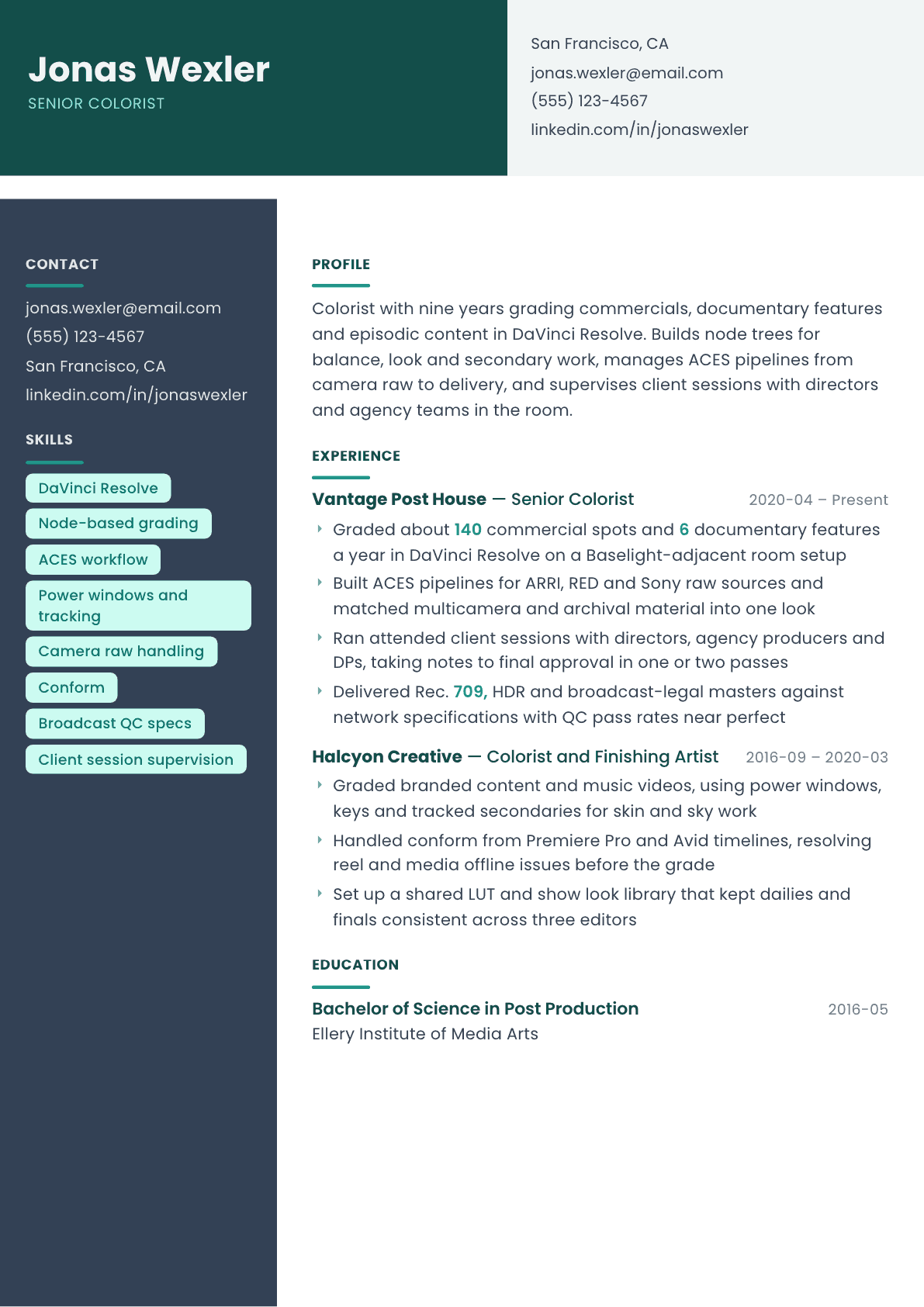
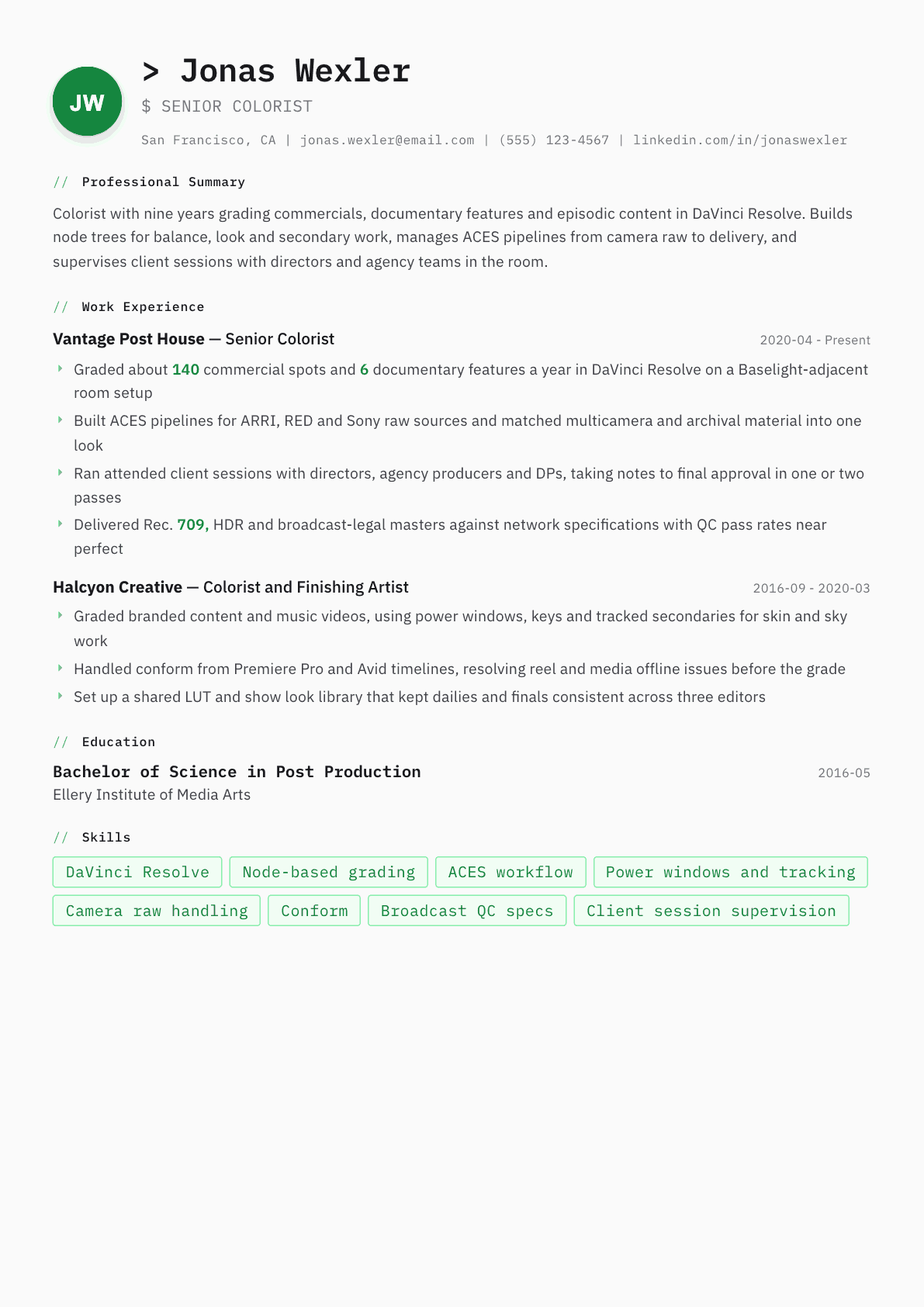
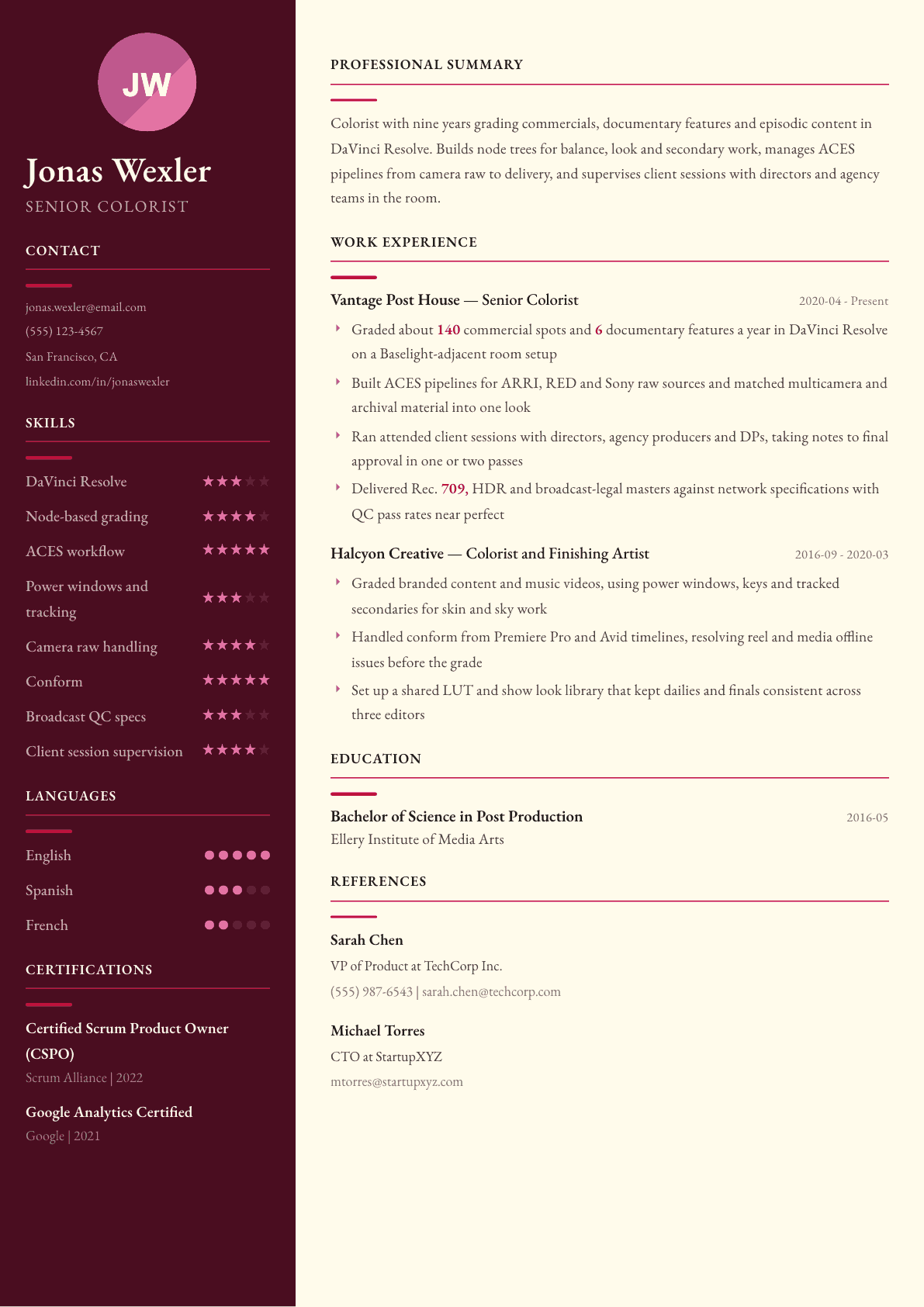
The same colorist content laid out in three CVBooster templates, so you can see what the finished document looks like before you write a word.
Example Colorist summary
Colorist with nine years grading commercials, documentary features and branded content in DaVinci Resolve. Builds node trees for balance, look and tracked secondaries, and manages ACES pipelines from ARRI, RED and Sony raw through Rec. 709 and HDR deliverables. Handles conform from Avid and Premiere timelines, and runs attended sessions with directors and agency producers to approval in one or two passes.
Skills to list on a Colorist resume
- DaVinci Resolve
- Node-based grading
- ACES color pipelines
- Log and camera raw formats
- Power windows and tracking
- Secondary and skin correction
- Shot matching
- LUT and show look creation
- Conform from Avid and Premiere
- HDR and Rec. 709 delivery
- Broadcast QC compliance
- Display calibration
- Client session supervision
- Dailies pipelines
What actually gets this resume read
- List your grading credits by format and length, since a spot reel and a feature grade prove different kinds of stamina.
- Name the systems and rooms you have worked in, including the panel, reference display and calibration you relied on.
- Show color science literacy in plain terms: log formats, camera raw sources, ACES or a custom pipeline, and the display target.
- Say whether you handle conform yourself, because many facilities hire a colorist who can also fix a broken timeline.
- Mention attended client sessions and how many passes you typically need, since room manner is half the job.
- Include delivery experience with broadcast and streaming specs, and note any QC rejections you learned to avoid.
How to write a colorist resume
A post house hiring a colorist is buying three things at once: an eye, a pipeline and a room manner. The eye is judged from a reel. The pipeline is judged from your resume, because that is where a supervisor learns whether you can take raw camera files from three manufacturers and archival material into one consistent look and out the other side as a compliant deliverable. The room manner is judged in the interview, but the resume can foreshadow it.
Of those three, the pipeline is where most applications are thin. Applicants describe their aesthetic and skip color management, conform, delivery specifications and quality control. A facility that has paid for a rejected master knows exactly which of those cost money.
This guide covers how to list grading credits by format, how to describe a node structure without drowning the reader, what to say about color management and delivery, how attended sessions signal seniority, and why conform ability makes a colorist far more employable.
Format: credits by format, then pipeline, then rooms
Group grading credits by format and length. Commercial spots, long form documentary, episodic and music video demand different stamina, and a facility filling a spot bay is looking for volume while a facility finishing features is looking for endurance and shot matching over hours of material.
Below the credits, put the pipeline block: color management, conform, delivery and quality control. Then the rooms and hardware you have worked in. A one or two page document with a reel link in the header is standard, and the reel should be gradable work with before and after where you can show it.
- Header: name, city, phone, email, reel link, and whether you work in a facility, remotely or both.
- Sections: summary, grading credits by format, pipeline and delivery, systems and rooms, education.
- Note remote grading capability explicitly, including your reference display and calibration practice at home.
Summary: formats, systems, pipeline, sessions
Four things in three sentences. The formats you grade, the system you work in, the color pipeline you manage, and whether you run attended client sessions. Attended sessions are the seniority marker in this trade, because grading alone in a dark room is a craft job and grading with a director, an agency producer and a director of photography behind you is a craft job plus a negotiation.
Add the raw sources you handle. Naming ARRI, RED and Sony raw formats, plus log encodings and archival material, says you have dealt with the messy reality of mixed sources rather than a single clean camera.
Grading craft: node structure over adjectives
Describe the shape of your work rather than its mood. A node tree that separates balance, look and secondary work is a structure a supervisor recognizes immediately, and it implies you build grades another colorist could pick up mid session.
Then the secondary toolkit as applied problems: power windows tracked through a moving shot, keys for skin and sky, matching a second camera to the hero, and pulling an archival clip into the show look without it fighting everything around it. Shot matching across a mixed multicamera scene is one of the hardest things in this job and it is worth naming.
Mention LUT and show look creation if you have built them. A colorist who supplies the on set look, keeps dailies consistent with it and then delivers a final that honors the same intention is solving a problem that spans three departments.
Color management, conform and delivery
State the pipeline in order: input transforms for each camera source, the working space, whether you run an ACES pipeline or a custom one, and the output transforms for each deliverable. Then the display targets, calibration practice and the reference monitor class you graded on.
Conform ability is a genuine hiring advantage. Many facilities want a colorist who can take a timeline from an offline editorial application, resolve reel and media problems, rebuild missing effects and get to a gradable sequence without a separate online artist. Say plainly whether you do that.
Delivery closes the argument. Name the standard targets you have delivered to, high dynamic range alongside standard, broadcast legal limits, and the quality control process each went through. If you have learned from a rejection, describe the check you added rather than the failure itself.
Client sessions and the room
Attended sessions are half the job at a commercial facility. Describe how you run one: taking notes from a director and an agency producer, working in passes rather than chasing every comment live, showing a comparison rather than arguing, and getting to approval in a small number of rounds.
If you also handle unattended and remote grades, say how you communicate: reference stills, annotated notes, a review link and a versioning convention that keeps everyone looking at the same cut. Remote work has made this an explicit skill rather than an assumption.
Colorist resume summary examples
Assistant colorist
Assistant colorist with two years preparing sessions, conforming timelines and handling dailies for a post facility. Builds project structures in DaVinci Resolve, applies show LUTs to camera raw sources, and has graded roughly 30 branded and social pieces independently. Comfortable with delivery specifications and broadcast legal checks.
Five years grading
Colorist with five years grading branded content, music videos and short documentary in DaVinci Resolve. Works node trees separating balance, look and tracked secondaries, handles conform from offline timelines, and built a shared LUT library that kept dailies and finals consistent across three editors.
Senior colorist
Senior colorist with nine years grading commercial spots, documentary features and episodic content. Builds ACES pipelines for ARRI, RED and Sony raw sources, matches multicamera and archival material into one look, and runs attended sessions with directors and agency producers to approval in one or two passes.
Work experience bullets: before and after
Before: Graded commercials and documentaries.
After: Graded roughly 140 commercial spots and six documentary features a year in DaVinci Resolve, working from camera raw through final approved masters.
Annual counts by format let a facility judge both throughput and the stamina long form requires.
Before: Worked with different camera formats.
After: Built ACES pipelines for ARRI, RED and Sony raw sources and matched multicamera and archival material into a single look across mixed scenes.
Naming the pipeline and the mixed source problem shows color management rather than preference.
Before: Ran client sessions in the grading suite.
After: Ran attended sessions with directors, agency producers and directors of photography, taking notes to final approval in one or two passes rather than chasing comments live.
Describing the method of the session shows room manner, which is what separates a senior colorist from a fast one.
Before: Handled conform when the timeline was broken.
After: Handled conform from offline editorial timelines, resolving reel and media offline issues and rebuilding missing effects before the grade began.
The specific problems solved prove genuine finishing ability rather than an occasional relink.
Before: Delivered files that met broadcast requirements.
After: Delivered standard dynamic range, high dynamic range and broadcast legal masters against network specifications, adding a legalizer and loudness check to the final pass after an early rejection.
Naming the deliverable types and the check you added turns compliance into a demonstrated process.
Hard skills
- DaVinci Resolve
- Node based grading
- ACES color pipelines
- Log and camera raw formats
- Power windows and tracking
- Secondary and skin correction
- Shot matching across cameras
- LUT and show look creation
- Conform from offline timelines
- High dynamic range and standard delivery
- Broadcast quality control compliance
- Display calibration
- Dailies pipelines
Soft skills
- Client session manner
- Reading a director's intent
- Patience with revisions
- Clear technical explanation
- Endurance in long sessions
- Collaboration with editorial
Certifications worth listing
- DaVinci Resolve Certified Colorist (Blackmagic Design)
- DaVinci Resolve Certified Trainer (Blackmagic Design)
Mistakes that cost colorist candidates the interview
- Describing an aesthetic at length while never naming a color pipeline, a display target or a delivery specification.
- Listing credits without format or length, so a facility cannot tell spot volume from long form endurance.
- Leaving conform off the page when many facilities specifically want a colorist who can fix a broken timeline.
- Never mentioning attended sessions, which leaves the reader unsure whether you can work with clients in the room.
- Submitting a reel of graded shots with no before and after, making it impossible to see what you contributed.
- Ignoring quality control and legalization, the failures that cost a facility a redelivery and a relationship.
- Claiming remote grading without describing your reference display, calibration practice and review workflow.
Colorist resume questions
What should a colorist reel show?
Graded sequences with before and after where the client permits it, spanning at least two formats. Include one mixed source scene that required shot matching, because that proves technical control in a way that a beautifully lit hero shot never does.
Do I need to know conform to get hired as a colorist?
Not always, but it widens your options considerably. Facilities without a dedicated online artist want somebody who can take an offline timeline, resolve media and reel problems and reach a gradable sequence without escalating to another department.
How do I describe color science knowledge without jargon?
Say it as a chain: the camera sources you take in, the transform you apply, the working space you grade in, and the output transforms for each deliverable. That sentence tells a supervisor everything they need without vocabulary for its own sake.
Does a certification matter for a colorist?
A vendor certification such as the Blackmagic Design colorist credential is a reasonable line item, especially early on, but no facility hires on it. The reel and the pipeline description decide the outcome of nearly every application.
How should I present remote grading experience?
State the reference display class and how often it is calibrated, the review and versioning workflow you use with clients, and how you handle notes without a shared room. Facilities now treat remote capability as a distinct skill worth listing on its own.