Graphic Designer Resume Examples: the lines they read
Graphic Designer Resume Examples for Designers at Every Level
By Mustafa Tarabya, founder of CVBooster · Published · Updated
Graphic designer resume examples for designers from junior to lead, plus UK graphic design CV examples: portfolio link, artifact bullets and tools.
Sample resumes for a graphic designer
The same graphic designer content laid out in three CVBooster templates, so you can see what the finished document looks like before you write a word.
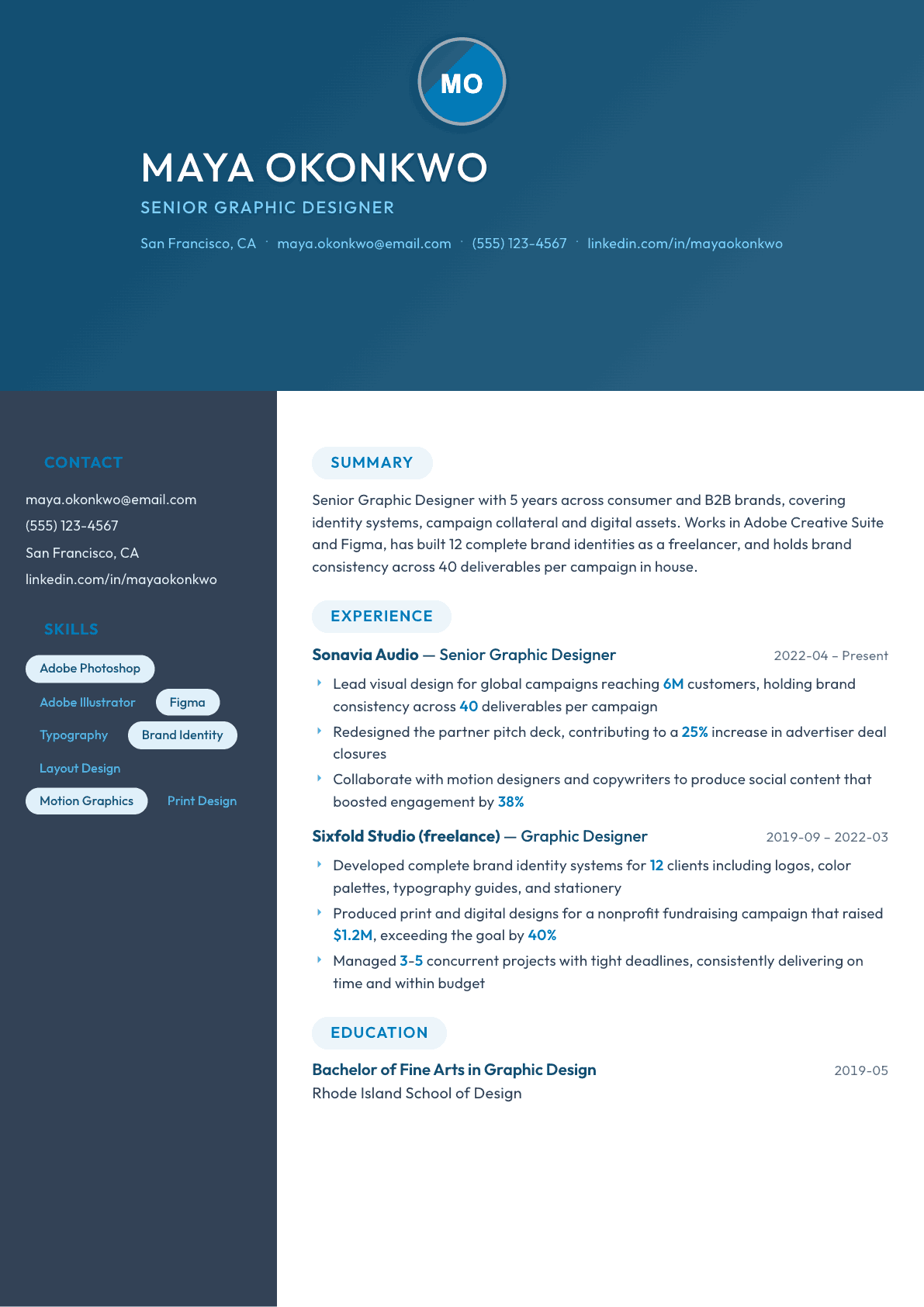
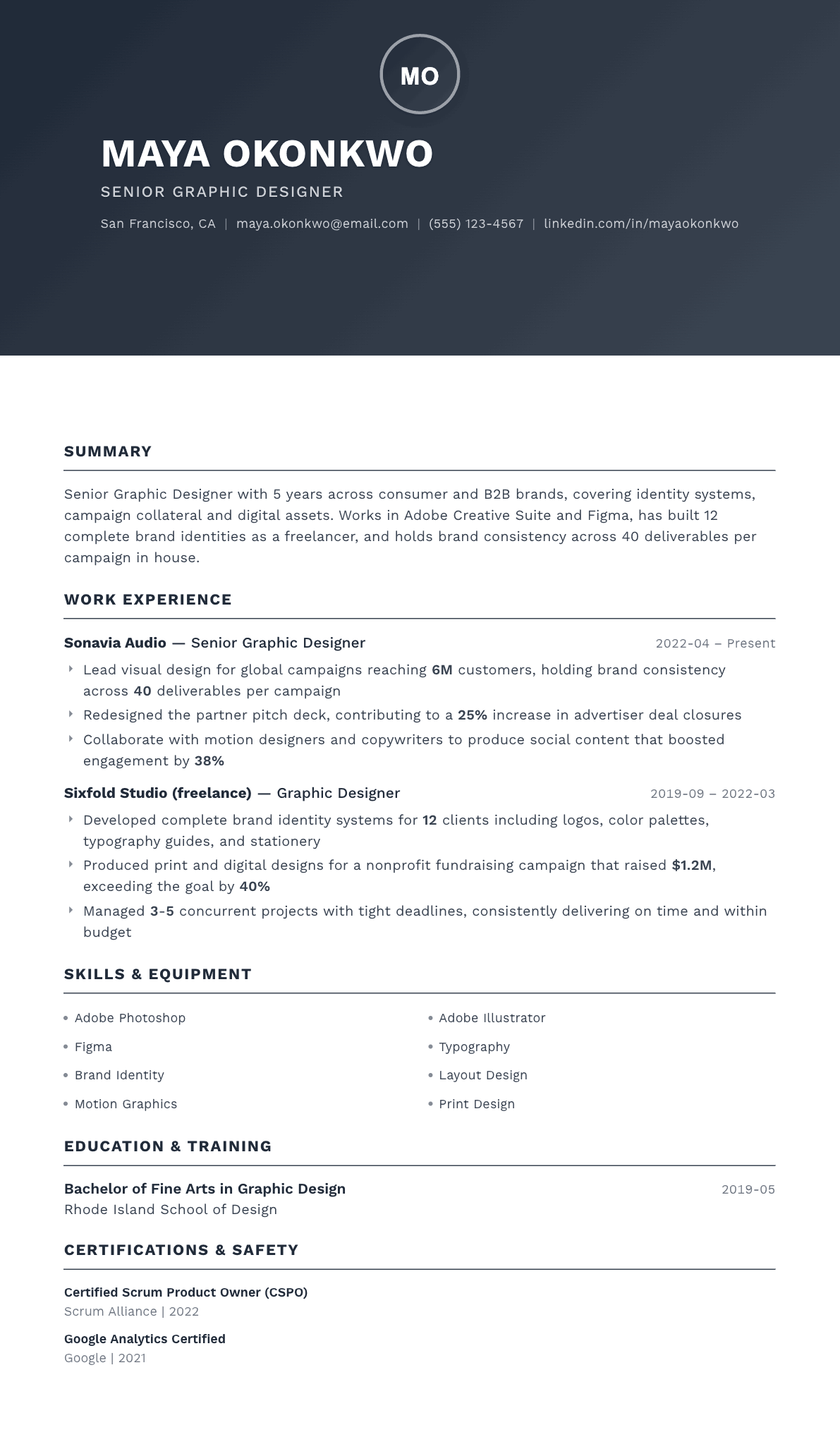
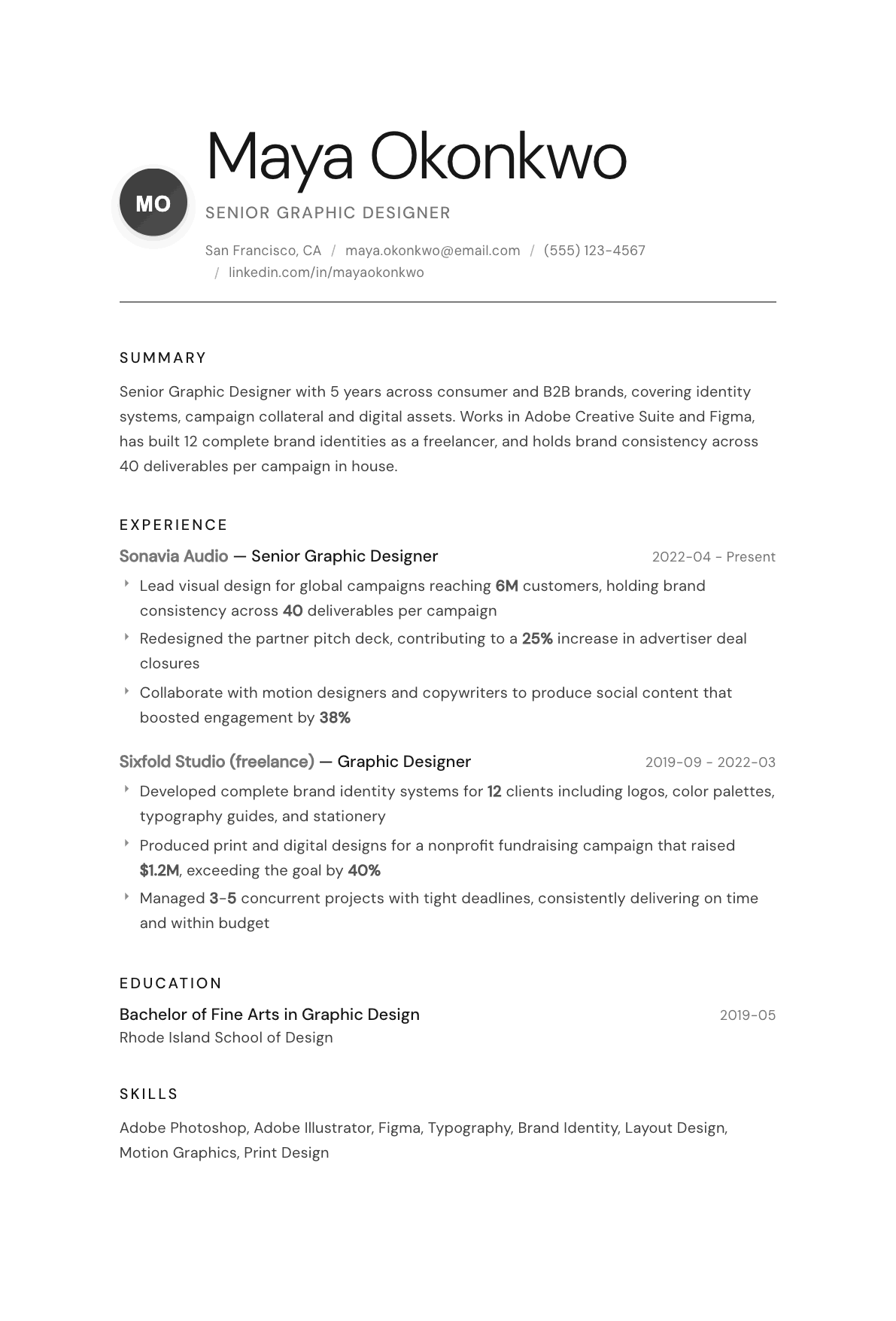
Example Graphic Designer summary
Graphic designer, 5 years, splitting work between brand systems and campaign production in Adobe Creative Suite and Figma. Twelve identity systems built end to end, a pitch deck redesign tied to 25% more advertiser closures, and social work that raised engagement 38%. Portfolio covers consumer audio, nonprofit and small studio clients.
Skills to list on a Graphic Designer resume
- Adobe Photoshop
- Adobe Illustrator
- Adobe InDesign
- Figma
- Sketch
- Typography
- Brand Identity
- Layout Design
- Motion Graphics
- Print Design
- Packaging Design
- Photo Editing
- Color Theory
- UI Design
- Design Systems
What actually gets this resume read
- Include a prominent link to your online portfolio or Behance/Dribbble profile at the top of your resume.
- Describe the business impact of your designs: increased engagement, higher conversions, or stronger brand recognition.
- List specific software proficiency levels and versions to help ATS matching.
- Show versatility by including a range of project types: branding, web, print, motion, packaging.
- Keep the resume layout clean and well-designed; your resume itself is a portfolio piece.
- Mention collaboration with cross-functional teams (marketing, product, engineering) to show you work well beyond the design silo.
How to write a graphic designer resume
Graphic design attracts more applicants per opening than almost any creative role, which means the resume is a filter before it is a sales document. The person reading it, usually a design lead or a marketing manager, is sorting for fit rather than talent: does this candidate work in brand identity, in campaign and social, in editorial and print, in packaging, or in product interface work. Those are four different careers sharing one job title, and a resume that refuses to pick one gets sorted into the maybe pile.
The second filter is production competence. Anyone can make a nice composition in a portfolio piece. Far fewer can prepare a file that prints correctly, build a layout that survives translation into six languages, keep a brand consistent across two hundred assets a quarter, or hand clean components to a developer. Naming that work is what separates a resume that gets a call from one that gets a polite no.
This guide covers how to structure the document, what belongs in the portfolio versus the resume, how a graphic design CV for a UK application differs, three summaries at different levels, before and after bullets that turn design tasks into evidence, and the questions designers ask when they are self taught or moving between print and digital. The resume examples for designers here are written for graphic design, but the same layout serves brand, web, UX and motion designers once the tools and outputs change.
Format: one page, plain structure, portfolio link at the top
One page for most designers, two only when you have led teams. The resume should be well set and quiet: a clear typographic hierarchy, generous margins, one or two weights, no color blocks behind text. Designers often over design this document and it works against them, because a large employer runs it through a parser first and a lead reads it on a phone second.
The portfolio link goes in the header next to the email, not at the bottom. If the site is behind a password, put the password on the resume. If your best work is under a client agreement you cannot publish, say that a private walkthrough is available and be ready to give one.
- Header: name, discipline line such as "Brand and Packaging Designer", city, email, portfolio link.
- Order: summary, experience, tools, education, awards or speaking.
- Junior designers add a projects section for freelance, student and volunteer work with real clients.
- Export as a text-based PDF, never as an image or an artboard export.
Summary: pick a lane and name the output
Say what kind of designer you are, the industries you have designed for, the years, and the volume or type of output you are used to. A designer who has produced a brand system with guidelines is offering something different from one who has run a weekly social campaign calendar, and the reader wants to know which is on the table.
If you work across disciplines, order them by strength rather than listing them flat. "Brand identity and packaging, with campaign and social support" is a position. "Print, digital, motion, web, illustration, UI, video" is a shrug.
Experience: the work, the constraints, and what it did
For each role, give the team shape and the throughput. Whether you were the only designer in a company of forty, one of eight on an in-house brand team, or a mid-weight at an agency with three concurrent accounts changes how a lead reads every bullet under it. Add the client types or the product categories.
Then write bullets that carry a constraint and an outcome. The constraint is what makes design work interesting to a hiring manager: a fixed print budget, a brand system that had to work in a second script, an accessibility contrast standard, a template that non-designers would use without breaking it. The outcome is what changed after the work went out.
Be specific about the artifacts. A brand guideline document, a component library, a packaging dieline set, a template kit, a campaign toolkit, an editorial grid: these are things a design lead has commissioned and can evaluate. "Created marketing materials" is not one of them.
Tools: group them and say what you build with each
Group the list rather than running twenty names together. Layout and print in one group, vector and image in another, interface and prototyping in a third, then motion and any supporting tools. Adobe Illustrator, Photoshop and InDesign remain the core for brand, editorial and print work, while Figma is the working environment for interface and increasingly for brand systems too.
Add the production knowledge that never appears in a portfolio image: color modes and separations, spot colors, bleed and trim setup, preflight and packaging files for a printer, image resolution and asset export pipelines, font licensing, and accessible color contrast. That paragraph is often the reason a mid-level designer is chosen over an equally talented junior.
- Layout and print: InDesign, editorial grids, prepress setup, printer proofs.
- Vector and image: Illustrator, Photoshop, logo construction, retouching.
- Interface: Figma, component libraries, design tokens, developer handoff.
- Motion and support: After Effects basics, asset export, digital asset management.
Graphic design CV: what changes for a UK application
In the UK and Ireland the same document is called a CV, and people search for it as a graphic designer CV or a graphic designing CV. The content above still applies: a discipline line, a portfolio link in the header, artifacts instead of tasks, and production knowledge named plainly. What changes is a handful of conventions that a UK studio or in house team expects to see.
Open with a personal profile of three or four lines instead of a summary, written in the first person without the pronoun: what kind of designer you are, the sectors you have worked in, and the work you want next. Two pages is normal for a UK CV once you have a few years of experience, so a mid weight designer does not need to cut real projects to fit one page. Use UK spelling throughout, because a design lead notices a stray American spelling on a UK application.
Leave out a photo, date of birth and marital status. UK employers do not expect them, and a photo on a CV invites the reader to judge the wrong thing. If you are applying from abroad, add one line under your contact details about your right to work in the UK, and name the city you are based in or moving to.
- Sample personal profile: Mid weight graphic designer with four years in a Manchester branding studio, working on identity systems, packaging and campaign artwork for food, drink and charity clients. Confident in prepress and print production, and looking for an in house role where I can own a brand across print and digital.
- Header line: Graphic Designer, Brand and Packaging | Leeds | email | portfolio link with password if needed.
- Education line: BA (Hons) Graphic Design, with the classification if it helps, and any industry brief or placement year named.
- Freelance line: Freelance graphic designer with start date and "present", then three named client types and the deliverables for each.
Portfolio and awards: the resume points, the portfolio proves
Keep the resume free of images and let the portfolio do that job. Four to six case studies is the right number, each showing the brief, the constraint, two or three process artifacts and the final result. A wall of pretty finals with no thinking behind it reads as a student site regardless of how good the work is.
Awards and recognized shows belong in a short list with the body named. Speaking, teaching, a published typeface or an open source template also earn a line, because they show a designer whose thinking travels beyond one employer.
Graphic Designer resume summary examples
Junior designer
Junior graphic designer with a design degree and two years of freelance and internship work in brand identity and social campaigns for small hospitality and nonprofit clients. Works daily in Illustrator, InDesign and Figma, and has prepared print-ready files for signage, menus and event collateral.
Five years in
Graphic designer with five years in-house at a consumer brand, owning packaging, retail signage and campaign toolkits across roughly 40 product lines. Built the current brand guideline document and the template kit the marketing team uses, and manages print vendor relationships and proofing.
Senior or lead designer
Senior designer leading a team of four across brand identity, packaging and digital campaign work for a multi-market retailer. Owns the brand system and its guidelines, runs design critique and hiring, and works with marketing and product to keep one visual language across print, store and screen.
Work experience bullets: before and after
Before: Designed marketing materials for the company.
After: Designed and produced print and digital campaign assets across email, paid social, in-store signage and trade collateral, running roughly 30 assets a month as the only designer on a marketing team of nine.
The channels, the volume and the team shape show the workload a lead is buying.
Before: Created the company logo and brand guidelines.
After: Rebuilt the brand identity from logo through type scale, color system and photography direction, and wrote a 40-page guideline document that non-designers across three departments now use without asking for approvals.
Naming the system components and the adoption outcome shows brand thinking rather than a logo sketch.
Before: Worked with printers on production.
After: Prepared press-ready files with correct bleed, spot colors and separations, ran proof rounds with two print vendors, and cleared a full catalog print run with no reprints.
Prepress detail and a zero-reprint result answer the production competence question directly.
Before: Made templates for other teams to use.
After: Built a locked template kit in InDesign and Figma for sales and regional marketing, cutting one-off design requests to the team by about half in the first quarter after release.
It reframes a design task as a workload decision the business felt.
Before: Designed website graphics and UI elements.
After: Built a Figma component library with type and color tokens for the marketing site, matched it to the developer implementation, and checked every text pairing against accessible contrast levels.
Components, tokens and accessibility are the parts of digital design that a lead can actually assess.
Hard skills
- Brand identity systems
- Adobe Illustrator
- Adobe InDesign
- Adobe Photoshop
- Figma and component libraries
- Typography and type systems
- Editorial layout and grids
- Prepress and print production
- Packaging and dieline artwork
- Campaign and social asset design
- Brand guideline documentation
- Accessible color contrast
- Developer handoff
Soft skills
- Presenting and defending work
- Taking critique without ego
- Estimating and holding deadlines
- Stakeholder management
- Written rationale
- Mentoring juniors
Certifications worth listing
- Adobe Certified Professional, Visual Design (Adobe)
- Adobe Certified Professional, Photoshop (Adobe)
- Adobe Certified Professional, Illustrator (Adobe)
Mistakes that cost graphic designer candidates the interview
- Over designing the resume itself with columns, icons and image type, which breaks parsing and distracts a lead reading on a phone.
- Listing every discipline equally so the reader cannot tell whether you are a brand designer or a campaign designer.
- Sending a portfolio of finished images with no brief, constraint or process, which reads as a student site.
- Leaving out production knowledge such as prepress, export pipelines and accessibility, which is what separates levels.
- Describing tasks instead of artifacts: "created marketing materials" instead of naming the toolkit, guideline or library you built.
- Using a portfolio password without putting it on the resume, or a site that takes ten seconds to load.
- Claiming team work as solo work, which unravels in the first portfolio walkthrough question.
Graphic Designer resume questions
Should a graphic designer resume be visually designed?
It should be well set, not decorated. Show typographic judgment through hierarchy, spacing and restraint. Avoid multi-column layouts, icon rows, skill rating bars and image-based text, all of which parse badly and tell a lead nothing about your ability.
How many projects should a graphic design portfolio have?
Four to six case studies is enough. Each should show the brief, the constraint you worked against, a couple of process artifacts and the final outcome. Depth beats breadth, and a weak project drags down the average impression of everything else.
Can I get a graphic design job without a degree?
Yes, this field hires on portfolio far more than credentials. Replace the education section with a projects section listing real clients and real deliverables, including freelance and volunteer work, and be specific about what you produced and what constraints you worked within.
Do these resume examples work for designers in other disciplines?
Yes, the structure carries over. UX, product, web, brand and motion designers use the same order: portfolio link in the header, a summary that picks a lane, and bullets naming the artifact and its result. Change the tools and outputs. Print designers moving to digital should add two Figma projects with real components.
What is the difference between a graphic designer resume and a graphic design CV?
In the UK and Ireland the document is called a CV and usually opens with a short personal profile, runs to two pages once you have experience, and uses UK spelling. In the US it is called a resume and is usually one page. In both, the portfolio link sits in the header and no photo is added.