Packaging Designer Resume Examples: the lines they read
Build a Packaging Designer Resume That Gets Noticed
By Mustafa Tarabya, founder of CVBooster · Published · Updated
Create a packaging designer resume showcasing your structural design, print production, and shelf-impact skills with creative templates.
Sample resumes for a packaging designer
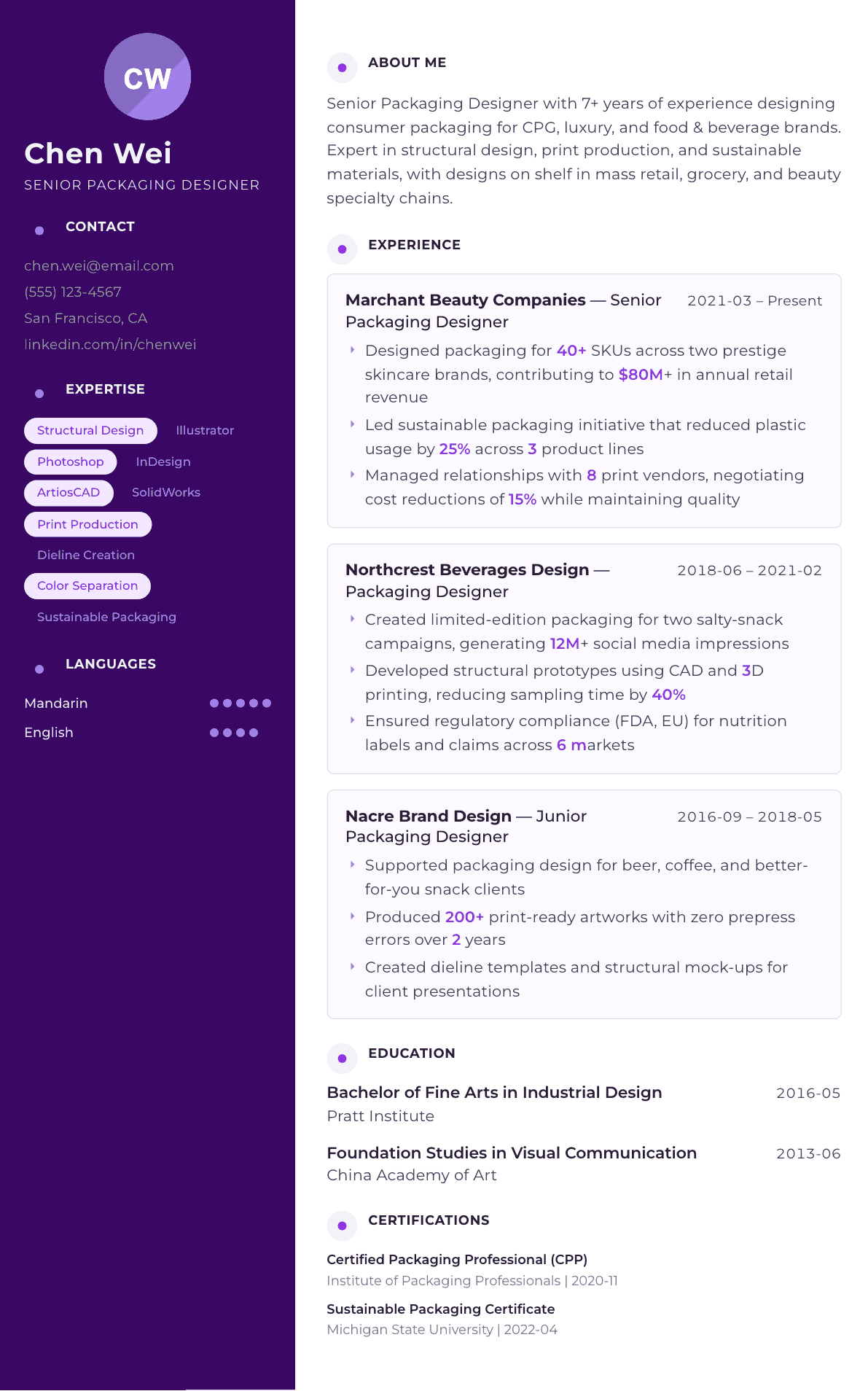
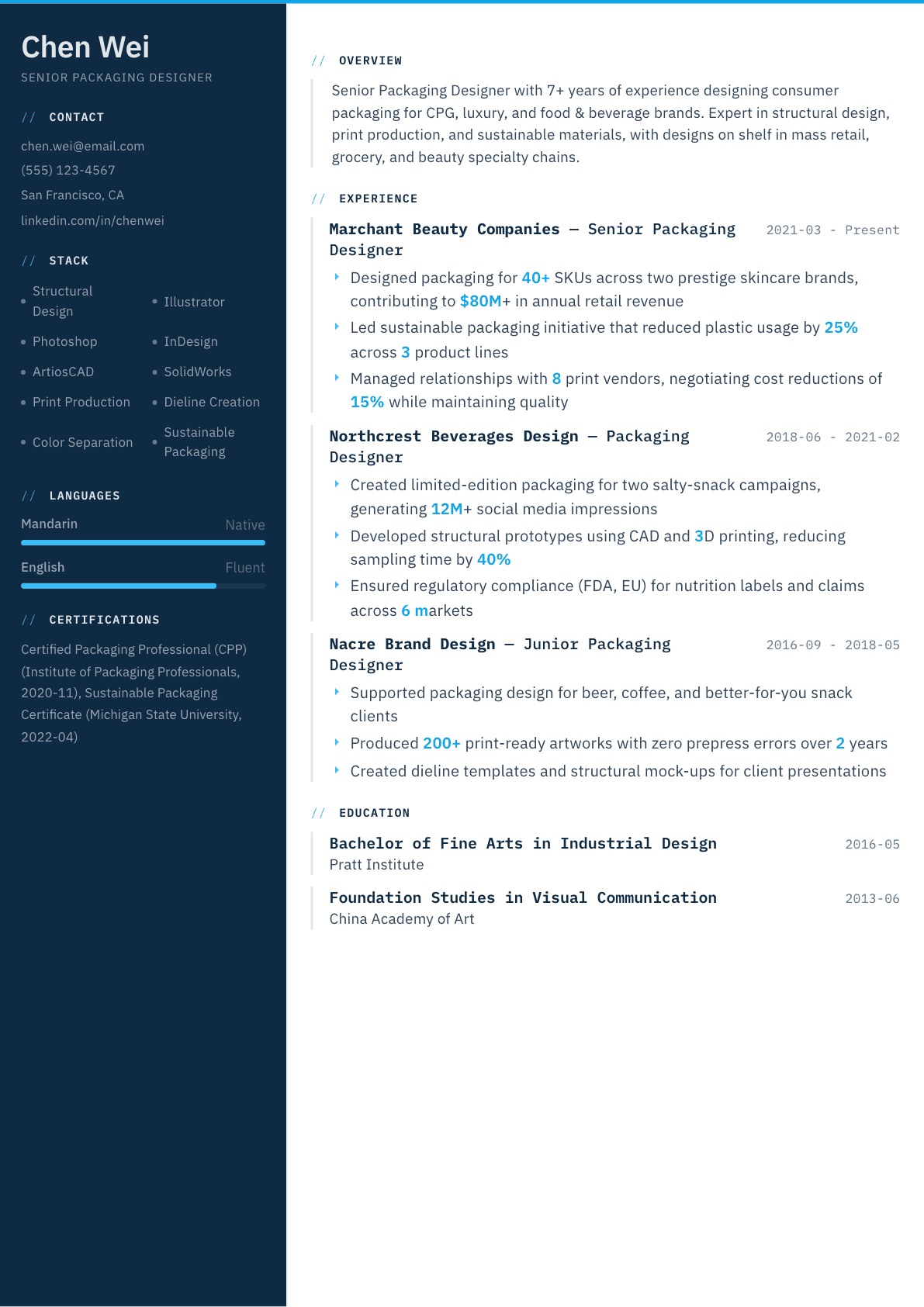
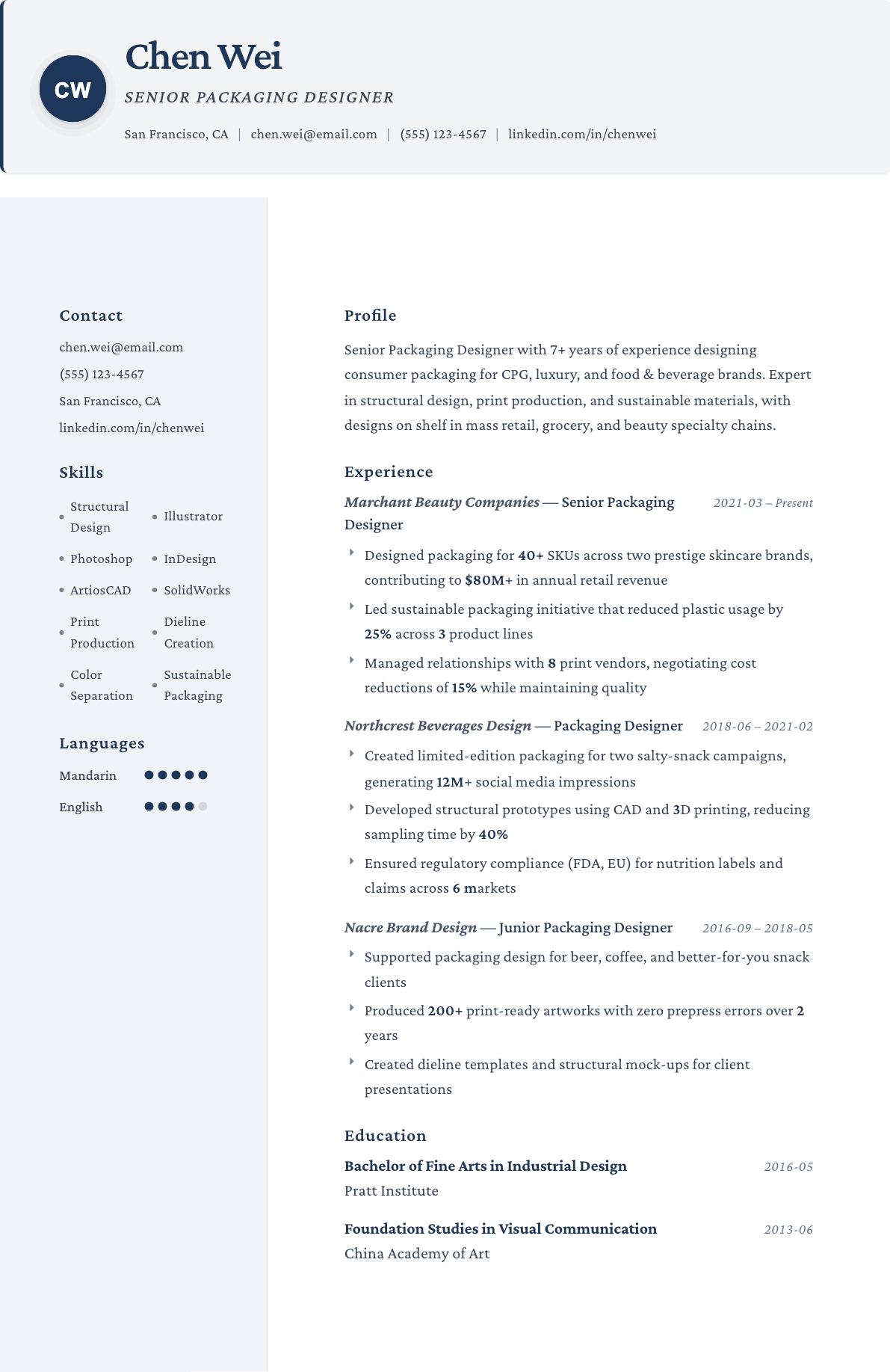
The same packaging designer content laid out in three CVBooster templates, so you can see what the finished document looks like before you write a word.
Example Packaging Designer summary
Packaging Designer with 7 years in CPG, beauty, and food and beverage packaging, from dieline to press check. Designed 40+ SKUs behind $80M in annual retail revenue and cut plastic use 25% across three product lines. Works in Illustrator, ArtiosCAD, and SolidWorks with 8 print vendors.
Skills to list on a Packaging Designer resume
- Structural Packaging Design
- Illustrator
- Photoshop
- InDesign
- ArtiosCAD
- SolidWorks
- Print Production
- Dieline Creation
- Color Management
- Sustainable Materials
- Prototyping
- Typography
- Brand Guidelines
- Regulatory Compliance
What actually gets this resume read
- Include high-quality photos of produced packaging in your portfolio -- shelf presence matters.
- Mention the retail channels where your designs are sold (Target, Walmart, Sephora, etc.) for instant credibility.
- Highlight sustainable design initiatives: material reductions, recyclability, or carbon footprint improvements.
- Show knowledge of print production: color separation, proofing, vendor management, and prepress.
- Quantify impact: SKUs designed, revenue contribution, cost savings, or error-free production records.
How to write a packaging designer resume
Packaging design is the one design discipline where a small mistake gets printed a million times. The person hiring you knows that, so the screen is less about taste than about control: can this designer build an accurate dieline, hold brand consistency across a hundred variants, get the mandatory copy and barcodes right, prepare separations a printer can run, and clear a proof round without a costly reprint.
The field also splits into two specialties that resumes often blur. Graphic packaging design owns the artwork, typography, hierarchy on shelf, and the print file. Structural packaging design owns the form, the material, the carton and the way the pack survives a distribution chain. Employers hire for one or the other, sometimes both, and they need to know within the first two lines which you are.
This guide covers the format packaging teams expect, how to describe a program so its real scale is visible, three summaries at different levels, before and after bullets that turn artwork tasks into production evidence, and the questions packaging designers ask about regulated categories, sustainability and moving in from general graphic design.
Format: one page, specialty named, portfolio link in the header
Keep it to one clean page while you are early, two once you have run programs across categories. State the specialty under your name: graphic packaging, structural packaging, or both. Then the categories you have worked in, because food, beverage, beauty, household, pharmaceutical and consumer electronics packaging each carry different regulations and different production realities.
Put the portfolio link in the header. Photograph produced packs on shelf or in hand, not only as flat artwork, because shelf presence and finish are half the argument. Include a dieline and a separation next to at least one project so a production reader can see the technical work.
- Header: name, specialty line such as "Packaging Designer, Structural and Graphic", city, email, portfolio link.
- Order: summary, experience, categories and programs, technical skills, certifications, education.
- List the substrates and print processes you have produced on under technical skills.
- Add a short line on the regulated categories you have worked in, if any.
Summary: specialty, categories, stock keeping unit volume
Name the specialty, the categories, the years, and the number of stock keeping units you have carried. Volume is the fastest way for a packaging manager to place you, because managing artwork for four hundred variants with rolling regulatory changes is a different job from designing eight beautiful bottles a year.
If you are moving in from general graphic design, say it and lead with the parts that transfer: typography, hierarchy, brand systems and prepress. Then be explicit about the packaging-specific skills you are building, such as dieline construction, substrate behavior and mandatory copy placement.
Experience: programs, variants, substrates and the print run
For each role, give the category, the retail channels, and the program scale. Say how many stock keeping units you owned, how many launches or refreshes a year, and whether the work was original design, an artwork adaptation program, or a rebrand rolled across an existing range. Adaptation work at volume is a real skill and worth naming rather than hiding.
Then describe the production side. Substrate and print process matter enormously: offset on folding carton, flexographic on film and corrugated, digital for short runs, gravure for long runs, plus finishing choices such as foil, spot varnish, embossing and metallized boards. Say what you have specified and what you have stood press-side for.
For structural work, describe the form and the constraints: carton style and closure, material caliper, pack-out configuration and case count, palletization, and the drop and compression testing that decides whether a pack arrives intact. Naming those tells a manager you design packs that survive distribution rather than only look good in a rendering.
Technical skills: artwork, dielines and prepress
Adobe Illustrator is the working environment for packaging artwork, with Photoshop for imagery and InDesign for multi-panel and multi-language documents. For structural work, name the tools you actually build in, such as ArtiosCAD or Esko for dielines and folding carton development, and any three-dimensional modeling package you use for containers and closures.
Then the production knowledge, which is what separates levels: color separations and spot color specification, trapping and overprint, bleed and trim on a folded structure, barcode setup and verification, ink limits by substrate, printer proofs and press checks, and the approval routing through regulatory, legal and quality teams. Add color measurement and a color management workflow if you have run one.
- Artwork: Illustrator, Photoshop, InDesign, multi-language and multi-variant artwork management.
- Structure: ArtiosCAD or Esko dielines, carton styles, three-dimensional mockups, mockup cutting.
- Prepress: separations, spot colors, trapping, ink limits, barcode setup and verification.
- Process: printer proofs, press checks, artwork approval routing, version and revision control.
Compliance and sustainability: the parts nobody sees until they break
Regulated categories carry mandatory content, and packaging designers are expected to know the rules for the categories they work in: ingredient and nutrition panels, allergen statements, net contents, warning and safety copy, recycling marks, country of origin, and minimum type sizes. Say which category rules you have worked to. It is the fastest reassurance a manager can get.
On sustainability, describe engineering rather than intent. Reducing board caliper while passing compression testing, moving from a mixed-material laminate to a mono-material film, removing a plastic window, or redesigning a case count to fit more units on a pallet are all real, measurable changes. Naming the recycling or certification standard you designed to gives the claim a reference.
Packaging Designer resume summary examples
Junior packaging designer
Junior packaging designer with a design degree and 18 months supporting a beauty brand, adapting artwork across roughly 60 stock keeping units in three languages. Builds dielines in Illustrator, prepares files for offset carton printing, and has attended two press checks with the production lead.
Five years in
Packaging designer with five years in food and beverage, owning artwork for about 200 stock keeping units across folding carton, flexible film and label formats. Specifies separations and spot colors, manages printer proof rounds, and works to the mandatory panel rules for packaged food.
Senior or lead designer
Senior packaging designer with twelve years across household and personal care, leading structural and graphic work for a portfolio of roughly 400 stock keeping units. Owns the artwork approval process with regulatory and quality, runs vendor qualification, and has delivered two material reduction programs that passed transit testing.
Work experience bullets: before and after
Before: Designed packaging for consumer products.
After: Designed and maintained artwork for about 180 stock keeping units across folding carton, shrink sleeve and flexible film, covering four product families and two retail channels.
Variant counts, formats and channels describe a workload a packaging manager recognizes.
Before: Prepared files for the printer.
After: Prepared press-ready artwork with four-color plus two spot separations, set trapping and ink limits for coated and uncoated stock, and verified barcode grade before every release.
Separations, ink limits and barcode verification are the prepress specifics that prevent expensive reprints.
Before: Worked on sustainable packaging improvements.
After: Reduced folding carton caliper across a nine-item range and removed the plastic window, keeping the pack within compression test limits and cutting board usage on every production run.
The engineering change plus the test constraint turns a sustainability claim into verified work.
Before: Created dielines and structural concepts.
After: Built dielines in ArtiosCAD for three new carton styles, cut and assembled physical mockups for retail review, and adjusted the pack-out to raise the units per case without changing the pallet footprint.
Dieline construction, physical mockups and a pack-out outcome show structural design end to end.
Before: Made sure packaging met regulations.
After: Routed artwork through regulatory and legal review for a food range, placing nutrition, allergen and net contents copy to the required minimum type sizes and clearing every item on the first review round.
Naming the mandatory content and a first-pass approval shows compliance as a managed process.
Hard skills
- Packaging artwork design
- Dieline construction
- ArtiosCAD and Esko workflows
- Adobe Illustrator
- Adobe Photoshop and InDesign
- Color separations and spot color specification
- Trapping, overprint and ink limits
- Substrate and print process selection
- Barcode setup and verification
- Printer proofs and press checks
- Mandatory copy and regulatory panels
- Structural carton and closure design
- Sustainable material specification
- Artwork version and approval control
Soft skills
- Attention to detail under volume
- Vendor and printer communication
- Working with regulatory and quality teams
- Presenting concepts to brand stakeholders
- Project tracking across many variants
- Calm handling of late copy changes
Certifications worth listing
- Certified Packaging Professional (CPP) (Institute of Packaging Professionals)
- Certified Professional in Training (CPIT) (Institute of Packaging Professionals)
- Adobe Certified Professional, Illustrator (Adobe)
Mistakes that cost packaging designer candidates the interview
- Not saying whether you do graphic packaging, structural packaging or both, which is the first question a manager has.
- Showing only flat artwork in the portfolio with no produced packs, dielines or separations behind it.
- Leaving out stock keeping unit volume, so a reader cannot tell whether you managed eight packs or four hundred.
- Skipping print process and substrate detail, which is where packaging expertise actually lives.
- Treating regulatory copy as somebody else problem, when placing mandatory panels correctly is part of the job.
- Writing sustainability as a value rather than as a measured material or structural change that passed testing.
- Ignoring the approval routing through regulatory, legal and quality, which is most of a packaging designer week.
Packaging Designer resume questions
What is the difference between graphic and structural packaging design?
Graphic packaging design owns the artwork, typography, shelf hierarchy and the print file. Structural packaging design owns the form, material, carton construction and how the pack survives distribution. Some teams hire both in one person, but the postings usually specify.
What should a packaging design portfolio include?
Produced packs photographed in hand or on shelf, the dieline behind at least one project, a separation or spot color breakdown, and a before and after on a redesign. Include one project with a real constraint such as a material change or a regulatory update.
How do I move from graphic design into packaging design?
Lead with typography, brand systems and prepress, which transfer directly. Then learn dieline construction, substrate behavior, spot color and mandatory copy rules, and build one packaging project that goes all the way to a printed, assembled mockup rather than a rendering.
Do packaging designers need to attend press checks?
In most roles yes, at least for launches and color-critical work. Standing at press to approve color against the proof is where a designer learns what a substrate will really do, and hiring managers treat press experience as a marker of production maturity.
How should I show sustainability work on a packaging resume?
Describe the specific change and the constraint it had to meet: caliper reduction that still passed compression testing, a move to mono-material film, a removed component, or a pack-out change that improved pallet efficiency. Name the standard you designed to where one applies.