Economist Resume Examples: free ATS score and gap list
Write an Economist Resume for Policy and Industry Roles
By Mustafa Tarabya, founder of CVBooster · Published · Updated
Economist resume examples covering econometrics, forecasting and policy analysis, with keywords and a guide to positioning research for non-academic hiring.
Sample resumes for a economist
The same economist content laid out in three CVBooster templates, so you can see what the finished document looks like before you write a word.
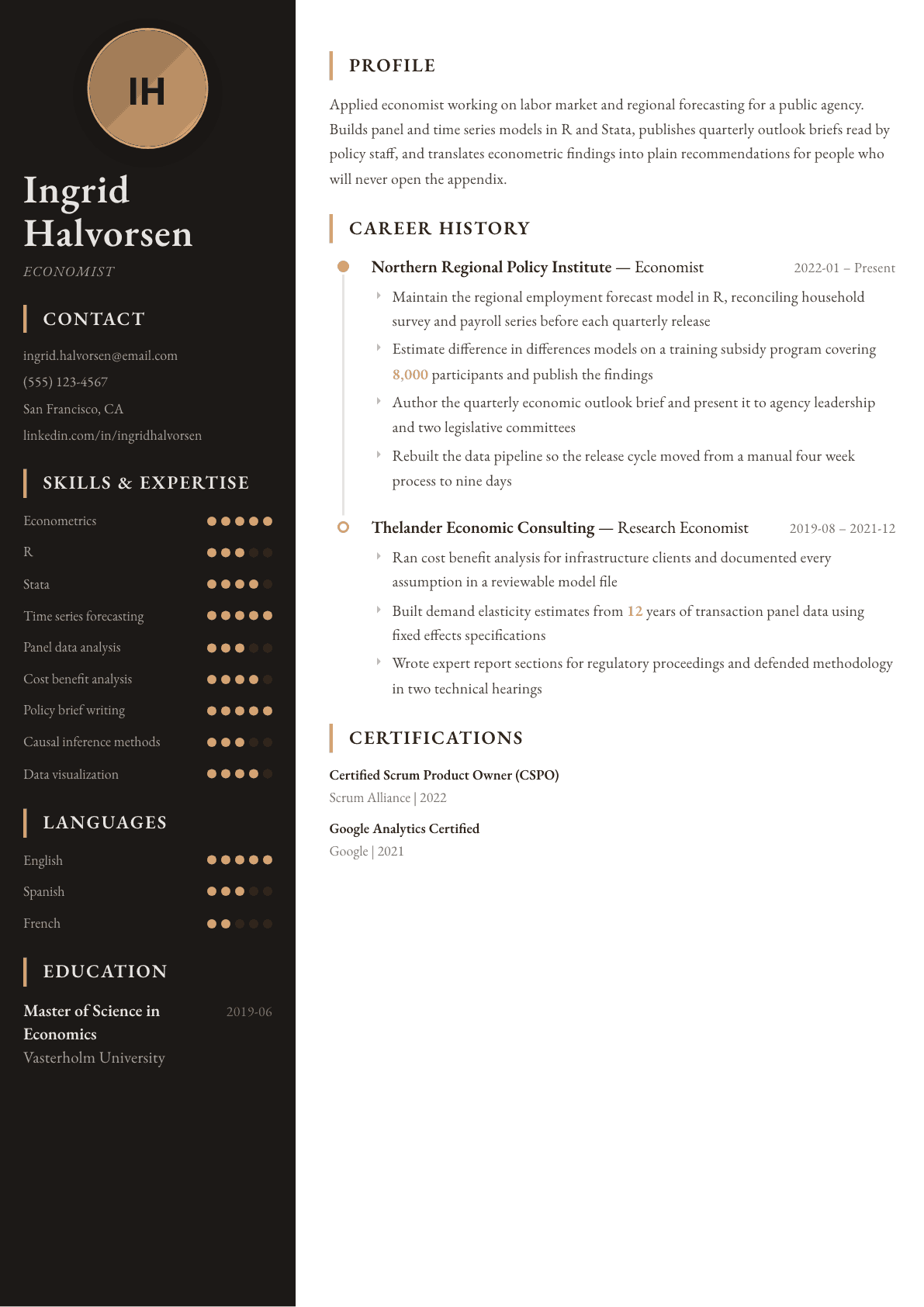
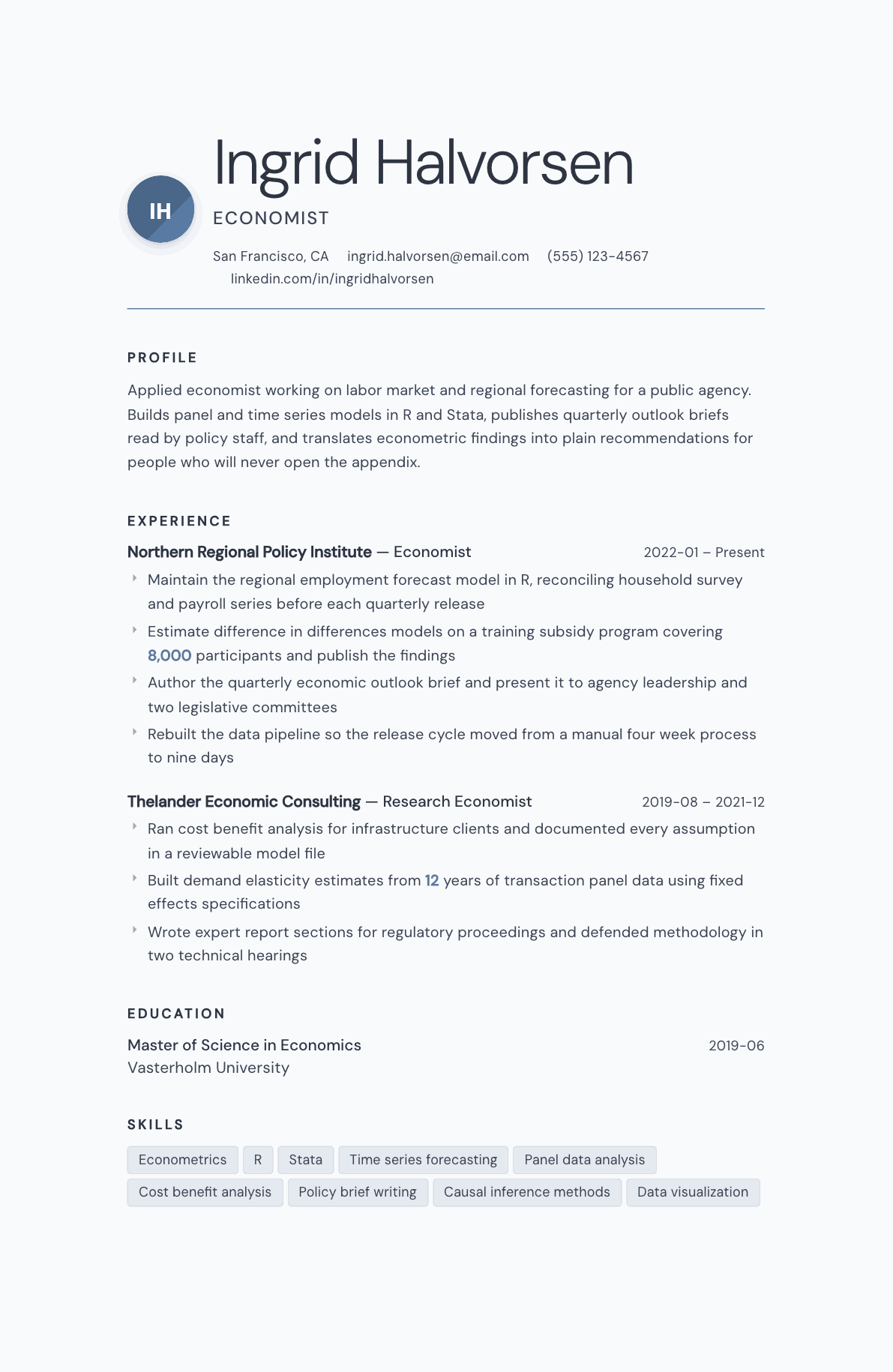
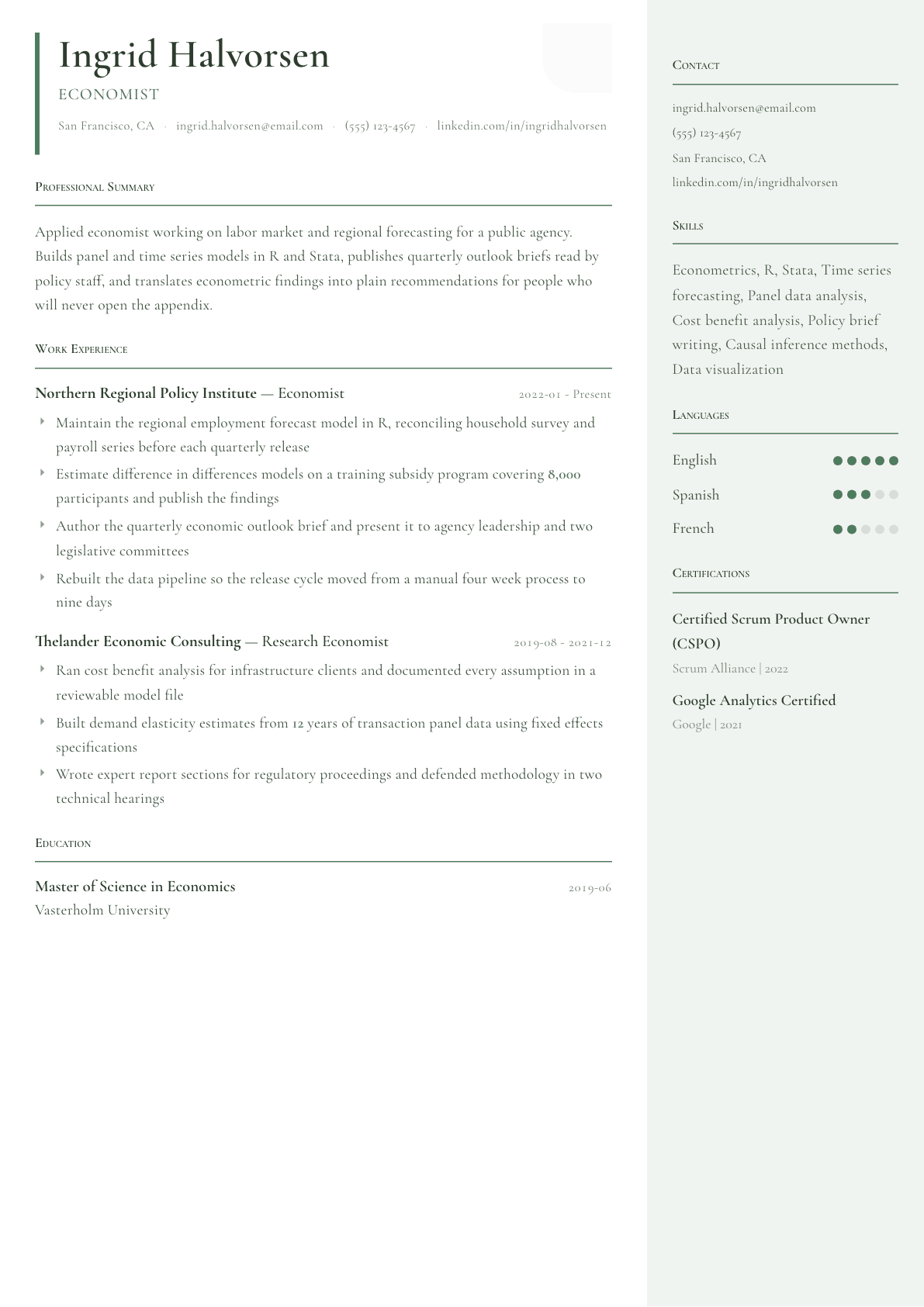
Example Economist summary
Applied economist with six years across public policy and consulting. Maintains a regional employment forecast in R, estimates program effects with difference in differences designs, and writes the quarterly outlook brief presented to agency leadership and legislative committees. Previously built demand elasticity estimates and defended methodology in regulatory hearings. Looking for a forecasting seat inside industry.
Skills to list on a Economist resume
- Econometrics
- Time series forecasting
- Panel data analysis
- Causal inference
- R
- Stata
- Python
- SQL
- Cost benefit analysis
- Economic impact analysis
- Policy brief writing
- Survey and administrative data
- Model documentation
- Data visualization
- Regulatory analysis
What actually gets this resume read
- Decide early whether you are targeting policy, consulting or industry, because each reads the same economist resume differently.
- Name your methods precisely: instrumental variables, difference in differences, vector autoregression, or synthetic control, not just analysis.
- List the statistical environments you work in daily and separate them from ones you have only used in a single course.
- Convert publications into results a manager can use, giving the question, the method and what the finding changed.
- Show the audience for your writing, since a brief read by legislators proves a different skill than a working paper.
- For industry roles, put forecasting and pricing work above academic output, because that ordering signals the transition clearly.
How to write a economist resume
An economist resume fails most often because it is written for an academic audience and read by an operating one. A hiring committee at an agency, a consultancy or a company wants to know what question you answered, what method you used, how defensible the estimate was, and what somebody did differently afterward. A publication list answers none of that on its own.
The reader is also checking whether you can be put in front of people. Applied economics work involves briefing officials who will not read an appendix, defending a specification in a hearing, or explaining to a commercial team why an elasticity estimate has wide confidence bands. Evidence that you have done this repeatedly is worth more than another working paper.
The sections below cover how to lay out an economist resume for non-academic hiring, three summaries spanning early career through senior applied work, before and after bullets that convert research into decisions, and the questions that come up when moving from academia or public service into industry.
Format: resume for industry, curriculum vitae for academia
Decide which document you are writing before anything else. An academic curriculum vitae is long, publication led and complete. An applied economist resume is one to two pages, led by experience and methods, with selected publications reduced to a short block near the end. Sending the first to an industry posting is the most common self-inflicted rejection in this field.
For applied roles use reverse chronological experience with a scope line for each position: the subject area, the data you worked with, the methods and the audience for your output. Keep a compact methods and tools block so a technical reviewer can confirm fit quickly.
- Header: name, city and state, phone, email, and a link to a public model, dashboard or brief if one exists.
- Sections: summary, experience, methods and tools, selected work, education.
- Selected work means three to five items chosen for relevance, not a complete publication list.
Summary: field, methods, data, audience
Name your applied field first: labor, health, energy, transport, regional, industrial organization, macro forecasting. An economist without a field reads as a generalist, and specialist teams hire specialists. Then your dominant methods, the data you work with, and who consumes your analysis.
End with the transition you are making if you are making one. An economist moving from public agency work into industry forecasting should say so, because the reader will otherwise spend the whole file wondering whether you want a research seat that is not on offer.
Experience: question, method, defense, consequence
Write each significant piece of work as four elements compressed into one or two bullets. The question, the identification strategy or model class, how the estimate was made defensible, and what it informed. Naming a difference in differences design on a program with a stated participant count is concrete. Saying you conducted econometric analysis is not.
Forecasting work needs its own treatment. State the model class, the series you reconcile, the release cadence and the revision discipline. An economist who explains how conflicting employment series are reconciled before a release is describing craft that a hiring team can immediately picture.
Include the production side of the job. Data pipelines, reproducible code, versioned model files and documentation are unglamorous, but they are the reason a forecast ships on schedule, and they distinguish an applied economist from a researcher who needs support staff.
Give at least one bullet where your work faced challenge: a technical hearing, an expert report, a peer review, or a committee that pushed back. Defending a specification under pressure is a distinct skill and it is nearly always relevant to the roles worth taking.
Methods and tools: precision beats breadth
List method families rather than every technique you have read about, and be prepared for each one. Instrumental variables, difference in differences, regression discontinuity, synthetic control, fixed effects panels, vector autoregression, structural time series and discrete choice models are all specific commitments, and an interview will pick one and go deep.
Separate the environments you work in daily from the ones you used for a single project. Also name the data you have handled, because administrative microdata, survey files, transaction panels and national accounts each carry their own cleaning problems, and someone who has wrestled with one of them is a different candidate from someone who has only worked with tidy course datasets.
- Statistical environments and the packages you rely on within them.
- Data types handled, including any restricted access files and the approval process you completed.
- Reproducibility practice: version control, documented pipelines, model file structure.
Keywords applied economics postings use
The recurring vocabulary includes econometric modeling, causal inference, forecasting, elasticity estimation, cost benefit analysis, economic impact analysis, policy evaluation, program evaluation, regulatory analysis and scenario modeling. Place each term where it sits next to real work. Applied economics reviewers are technically trained, so a term without a method or a dataset attached reads as padding to precisely the person you are trying to impress.
Economist resume summary examples
Recent graduate
Economics graduate with a thesis estimating commuting cost effects on labor supply using administrative panel data and a fixed effects specification. Works in R and Stata daily, builds reproducible pipelines, and completed a research assistantship cleaning survey microdata. Seeking an applied research or policy analysis role.
Six years applied
Applied economist maintaining a regional employment forecast in R, reconciling household survey and payroll series before each quarterly release. Estimates program effects with difference in differences designs and authors the outlook brief presented to agency leadership and two legislative committees.
Lead economist
Lead economist with twelve years across consulting and public policy, directing a three person team on forecasting, elasticity estimation and regulatory analysis. Has defended methodology in technical hearings, authored expert report sections, and rebuilt a release pipeline that halved the production cycle.
Work experience bullets: before and after
Before: Conducted econometric analysis of government programs.
After: Estimated difference in differences models on a training subsidy program covering 8,000 participants, testing parallel trends across three pre-periods before publishing the effect estimate.
The design, the sample scale and the assumption check show a defensible study rather than an unspecified analysis.
Before: Produced economic forecasts for the region.
After: Maintain the regional employment forecast model in R, reconciling household survey and payroll series each quarter and documenting every revision against the prior vintage.
Naming the series conflict and the revision discipline demonstrates the craft that forecasting teams actually assess.
Before: Wrote reports and briefs on economic conditions.
After: Author the quarterly economic outlook brief and present it to agency leadership and two legislative committees, translating model output into three decisions the audience can act on.
Identifying the audience and the translation step proves communication skill that a report count alone cannot.
Before: Worked on cost benefit analysis for clients.
After: Ran cost benefit analysis for infrastructure clients with every discount rate, valuation and lifecycle assumption documented in a reviewable model file that survived opposing expert scrutiny.
Documented assumptions and external scrutiny turn a standard method claim into evidence of rigor under challenge.
Before: Improved the data process for our publications.
After: Rebuilt the release data pipeline with version controlled scripts and automated validation checks, moving the cycle from a manual four week process to nine days.
The engineering detail plus the cycle time makes clear that the improvement was structural rather than a one-time effort.
Hard skills
- Econometric modeling
- Causal inference design
- Panel data analysis
- Time series forecasting
- Elasticity estimation
- Cost benefit analysis
- Economic impact analysis
- Program and policy evaluation
- R
- Stata
- Python
- SQL and administrative data handling
Soft skills
- Translating models for lay audiences
- Defending methodology under challenge
- Concise policy writing
- Collaboration with subject experts
- Judgment on data limitations
- Presenting to committees
Certifications worth listing
- Chartered Financial Analyst (CFA) (CFA Institute)
- Certified Business Economist (CBE) (National Association for Business Economics)
Mistakes that cost economist candidates the interview
- Sending an academic curriculum vitae to an applied posting, which signals you want a research seat that is not on offer.
- Listing methods generically so a technical reviewer cannot tell which identification strategies you have actually implemented.
- Describing publications without the question, the finding or what the finding changed for anyone.
- Leaving out the production side of the job, when pipelines and documentation are why applied work arrives on time.
- Omitting the applied field entirely, which makes a specialist team read you as a generalist.
- Never mentioning an audience, so a hiring committee cannot tell whether you can brief people outside the discipline.
Economist resume questions
Should an economist use a resume or a curriculum vitae?
A resume of one to two pages for industry, consulting and most agency roles, and a full curriculum vitae for academic positions and some research institutes. If a posting is ambiguous, send the resume with a short selected work block and offer the complete list on request.
How do I move from academia into an industry economist role?
Lead with methods, data handling and delivery rather than publications. Reframe each project around the question and the decision it could inform, add any consulting or advisory work, and make your programming and pipeline skills prominent, since those close the largest perceived gap.
How many publications should I list on an applied economist resume?
Three to five, chosen because they demonstrate a method or a subject the employer cares about. A complete list belongs in a curriculum vitae. Selection itself signals that you understand what this particular reader needs, which is part of what they are assessing.
Do I need a doctorate to work as an economist?
Not for most applied, forecasting and policy analysis positions, where a master degree with strong econometric and programming skills is standard. Research institutes, central banks and some senior advisory roles do treat a doctorate as a requirement, so read the posting carefully.
What programming skills do employers expect from economists?
Fluency in at least one statistical environment, usually R or Stata, plus enough SQL to pull your own data. Python and version control are increasingly expected in industry roles, and reproducible pipeline experience is now a differentiator rather than a bonus.
Related resume examples
- Market Research Analyst Resume example
- Financial Analyst Resume example
- Pricing Analyst Resume example
- Risk Analyst Resume example
- Revenue Analyst Resume example
- Forensic Accountant Resume example