Route Planner Resume Examples: free ATS score and gap list
Write a Route Planner Resume That Proves Cost Per Stop
By Mustafa Tarabya, founder of CVBooster · Published · Updated
A route planner resume built around routing software, service windows and cost per stop, with a sample resume and a guide to every section.
Sample resumes for a route planner
The same route planner content laid out in three CVBooster templates, so you can see what the finished document looks like before you write a word.
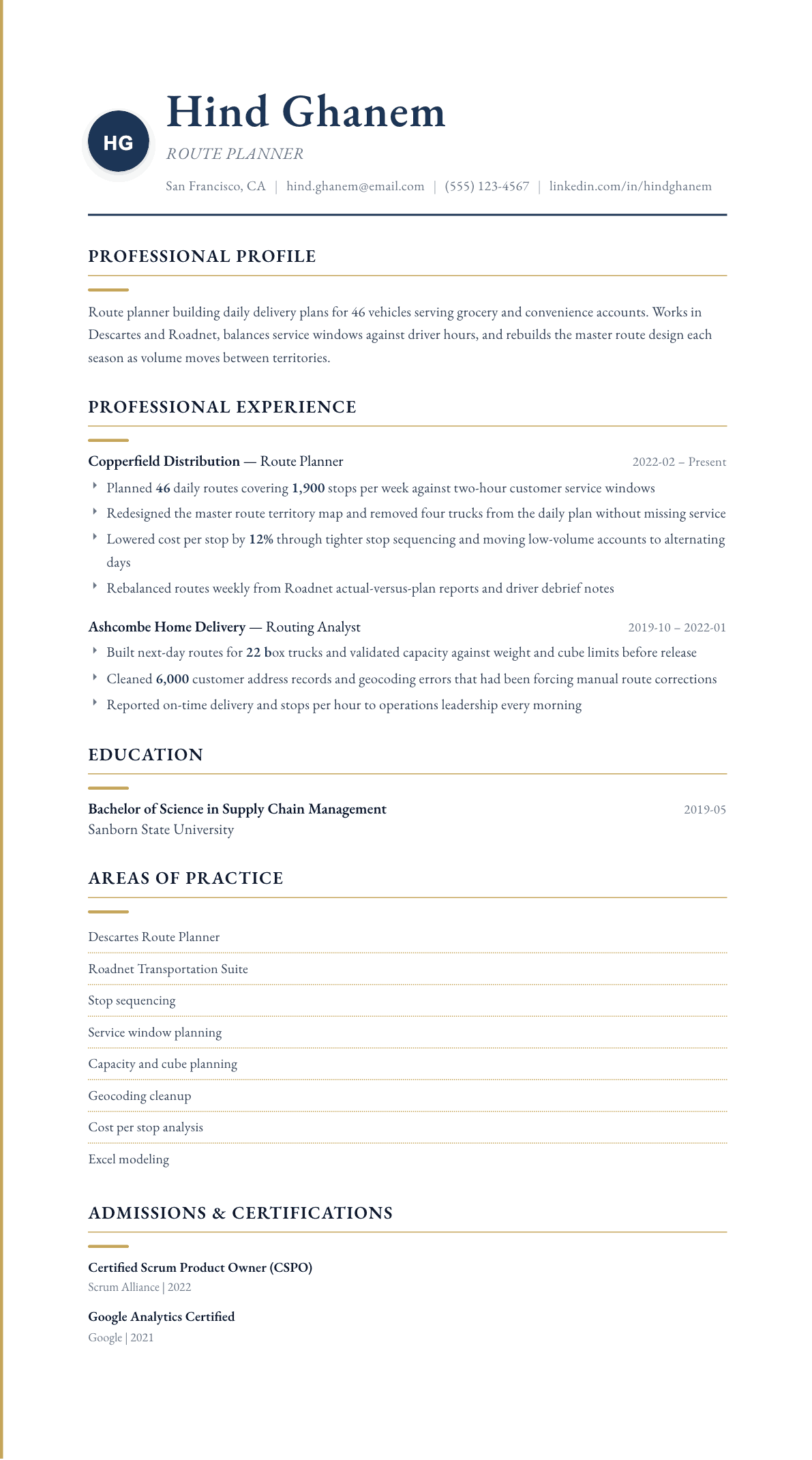
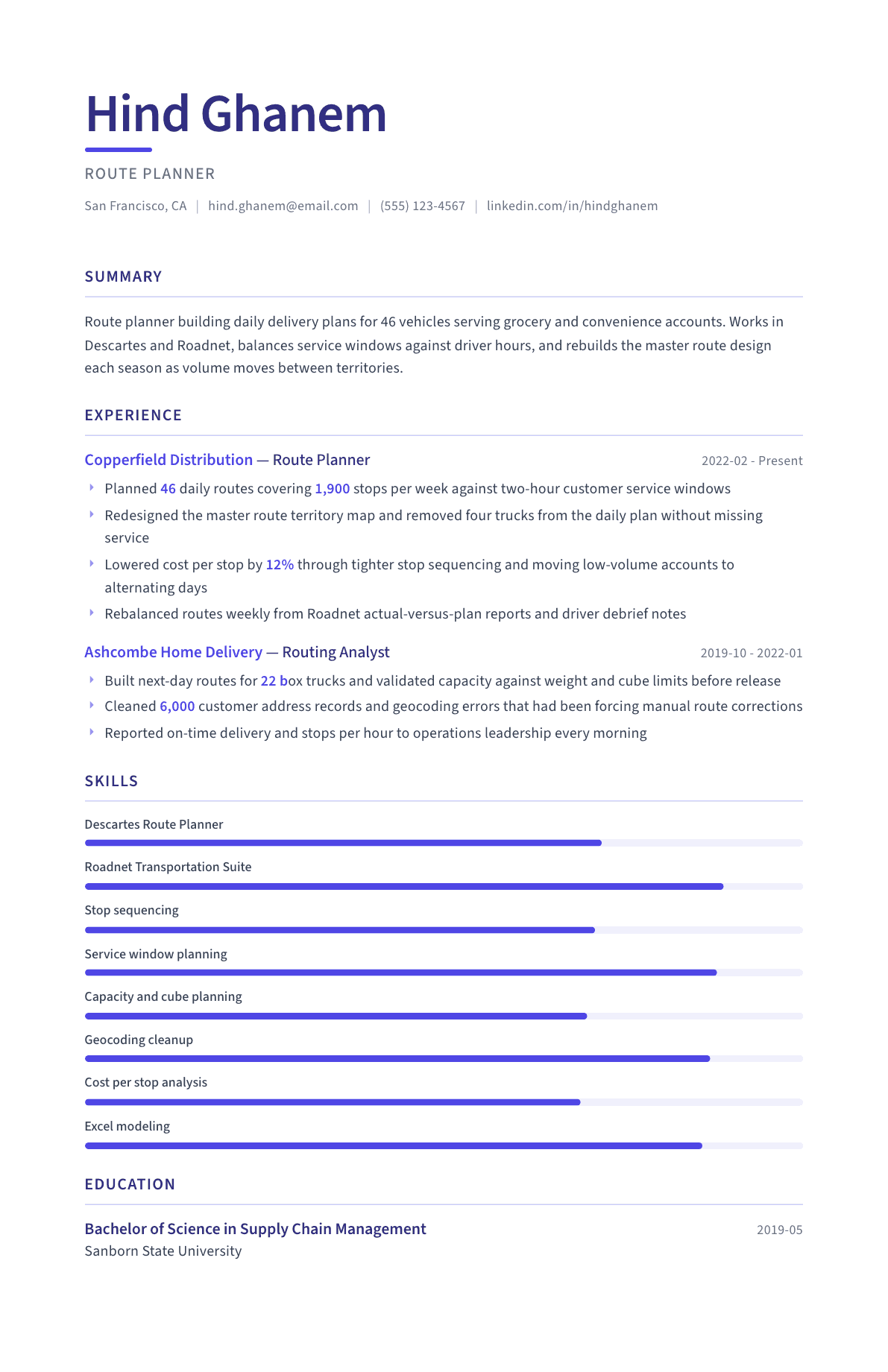
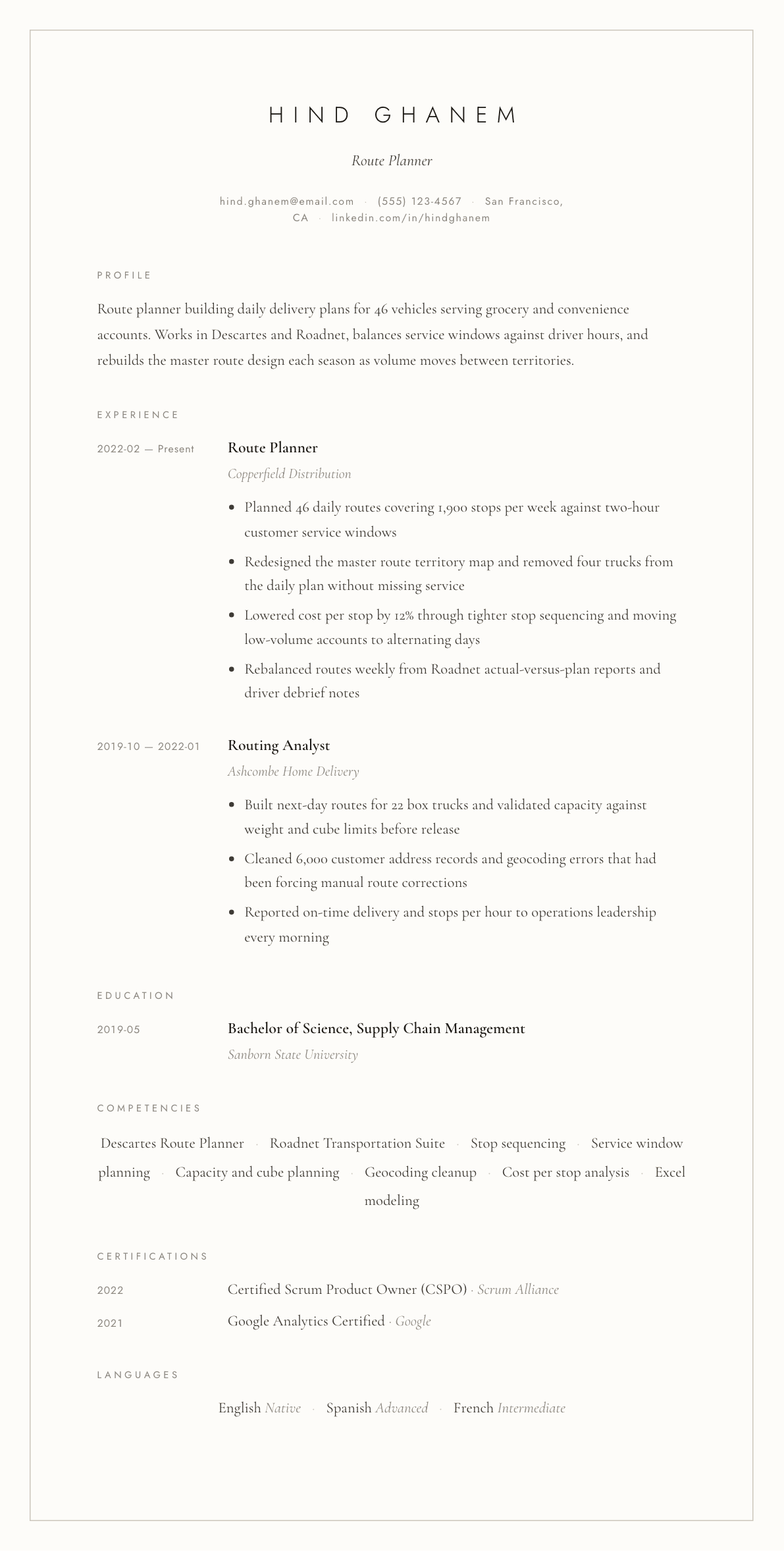
Example Route Planner summary
Route planner with five years building daily and master route plans for delivery fleets of 20 to 50 vehicles. Fluent in Roadnet and Descartes, plans against service windows, cube limits and driver hours, and validates every plan against the previous day actuals. Removed four trucks from a daily plan through territory redesign while holding service. Seeking a routing role with network design scope.
Skills to list on a Route Planner resume
- Route optimization
- Roadnet
- Descartes
- Stop sequencing
- Territory design
- Service window compliance
- Cube and weight planning
- Cost per stop analysis
- Geocoding
- Excel and pivot tables
- SQL reporting
- Driver debrief analysis
- Fleet capacity planning
- On-time delivery reporting
What actually gets this resume read
- Lead each job with the number of routes, stops and vehicles you planned, because scale is the first thing a reader checks.
- Name the routing engine you used, whether Descartes, Roadnet, Verizon Connect, OptimoRoute or an in-house optimizer.
- Give a cost result: cost per stop, stops per hour, miles per route or trucks removed from the daily plan.
- Show that you plan against real constraints such as service windows, cube limits, driver hours and dock schedules.
- Mention master route redesign work separately from daily planning, since the two skills are hired for differently.
- Add the data work: address cleanup, geocoding fixes and the reports you built from actual versus planned results.
How to write a route planner resume
A route planner resume is read by someone who owns a delivery budget. They want to know how many routes you built, against what constraints, in which optimization engine, and what the plan cost to run. Route planning sits between analysis and operations, and a page that leans only on one side loses to a candidate who shows both.
The weakest route planner resumes describe the software. Running the optimizer is the easy part of the job. The hard part is the judgment underneath: which accounts move to alternating days, when a service window is worth a truck, how to sequence around a dock schedule, and how to read yesterday actuals well enough to change tomorrow plan.
This guide takes the sections in reading order, provides summaries for a new analyst, a working planner and a network planner, rewrites five bullets that appear on most routing resumes, and closes with the questions planners ask when they move between last mile, distribution and field service work.
Format: one page, scale in the first line of every job
Reverse chronological, one page for most planners, two only if you have run planning at several networks. Lead each job with the operation: routes per day, stops per week, vehicle count and types, and the customer base. That single line does more work than any adjective in the summary.
Keep the layout simple and put a short systems block near the top. Routing engines are the first screen, and a reader should not have to hunt through three jobs to learn which one you used.
- Summary of three lines: routes, stops, fleet size, engine, and one cost result.
- Experience with the operating detail first, then results in the bullets.
- A systems line covering the routing engine, the ERP or order source, and your reporting tools.
- Education last unless you are early enough that a supply chain degree is the strongest item.
Summary: the network you planned and what it cost
Name the type of delivery network, because grocery replenishment, home delivery, field service and parcel work have almost nothing in common operationally. Then give the daily route count, the fleet, and the metric your employer measured you against.
One cost result belongs in the summary. Cost per stop, stops per hour, miles per route, or trucks removed from the daily plan. Planning is one of the few operations roles where the outcome is directly measurable, so a summary without a figure looks like a candidate who never owned the result.
Experience: constraints, not clicks
Write bullets that show the constraints you planned against. Two-hour customer windows, trailer cube and weight limits, driver hours, dock and yard slots, refrigerated compartment rules, union work rules, and site access restrictions. Constraints are what make routing hard, and naming them is how a hiring manager recognizes a real planner.
Separate daily planning from master route design. Daily planning is execution: build, validate, release, adjust. Master route design is strategy: territory boundaries, delivery day patterns, fleet sizing and depot assignment. Employers hire for these differently, and a resume that blends them undersells whichever one you are strongest at.
Then show the feedback loop. Plan versus actual review, driver debrief notes, exception reporting, and the changes you made because of them. A planner who never looks at what actually happened is building spreadsheets, not routes.
Data work and the tools underneath
Routing quality collapses when the data is bad, and cleaning it is real work that belongs on the page. Address standardization, geocoding corrections, service time calibration by account type, and vehicle profile maintenance all change the output more than any parameter tweak. Say what you fixed and what it stopped costing.
Name the engine and the analysis stack. Roadnet, Descartes, Verizon Connect, OptimoRoute, Aptean and in-house optimizers each behave differently, and reporting skill in Excel, SQL or a dashboard tool is what turns route output into an argument leadership will fund.
- Routing engine and the version or module you worked in.
- Order source: the ERP, order management or dispatch system feeding the plan.
- Analysis tools: Excel modeling, SQL, and any dashboard you built or maintained.
- Data maintenance you owned, such as geocoding, service times and vehicle profiles.
Keywords that surface a routing resume
Postings for this work repeat a narrow vocabulary: route optimization, stop sequencing, territory design, service window, cube utilization, cost per stop, stops per hour, on-time delivery, dynamic routing, static routes, last mile, and the engine name. Put the true ones in the summary and again inside a bullet where they carry a number.
Job titles vary widely for the same work, so mirror the posting title in your summary line. Routing analyst, transportation planner, delivery planner and logistics planner all appear on postings that describe the same desk.
Route Planner resume summary examples
New routing analyst
Supply chain graduate with a year supporting a delivery operation of 22 box trucks. Builds next-day routes, validates weight and cube before release, and cleaned roughly 6,000 customer address records that had been forcing manual corrections every morning. Comfortable in Roadnet and Excel.
Three years planning
Route planner building 46 daily routes covering 1,900 weekly stops against two-hour service windows for grocery and convenience accounts. Works in Descartes and Roadnet, rebalances weekly from plan versus actual reports, and lowered cost per stop by 12% through tighter sequencing.
Network route planner
Senior route planner responsible for master route design across three depots and 130 vehicles. Owns territory boundaries, delivery day patterns and fleet sizing, models depot and consolidation scenarios in SQL and Excel, and removed nine trucks from the standing plan while holding on-time delivery above 96%.
Work experience bullets: before and after
Before: Created delivery routes using routing software.
After: Planned 46 daily routes covering 1,900 stops per week against two-hour customer service windows and trailer cube limits in Descartes.
Route count, stop volume and the actual constraints show the difficulty a generic software line hides.
Before: Improved route efficiency.
After: Lowered cost per stop by 12% by resequencing dense urban runs and moving low-volume accounts to alternating delivery days.
A named metric plus the two decisions behind it lets a reader judge whether the method transfers.
Before: Redesigned territories for the delivery fleet.
After: Rebuilt the master territory map across three depots and removed four trucks from the daily plan with no reduction in service coverage.
Trucks removed is the number an operations budget owner recognizes immediately.
Before: Cleaned up customer address data.
After: Standardized roughly 6,000 customer addresses and corrected geocoding errors that had been placing stops on the wrong side of a river, ending daily manual route repairs.
The specific failure mode makes the data work concrete instead of clerical.
Before: Reported on delivery performance.
After: Published a daily plan versus actual report on stops per hour and on-time delivery, and used driver debrief notes to correct service times on 200 accounts.
Showing the feedback loop proves the reporting changed the next plan rather than filling an inbox.
Hard skills
- Route optimization engines
- Roadnet Transportation Suite
- Descartes routing
- Stop sequencing
- Territory and master route design
- Service window planning
- Cube and weight capacity planning
- Geocoding and address standardization
- Cost per stop analysis
- Excel modeling and pivot tables
- SQL reporting
- Plan versus actual analysis
Soft skills
- Analytical judgment
- Working with drivers and supervisors
- Explaining tradeoffs to operations leaders
- Attention to detail
- Calm replanning under disruption
- Documentation discipline
Certifications worth listing
- Certified Supply Chain Professional (CSCP) (Association for Supply Chain Management)
- Certified in Logistics, Transportation and Distribution (CLTD) (Association for Supply Chain Management)
- Certified Analytics Professional (CAP) (INFORMS)
Mistakes that cost route planner candidates the interview
- Describing the routing software without ever stating how many routes or stops you planned.
- Omitting constraints, which makes the work look like a button press rather than a planning decision.
- Blending daily planning and master route design so a reader cannot tell which one you are strong at.
- Claiming efficiency gains with no cost per stop, miles or vehicle count attached.
- Leaving out the data work that actually made the optimizer produce usable plans.
- Ignoring driver feedback and plan versus actual review, which every operations manager asks about.
- Using a job title nobody searches for instead of mirroring the language on the posting.
Route Planner resume questions
What is the most important number on a route planner resume?
Cost per stop if your employer measured it, otherwise stops per hour or trucks removed from the daily plan. Any of the three tells a budget owner what your planning was worth, which no description of the software can do.
Do I need to know a specific routing engine to be hired?
Employers prefer their own engine but most will take a planner who is fluent in a comparable one, because the concepts transfer. Name every engine you have used, note how long you spent in each, and say which modules you owned.
How do I show routing experience without formal software?
Plenty of planners start in spreadsheets and mapping tools. Describe the manual method, the volume you handled, and the constraints you balanced, then list any optimization training you have completed so the reader sees a short ramp.
Should a route planner resume include driver feedback work?
Yes. Route plans fail on the ground when service times or access notes are wrong, and a planner who runs debriefs and corrects the master data is exactly what an operations manager wants. Give the account count you corrected.
How is a route planner resume different from a dispatcher resume?
A planner is measured on the design of the plan, so the page leads with routes, stops, constraints and cost. A dispatcher is measured on execution during the day, so that page leads with load coverage, driver management and on-time performance.
Related resume examples
- Transportation Planner Resume example
- Logistics Analyst Resume example
- Delivery Driver Resume example
- Transportation Coordinator Resume example
- Transportation Manager Resume example
- Delivery Operations Manager Resume example