Logistics Analyst Resume Examples: the lines they read
Build a Logistics Analyst Resume That Reads Like a Cost Model
By Mustafa Tarabya, founder of CVBooster · Published · Updated
Logistics analyst resume example with freight cost, network and carrier scorecard keywords, plus a writing guide for supply chain analytics applications.
Sample resumes for a logistics analyst
The same logistics analyst content laid out in three CVBooster templates, so you can see what the finished document looks like before you write a word.
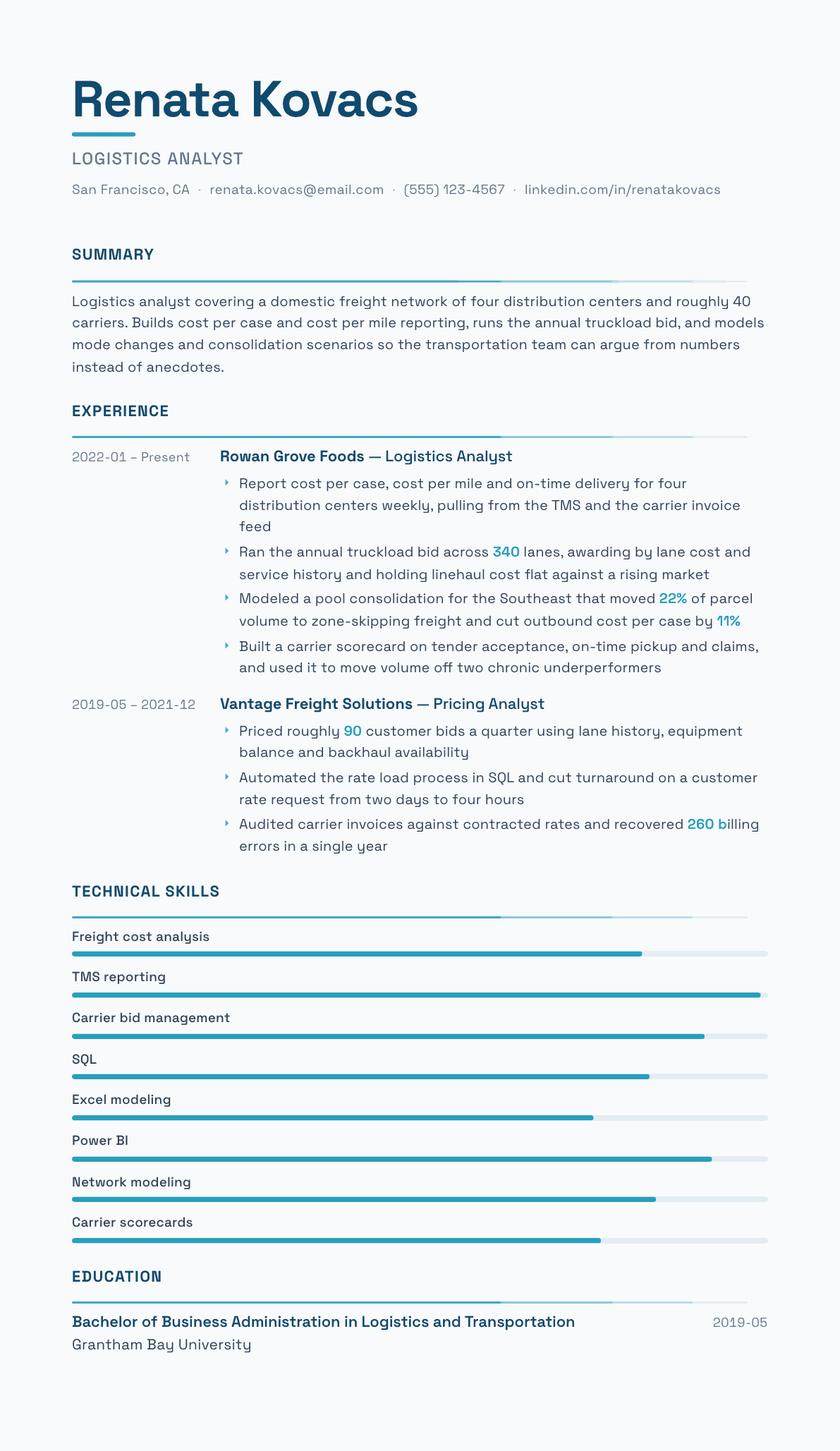
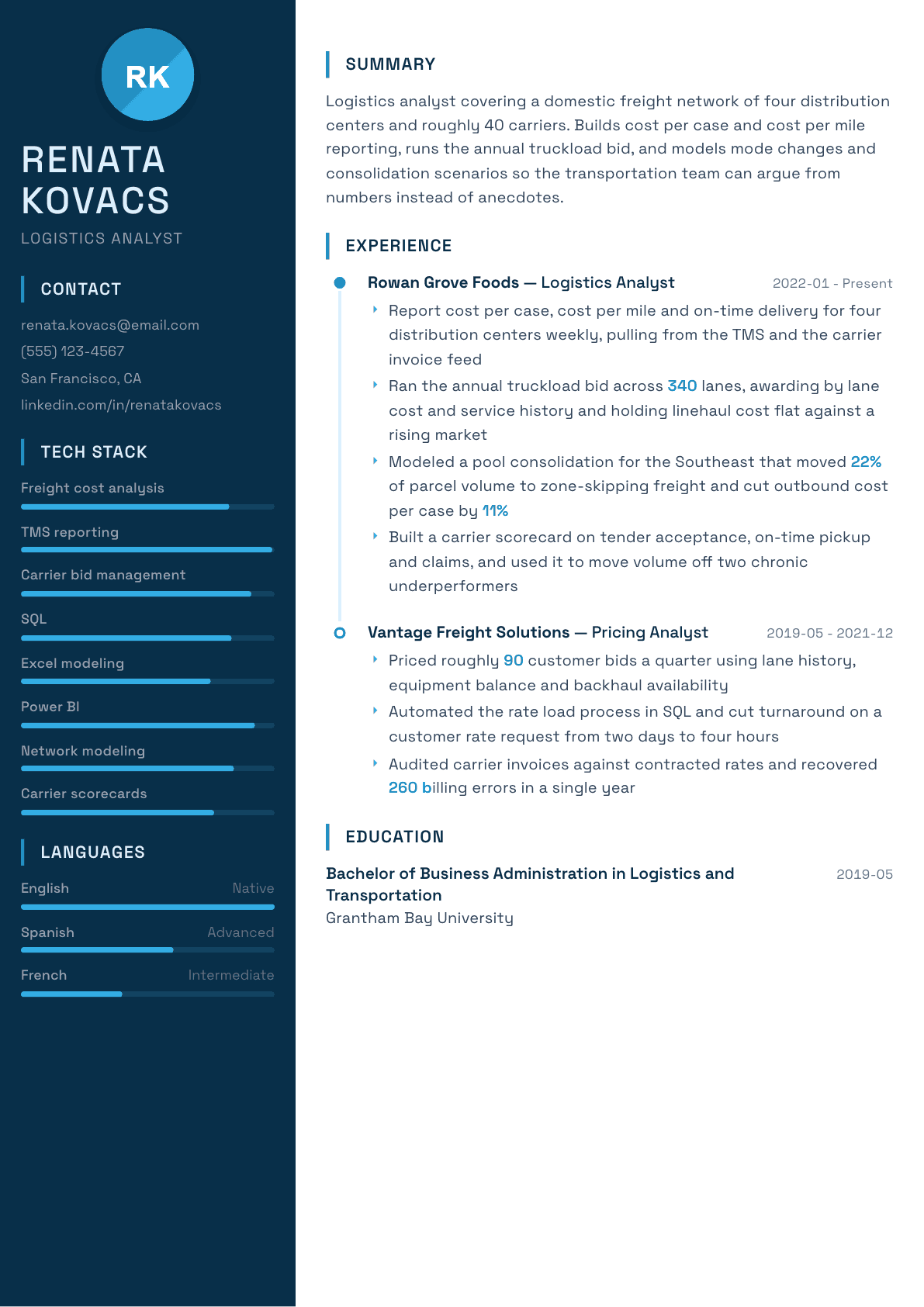
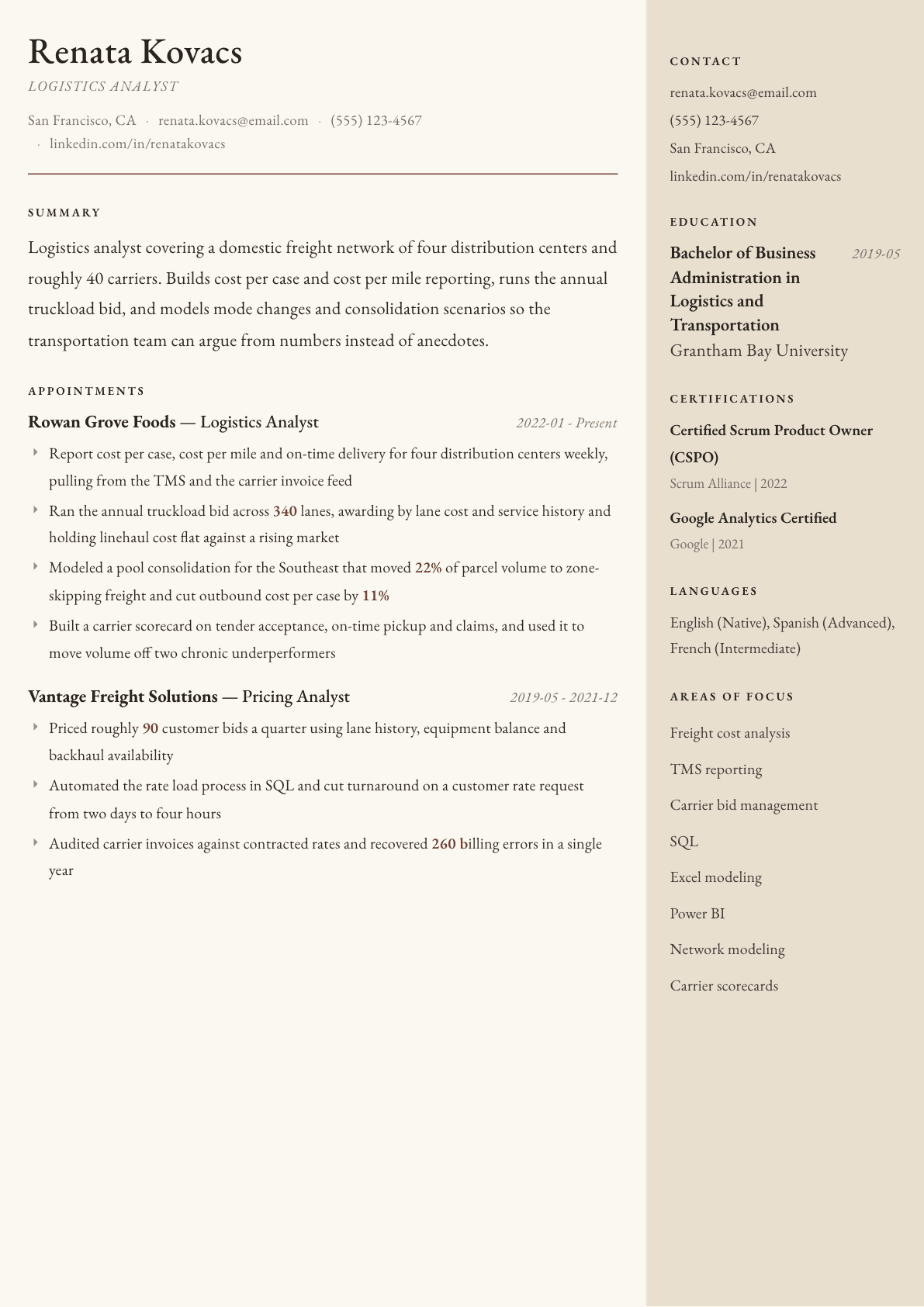
Example Logistics Analyst summary
Logistics analyst with five years in food distribution and third party freight, covering four distribution centers and roughly forty carriers. Runs the annual truckload bid across hundreds of lanes, builds cost per case and on-time reporting from the TMS, and modeled a consolidation that cut outbound cost per case by 11%. Comfortable in SQL and Power BI. Seeking a senior transportation analytics role.
Skills to list on a Logistics Analyst resume
- Freight cost analysis
- Transportation management systems
- Carrier bid management
- Lane analysis
- Network modeling
- Mode optimization
- Carrier scorecards
- Freight invoice audit
- SQL
- Excel modeling
- Power BI
- On-time delivery reporting
- Distribution planning
- Supply chain analytics
What actually gets this resume read
- Lead with the network you analyzed: how many sites, how many lanes, which modes, and whether it was domestic or cross border.
- Use the cost units transportation managers actually track, such as cost per mile, cost per case or cost per shipment.
- Name the transportation management system by name, because that word separates an analyst who has run one from one who has not.
- Show one modeling project end to end, from the question through the scenario to the decision it changed.
- Prove the analytics stack with evidence: a query you wrote, a dashboard you own, a process you automated.
- Balance cost claims with a service number, since a manager reads a saving next to on-time delivery or nothing at all.
How to write a logistics analyst resume
A logistics analyst gets hired when a transportation budget stops making sense. Freight cost is rising, the team blames the market, and nobody can prove which lanes, which carriers or which modes are responsible. The manager reading your resume wants evidence that you can take an invoice feed, a transportation management system and a spreadsheet, and produce an answer somebody can act on.
That means the resume has to be quantitative without becoming a list of tools. The strongest lines pair a cost unit the reader recognizes, such as cost per mile or cost per case, with the analysis that produced the change. A logistics analyst who has never named a lane, a mode or a carrier scorecard reads like a generalist who happened to sit near transportation.
What follows is how to size your network, which analyses carry weight with a transportation director, three summaries from a first analyst seat through a senior network role, before and after bullets, and the questions analysts ask when they move between a carrier, a broker and a shipper side job.
Format: one page early, technical block high, cost units in the summary
Single column, reverse chronological, one page until roughly eight years of history. Transportation teams are small and the hiring manager usually reads the file himself, so the value of a clean scannable page is practical rather than cosmetic.
Put a short technical block under the summary naming the transportation management system, the query and modeling tools, the reporting layer, and any routing or network modeling software. Postings filter on those names, and the analyst who can pull his own invoice data is a different hire from the one who requests an extract every week.
- Header: name, city and state, phone, email.
- Technical block: TMS, SQL, Excel depth, reporting tool, modeling software.
- Sections: summary, technical block, experience, education, certifications.
Summary: network size, modes, and the cost unit you moved
Open with the shape of the network you analyzed: how many sites, roughly how many lanes, which modes, domestic or cross border. Then the cost unit you are accountable for and one result. A logistics analyst who writes analyzed data to drive efficiencies has described the entire profession. One who writes reports cost per case and on-time delivery for four distribution centers and ran a bid across 340 lanes has described a specific job with a specific size.
Always pair a cost claim with a service number. A director reads a freight saving suspiciously until he sees what happened to on-time delivery, because moving volume to the cheapest carrier is a trick anyone can perform once.
Experience: the analyses that transportation actually buys
There are a handful of analyses this role is hired to run, and each deserves its own bullet if you have done it. A carrier bid or rate benchmarking exercise across a defined lane set. A mode conversion study, such as parcel to consolidated freight or truckload to intermodal. A network or facility location scenario. A carrier scorecard tied to real award decisions. A freight invoice audit that recovers billing errors and accessorial charges.
For each one, write the question, the method, and the decision. A bid bullet that says managed the annual bid is weaker than one that names the lane count, the award logic and what happened to linehaul cost and service. The method is what proves you did the analysis rather than administered the process.
Do not hide the operational work either. Analysts who have sat with dispatch during a bad week understand why a model that looks clean fails against driver hours, dock capacity and receiver appointment windows, and saying so signals judgment.
- Scope: sites, lanes, modes, annual load or shipment count.
- Cost: cost per mile, per case, per shipment, or accessorial spend as a category.
- Service: on-time pickup and delivery, tender acceptance, transit reliability.
- Decisions: awards moved, modes changed, lanes rerouted, carriers removed.
Data work: show that you can get the numbers yourself
Freight data is messy in a way that is specific to this field. Rates live in a contract, charges live on an invoice, events live in the transportation system, and the three rarely agree. Describing how you reconciled them is one of the most convincing things you can put on this resume, because every transportation team has that problem and few analysts solve it well.
Name what you automated. A rate load process, an invoice audit rule set, a weekly scorecard refresh, a lane cost model that updates from the raw feed: each one shows you turned a recurring chore into infrastructure, which is what a manager is hoping to buy.
Keywords transportation analytics postings use
The recurring terms are lane analysis, freight spend, cost per mile, linehaul, accessorial, tender acceptance, on-time delivery, mode optimization, carrier scorecard, network modeling, freight audit and pay, and the system names. Use them where they attach to a real analysis. A carrier scorecard mentioned in a bullet with the award decision behind it is worth more than a keyword block listing twenty terms nobody can verify.
Logistics Analyst resume summary examples
First analyst seat
Logistics graduate with an internship in a distribution center and a year in carrier pricing, building lane cost history and auditing invoices against contracted rates. Comfortable in Excel and learning SQL, and looking for a logistics analyst role supporting a domestic freight network.
Four years in
Logistics analyst covering four distribution centers and roughly forty carriers, reporting cost per case, cost per mile and on-time delivery from the transportation system and the invoice feed. Ran a truckload bid across 340 lanes and modeled a consolidation that cut outbound cost per case by 11%.
Senior network analyst
Senior logistics analyst owning freight spend analytics for a national network across truckload, less than truckload, parcel and intermodal. Leads the annual bid, maintains the carrier scorecard behind award decisions, and built the lane cost model the transportation director uses in budget planning.
Work experience bullets: before and after
Before: Analyzed freight costs and found savings.
After: Built weekly cost per case and cost per mile reporting for four distribution centers from the transportation system and the carrier invoice feed.
Naming the metric, the scope and the two data sources shows what the analysis was actually made of.
Before: Helped with the annual carrier bid.
After: Ran the annual truckload bid across 340 lanes, scoring awards on lane cost and service history, and held linehaul cost flat against a rising market.
Lane count, award logic and the market context turn participation into ownership.
Before: Worked on a project to reduce parcel costs.
After: Modeled a Southeast pool consolidation that moved 22% of parcel volume to zone-skipping freight, cutting outbound cost per case by 11% with no change in transit days.
The mode change, the volume moved and the unchanged transit prove the saving was structural, not a service cut.
Before: Tracked carrier performance.
After: Built a carrier scorecard on tender acceptance, on-time pickup and claims frequency, and used it to move volume off two chronic underperformers at the next award.
A scorecard is only credible when the reader can see it changed where the freight went.
Before: Checked invoices for errors.
After: Audited carrier invoices against contracted rates and accessorial rules, recovering 260 billing errors in a single year and feeding the top three causes back to the carriers.
Recovery volume plus the feedback loop shows prevention, not just detection.
Hard skills
- Freight cost analysis
- Transportation management systems
- Carrier bid and rate management
- Lane and mode analysis
- Network modeling
- Carrier scorecards
- Freight audit and pay
- Accessorial spend analysis
- SQL
- Excel modeling
- Power BI or equivalent reporting
- On-time performance reporting
Soft skills
- Translating models into recommendations
- Working with carriers and dispatch
- Written analysis
- Skepticism toward clean data
- Presenting to transportation leadership
- Managing bid timelines
Certifications worth listing
- Certified in Logistics, Transportation and Distribution (CLTD) (Association for Supply Chain Management)
- Certified Supply Chain Professional (CSCP) (Association for Supply Chain Management)
- Certified Supply Chain Analyst (CSCA) (International Supply Chain Education Alliance)
- Certified Six Sigma Green Belt (CSSGB) (American Society for Quality)
Mistakes that cost logistics analyst candidates the interview
- Describing analysis in general terms without ever naming a lane, a mode or a carrier decision that changed.
- Claiming a freight saving with no service number beside it, which any transportation director will immediately distrust.
- Listing the transportation system as a skill while every bullet suggests you only received extracts from it.
- Sizing the role in vague words such as large network instead of sites, lanes and annual load count.
- Treating the freight invoice audit as clerical work when recovery and prevention are among the clearest results you can show.
- Writing the bid as a calendar event you supported rather than an award decision you shaped.
Logistics Analyst resume questions
What is the difference between a logistics analyst and a supply chain analyst?
A logistics analyst usually owns transportation and distribution: lanes, carriers, modes and freight cost. A supply chain analyst covers a wider span including sourcing, inventory and planning. The overlap is real, so match your summary to the span the specific posting describes.
Do I need to know a transportation management system to get hired?
It helps enormously and it is the first keyword most postings filter on. If you have not used one, be specific about the data you have worked with instead, such as carrier invoices, rate files and delivery events, and say which system produced them.
How do I move from a carrier or brokerage job to a shipper side analyst role?
Lead with what transfers: lane economics, rate construction, capacity behavior and carrier performance. Then reframe your results in the language a shipper uses, which is cost per unit moved and delivery reliability rather than margin per load.
Should I include a dashboard or portfolio link?
A short note that you own a named recurring report is usually enough, and real freight data cannot be published anyway. If you build a personal example, use public rate or fuel data and describe the question it answers rather than the chart types you used.
How technical does a logistics analyst need to be?
Excel to a modeling standard is the floor, SQL is the practical differentiator, and a reporting tool is expected in most teams. Optimization or routing software matters only for network heavy roles, so read the posting before investing time in learning one.
Related resume examples
- Supply Chain Analyst Resume example
- Logistics Manager Resume example
- Transportation Planner Resume example
- Freight Coordinator Resume example
- Route Planner Resume example
- Procurement Analyst Resume example