Delivery Operations Manager Resume Examples: free score
Deliver Results with a Delivery Operations Manager Resume
By Mustafa Tarabya, founder of CVBooster · Published · Updated
Build a delivery operations manager resume showcasing your last-mile logistics, team leadership, and operational efficiency expertise.
Sample resumes for a delivery operations manager
The same delivery operations manager content laid out in three CVBooster templates, so you can see what the finished document looks like before you write a word.
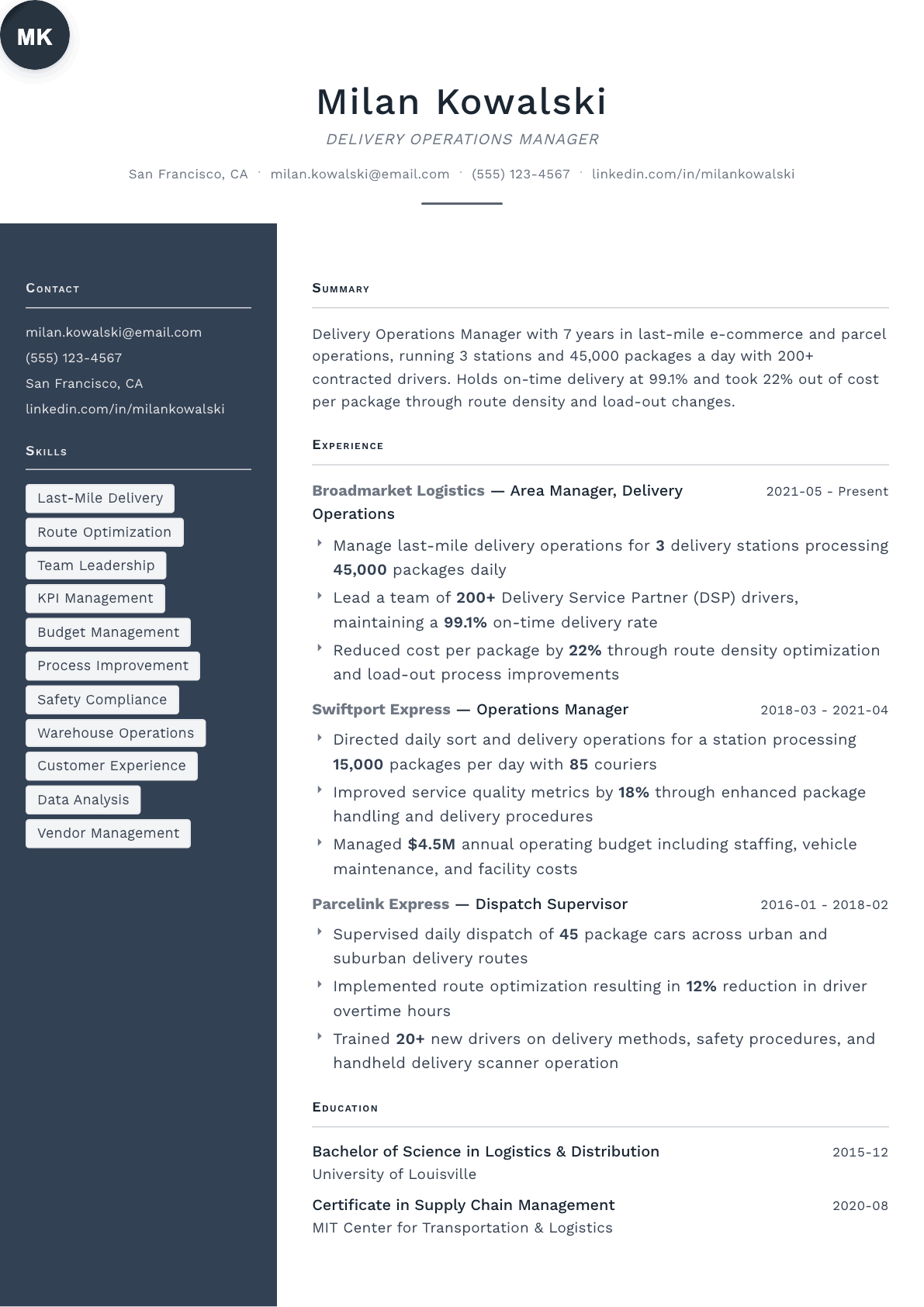
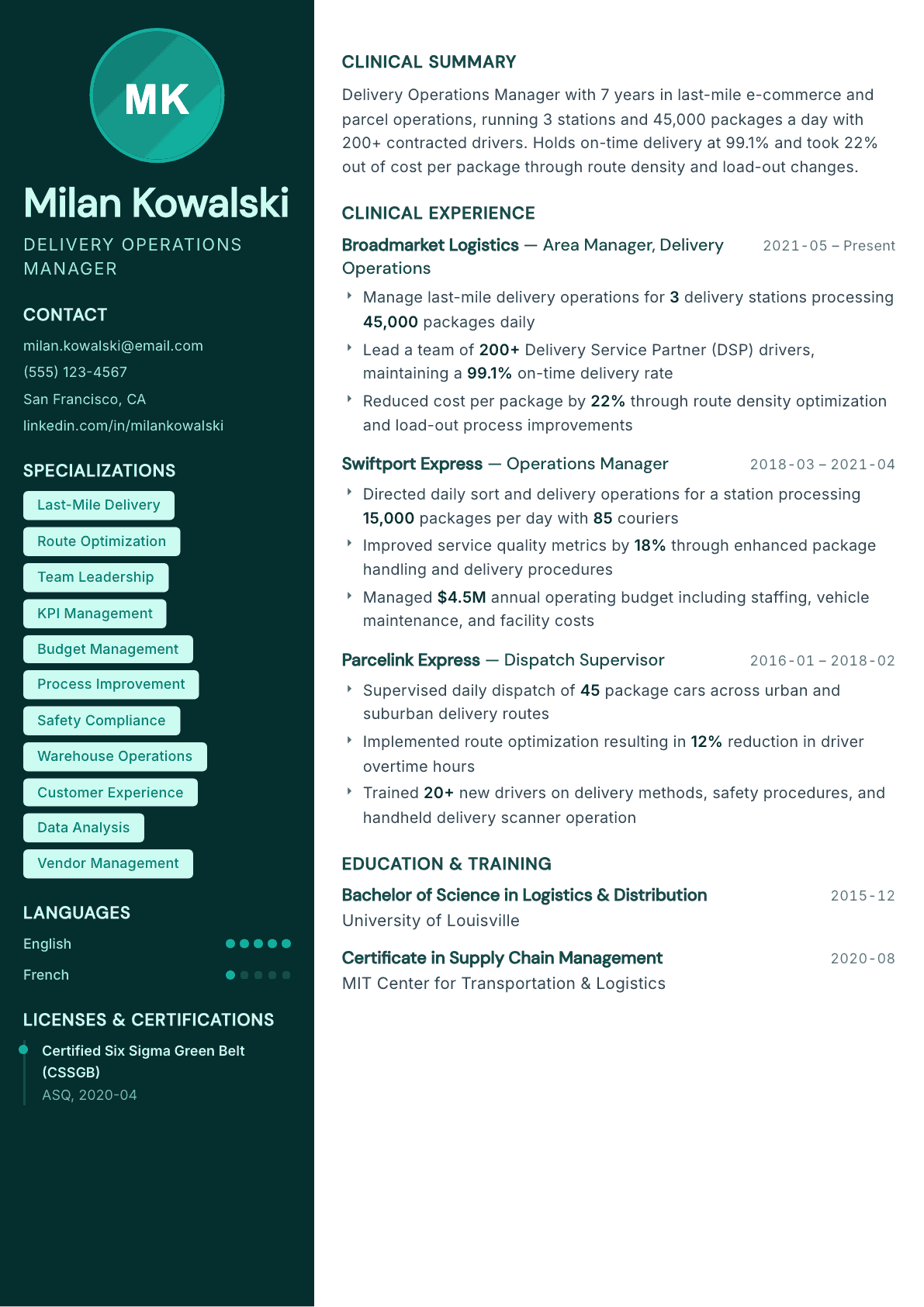
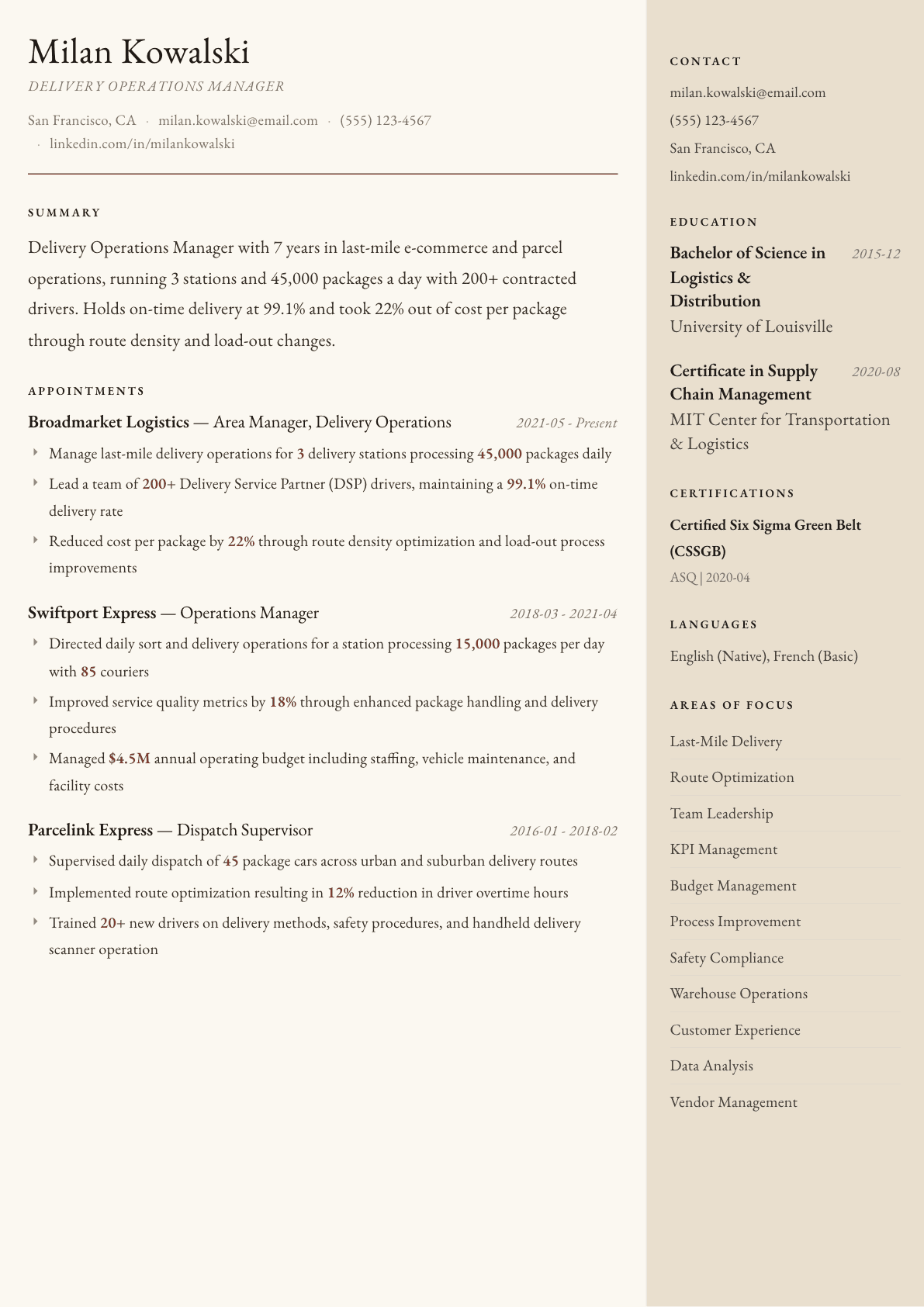
Example Delivery Operations Manager summary
Delivery Operations Manager, 7 years in last-mile parcel operations across 3 stations moving 45,000 packages a day. Holds 99.1% on-time delivery, cut cost per package 22%, and manages a $4.5M station budget. Seeking a regional operations director role.
Skills to list on a Delivery Operations Manager resume
- Last-Mile Delivery
- Route Optimization
- Team Leadership
- KPI / Metrics Management
- Budget Management
- Process Improvement
- Safety & Compliance
- Warehouse Operations
- Customer Experience
- Data Analysis
- Vendor Management
- Lean Six Sigma
- Staffing & Scheduling
- Fleet Coordination
What actually gets this resume read
- Quantify your operation scale: daily package volume, number of drivers, stations managed.
- Highlight on-time delivery rates, cost per package reductions, and customer satisfaction scores.
- Include experience with route optimization tools: ORION, RouteSmart, Routific, OptimoRoute.
- Show leadership experience managing drivers, dispatchers, and warehouse staff.
- Mention process improvement initiatives and their measurable outcomes.
- Include safety metrics: DART rate, vehicle accident frequency, and workers comp claims reduction.
How to write a delivery operations manager resume
Last-mile delivery is a business of small numbers multiplied by enormous volume, and the people who hire delivery operations managers think in exactly those terms. A regional director reads your resume looking for cost per package, stops per hour, delivery success rate, driver turnover and safety incidents per million miles. If those numbers are missing, the reader has no way to tell whether you ran a strong station or simply survived one.
The second thing they read for is the labor model, because it changes the job completely. Managing employed drivers means scheduling, discipline and union or works council considerations. Managing contracted delivery partners means holding another company to a scorecard without directing their employees. Managing gig couriers means capacity forecasting and offer pricing. Say which model you ran, and how many drivers, vans and routes were in scope.
This guide covers the layout for station and regional roles, how to write volume and cost metrics that survive scrutiny, how to present safety and peak season performance, three summaries from a shift supervisor to a regional manager, before-and-after bullets, and the questions delivery managers ask when moving between carriers, retailers and third-party logistics providers.
Format: scope line first, metrics in every entry
Two pages once you have managed a station. Reverse-chronological, single column, plain headings. Under each job title, write a scope line before the bullets: sites managed, daily package volume, routes dispatched, vans in service, drivers or partner companies, and the operating budget in headcount terms rather than currency. A director can size your experience from that line alone.
Keep the metric vocabulary consistent down the page. If you call it delivery success rate in one job and on-time performance in the next, a reader assumes you are describing two different things. Pick the terms the posting uses and hold them.
- Header: name, city and state, phone, email, and willingness to relocate if you are applying across regions.
- Sections in this order: summary, operations experience with a scope line each, safety and compliance, systems, education and certifications.
- Note the labor model in the scope line: employed drivers, contracted delivery partners, or independent couriers.
- Include shift pattern where it matters, since night sort and day dispatch are different operations.
Summary: volume, sites, drivers, and the number you moved
Name the years, the sites and volume you have run, the labor model, and the single metric you improved most. Cost per package, stops per hour, first-attempt delivery rate, driver retention and damage rate are the currencies of this field, and a summary that carries one of them with a real starting and ending value beats a paragraph of adjectives.
If you are crossing between segments, address it in the summary. A parcel station manager moving to grocery delivery inherits perishable handling, tighter delivery windows and substitution policy, and naming those shows you know what changes rather than assuming volume experience transfers whole.
Experience: the flow from sort to doorstep
Write bullets that follow the operating day, because that is how an interviewer will probe. Inbound arrival and unload, sort accuracy and missort rate, load-out and dispatch window, route density and stem time, on-road rescue and reroute, return to station volume, and the closing reconciliation. A manager who can describe the whole flow with numbers is immediately more credible than one who only names achievements.
Then the people half. Headcount managed, staffing ramp for peak season, absenteeism and no-show rate, driver onboarding and time to full route capability, retention or turnover, and how you handled performance management. Turnover is the metric that quietly drives everything else in this business, so a manager who improved it should say by how much and through what change.
Cost work needs the mechanism. Reducing cost per package by consolidating routes, raising packages per stop, cutting overtime, improving load-out sequence or renegotiating van utilization are each different levers, and naming the lever is what convinces a director you understand the number rather than having inherited a good quarter.
- Volume: daily packages, routes dispatched, stops per route, vans in service, seasonal peak multiple.
- Service: first-attempt delivery rate, on-time rate, missort rate, damage and loss rate, customer concession volume.
- Cost: cost per package or per stop, overtime hours, van utilization, rescue route count, fuel and mileage per route.
- People: headcount, turnover, time to full productivity for a new driver, absenteeism, peak season ramp size.
Safety, compliance and the incident record
Safety belongs in its own section once you have managed a site, because it is the item a regional director escalates to. Give the incident rate, preventable collisions per million miles, injury frequency, vehicle inspection compliance, and any telematics or camera coaching program you ran. Name the program and the coaching cadence rather than saying you promoted a safety culture.
Compliance detail depends on the fleet. Vans under the commercial threshold sit outside most federal driver rules while heavier vehicles bring hours of service, driver qualification files and inspection obligations. Say which applied to your fleet, because the reader is trying to work out what regulatory exposure you have actually managed.
Include audits and inspections you have been through and their outcomes. Site safety audits, insurance inspections, customer compliance audits and roadside inspection results are all verifiable, and a clean record stated plainly is worth more than a claim about commitment to safety.
Systems and the language of the posting
Name the platforms: routing and dispatch software, the handheld or mobile scanning application drivers used, the warehouse or sortation system, the telematics and camera platform, workforce scheduling, and the reporting tool you built your dashboards in. Employers ask because a manager who already reads their daily scorecard starts influencing it in the first week.
Match the vocabulary of the segment. Parcel carriers use sort, load-out, stem, rescue and concessions. Retail and grocery use fulfillment windows, substitutions, chilled chain and delivery slots. Third-party providers use client scorecards, service level agreements and contract compliance. Mirror the set that fits the job and drop the rest.
Delivery Operations Manager resume summary examples
Delivery supervisor
Delivery supervisor with three years running a morning dispatch of 45 routes and a team of 50 drivers, covering load-out, on-road rescue and end-of-day reconciliation. Cut driver no-shows by a third through a standby roster and moved the dispatch window forward by 20 minutes. Seeking a station manager role.
Station manager
Station manager with seven years in last-mile operations, running a site handling roughly 15 thousand packages a day across 85 routes with 110 drivers. Held a 99.1% on-time rate through two peak seasons, reduced cost per package by 22% and cut driver turnover from 74% to 41%.
Regional operations manager
Regional delivery operations manager with twelve years and four stations reporting in, covering 220 routes and 18 contracted delivery partners. Owns the regional service scorecard, safety program and peak season ramp, and closed the last insurance site audit with no corrective actions across all four sites.
Work experience bullets: before and after
Before: Managed daily delivery operations at the station.
After: Ran a station dispatching 85 routes a day with 110 drivers, owning inbound unload, sort, load-out and the dispatch window from the first van out to the last route closed.
Route count, headcount and the named stages of the operating day let a director size the site immediately.
Before: Reduced delivery costs through process improvements.
After: Cut cost per package by 22% by rebuilding route boundaries around density, raising average stops per route from 118 to 141 and removing four routes from the daily plan.
Naming the lever and the intermediate metric shows the saving was engineered rather than inherited.
Before: Improved on-time delivery performance.
After: Raised first-attempt delivery rate from 94.2% to 99.1% over two quarters by moving load-out earlier, adding a standby rescue driver and coaching the ten lowest-performing routes weekly.
A starting value, an ending value and three concrete actions make the improvement credible and repeatable.
Before: Focused on safety and reduced accidents.
After: Ran weekly camera-footage coaching with 110 drivers and cut preventable collisions from 14 to 5 across a year while holding daily vehicle inspection compliance above 98%.
A named program and two safety metrics replace a claim about culture with evidence a director can audit.
Before: Hired and trained delivery drivers.
After: Ramped headcount from 110 to 180 for peak season, running a four-day onboarding that brought new drivers to full route capability in eight days instead of fourteen.
Ramp size and time to productivity are the two staffing numbers that decide whether a peak season holds.
Hard skills
- Last-mile route planning and density optimization
- Sort and load-out operations
- Dispatch window management
- Delivery service level reporting
- Cost per package and cost per stop analysis
- Contracted delivery partner management
- Peak season capacity planning
- Telematics and driver coaching programs
- Vehicle inspection and fleet readiness
- Workforce scheduling and staffing ramp
- Warehouse safety compliance
- Routing and dispatch software
Soft skills
- Decision making at dispatch
- Coaching frontline drivers
- Escalation handling with customers
- Holding partners to a scorecard
- Stamina across early shifts
- Calm during peak volume
Certifications worth listing
- Certified in Logistics, Transportation and Distribution (CLTD) (Association for Supply Chain Management)
- Certified Six Sigma Green Belt (CSSGB) (American Society for Quality)
- OSHA 30-Hour General Industry (Occupational Safety and Health Administration)
- Project Management Professional (PMP) (Project Management Institute)
- Certified Transportation Professional (CTP) (National Private Truck Council)
- Certified Director of Safety (CDS) (North American Transportation Management Institute)
Mistakes that cost delivery operations manager candidates the interview
- Writing achievements with no baseline, so a reader cannot tell an improvement from a starting position.
- Leaving out the labor model, when managing employed drivers and holding a contracted partner to a scorecard are different jobs.
- Omitting daily volume, route count and headcount, which is the scope line every director looks for first.
- Claiming a cost reduction without naming the lever that produced it.
- Skipping safety metrics entirely on a role where collisions and injuries are the largest single liability.
- Ignoring driver turnover, the number that quietly drives service, cost and overtime at the same time.
- Using generic warehouse language on a last-mile application, where sort, load-out, stem time and rescue are the actual vocabulary.
Delivery Operations Manager resume questions
Which metrics belong on a delivery operations manager resume?
Daily package volume, routes dispatched, headcount, first-attempt or on-time delivery rate, cost per package or per stop, damage and loss rate, driver turnover and safety incident rate. Give a before and after value for anything you claim to have improved.
How do I show peak season experience?
State the volume multiple you absorbed, the headcount ramp you hired and trained, how many additional routes or vans you added, and whether service held through the period. Peak performance is the closest thing this field has to a stress test, so it deserves its own bullets.
Do I need a CDL for a delivery operations manager role?
Usually not, since most last-mile fleets run vans below the commercial licensing threshold. What matters is knowing which rules applied to your fleet, whether that meant driver qualification files and hours of service for heavier vehicles or only company policy and vehicle inspections.
How is managing contracted delivery partners different on a resume?
Write it as vendor performance management rather than direct supervision: scorecard design, weekly business reviews, capacity commitments, onboarding new partners and remediating underperformers. Be careful not to describe directing another company employees, which readers in this field notice.
What should I include if I came up from driving?
Keep the driving years in a short entry, then make the supervisory experience the substance of the page. Coming from the road is an advantage in coaching and credibility, so mention route knowledge and safety mentoring, but let scope and metrics carry the resume.
Related resume examples
- Fleet Manager Resume example
- Warehouse Worker Resume example
- Logistics Coordinator Resume example
- Distribution Manager Resume example
- Logistics Manager Resume example
- Transportation Manager Resume example