Transportation Manager Resume Examples: read this first
Build a Transportation Manager Resume That Shows Fleet Command
By Mustafa Tarabya, founder of CVBooster · Published · Updated
Transportation manager resume example with fleet, DOT compliance and freight budget keywords, plus a writing guide for transportation leadership applications.
Sample resumes for a transportation manager
The same transportation manager content laid out in three CVBooster templates, so you can see what the finished document looks like before you write a word.
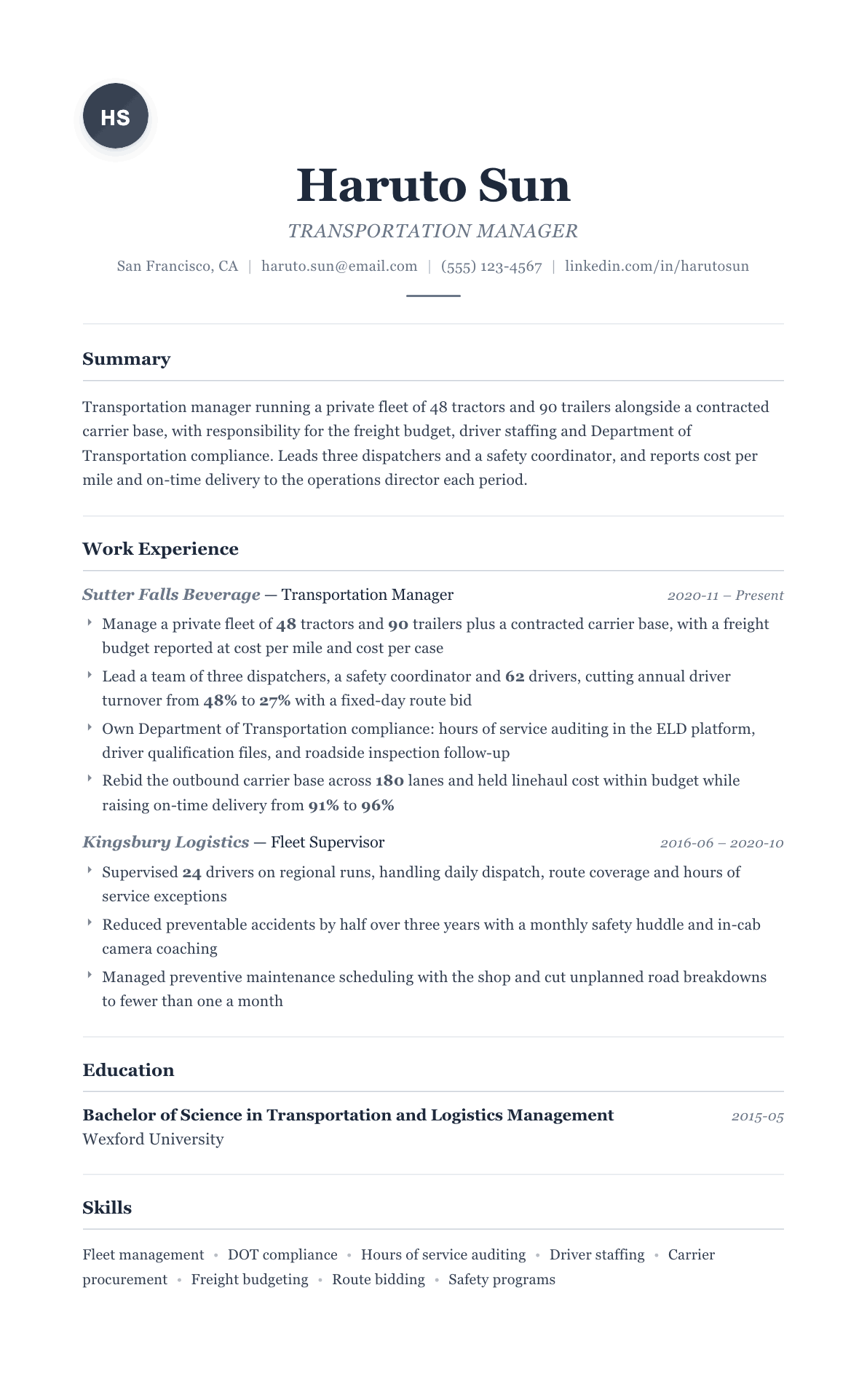
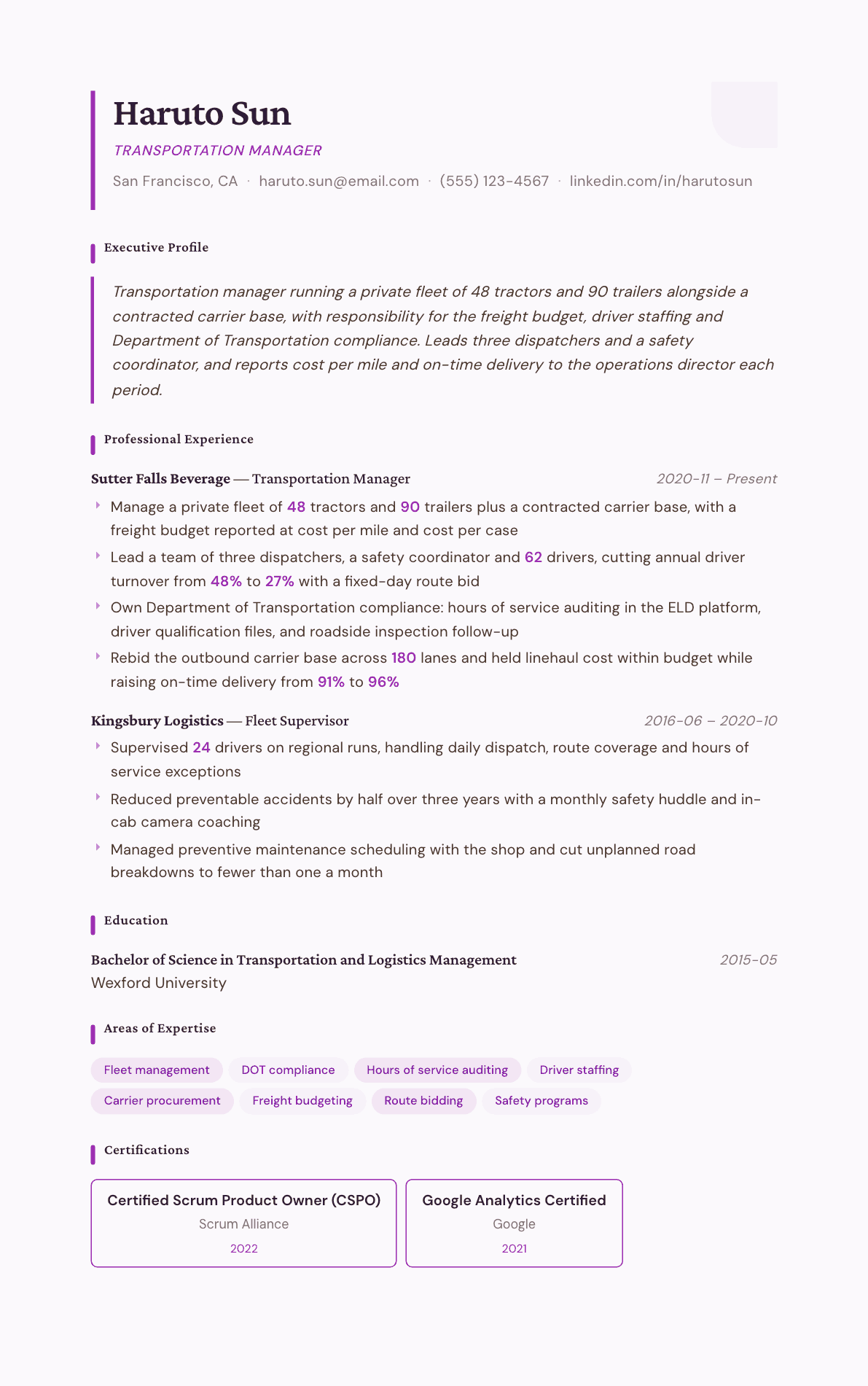
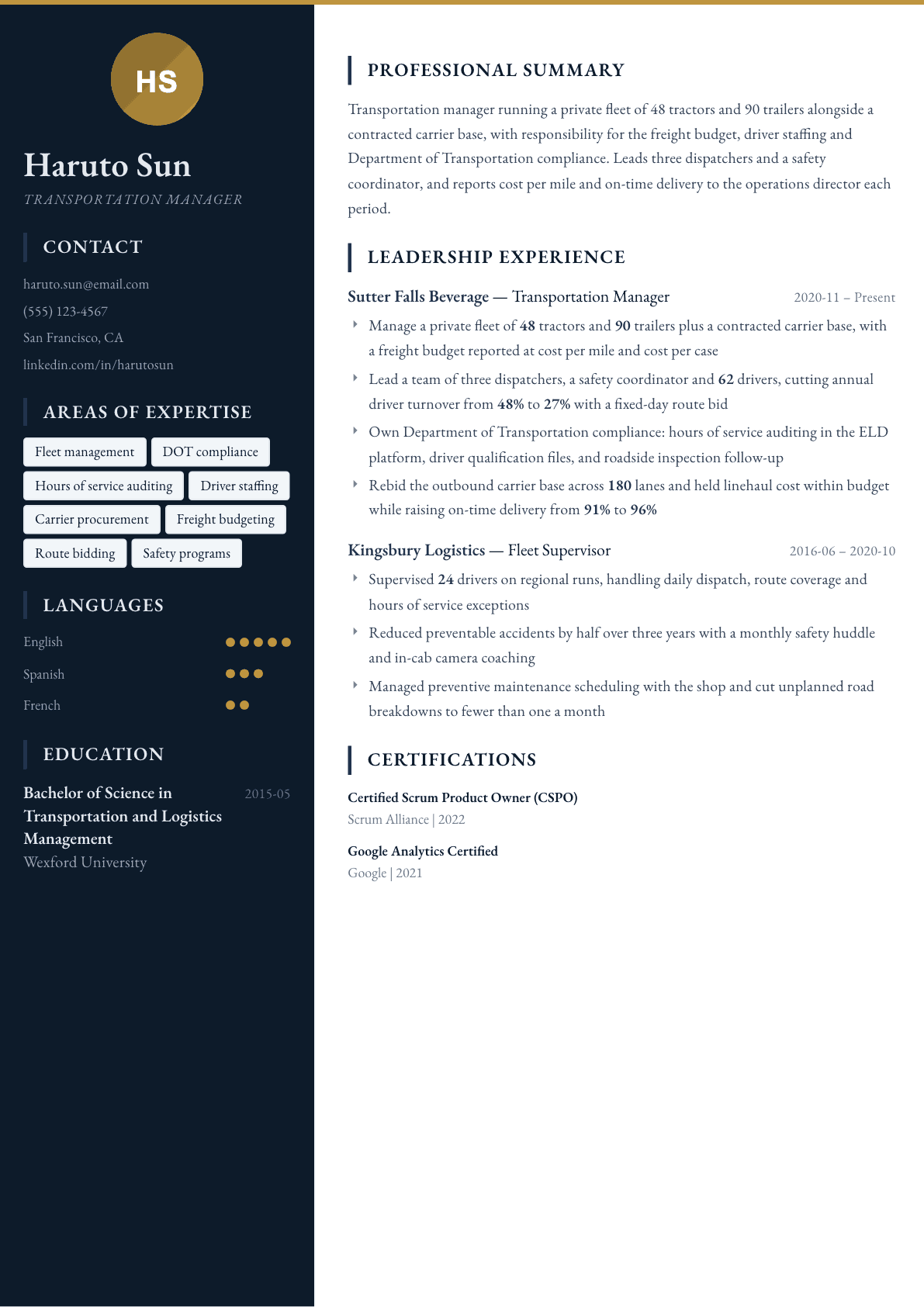
Example Transportation Manager summary
Transportation manager with nine years leading private fleet and contracted carrier operations in beverage and third party distribution. Runs 48 tractors, 90 trailers and 62 drivers against a freight budget measured in cost per mile and cost per case. Cut driver turnover from 48% to 27% and raised on-time delivery to 96% while holding linehaul cost flat. Owns Department of Transportation compliance end to end.
Skills to list on a Transportation Manager resume
- Fleet management
- DOT compliance
- Hours of service auditing
- Electronic logging devices
- Driver recruiting and retention
- Carrier procurement
- Freight budgeting
- Cost per mile analysis
- Route bidding
- Safety program management
- Preventive maintenance planning
- Transportation management systems
- On-time delivery reporting
- Team leadership
What actually gets this resume read
- Size the operation in the first line: tractors, trailers, drivers, sites, and whether the fleet is private, dedicated or brokered.
- Put the budget you own in cost terms your industry uses rather than a raw dollar figure that invites a screening question.
- Make compliance explicit, naming hours of service auditing, driver qualification files and the electronic logging platform you run.
- Report turnover and safety alongside cost, because a transportation manager is hired to hold all three at once.
- Show the carrier side as well as the fleet side, since most managers balance owned assets against purchased capacity.
- Two pages is fine at this level, but keep the first half page to scope, budget, headcount and results.
How to write a transportation manager resume
A transportation manager resume is read by an operations director who has three worries: the freight budget, the drivers walking out the door, and the compliance file that could shut the fleet down. Everything on the page is judged against those three. A candidate who shows cost control but no retention story, or safety results with no budget scope, looks like half a manager.
Scope has to come first because this title covers a nine truck local fleet and a national network with the same two words. Tractors, trailers, drivers, sites, annual load count and whether the capacity is owned, dedicated or purchased: those figures let a director place you in about five seconds, and leaving them out is the most common reason a strong manager gets screened out.
This guide covers how to size a fleet on paper, how to write compliance so it reassures rather than bores, three summaries from a first supervisor role to a multi-site manager, before and after bullets, and the questions managers ask when they move between private fleet and brokered operations.
Format: two pages is fine, scope and results in the top half
Two pages is normal at this level, but the first half of page one has to carry scope, budget responsibility, headcount and three results. A director rarely reaches page two before deciding, so the deep history belongs there and the proof belongs up front.
Use a short scope block under the summary: assets, drivers, sites, modes and annual volume. Then a results strip of three lines with a cost result, a service result and a people or safety result. That structure reads faster than a paragraph and it forces you to answer all three worries.
- Header: name, city and state, phone, email.
- Scope block: tractors, trailers, drivers, sites, modes, annual loads or miles.
- Results strip: cost per mile or per case, on-time delivery, turnover or safety record.
Summary: assets, people, budget language, and compliance ownership
Four elements. What you run, who reports to you, how your budget is measured, and the fact that compliance sits with you. A manager who writes proven leader with a track record of driving results has given a director nothing to evaluate. One who writes runs a private fleet of 48 tractors and 62 drivers against a budget measured in cost per mile, and owns hours of service auditing and driver qualification files, has answered the screen in one line.
Use cost units rather than raw budget totals. Cost per mile, cost per case and cost per stop compare across companies. A total freight spend figure mostly signals company size, and it invites a screening question you cannot control.
Experience: cost, service, people and compliance in every job
Each role should carry all four threads. Cost is the budget you managed and the unit it was measured in. Service is on-time delivery or appointment compliance. People is driver staffing, turnover and how you changed it. Compliance is hours of service auditing, driver qualification files, roadside inspection follow up, drug and alcohol program administration, and equipment inspection records.
Retention deserves a real bullet, not a mention. Driver turnover is the most expensive recurring problem in most fleets, so a manager who moved it and can explain the mechanism, whether that was a route bid, fixed days off, pay structure or dispatch behavior, is describing the most valuable thing on the resume.
Show both sides of capacity. Most managers run owned assets and purchased capacity together, so include carrier procurement, rate negotiation and the award process alongside the fleet work. A manager who has only ever run trucks looks narrow to a company that brokers half its freight, and the reverse is equally true.
- Assets: tractors, trailers, and whether maintenance is in house or contracted.
- People: drivers, dispatchers, supervisors, and turnover before and after.
- Compliance: auditing routine, inspection results, and program administration.
- Capacity: carrier base size, bid cadence, and how awards are decided.
Compliance: specific enough to reassure, short enough to read
Name the actual work: hours of service auditing in the electronic logging platform, driver qualification file maintenance, annual reviews of driving records, the drug and alcohol testing program, vehicle inspection and maintenance records, and roadside inspection follow up. A director wants to know these are habits rather than a binder somebody dusts before an audit.
If you have been through a compliance review or an audit, say so and say what the outcome was. Managers who have run a fleet through scrutiny and come out clean are a small group, and it is the kind of claim a reference confirms easily.
Keywords transportation leadership postings use
The recurring terms are fleet management, hours of service, electronic logging device, driver qualification file, carrier procurement, freight budget, cost per mile, on-time delivery, route optimization, preventive maintenance, safety program and transportation management system. Place them in bullets that carry a number. Compliance vocabulary with nothing attached reads as familiarity with the words rather than the work.
Transportation Manager resume summary examples
First supervisor role
Fleet supervisor over 24 regional drivers, handling daily dispatch, route coverage and hours of service exceptions. Cut preventable accidents by half in three years with a monthly safety huddle and in-cab camera coaching, and managed preventive maintenance scheduling with the shop.
Single site manager
Transportation manager running a private fleet of 48 tractors and 90 trailers plus a contracted carrier base, with three dispatchers and 62 drivers reporting in. Cut driver turnover from 48% to 27% with a fixed-day route bid and raised on-time delivery to 96% while holding linehaul cost flat.
Multi-site transportation manager
Transportation manager across three distribution centers with a mixed private and dedicated fleet plus a national carrier base. Owns the freight budget in cost per case, the annual bid, and compliance across all sites, and has taken two fleets through review with no findings.
Work experience bullets: before and after
Before: Managed the company fleet and drivers.
After: Managed a private fleet of 48 tractors and 90 trailers with 62 drivers and three dispatchers, against a freight budget reported in cost per mile and cost per case.
Asset counts, headcount and the budget unit let a director size the job instead of guessing at it.
Before: Reduced driver turnover.
After: Cut annual driver turnover from 48% to 27% over two years by introducing a fixed-day route bid that gave every driver a predictable home time schedule.
The before and after plus the mechanism make the improvement repeatable rather than lucky.
Before: Responsible for DOT compliance.
After: Owned hours of service auditing in the electronic logging platform, driver qualification files and roadside inspection follow up, with no violations on the last two reviews.
Naming the specific programs and the review outcome turns a duty line into evidence.
Before: Negotiated with carriers to lower costs.
After: Rebid the outbound carrier base across 180 lanes and held linehaul cost within budget while raising on-time delivery from 91% to 96%.
Lane count with cost and service together proves the saving did not come out of the customer promise.
Before: Improved safety at the terminal.
After: Reduced preventable accidents by half over three years through monthly safety huddles, camera coaching on hard braking events, and a same week review of every incident.
The specific practices show a program a director could copy, which is the point of the claim.
Hard skills
- Private and dedicated fleet management
- Hours of service auditing
- Electronic logging platforms
- Driver qualification file administration
- Carrier procurement and bids
- Freight budget ownership
- Cost per mile analysis
- Route bidding and optimization
- Preventive maintenance planning
- Safety program management
- Transportation management systems
- On-time delivery reporting
Soft skills
- Driver retention leadership
- Negotiation with carriers
- Coaching supervisors
- Decision making during disruption
- Communication with customers
- Budget defense with finance
Certifications worth listing
- Certified in Logistics, Transportation and Distribution (CLTD) (Association for Supply Chain Management)
- Certified Director of Safety (CDS) (North American Transportation Management Institute)
- Certified Transportation Professional (CTP) (National Private Truck Council)
- Certified Safety Supervisor (CSS) (North American Transportation Management Institute)
Mistakes that cost transportation manager candidates the interview
- Writing manager without the asset and headcount numbers, which leaves a director unable to tell a nine truck fleet from a national one.
- Leading with a total freight spend figure instead of a cost unit that compares across companies.
- Treating compliance as a single duty line when it is the risk a director loses sleep over.
- Reporting cost savings with no service number, which reads as a promise broken somewhere downstream.
- Leaving driver turnover off the page entirely, when it is the most expensive recurring problem in the operation.
- Showing only fleet work at a company that buys most of its capacity, or only brokerage at a company that runs its own trucks.
Transportation Manager resume questions
How do I show fleet size without making the resume look like a list of numbers?
Put the counts in one scope line under the summary and then keep bullets narrative. Tractors, trailers, drivers, sites and annual loads belong together where a director reads them in one pass, which frees the bullets to carry results.
Do I need a commercial driver license to be a transportation manager?
Not usually, though holding one helps credibility with drivers and some private fleets prefer it. What matters more is documented compliance ownership and the ability to interpret hours of service rules when a dispatcher escalates a question.
How should I present a fleet that shrank or a terminal that closed?
State it plainly and describe what you managed through it: consolidation, redeployment of drivers, contract renegotiation or an orderly wind down. Managers who handle contraction well are valuable, and hiding it creates a gap that raises a harder question.
Should I list safety statistics on a transportation manager resume?
Yes, when you can state them as trends rather than absolute claims. Preventable accident direction, injury free stretches and inspection outcomes are all defensible. Avoid any figure you could not source if a director asked where it came from.
How do I move from a dedicated carrier into a private fleet manager role?
Emphasize the parts that transfer directly: driver management, hours of service, maintenance coordination and customer service levels. Then address the difference openly, which is owning the asset budget and the capital conversation rather than billing a customer for it.
Related resume examples
- Logistics Manager Resume example
- Supply Chain Manager Resume example
- Fleet Coordinator Resume example
- Distribution Manager Resume example
- Transportation Coordinator Resume example
- Owner Operator Truck Driver Resume example