Transportation Planner Resume Examples: read this first
Plan Your Path to Success with a Transportation Planner Resume
By Mustafa Tarabya, founder of CVBooster · Published · Updated
Create a transportation planner resume showcasing your traffic analysis, transit planning, and multimodal transportation design expertise.
Sample resumes for a transportation planner
The same transportation planner content laid out in three CVBooster templates, so you can see what the finished document looks like before you write a word.
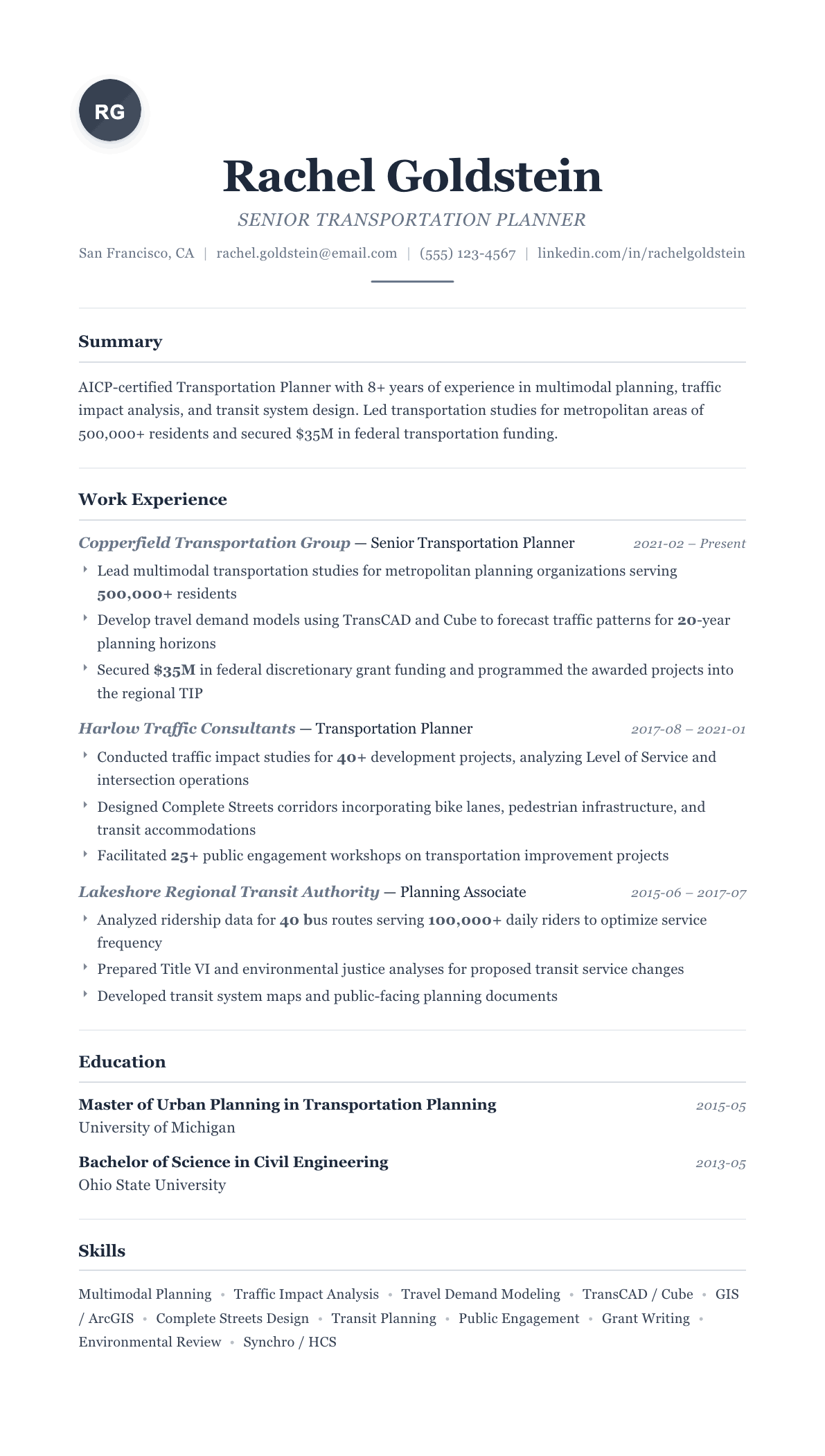
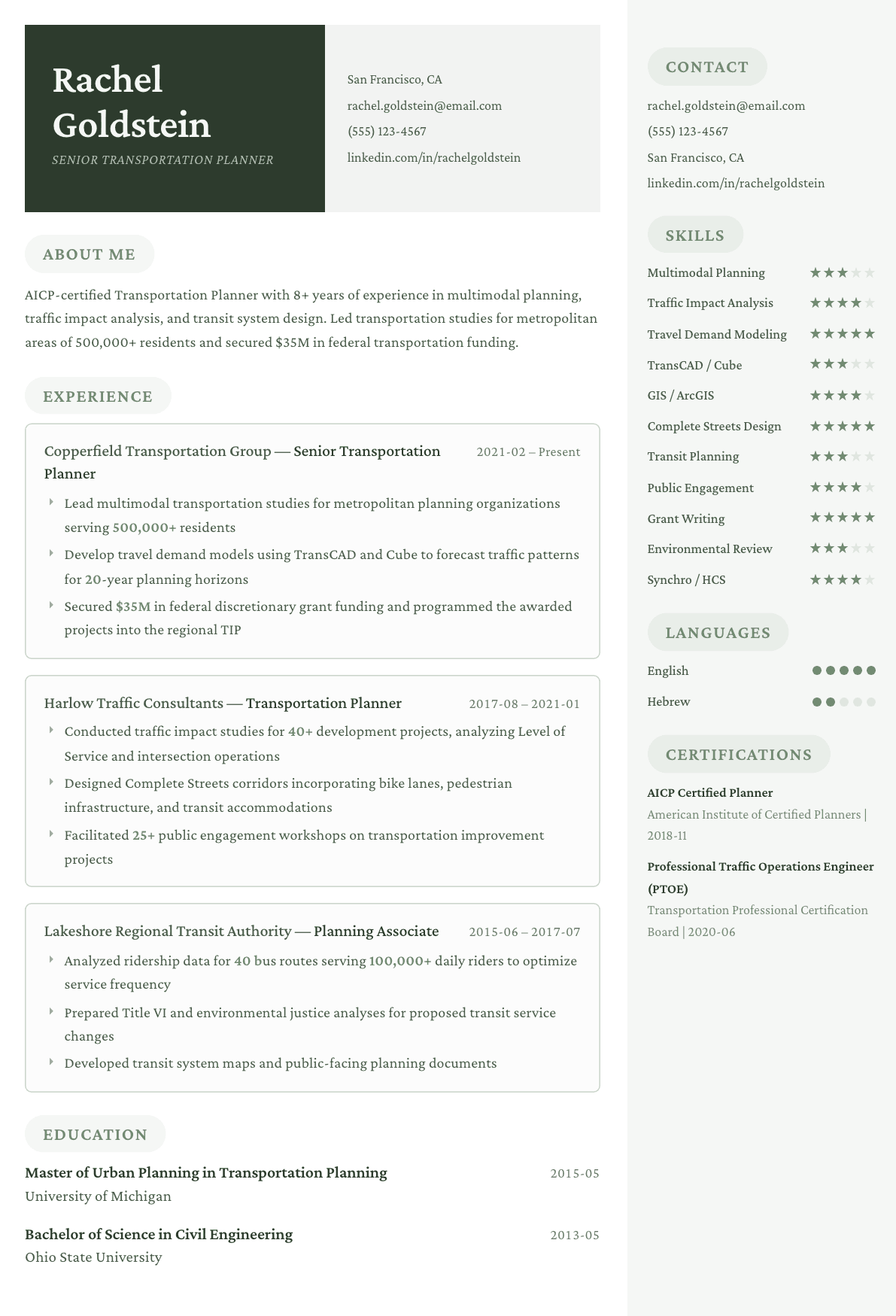
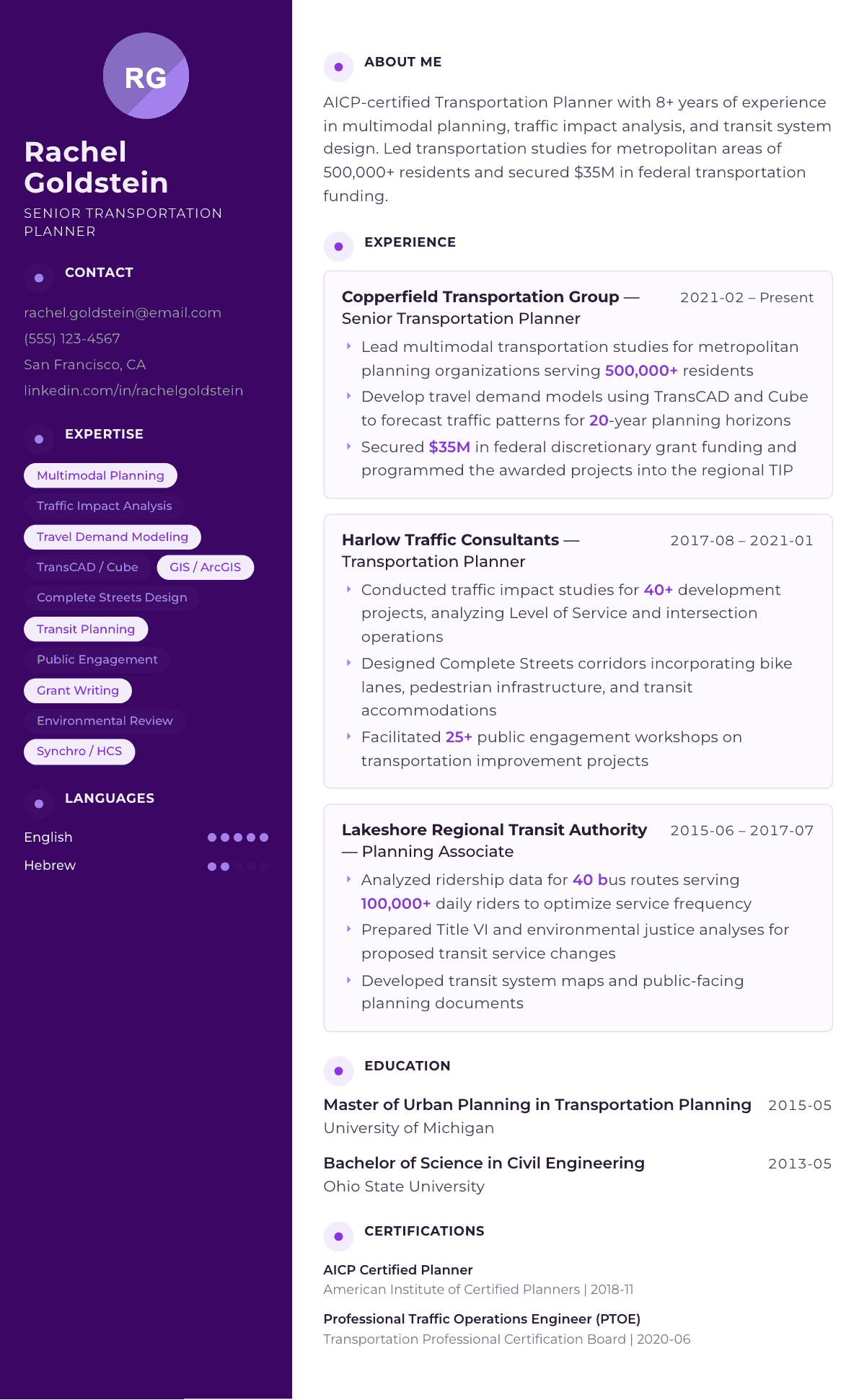
Example Transportation Planner summary
AICP-certified Transportation Planner with 8 years of experience in multimodal planning, traffic analysis, and transit system design. Led studies for metropolitan areas of 500,000+ and secured $35M in federal funding. Seeking a transportation planning director role.
Skills to list on a Transportation Planner resume
- Multimodal Planning
- Traffic Impact Analysis
- Travel Demand Modeling
- TransCAD / Cube / Visum
- GIS / ArcGIS
- Synchro / HCS
- Complete Streets
- Transit Planning
- Pedestrian & Bicycle Planning
- Public Engagement
- Grant Writing
- NEPA Compliance
- Title VI Analysis
- Capital Improvement Planning
What actually gets this resume read
- Include AICP certification and any specialized credentials (PTOE, PTP, RSP) prominently.
- List transportation modeling software: TransCAD, Cube, Visum, Synchro, CORSIM, Vissim.
- Quantify project impact: population served, funding secured, ridership increases, congestion reductions.
- Highlight public engagement experience: workshops facilitated, stakeholders consulted, communities served.
- Mention compliance with federal requirements: NEPA, Title VI, ADA, STIP/TIP programming.
How to write a transportation planner resume
Transportation planning resumes are read by two very different employers. A metropolitan planning organization or city department wants evidence you can carry a plan through a public process and a federal funding pipeline. A consulting firm wants evidence you can bill hours, hit a deliverable date and run the model without supervision. The same experience has to be framed differently for each.
What both readers look for immediately is the project list. Corridor studies, transit plans, safety action plans, traffic impact analyses, long range plans and their adoption status. A planner who lists duties instead of named project types leaves the reviewer unable to judge whether the work was a technical memo or a plan a council voted on.
This guide covers the document structure that suits both public and consulting employers, how to write project bullets that carry scale and outcome, the credentials that matter, sample summaries for an entry planner through to a project manager, and the questions planners ask when moving between the two sides of the profession.
Format: one page early, two once the project list earns it
Reverse-chronological with a separate project list once you have more than a handful of studies to your name. Public agencies often score applications against posted minimum qualifications, so make the degree, years of planning experience and credentials easy to locate rather than distributed through the prose.
Keep it single column and text based. Agency application portals frequently reparse an uploaded resume into a form, and a two-column layout with graphics turns that parse into nonsense on the very page a human reviewer reads.
- Header: name, city and state, phone, email, and credentials such as AICP or PTP after the name.
- Order: summary, technical skills, experience, selected projects, education, certifications, professional service.
- Include the degree and whether the planning program was accredited, since some agency postings reference it directly.
Summary: modes, geography, and the kind of work you carry
Say what you plan for: transit, bicycle and pedestrian networks, freight movement, roadway operations, safety, or all of it under a long range plan. Then the geography and jurisdiction type, because planning at a state department of transportation, a metropolitan planning organization, a county and a small city are four different jobs with different funding processes.
Close the summary with the level of ownership you have held. Supporting analyst, task lead, project manager or plan author. Reviewers use that to slot you into a salary band before they read a single bullet.
Experience and projects: name the study, the scale and the outcome
Each project bullet should carry the study type, the geographic scale, your role, the technical method and what happened at the end. A corridor study covering nine miles where you built the model, ran the alternatives and presented to a council that adopted the preferred alternative is a complete and checkable line.
Say what you personally did. Review panels are practiced at spotting a resume that claims a whole project when the candidate produced one chapter. "Authored the existing conditions and safety analysis chapters" is more credible and more useful than a claim to have led a plan you supported.
Include the funding and process machinery where you touched it. Programming projects into a transportation improvement program, preparing grant applications, environmental documentation under the National Environmental Policy Act, Title VI and environmental justice analysis, and Americans with Disabilities Act transition plan work. This is the part of the job consultants often lack and agencies always need.
Technical skills: model, tool, and what you produced with it
List the travel demand modeling platform you have actually run, such as TransCAD, Cube or Visum, and separate it from operational analysis in Synchro, Vissim, SIDRA or Highway Capacity Software. Confusing regional demand modeling with intersection operations is a fast way to fail a technical screen.
Add the spatial and data work: ArcGIS Pro, network analysis, crash data processing, traffic count programs, origin and destination data from mobile sources, and any scripting you use to automate it. Where you produced a level of service analysis, a safety screening or a multimodal level of comfort assessment, say which method or manual you followed.
Public engagement: the section agencies read closely
Give the engagement work real detail. Number of public meetings facilitated, workshop formats used, advisory committees staffed, survey instruments designed and the number of responses handled, and how you translated comments into plan revisions. Agencies hire planners who can stand in a room where people are angry about parking and keep the process moving, and that ability is invisible unless you write it down.
Transportation Planner resume summary examples
Entry-level planner
Transportation planner with a master of urban planning and 18 months at a regional council supporting bicycle and pedestrian planning. Processes crash and count data in ArcGIS Pro, drafted two existing conditions chapters, and staffed a nine member advisory committee through six public meetings.
Five years in
Transportation planner with five years in consulting across corridor studies, traffic impact analyses and transit plans in three states. Runs Synchro and Vissim analysis, supports the regional travel demand model in Cube, and holds AICP with a PTP designation.
Project manager
Senior transportation planner and project manager with 11 years, leading long range plan updates and safety action plans for metropolitan planning organizations. Manages multidisciplinary teams, programs projects into the transportation improvement program, and has secured competitive federal grants for two corridors.
Work experience bullets: before and after
Before: Worked on a corridor study for the city.
After: Served as task lead on a nine mile arterial corridor study, developed three alternatives in Synchro, and presented the preferred alternative to the city council, which adopted it.
Role, scale, method and adoption outcome let a reviewer judge the work instead of guessing at it.
Before: Attended public meetings and took comments.
After: Facilitated six public workshops and two pop-up events, designed the online comment map that collected 400 responses, and revised the network recommendation based on the parking concerns raised.
The engagement formats, the response count and the plan change show a process that actually influenced the outcome.
Before: Used GIS for transportation projects.
After: Built a crash screening in ArcGIS Pro over five years of state crash records, ranked 60 intersections by severity weighted rate, and used the ranking to prioritize safety countermeasures.
A named dataset, a stated method and a decision that followed prove analytical capability rather than software exposure.
Before: Helped with grant applications.
After: Wrote the project narrative and benefit case for two federal discretionary grant applications, coordinating cost estimates with the engineering team and letters of support from three jurisdictions.
Naming the components you produced and the coordination involved separates authorship from assistance.
Before: Assisted with the long range transportation plan.
After: Authored the freight and safety elements of a 25 year metropolitan transportation plan, ran fiscal constraint checks against revenue forecasts, and documented Title VI analysis for the adopted plan.
Specific chapters, the fiscal constraint requirement and the civil rights analysis show command of the federal planning process.
Hard skills
- Travel demand modeling in TransCAD, Cube or Visum
- Traffic operations analysis in Synchro and Vissim
- Highway Capacity Manual methods
- ArcGIS Pro and spatial network analysis
- Crash data analysis and safety screening
- Traffic impact analysis
- Transit service and route planning
- Bicycle and pedestrian network planning
- Transportation improvement program development
- National Environmental Policy Act documentation
- Title VI and equity analysis
- Grant writing and benefit case development
Soft skills
- Public meeting facilitation
- Technical writing for lay readers
- Stakeholder negotiation
- Composure with hostile comment
- Interagency coordination
- Deliverable and budget discipline
Certifications worth listing
- AICP Certified Planner (American Institute of Certified Planners)
- Professional Transportation Planner (PTP) (Transportation Professional Certification Board)
- Professional Traffic Operations Engineer (PTOE) (Transportation Professional Certification Board)
- Road Safety Professional (RSP) (Transportation Professional Certification Board)
- Certified GIS Professional (GISP) (GIS Certification Institute)
Mistakes that cost transportation planner candidates the interview
- Listing duties instead of named studies, which leaves a review panel unable to judge the scale of anything you have done.
- Claiming credit for whole plans when you produced individual chapters, a claim reviewers regularly test in the interview.
- Mixing travel demand modeling and intersection operations software into one list as if they were the same skill.
- Leaving out the federal process work, which is the part agencies cannot train quickly and consultants often lack.
- Treating public engagement as a soft skill footnote rather than counting meetings, formats and comment volumes.
- Submitting a consulting-style resume to an agency posting without addressing the posted minimum qualifications directly.
Transportation Planner resume questions
Do I need AICP to work as a transportation planner?
No, but it changes how public agency panels read your file and it appears as a preferred qualification in many senior postings. Consulting firms weigh technical credentials such as PTP or PTOE at least as heavily, so choose based on where you want to work.
How long should a transportation planner resume be?
One page for the first few years, then two once you have a project list worth reading. Public agency applications tolerate longer documents than private sector ones because reviewers score against posted qualifications rather than skimming.
Should I include projects that were never built?
Yes. Most planning work ends in an adopted plan rather than construction, so state the outcome accurately: adopted by council, programmed for funding, or completed as a technical memo. Reviewers understand the difference and respect the honesty.
How do I move from consulting to a public agency job?
Reframe around process rather than deliverables. Highlight work with committees, elected officials, funding programs and public comment, and name the agencies you supported as clients, since panels want proof you can operate inside a governmental process.
What software should a transportation planner list first?
Lead with whatever the posting names. Beyond that, ArcGIS Pro belongs on nearly every planner resume, then the operational tools such as Synchro for roadway work or the regional modeling platform if you support a metropolitan planning organization.
Related resume examples
- Urban Planner Resume example
- Supply Chain Analyst Resume example
- Logistics Coordinator Resume example
- Route Planner Resume example
- Demand Planner Resume example
- Distribution Manager Resume example