Musician Resume Examples: free score, then the gap list
Write a Musician Resume for Gigs, Teaching and Ensembles
By Mustafa Tarabya, founder of CVBooster · Published · Updated
Musician resume examples covering performance credits, repertoire, session work and teaching, with the sections music directors read first.
Sample resumes for a musician
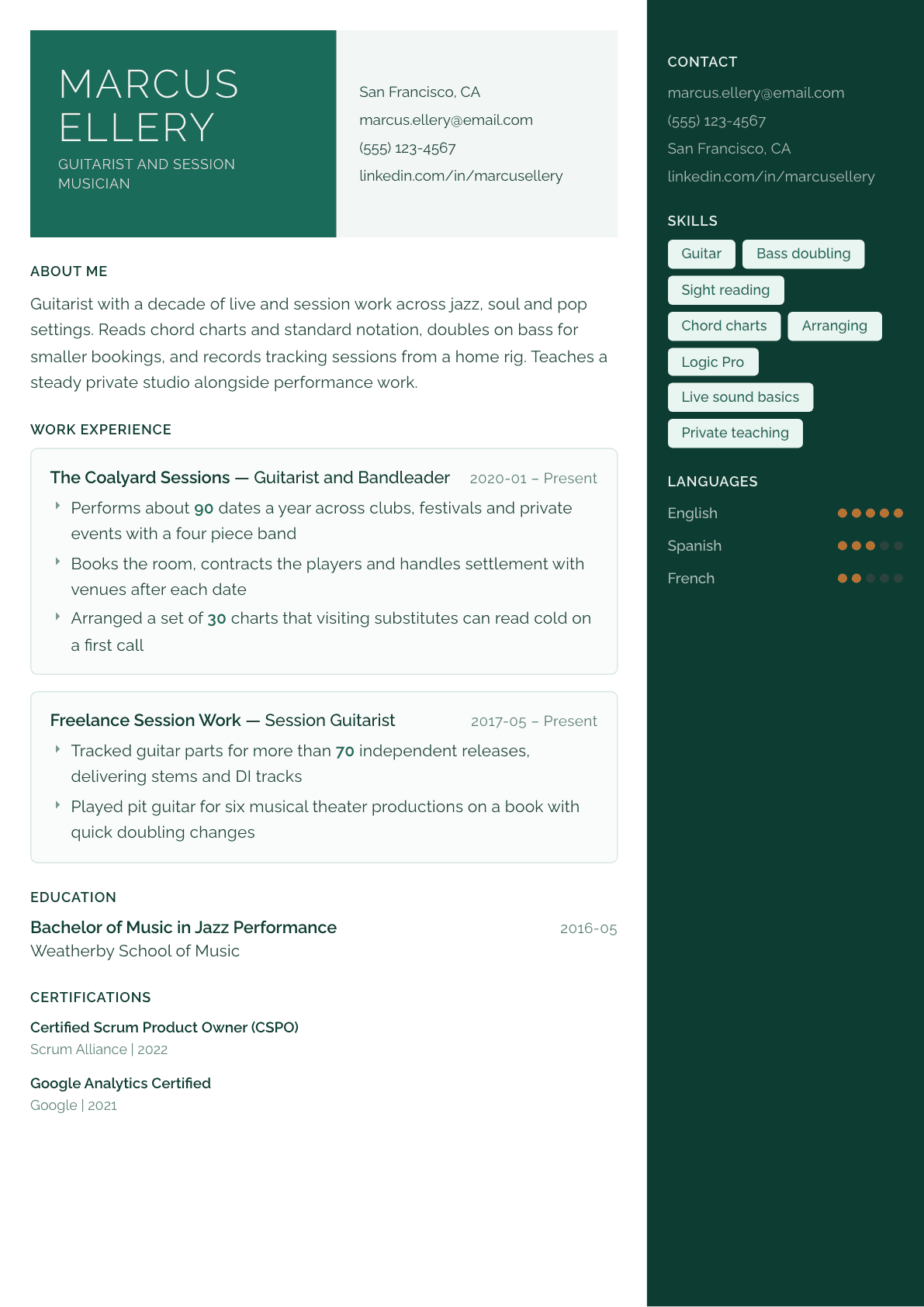
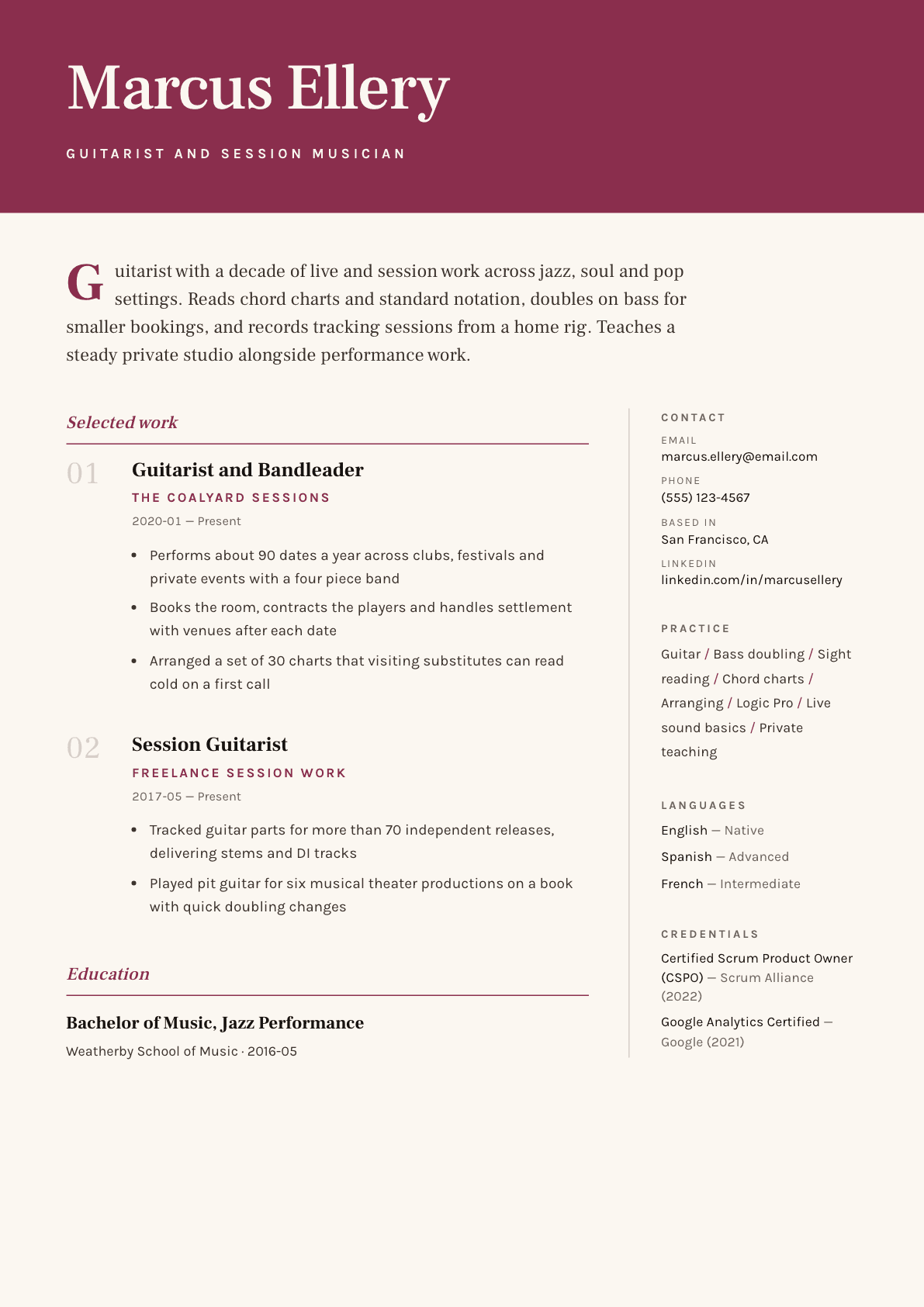
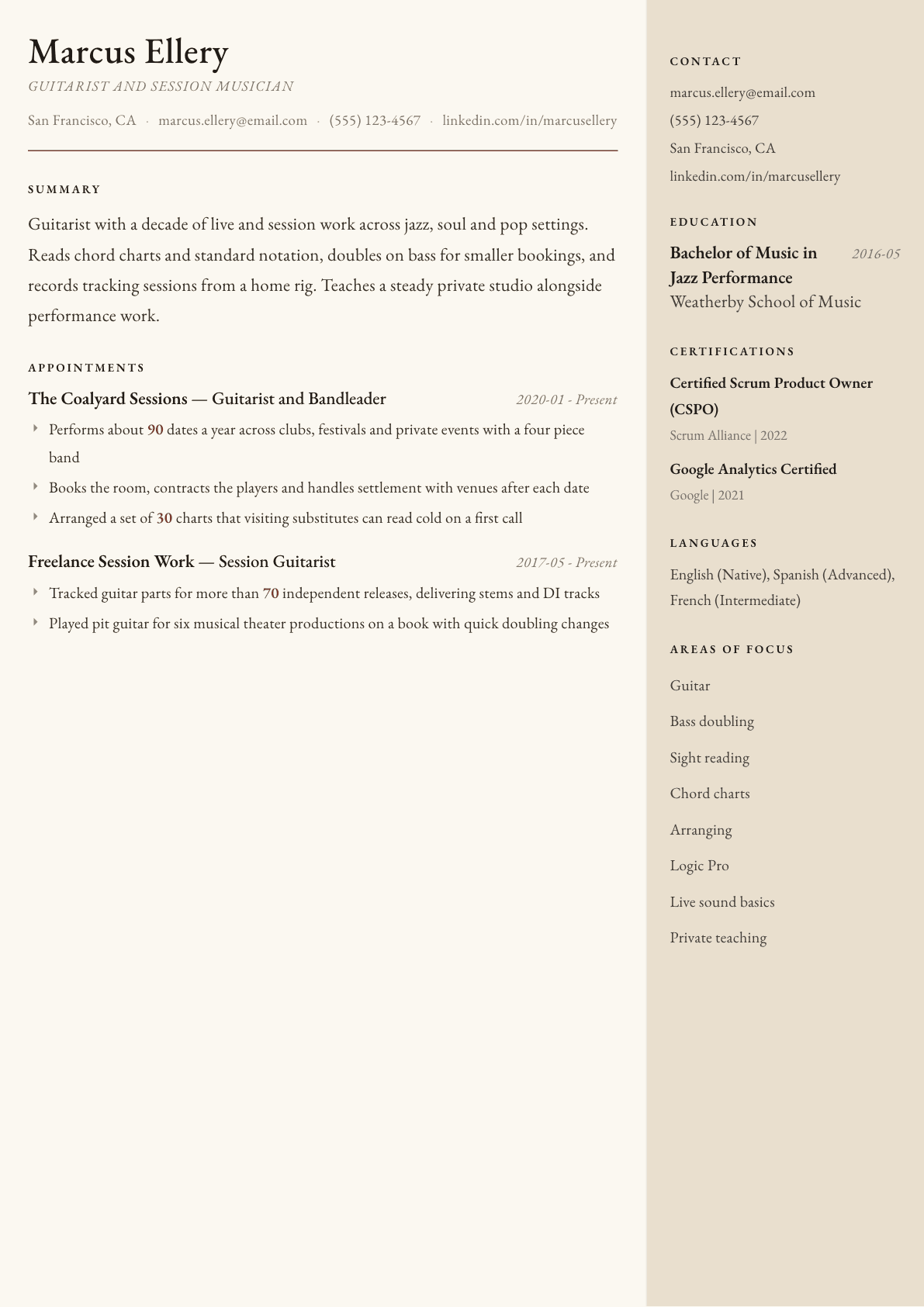
The same musician content laid out in three CVBooster templates, so you can see what the finished document looks like before you write a word.
Example Musician summary
Guitarist and session musician with a decade of club, festival and theater work across jazz, soul and pop. Reads standard notation and chord charts, doubles on bass, and tracks sessions from a home rig with clean stems. Leads a working quartet, contracts the players and handles venue settlement. Teaches a private studio of steady students alongside performance and recording work.
Skills to list on a Musician resume
- Instrumental performance
- Sight reading
- Chord chart reading
- Improvisation
- Ensemble playing
- Arranging
- Session recording
- Home studio tracking
- Logic Pro
- Rehearsal leadership
- Repertoire building
- Private instruction
- Live sound basics
- Contracting and settlement
What actually gets this resume read
- Open with instrument, genres and reading ability, because a music director decides on those three lines alone.
- Split the page into performance, session, teaching and recording, since each one is a different hiring conversation.
- List venues, festivals and ensembles by name, because a booker recognizes rooms faster than they recognize band names.
- State whether you read standard notation, chord charts or play by ear, and be exact, since the first rehearsal exposes it.
- Include doubling instruments and any pit experience, because theater contracts pay extra for doubles.
- Add a link to two or three live recordings rather than a full discography that nobody has time to open.
How to write a musician resume
A musician resume gets read by three different buyers and each one stops at a different line. A music director hiring for a show wants the instrument, the doubles and the reading ability. A bandleader filling a date wants the genres, the repertoire and whether you can be called at short notice. A school or studio hiring a teacher wants the credential, the age groups and the student outcomes.
Because of that, the strongest musician resume splits the page into distinct working identities rather than telling one chronological story. Performance, session recording, teaching and musical direction are four separate hiring conversations, and merging them buries the one the reader came for.
This guide covers the opening lines that decide a call, how to list venues and ensembles so a booker recognizes them, why reading ability must be stated exactly, how to present teaching and contracting work as the professional practice it is, and a complete music resume template you can copy section by section, with music resume samples for a recent graduate, a working player and a bandleader who also teaches in the summaries below it. The same structure works as a music curriculum vitae template for UK applications, with the changes listed in the template section.
Format: instrument, genres and reading in the first two lines
One page for most working musicians, two if you carry both a substantial performance history and a teaching practice. Open with the instrument, the doubles, the genres and the reading ability. A music director makes the first decision on those four facts alone, and hiding them below a paragraph of adjectives costs you the call.
Link two or three live recordings rather than a full discography. A booker will not open a long list, but they will click one clip if you tell them what is on it and how long it runs.
- Header: name, instrument and doubles, city, phone, email, two or three audio links.
- Sections: performance, session and recording, teaching, musical direction or contracting.
- State reading level exactly: standard notation, chord charts, lead sheets, or by ear.
- List gear only when the gig depends on it, such as backline, doubles or amplification.
Performance: name the rooms, the ensembles and the volume
Venues, festivals and named ensembles do the work of references. A booker recognizes rooms faster than band names, so list the clubs, halls and festivals alongside the group. Give the number of dates a year if it is substantial, because a musician performing regularly is a musician whose time keeping and stamina are already proven.
Say what the gig demanded rather than that it happened. A quartet where you also book the room, contract the players and settle with the venue after the show is a management role as much as a playing one, and it belongs in the bullets in those words.
If you have prepared charts for substitutes, say so. A book that a visiting player can read cold on a first call is a real asset and it tells a bandleader you think about continuity rather than only your own part.
Session and theater work: doubles, deadlines and delivery
For session work, list the number of releases you have tracked on and what you deliver: stems, direct signal tracks, multiple takes, or a produced part with your own tone. Remote session work is now standard, so name the software you record in and the file conventions you deliver by.
Pit work is its own category and pays for doubles, so list the shows and the instruments the book required. Musical theater contractors hire almost entirely on the combination of reading accuracy and doubling, and a resume that leaves the doubles vague gets passed over for one that lists them.
Teaching and repertoire: be specific about what you can hand over
A private studio is a business, so describe it as one: the instruments taught, the age range, the levels, whether you prepare students for graded examinations or auditions, and how long the studio has run. Schools and community programs also want to know about ensemble direction and any group teaching experience.
Repertoire belongs on the page in a compact form. Name the styles you can cover on a first call and the standards or set lists you hold from memory. A booker filling a last minute date is reading for exactly that and nothing else.
Keywords bookers and schools search on
The vocabulary is consistent: sight reading, chord charts, lead sheets, improvisation, ensemble playing, arranging, session recording, pit orchestra, doubling, bandleader, repertoire, private instruction, rehearsal direction. Use the ones that are true in real sentences, because every one of them is testable in a first rehearsal.
When applying to a school or a program, mirror their language on curriculum, ensembles and student progression. When applying for a playing gig, drop that entirely and lead with genres, reading and availability.
Music resume template and sample: one complete page, section by section
A music resume template is only useful if the order of sections matches the reader. For playing work the order is header, playing summary, performance credits, session and theater credits, teaching, education, then skills. For a teaching post, move teaching and education up to sit under the summary. The sample below is invented; copy the structure and replace every credit with your own.
Applying in the UK, or to a conservatoire, orchestra or music service that asks for a music curriculum vitae? The same template works as a CV with four changes. Call it a CV, open with a short personal statement instead of a playing summary, list graded exams and diplomas such as ABRSM or Trinity grades in the education section, and add your DBS check if you teach children. Two pages is normal for a music CV, with performance credits on page one and teaching and education on page two.
Header: Daniel Reyes, Guitarist and Bassist, with city, phone, email and links to two live clips and a repertoire list. Keep it to one page for gigs and two pages only for a school or program application.
- Playing summary: guitarist and electric bassist for pop, soul, funk and musical theater; reads standard notation and chord charts at sight; doubles on acoustic guitar and mandolin; available for depping at short notice.
- Performance: house band guitarist for a weekly soul night at a 300 capacity club; touring bassist for an independent folk act across two regional tours; regular dep for three function bands.
- Session and theater: guitar book for two regional theater productions of a touring musical, with doubles on acoustic and mandolin; remote session tracking for independent artists, delivering edited stems on deadline.
- Teaching: private guitar and bass instruction for students aged ten to adult, preparing students for school jazz band auditions and graded exams.
- Education: Bachelor of Music in Jazz Performance, state university.
- Skills: sight reading, chord charts, Nashville number system, improvisation, Logic Pro, Pro Tools, in-ear monitor setup, own transport and full backline.
Musician resume summary examples
Recent music graduate
Guitarist and bassist out of a jazz performance program, reading standard notation and chord charts. Plays club dates and function work in jazz, soul and pop settings, records basic tracking sessions at home, and teaches a small private studio of beginner and intermediate students on both instruments.
Ten years working
Guitarist and session musician with a decade of club, festival and theater work across jazz, soul and pop. Reads notation and chord charts, doubles on bass, and tracks sessions from a home rig with clean stems. Leads a working quartet, contracts the players and handles venue settlement.
Bandleader and educator
Performing musician and educator with a long running quartet, festival credits and a steady session client list. Arranges the book, prepares charts substitutes can read cold, and directs rehearsals for larger ensembles. Runs a private teaching studio and coaches student groups toward auditions and graded examinations.
Work experience bullets: before and after
Before: Play gigs regularly with my band.
After: Performs about 90 dates a year across clubs, festivals and private events with a four piece band, covering jazz, soul and pop set lists.
Date volume, venue types and genres tell a booker your reliability and your repertoire in one line.
Before: Run the band and handle the business side.
After: Books the room, contracts the players and handles settlement with venues after each date, including deposits, set times and backline requirements.
Naming the actual business tasks turns bandleader from a label into a set of competencies.
Before: Wrote arrangements for the group.
After: Arranged a book of 30 charts that visiting substitutes can read cold on a first call, with clearly marked forms, cues and endings.
The chart count and the substitute test show the arrangements serve the band rather than the writer.
Before: Recorded guitar for various artists.
After: Tracked guitar parts for more than 70 independent releases, delivering direct signal tracks alongside processed stems so producers could re amp later.
The delivery detail proves session literacy, which is what separates a player from a session player.
Before: Played in musicals.
After: Played pit guitar for six musical theater productions on books requiring quick doubling changes between electric, acoustic and nylon string parts.
Doubling is what pit contracting pays for, so naming the instruments makes the credit useful.
Hard skills
- Instrumental performance
- Sight reading standard notation
- Chord chart and lead sheet reading
- Improvisation
- Ensemble playing
- Arranging
- Session recording
- Home studio tracking
- Logic Pro
- Rehearsal leadership
- Repertoire building
- Private instruction
- Live sound basics
- Contracting and settlement
Soft skills
- Reliability on call
- Listening in an ensemble
- Adapting to a bandleader
- Working with venue staff
- Teaching patience
- Handling last minute changes
Certifications worth listing
- Nationally Certified Teacher of Music (NCTM) (Music Teachers National Association)
Mistakes that cost musician candidates the interview
- Burying the instrument, doubles and reading ability under a paragraph about passion for music.
- Listing band names without the venues, festivals or ensembles a booker would actually recognize.
- Overstating reading ability, which is exposed in the first ten minutes of the first rehearsal and rarely forgiven.
- Linking a full discography instead of two or three clips chosen for the gig being applied for.
- Merging performance, session and teaching work into one chronological list, so each reader has to sift for their part.
- Leaving out doubling instruments, which is the specific thing theater contractors and function bands pay extra for.
Musician resume questions
What goes in the first line of a musician resume?
Instrument, doubles, genres and reading ability. A music director or bandleader decides whether to keep reading on those four facts, and everything else on the page only matters once they have.
Should I list every gig I have played?
No. Group them by ensemble or by residency with a date range and name the notable venues and festivals. A long undifferentiated gig list reads as filler, while a short list of recognizable rooms reads as a career.
How do I present teaching alongside performance work?
Give teaching its own section with the instruments, age range, levels and any examination or audition preparation you do. Schools want the pedagogy detail, and performance bookers can skip the section entirely without losing the thread.
Is there a music resume template that works for both gigs and teaching?
Yes, if you keep one master file and reorder it. For gigs lead with the playing summary and performance credits; for teaching move teaching and education under the summary. The sections stay the same, only the order and the summary change, so you never maintain two different documents.
What audio should I link from a musician resume?
Two or three live recordings that match the kind of work you want, each labeled with the setting and the runtime. A booker will click one short clip and will not open a full album to find the thirty seconds that answers their question.