Content Strategist Resume Examples: the lines they read
Build a Content Strategist Resume That Tells Your Story
By Mustafa Tarabya, founder of CVBooster · Published · Updated
Craft a compelling content strategist resume with editorial planning expertise, audience growth metrics, and cross-channel content skills that stand out.
Sample resumes for a content strategist
The same content strategist content laid out in three CVBooster templates, so you can see what the finished document looks like before you write a word.
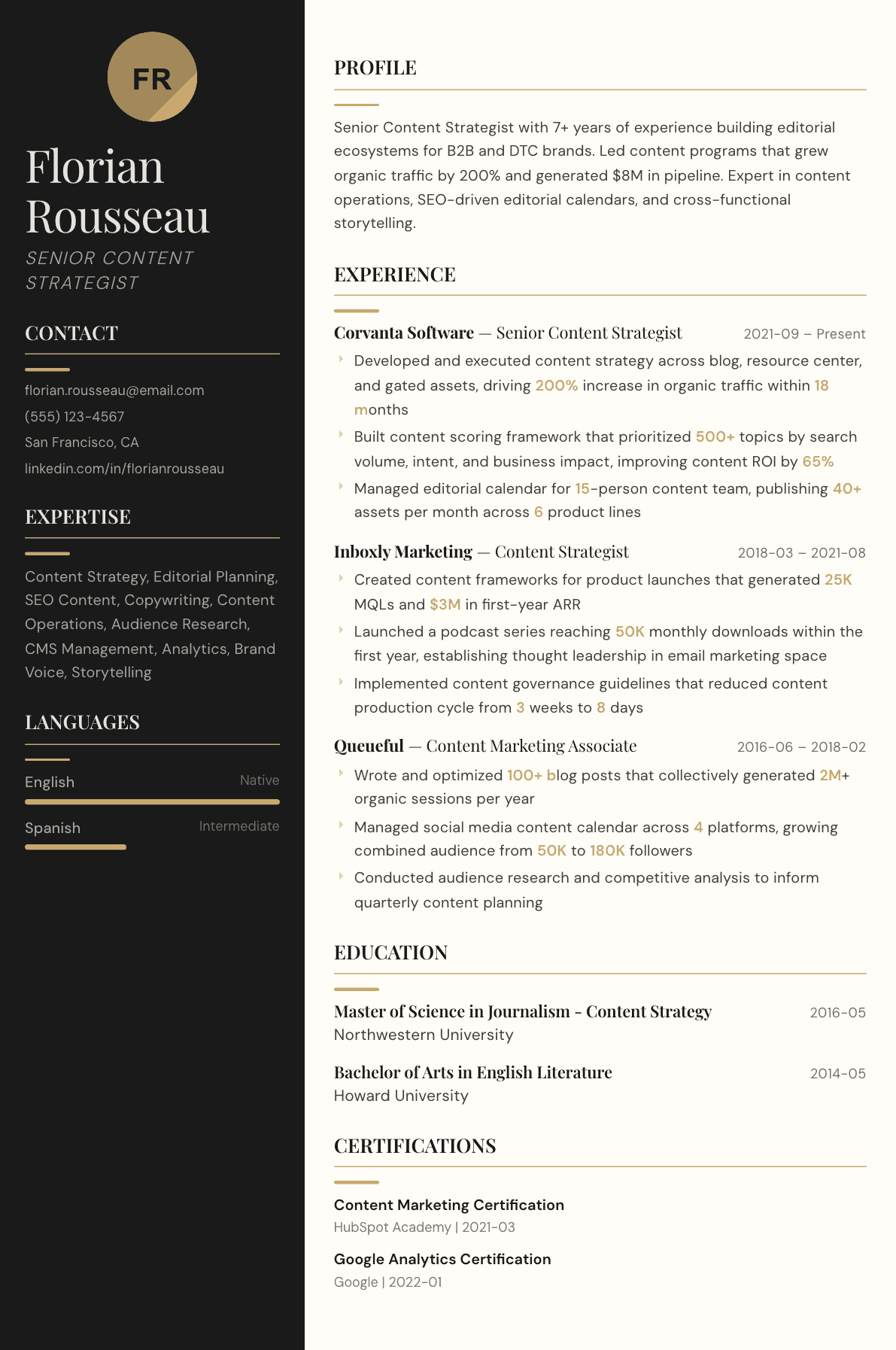
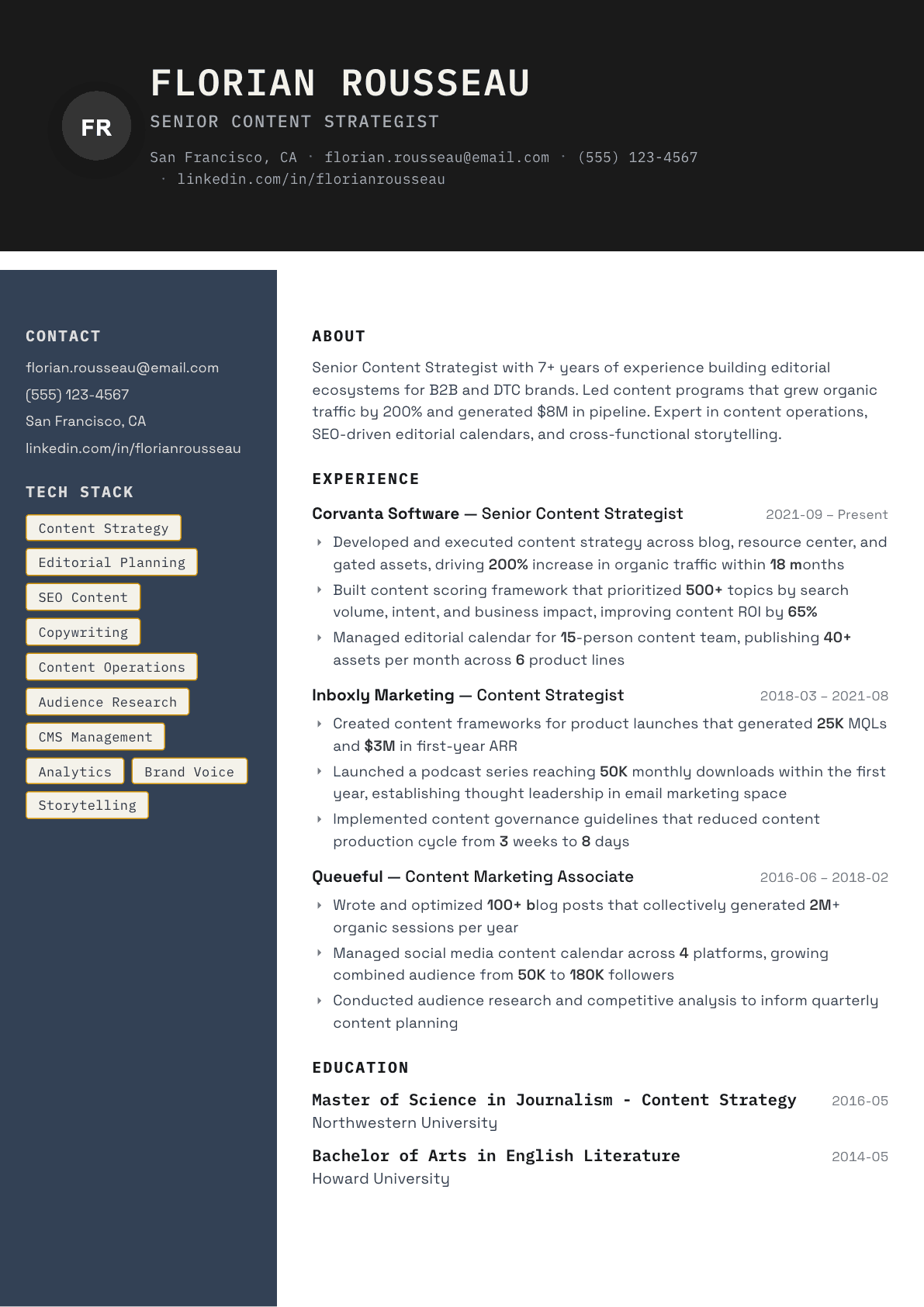
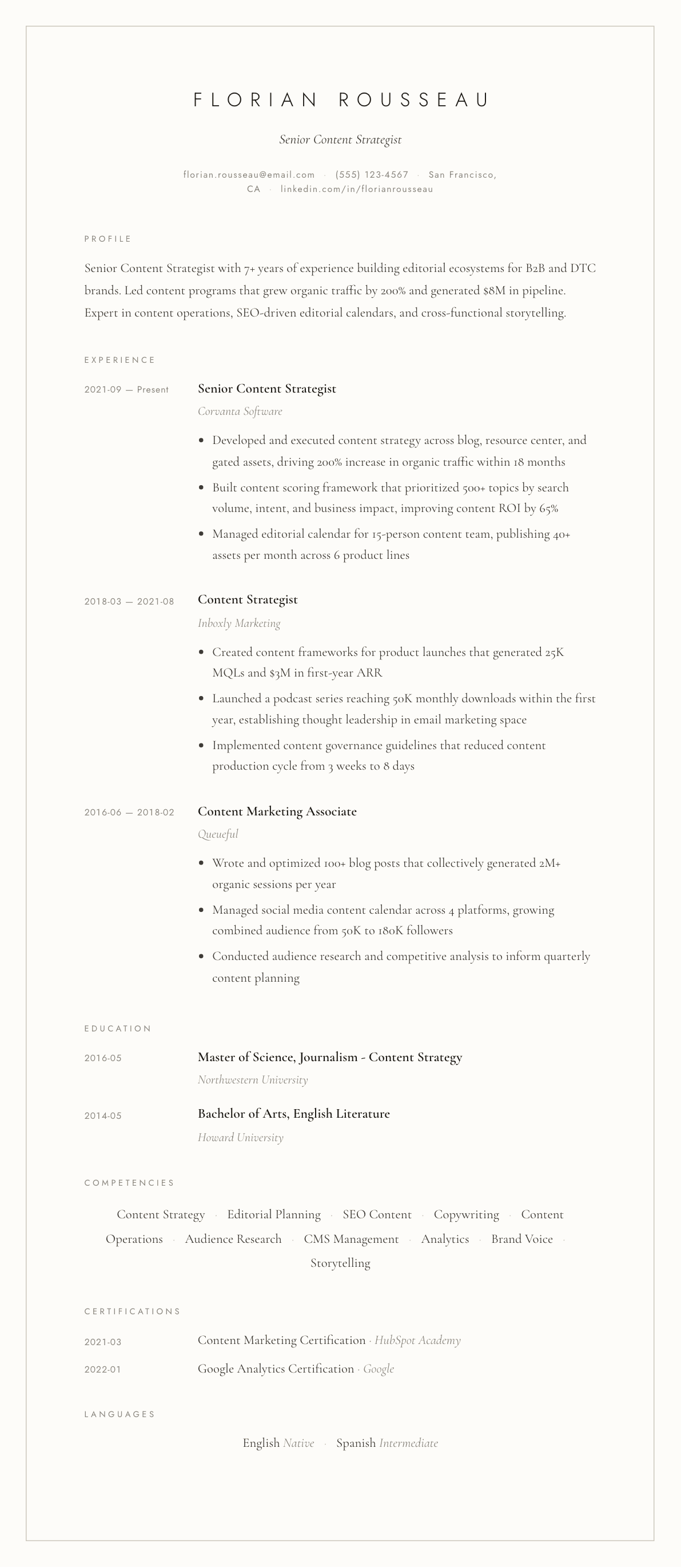
Example Content Strategist summary
Content Strategist with 7 years building editorial programs for B2B software and DTC brands. Grew organic traffic 200% in 18 months and generated $8M in pipeline by scoring topics against search demand and business impact. Runs editorial calendars for teams of 15 across 6 product lines.
Skills to list on a Content Strategist resume
- Content Strategy
- Editorial Planning
- Content Operations
- SEO Writing
- Copywriting
- Brand Storytelling
- Audience Research
- Content Governance
- CMS Management
- Google Analytics
- Content Marketing
- Social Media Strategy
- Podcast Production
- A/B Testing
What actually gets this resume read
- Show the business impact of your content: pipeline generated, MQLs, organic traffic growth, conversion rates.
- Demonstrate your ability to build and manage editorial calendars, content operations, and governance frameworks.
- Highlight cross-functional collaboration with product, sales, and design teams.
- Include specific content types you excel at: long-form, video scripts, podcasts, whitepapers, case studies.
- Mention tools you use: CMS platforms, SEO tools, project management tools, analytics platforms.
- Showcase thought leadership through published work, speaking engagements, or personal content projects.
How to write a content strategist resume
Content strategist means two different jobs, and the resumes that fail are the ones that do not pick a side. In marketing organizations the strategist owns an editorial program: the topics, the calendar, the search demand behind them, the writers who produce them, and the pipeline the work is supposed to feed. In product and UX organizations the strategist owns the words inside an interface, the taxonomy, the content model and the governance that keeps a hundred pages from contradicting each other. Both are real, and neither hiring manager will read very far into a document written for the other one.
Once the reader knows which strategist you are, they look for the same three things: evidence that you decide what not to publish, evidence that you have run other people's writing rather than only your own, and evidence that the program moved a number the business cares about. Portfolios full of articles you wrote yourself read as a writer resume, which is a different and more junior hire.
This guide covers the section order for a strategist file, how to describe an editorial program that a stranger can picture, three summaries at different stages, before-and-after bullets, and the questions strategists ask when they try to prove the value of work that took a year to compound.
Format: one to two pages, with a program snapshot near the top
One page under six years, two after that. Under the summary, add a compact program snapshot: the audiences you write for, the formats you own, the publishing cadence you sustained, the size of the writer and freelancer bench you directed, and the content management system you worked in. A strategist is hired to run a machine, and the snapshot describes the machine.
Add a portfolio link, but curate it for strategy rather than volume. Three items with a short note on the brief, the decision and the result beat forty article links. If your best work is a content model, an editorial standards document or a taxonomy, include a redacted version rather than only published articles.
- Header: name, title, city, email, portfolio link.
- Program snapshot: audiences, formats, cadence, team and freelance bench, CMS and analytics stack.
- Sections in this order: summary, snapshot, experience, selected work, skills, education.
Summary: the audience, the program, the number it fed
Three lines that answer who you write for, what you run, and what it produced. Name the buyer or user, the program shape, and the outcome, whether that is organic sessions to a set of money pages, qualified leads from gated work, sales enablement adoption, or reduced support contacts after a documentation rewrite.
If you are moving between the marketing and the product flavors of the job, address it directly. A marketing strategist moving into UX content should lead with information architecture, content models and governance work, not with blog traffic.
Experience: strategy decisions, not a list of things published
A publishing list is not strategy. What proves strategy is a decision with a reason and a consequence: you cut the publishing rate in half and moved the budget to updating the twenty pages that already ranked, you retired a format that never converted, you reorganized a sprawling help center around tasks rather than product features, you moved a topic cluster from awareness to comparison because the search results demanded it.
Show the operating side too, because that is what a manager cannot train quickly. Editorial calendars and intake, briefs that a freelancer can execute without a call, review workflows and legal signoff, a style guide people actually use, and the measurement rhythm that decides what gets refreshed.
Attribute honestly. Content rarely converts alone, so name the model you used, whether that is first touch, last touch, an influenced pipeline view or an assisted conversion report, and give the window. A reader who has run content marketing will trust an honest attribution note far more than a round number with no method behind it.
Search, audience research and the evidence behind topic choices
Explain how topics get chosen, because that is the core of the craft. Keyword research and search results analysis, customer interviews, sales call reviews, support ticket themes, community questions, competitor gap analysis. Name the sources you used and the cadence you refreshed them on.
Then show the structure that came out of it. Pillar and cluster architecture, internal linking rules, a refresh policy with a trigger, and a retirement policy for pages that no longer earn their place. Governance is the least glamorous part of the resume and often the reason a strategist gets hired over a writer.
Tools and keywords a strategist file should carry
Name the content management systems you have worked inside, such as WordPress, Contentful, Sanity, Webflow or a bespoke internal platform, and say whether you configured content types or only wrote into them. Add the search and analytics tools you used and the project system your calendar lived in.
Postings repeat a small vocabulary: content strategy, editorial calendar, content operations, content governance, brand voice, audience research, topic cluster, content audit, style guide, content model. Use the ones your work supports, once in the summary and again inside a real accomplishment.
Content Strategist resume summary examples
First strategy role after writing
Writer moving into content strategy, currently owning the editorial calendar and briefs for a small B2B software team publishing eight pieces a month. Ran the first full content audit of 140 pages, retired 30 of them, and rebuilt the remaining product-adjacent articles into three topic clusters that doubled non-branded entrances.
Six years in
Content strategist with six years running editorial programs for subscription products, directing two staff writers and a bench of five freelancers. Built the brief template, style guide and refresh policy still in use, and grew organic entrances to comparison and pricing pages by 90% over four quarters without increasing publishing volume.
Head of content
Head of content leading strategy, editorial and documentation for a platform business with four audiences across two regions. Introduced a content model and governance council that cut duplicate pages by a third, and moved the program from a volume target to a quarterly refresh cycle tied to influenced pipeline reporting.
Work experience bullets: before and after
Before: Managed the content calendar and published blog posts weekly.
After: Ran a rolling twelve-week editorial calendar across blog, documentation and email, with a brief template and intake form that let five freelancers file usable drafts without a kickoff call.
The rewrite shows an operating system a stranger could inherit rather than the fact that a calendar existed.
Before: Improved SEO performance of the blog.
After: Audited 140 published pages, retired 30 with no entrances, consolidated 22 into six comparison pages, and grew non-branded entrances to that cluster by 90% in two quarters.
Naming the audit, the cuts and the consolidation shows judgment, since deciding what to remove is the harder half of the work.
Before: Worked with sales and product on content needs.
After: Reviewed 40 recorded sales calls a quarter for objection themes, turned the four most common into comparison and pricing pages, and briefed the sales team on how to send them mid-cycle.
A specific research input and the downstream use turn cross-functional collaboration into an evidenced method.
Before: Created a style guide for the brand.
After: Wrote a nine-page editorial standards guide covering voice, structure, sourcing and accessibility, then trained the freelance bench on it and cut average edit rounds per article from three to one.
A guide is only worth listing when the reader can see adoption and the cost it removed.
Before: Reported on content performance to leadership.
After: Built a quarterly content review reporting entrances, assisted conversions and influenced pipeline on a 90-day window, which set the refresh list for the following quarter.
Stating the metrics and the attribution window makes the reporting credible and shows it drove the next decision.
Hard skills
- Content strategy
- Editorial calendar and intake
- Content audits
- Topic clusters and internal linking
- Keyword and search results research
- Audience and customer research
- Content model and taxonomy design
- Content governance
- Style guide development
- Briefing and editing
- CMS configuration
- Analytics and attribution reporting
- Localization planning
- Documentation strategy
Soft skills
- Editorial judgment
- Stakeholder negotiation
- Directing freelance writers
- Prioritization against a fixed budget
- Clear feedback
- Persuading with evidence
Certifications worth listing
- Content Marketing Certification (HubSpot Academy)
- Google Analytics Certification (Google Skillshop)
Mistakes that cost content strategist candidates the interview
- Writing a strategist resume that is really a portfolio of articles, which reads as a writer application.
- Listing publishing volume as an accomplishment when the interesting decision was usually what you stopped publishing.
- Claiming traffic growth with no window, no baseline and no attribution note, which an experienced reader discounts entirely.
- Ignoring governance, so nothing on the page proves you can keep a large library from drifting into contradictions.
- Applying to a UX content role with a blog-heavy document instead of leading with content models and information architecture.
- Naming every tool in the category rather than the ones you configured, which invites questions you cannot answer.
- Burying the team and freelance bench you directed, so the reader assumes you wrote everything alone.
Content Strategist resume questions
What is the difference between a content strategist and a content marketing manager?
A strategist decides what the program should be: audiences, topics, formats, structure and governance. A content marketing manager usually owns delivery and channel results against that plan. Many postings blend them, so mirror the wording of the specific job rather than defending a definition.
Do I need a portfolio for a content strategist role?
Yes, but curate it for decisions rather than volume. Three case notes showing the brief, the constraint, the choice you made and what happened will do more than dozens of article links, and a redacted content model or audit shows work most candidates cannot show.
How do I prove content drove revenue?
State the model and the window openly. Report assisted conversions or influenced pipeline over a defined period, name the pages involved, and say which system produced the figure. An honest, bounded claim survives interview scrutiny where a large round number does not.
Should a content strategist resume include SEO skills?
Yes, at the level you actually work. Search demand research, results analysis, cluster structure and internal linking belong on the page. Leave technical audits, log file analysis and redirect mapping off unless you have genuinely run them, since that is a specialist claim.
How do I move from writing into content strategy?
Take on the decisions before the title. Run a content audit, build a brief template, propose a refresh policy, or map a topic cluster from search results, then put those artifacts at the top of the resume and let the writing samples sit underneath as supporting evidence.