Copywriter Resume Examples: free ATS score and gap list
Write a Copywriter Resume That Sells Your Skills
By Mustafa Tarabya, founder of CVBooster · Published · Updated
Build a creative copywriter resume with conversion-focused writing samples, campaign results, and brand voice expertise that copywriting teams want to see.
Sample resumes for a copywriter
The same copywriter content laid out in three CVBooster templates, so you can see what the finished document looks like before you write a word.
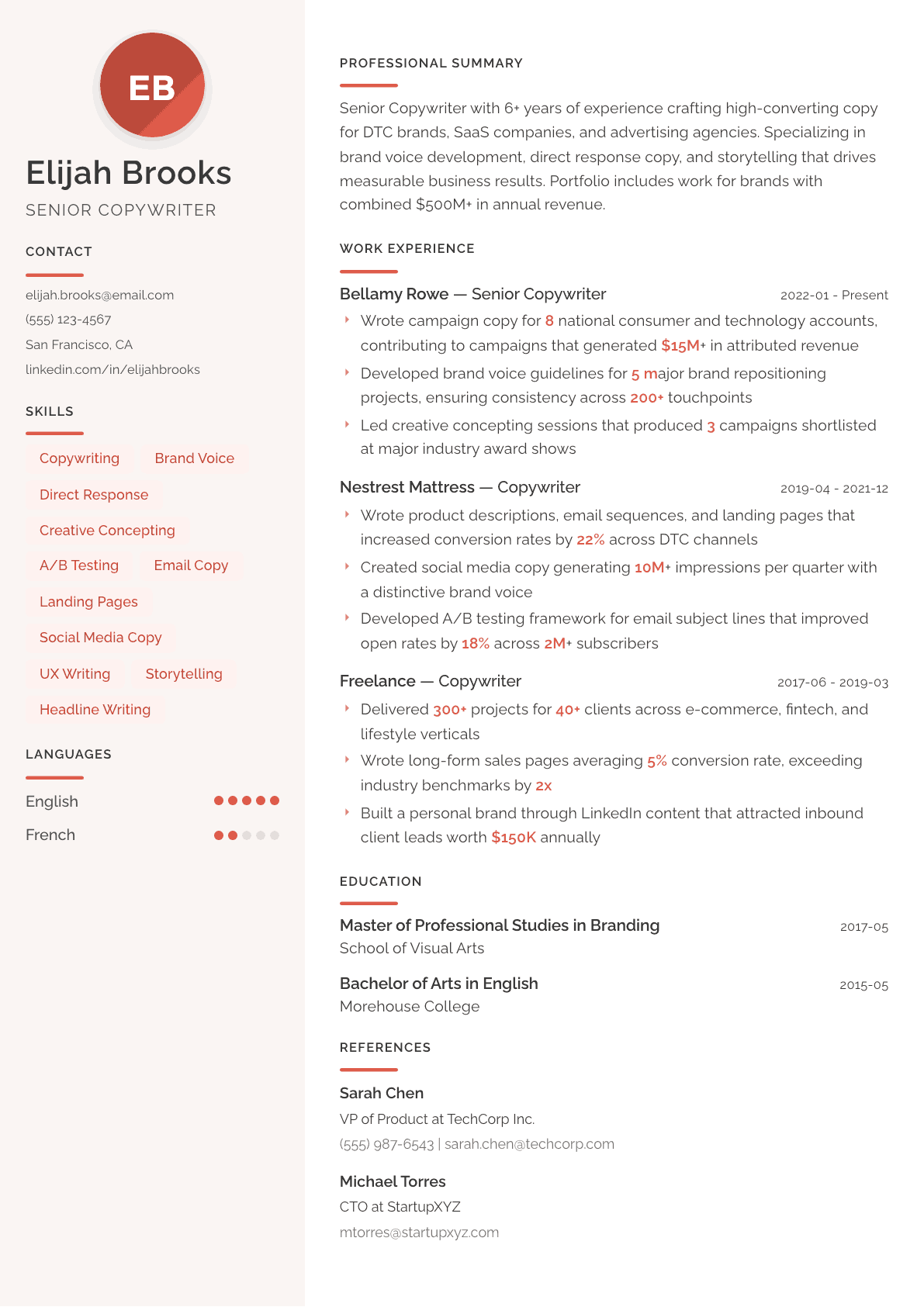
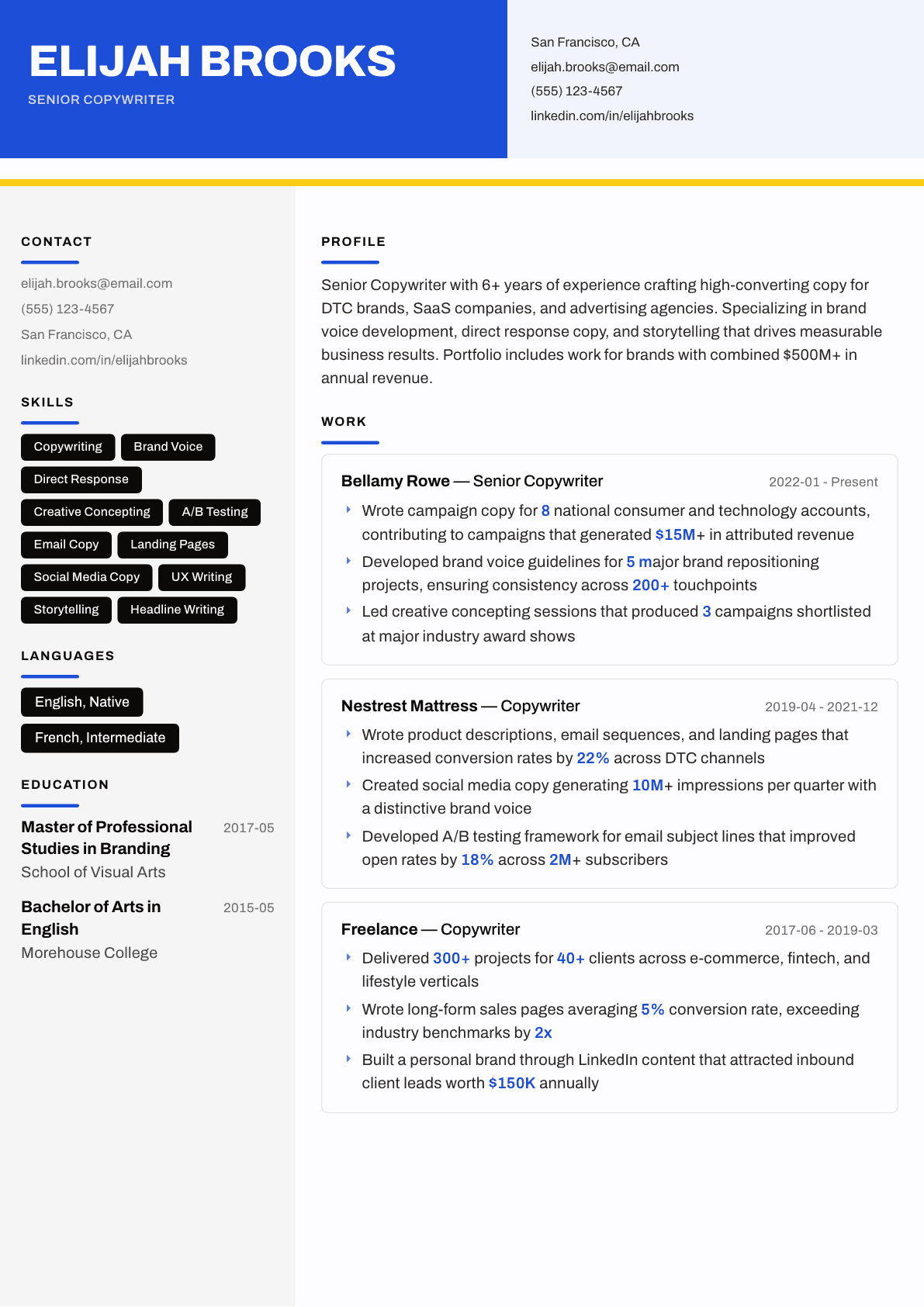
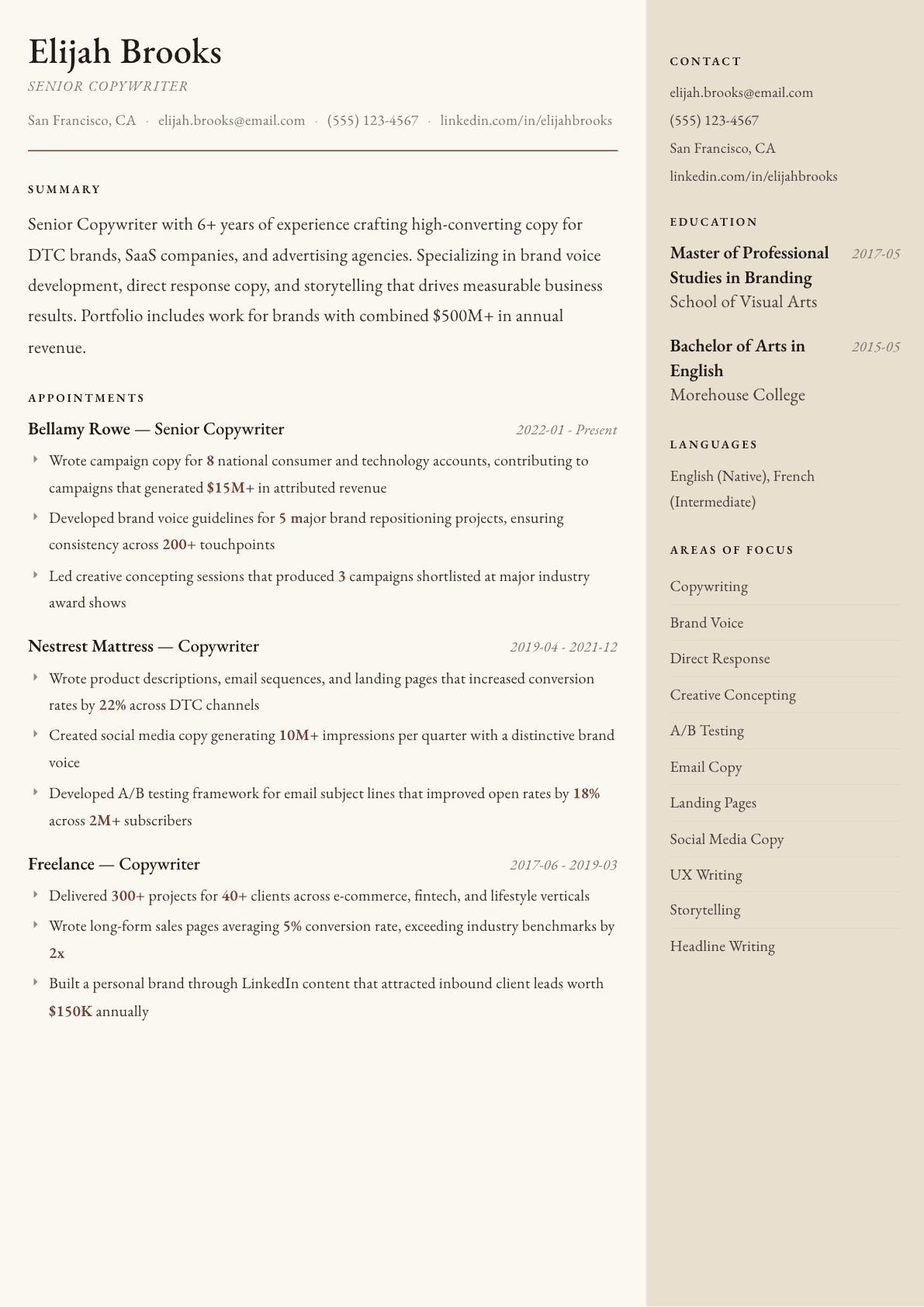
Example Copywriter summary
Copywriter with 6 years writing conversion-focused copy for DTC and SaaS brands, agency side and in house. Campaign work contributed $15M+ in attributed revenue, and DTC landing pages and email sequences lifted conversion 22%. Looking for a senior creative role that pairs storytelling with measurable results.
Skills to list on a Copywriter resume
- Copywriting
- Brand Voice Development
- Direct Response Copy
- Creative Concepting
- Email Copywriting
- Landing Page Copy
- Social Media Copy
- UX Writing
- Headline Writing
- A/B Testing
- Storytelling
- Ad Copy
- SEO Copywriting
- Script Writing
What actually gets this resume read
- Include a link to your portfolio or writing samples -- this is non-negotiable for copywriting roles.
- Quantify the impact of your copy: conversion rates, revenue generated, engagement metrics.
- Showcase versatility across formats: ad copy, email, landing pages, social media, long-form, UX copy.
- Mention specific brand voice work and how you developed or maintained tone across channels.
- Highlight A/B testing experience to demonstrate data-informed creative decisions.
- List industries you have written for to help recruiters assess vertical expertise.
How to write a copywriter resume
Copywriting applications are decided by the book, not the resume. A creative director or a growth lead opens your portfolio, looks at the first two pieces, and forms a view before reading a single bullet. The resume then has one job: make the book easy to find, explain what kind of copywriter you are, and answer the practical questions the work cannot answer on its own, such as who briefed you, what the constraint was, and whether the idea survived to production.
There are two distinct hiring lanes and mixing them costs interviews. Agency and brand copywriting is judged on concepting: the idea, the line, the campaign that holds together across channels. Direct response and performance copywriting is judged on the number: the tested subject line, the landing page that converted, the ad that beat the control. A book full of brand films will not land a growth team, and a folder of tested ad variants will not get you into a creative department.
This guide covers how to structure a copywriter resume around the portfolio, how to write about copy without vague claims of storytelling, three summaries at different stages, before-and-after bullets, and the questions copywriters ask when the strongest work they have was killed by a client or is covered by an agreement.
Format: one page, portfolio in the header, lane declared
One page, always, until you are a creative lead. The portfolio link goes in the header on its own line with a password in plain text if the site is gated, because a hiring reader will not email you for it. Make sure the link works on a phone.
Under the summary, declare your lane in a single line: brand and campaign concepting, direct response and performance, product and interface copy, or a documented mix. Then list the formats you write and the categories you have written in. That line stops your file from being sorted into the wrong pile.
- Header: name, title, city, email, portfolio link and password if gated.
- Lane line: concepting or direct response, formats, categories, and whether you work from strategy or to a brief.
- Sections in this order: summary, lane line, selected work, experience, skills, awards, education.
- Awards only if they are real and named, with the show, the year and the category.
Summary: what you write, who you write it for, what it did
Three lines, written in your own voice, because this is the first writing sample the reader sees. A stiff summary undercuts a good book. Name the categories, the channels, and the strongest evidence you have, whether that is a campaign that ran nationally or a landing page that beat a long-standing control.
Skip award-winning as an opening adjective unless the award is named a line later. Skip storyteller entirely. If you write in a specific register, whether that is dry and technical, warm and plain, or fast and funny, show it in the summary rather than claiming range you cannot demonstrate.
Selected work: the brief, the constraint, the line, the outcome
For each of four to six pieces, give the client or brand, the assignment, the constraint you worked against, what you wrote, and what happened. The constraint is the part almost every candidate leaves out and the part that most impresses a creative director: a legal restriction on the claim, a fourteen-character button, a launch in nine markets, a product that could not be shown.
Credit honestly. Say whether you concepted or executed, who art directed with you, and whether the work ran. Creative departments are small and reference checks are informal, so an inflated credit is found quickly. Work that was sold but never produced can be shown and labeled as such.
Direct response evidence: tests, controls and the honest number
If you write to convert, treat your bullets like test reports. Name the control you were beating, the variable you changed, the traffic or list size, and the metric that moved. A subject line test on a small list that lifted opens is worth listing when the size is stated; the same claim without the denominator reads as noise.
Show that you understand where copy is not the lever. A copywriter who has diagnosed that a landing page underperformed because the offer was wrong, not because the headline was weak, is a more valuable hire than one who rewrites headlines forever. One bullet on that judgment is enough.
Voice work, tools and the keywords postings actually use
Brand voice work is a real skill and needs evidence: a voice guide you wrote, a tone framework applied across channels, onboarding you ran for other writers, or a rewrite of an existing library into a new register. Say what the voice was before and after in plain words.
Postings repeat a compact vocabulary: copywriting, concepting, brand voice, direct response, conversion copy, landing page, email copy, ad copy, product copy, interface copy, headline testing. Use the ones your work supports. Name the tools where they matter, such as the design file your copy is written into, the testing tool that ran your variants, and the email platform your sequences live in.
Copywriter resume summary examples
Junior copywriter
Junior copywriter with a year in an agency studio writing social, email and product copy across two retail accounts, plus a spec book built with an art director partner. Comfortable writing to a creative brief, taking notes in the room, and turning around variant sets the same day.
Six years in
Copywriter with six years split between a creative agency and an in-house growth team, concepting campaigns and writing the performance copy underneath them. Wrote the launch line and channel copy for a national retail campaign, and beat a two-year-old landing page control by 18% on a paid traffic test.
Senior copywriter and voice lead
Senior copywriter leading voice for a consumer finance brand across product, marketing and support channels. Wrote the voice guide used by twelve writers, rewrote the onboarding and billing messages into plain language, and cut billing-related support contacts by a fifth after launch.
Work experience bullets: before and after
Before: Wrote copy for advertising campaigns.
After: Concepted and wrote a national retail campaign with an art director, covering the launch line, three film scripts, out of home and store windows across nine markets.
Naming the channels, the partner and the market count shows the scale of the assignment rather than the job function.
Before: Improved conversion rates on landing pages.
After: Rewrote the offer and headline on the paid acquisition landing page, tested against a control that had held for two years, and lifted signups by 18% across forty thousand sessions.
A control, a changed variable and a stated sample size make the claim testable instead of decorative.
Before: Wrote email campaigns for the brand.
After: Wrote a five-message welcome sequence and ran subject line tests each cycle, raising first-week activation among new subscribers from 24% to 37%.
Sequence structure, a testing habit and an activation metric show a working method behind the writing.
Before: Developed the brand voice.
After: Wrote a voice guide with three tone principles and rewritten before and after examples, then trained twelve writers on it and reviewed the first month of output against it.
A voice guide only counts once the reader sees adoption and the review that made it stick.
Before: Wrote UX copy for the app.
After: Rewrote onboarding, error and billing messages in plain language with the product designer, replacing system phrasing with the next action, which cut billing-related support contacts by a fifth.
Naming the message types, the partner and the support outcome turns interface copy into measurable product work.
Hard skills
- Concepting
- Headline writing
- Direct response copy
- Landing page copy
- Email and sequence copy
- Social and ad copy
- Script writing
- Interface and error message copy
- Brand voice guides
- A/B and multivariate test copy
- Long-form sales pages
- Editing and proofreading
- Working from creative briefs
- Claims and legal review
Soft skills
- Taking creative direction
- Presenting work to clients
- Partnering with art direction
- Killing your own lines
- Working under a live deadline
- Curiosity about the customer
Mistakes that cost copywriter candidates the interview
- Sending a portfolio link that is broken, gated without the password, or unreadable on a phone.
- Showing fifteen pieces when four with the brief and the constraint would have made the case faster.
- Claiming a campaign you executed on but did not concept, which reference checks in a small industry expose.
- Writing a stiff, formal summary that contradicts the voice the portfolio is trying to sell.
- Quoting conversion lifts with no control and no sample size, which a growth reader discounts immediately.
- Applying to a performance role with a book of brand films, or to a creative department with a folder of test variants.
- Leaving a typo in the resume, which in this role reads as a work sample rather than an accident.
Copywriter resume questions
Do I need a portfolio to apply for a copywriter job?
Yes, without exception. If you have no client work, build a spec book of four pieces on real brands with a stated brief and constraint for each. Hiring readers care about the thinking and the lines, not whether the work was paid.
Can I show work that never ran?
Yes, as long as you label it. Sold but unproduced work and spec pieces are normal in a book. Mark them clearly, explain the assignment, and say why the work did not run if the reason reflects well on the thinking rather than the execution.
Should a copywriter resume include metrics?
It depends on the lane. Direct response and growth roles expect a control, a variable and a sample size for any lift you claim. Brand and campaign roles care more about the assignment, the idea and where the work ran, so metrics there should be used sparingly.
How do I list awards on a copywriter resume?
Name the show, the category and the level, and only include shows a hiring reader will recognize in your market. One line each in a short awards section near the bottom is enough. Never write award-winning in the summary without naming the award.
How do I move from content writing into copywriting?
Rebuild the book around persuasion rather than explanation. Write landing pages, email sequences and ad sets for products you understand, show the brief and the constraint for each, and lead your resume with any tested work, even from a small list or a side project.