Student Ambassador Resume Examples: the lines they read
Write a Student Ambassador Resume That Proves Campus Impact
By Mustafa Tarabya, founder of CVBooster · Published · Updated
Student ambassador resume example, keyword list and writing guide covering campus tours, open day panels, admitted student outreach and CRM notes.
Sample resumes for a student ambassador
The same student ambassador content laid out in three CVBooster templates, so you can see what the finished document looks like before you write a word.
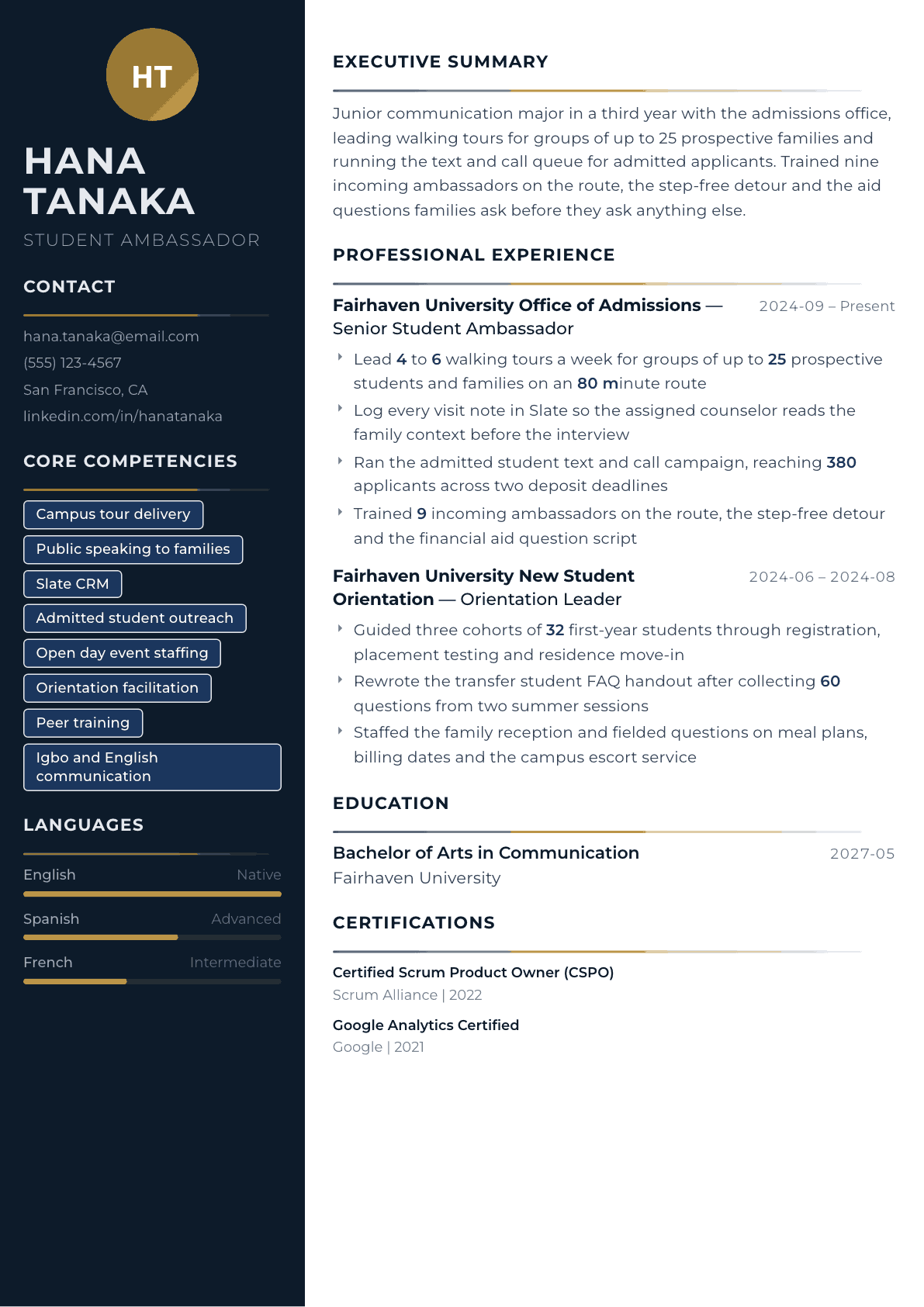
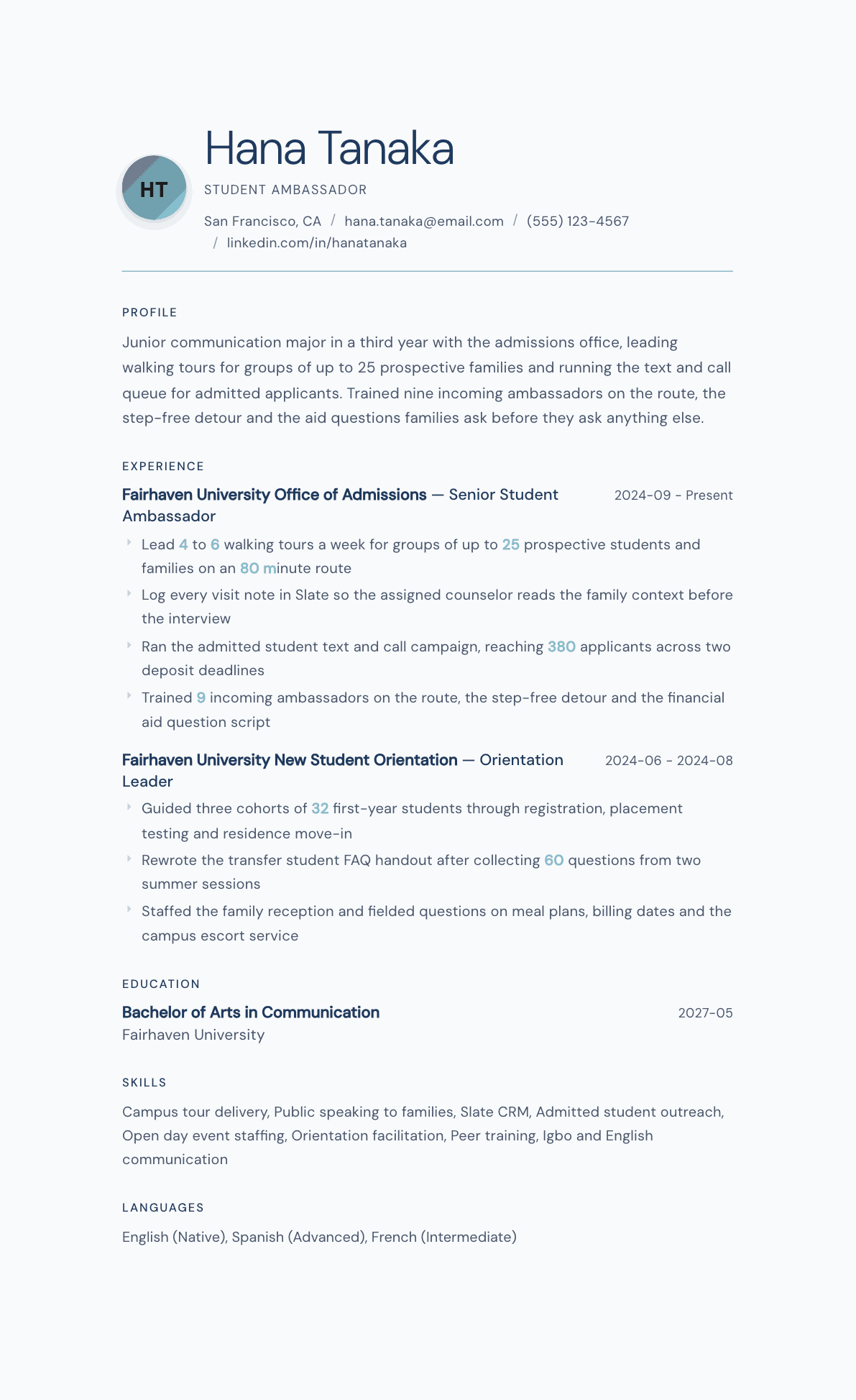
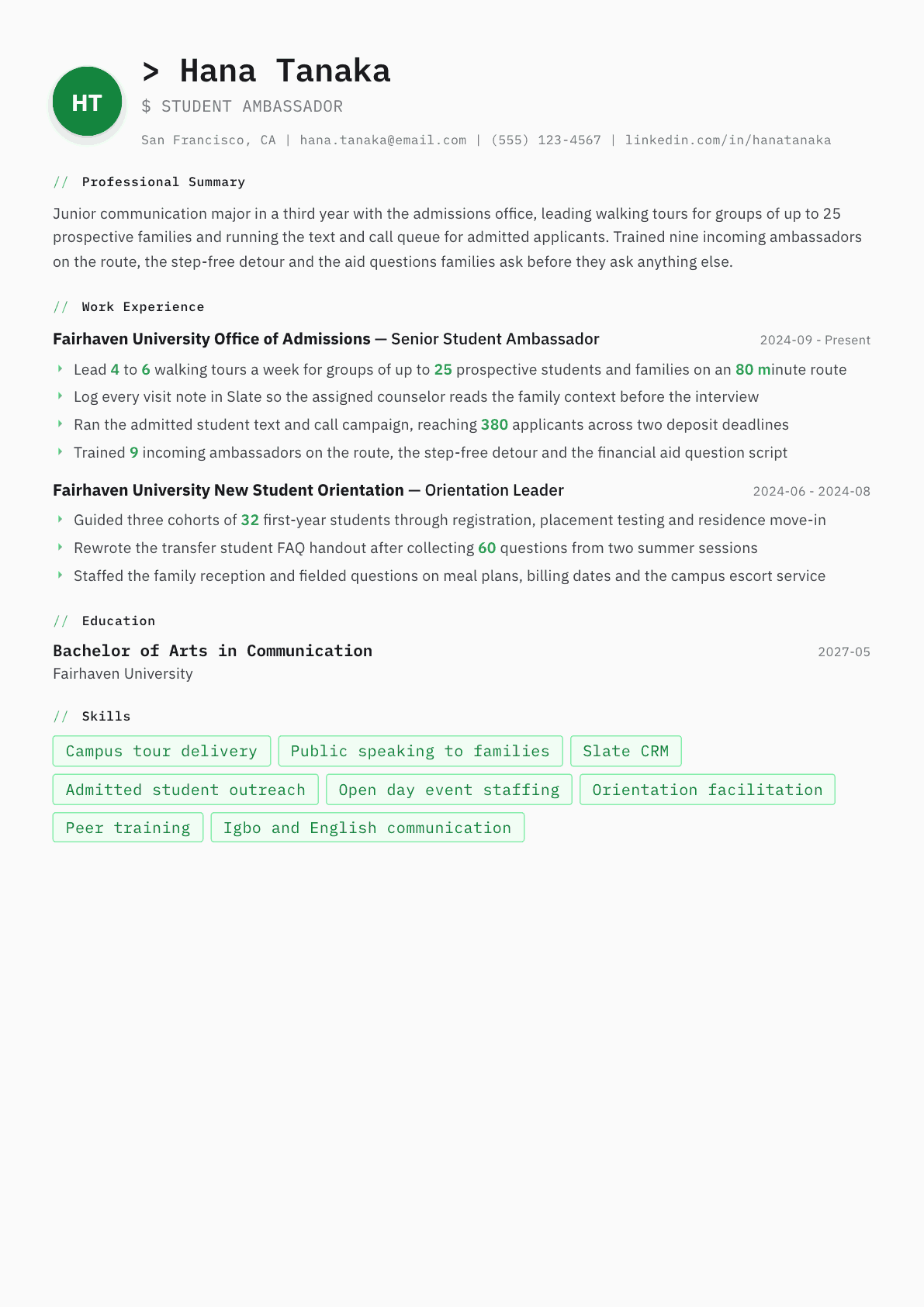
Example Student Ambassador summary
Student ambassador with three years in the admissions office, leading walking tours for groups of up to 25 families and covering open days, yield receptions and the admitted student call queue. Logs every visit in the admissions CRM so counselors inherit real context, trains incoming ambassadors on the route, and answers financial aid questions without guessing. Seeking a senior ambassador or visit coordinator role.
Skills to list on a Student Ambassador resume
- Campus tour delivery
- Public speaking to mixed family audiences
- Admissions CRM record keeping
- Prospective student outreach
- Text and call campaigns
- Open day and yield event staffing
- Orientation facilitation
- Student panel moderation
- Social media takeovers
- Peer mentoring
- Accessibility-aware route planning
- Applicant record confidentiality
- Shift scheduling and coverage
- Multilingual visit support
What actually gets this resume read
- Give the size of the groups you tour and how many tours you cover in a typical week.
- Name the admissions CRM you log visits in, because an ambassador who already knows Slate needs no training week.
- Separate paid ambassador shifts from volunteer open day help so the reader can count your real hours.
- Show the outreach work: call lists, text campaigns, admitted student panels and the number of families reached.
- Mention every language you can tour in, since offices assign multilingual ambassadors to specific visit groups.
- Describe the training you deliver to new ambassadors, from the route walkthrough to the step-free detour.
- Keep one line on handling applicant records quietly, since ambassadors overhear family money conversations all day.
How to write a student ambassador resume
The person reading a student ambassador application is almost always a visit coordinator holding a tour calendar with holes in it. She wants to know which mornings you can walk a route, whether you can hold a lobby full of families while a counselor finishes an interview, and whether she can put you in front of a parent who is about to ask what the aid offer really means. A page that answers those three questions gets an interview slot the same week.
Ambassador postings read casually and the hiring is anything but. Most offices recruit once a year, take a small cohort, and choose people who can already do the parts of the job a training weekend cannot teach: reading a group of nervous seventeen year olds, walking backwards on a wet path without losing the thread of a sentence, and leaving behind a visit note a counselor can still use two months later. Show evidence of those, not adjectives about enthusiasm.
This guide covers the format visit coordinators expect, how to write tours and outreach with numbers that mean something, three summaries for a first-time applicant, a returning ambassador and a senior lead, and the questions that come up in ambassador interviews.
Format: availability first, tour experience second, coursework last
One page, always. Put a short availability line near the top with your class schedule blocks, because the coordinator is building a tour grid and a candidate who is free on Friday mornings is worth more to her than a candidate with a better essay. Then campus-facing experience, then work and volunteering, then education and coursework at the bottom.
Do not open with an objective. The office knows what you are applying for. Use that space for a two-line profile naming the audiences you have spoken in front of, the languages you can tour in, and any visit program you have already worked, even as a volunteer on a single open day.
- Availability line: the days and blocks you are free, and whether you can work admitted student Saturdays.
- Campus-facing section first: tours, open days, orientation, phone and text outreach, panels, overnight hosting.
- Every entry names the office or department, since housing, athletics and admissions ambassadors do different work.
- A first-time applicant leads with the closest thing they have: peer mentoring, front desk work, or high school tour guiding.
Summary: the route you walk, the groups you hold, the languages you hold them in
Three lines that a coordinator can act on. Name the visit formats you have run, the typical group size you are comfortable with, and the languages you can deliver a tour in. A bilingual ambassador is scheduled deliberately, not randomly, and offices will build a Saturday around one.
If you have not toured before, say what you have done that is structurally the same: leading a club meeting, running a high school shadow day, working an information desk. The transferable part is holding attention while walking and answering an unscripted question without inventing an answer.
Experience: tours, yield events and the outreach queue
Give tour work three numbers: tours per week, typical group size, and route length in minutes. A coordinator reads that as capacity. Then name the visit types you have covered, because a daily walking tour, an open day with concurrent sessions, an admitted student reception and an overnight host shift are four different jobs sharing one title.
Outreach is the half of the role most applicants leave off. If you have called or texted admitted applicants, say how many families you reached and across which deadline. If you have sat on a student panel, say how many attended and what topics you took. If you have written a social takeover, say what the office asked you to cover and how you kept it within their guidelines.
Cut the line about being a friendly face of the university. Every applicant writes it. Replace it with something a coordinator can schedule against: you cover the science quad route, you can take a group of thirty, you can run the aid overview when the counselor runs late.
The unwritten half: records, aid questions and the accessible route
Ambassadors handle applicant information. If you have logged visits in an admissions CRM, name it, and describe what you record: who attended, what they asked, what they were worried about. Coordinators care because a good note turns into a counselor call that turns into a deposit, and a bad note wastes a family visit.
Two other details separate trained ambassadors from willing ones. The first is knowing the boundary on financial aid: you point families to the aid office and describe the process, you never estimate a package. The second is the accessible route, the elevator that is out, and the plan for a family with a stroller or a mobility aid. Put one line on each. Nobody puts them in the job advert and every coordinator notices them on a resume.
- Name the CRM or visit system you log in, and say what a note of yours contains.
- One line on the aid boundary: what you explain, and where you hand a family off.
- One line on the step-free route and how you decide when to switch to it mid-tour.
- Any training you deliver: route walkthroughs, question scripts, shadowing new ambassadors.
Skills and the words admissions offices scan for
Ambassador postings recycle a compact vocabulary: campus visit, yield, open day, admitted student, prospective family, tour route, panel, orientation, telecounseling, CRM. Use the ones that are true of you once in the skills block and once inside an experience bullet where the work is visible. Never list a language at conversational level and let an office schedule a family visit against it.
Add the operational skills that keep a visit day running: shift swapping, radio or group chat coordination, check-in desk work, name badge and packet preparation, and handling a group that arrives late while the session has already started. These are the tasks a coordinator hands to the ambassador she trusts.
Student Ambassador resume summary examples
First-time applicant
Second-year student applying for a first ambassador role, with two years of high school shadow day guiding and a semester at the library information desk. Comfortable speaking to mixed groups of parents and teenagers, available Tuesday and Friday mornings and admitted student Saturdays, and able to tour in English and Portuguese.
Returning ambassador
Ambassador in a second year with the admissions office, leading 4 to 6 walking tours a week for groups of up to 25 families on the 80 minute main route. Covered three open days and the spring admitted student reception, and logs a visit note on every family before the end of shift.
Senior ambassador and trainer
Senior ambassador running the tour rota for a cohort of 18, training new hires on the route, the step-free detour and the aid question script. Ran the admitted student text campaign across two deposit deadlines and moderated the student life panel at every open day this cycle.
Work experience bullets: before and after
Before: Gave campus tours to visitors.
After: Led 4 to 6 walking tours a week on an 80 minute route for groups of up to 25 prospective students and families, including two dedicated transfer visit days each term.
Frequency, route length and group size tell a visit coordinator exactly where you fit on her grid.
Before: Helped with open day events.
After: Staffed three open days on the check-in desk and the science quad route, handling 210 registered families across the day and rerouting two groups when a building closed for maintenance.
The volume and the recovery under pressure show you have worked a real visit day, not just attended one.
Before: Contacted admitted students.
After: Reached 380 admitted applicants by text and call across two deposit deadlines, logging every reply in the admissions CRM so counselors could follow the aid and housing questions.
Naming the channel, the count and the handoff turns outreach into work someone can measure.
Before: Answered questions from parents.
After: Handled the recurring parent questions on billing dates, meal plans and the campus escort service, and referred every financial aid package question straight to the aid counselor on duty.
Showing where you stop is stronger than claiming you can answer anything a family asks.
Before: Trained the new ambassadors.
After: Trained 9 incoming ambassadors through a route walkthrough, a shadow tour and a live tour with feedback, and rewrote the step-free detour notes after an elevator outage.
A training method with a fixed sequence and an artifact reads as ownership rather than helping out.
Hard skills
- Campus tour delivery on a set route
- Open day and yield event staffing
- Admitted student text and call outreach
- Admissions CRM visit notes
- Student panel moderation
- Orientation session facilitation
- Check-in desk and registration
- Step-free route planning
- Applicant record confidentiality
- Social media takeovers within office guidelines
- Shift scheduling and coverage
- Multilingual tour delivery
Soft skills
- Holding a group of strangers on a moving route
- Answering an unscripted question without inventing an answer
- Reading when a parent is worried about money
- Recovering a visit day when a building or a speaker falls through
- Discretion about anything a family says in confidence
Mistakes that cost student ambassador candidates the interview
- Leaving off your availability, which is the first filter a visit coordinator applies before she reads a word of prose.
- Writing that you love your school instead of showing a tour count, a group size and a route you can walk cold.
- Listing every club you have joined and burying the one desk job that proves you can talk to strangers all day.
- Claiming a language you could not run a full ninety minute tour in, which will be scheduled against you.
- Skipping the outreach work entirely, when calling and texting admitted applicants is half of what the office needs.
- Ignoring the record keeping side, so the reader has no way to tell whether your visit notes would be usable.
Student Ambassador resume questions
Do I need tour experience to be hired as a student ambassador?
No. Offices hire first-time ambassadors every cycle and train the route. What they will not train is comfort with an audience, so lead with anything that put you in front of a group: peer mentoring, coaching, retail, a service desk, or guiding at your own high school.
How do I write ambassador work if it was unpaid?
Write it exactly as you would a paid role, with the office name, your dates and what you covered, then label it as a volunteer position in the entry. Coordinators care about the visit days you have worked, not the payroll line they came from.
Should I put my grade point average on an ambassador resume?
Include it only if your office sets a minimum, which many do because ambassadors are held to a standing requirement. Otherwise the space is better used on visit formats you have covered and the languages you can deliver a tour in.
How much detail should I give about difficult family questions?
Enough to show judgment, never enough to identify anyone. Describe the category of question, how you responded, and who you referred it to. A line about routing aid package questions to a counselor tells a coordinator more than any story with details in it.
Does ambassador work help me after graduation?
Yes, and the resume should be written so it carries over. Tours become public speaking to mixed audiences, outreach becomes pipeline work with a CRM behind it, and running a rota becomes scheduling. Keep the numbers, and the entry transfers into admissions, events and recruiting applications.