Campus Recruiter Resume Examples: the lines they read
Write a Campus Recruiter Resume for Early Careers Hiring
By Mustafa Tarabya, founder of CVBooster · Published · Updated
Campus recruiter resume example with intern and graduate program numbers, university partnership keywords, and a writing guide.
Sample resumes for a campus recruiter
The same campus recruiter content laid out in three CVBooster templates, so you can see what the finished document looks like before you write a word.
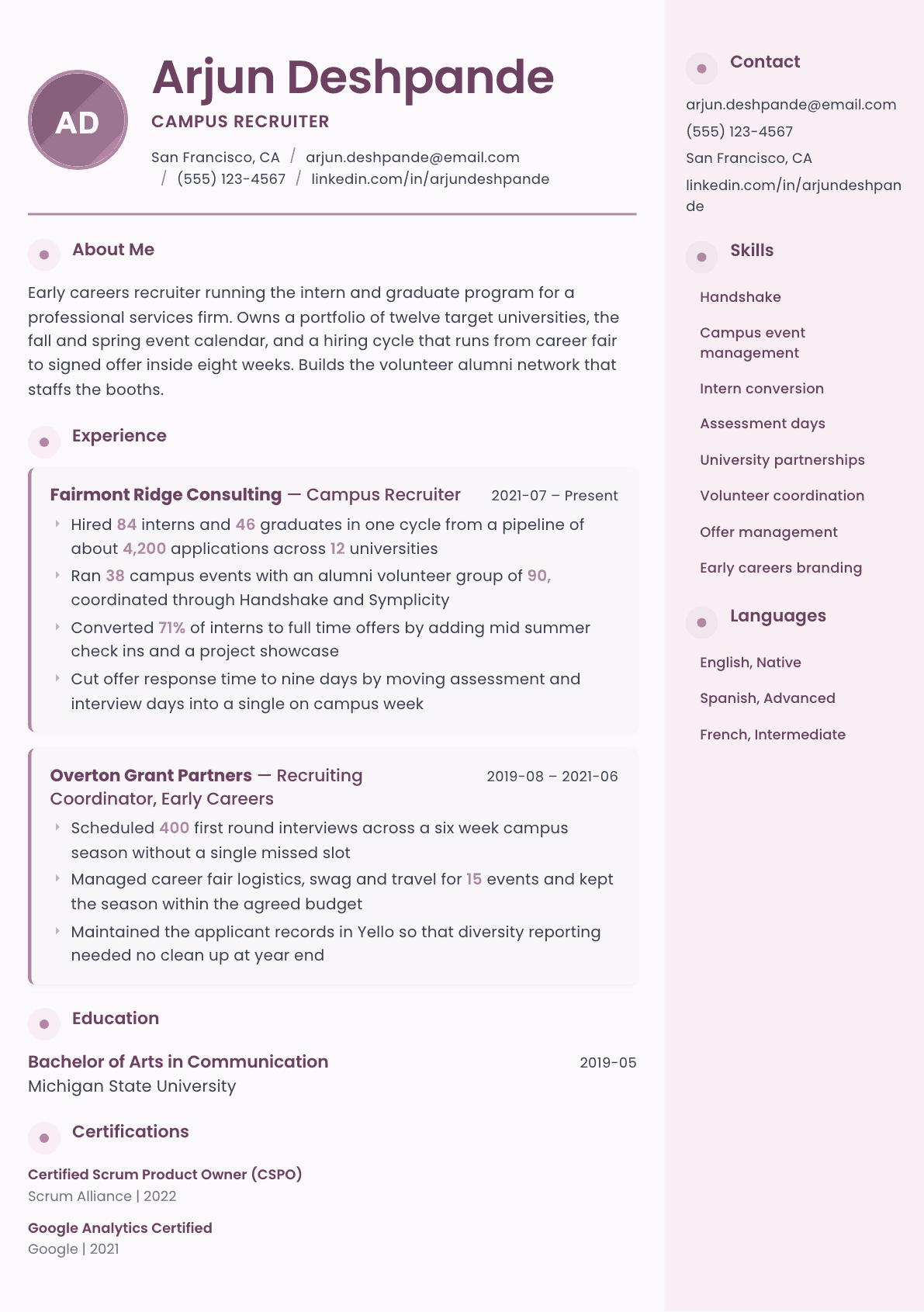
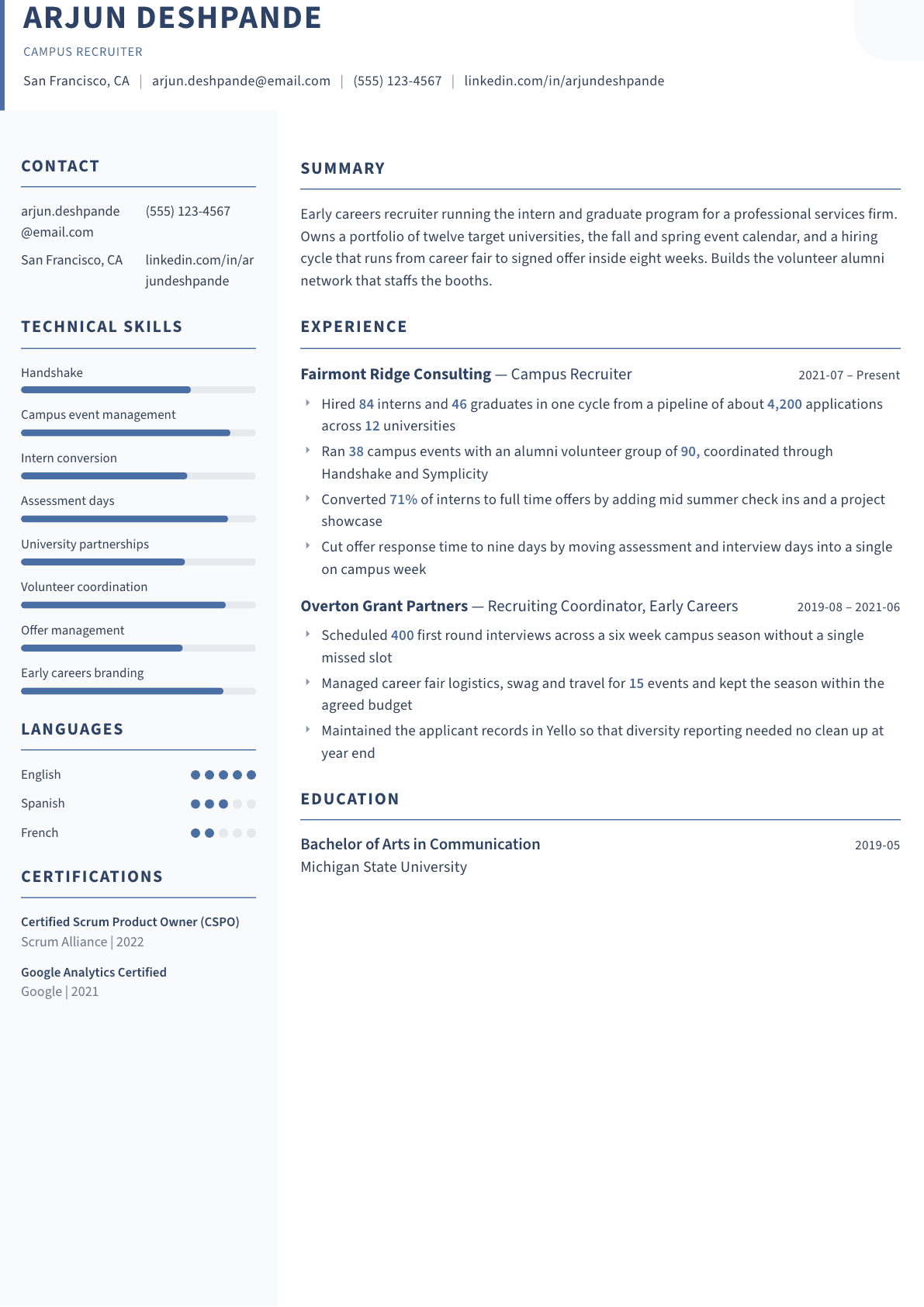
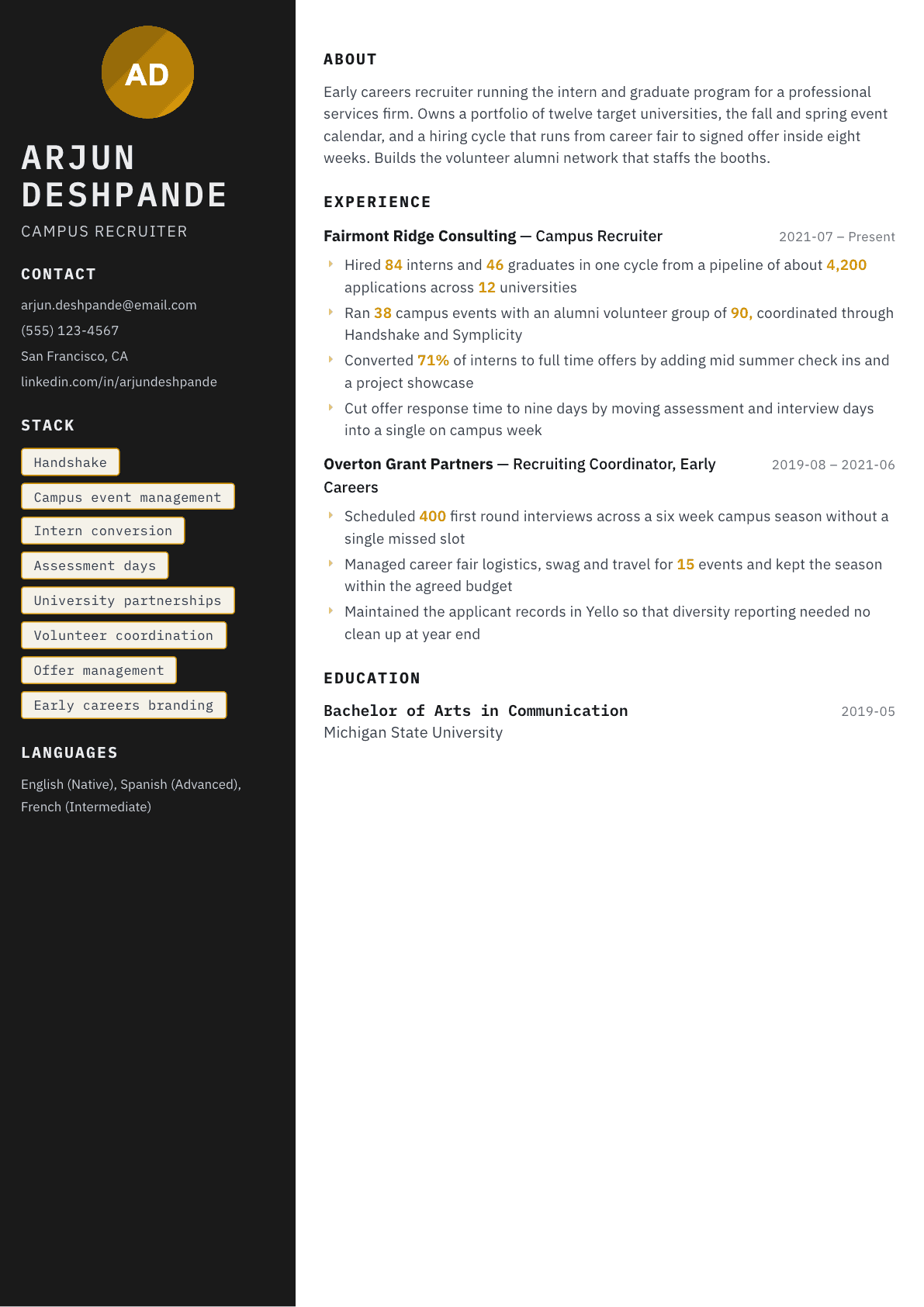
Example Campus Recruiter summary
Campus recruiter running the intern and graduate program for a professional services firm across twelve target universities. Hired eighty four interns and forty six graduates in the last cycle, lifted intern conversion past seventy percent, and manage an alumni volunteer group that staffs every event. Looking for an early careers team building its first structured graduate program.
Skills to list on a Campus Recruiter resume
- Early careers recruiting
- University relations
- Campus event management
- Handshake
- Applicant tracking systems
- Assessment center design
- Intern program management
- Offer management
- Volunteer interviewer coordination
- Employer branding on campus
- Diversity outreach programs
- Recruiting budget management
- Career services partnerships
- Candidate communications
What actually gets this resume read
- Give the size of your school portfolio and the cycle volume, because early careers hiring is a calendar and a funnel.
- Report intern conversion rate, which is the single number an early careers leader asks about first.
- Name the campus platforms you work in and the career services relationships you personally hold.
- Show how you managed volunteers and alumni, since campus teams run on borrowed interviewer time.
- Describe the assessment format you used, such as case days, group exercises or structured behavioral rounds.
- Include your season budget work if you owned travel, events and materials for a recruiting calendar.
How to write a campus recruiter resume
Campus recruiting runs on a calendar that does not move. Career fairs, application deadlines, assessment days, offer windows and intern start dates all sit in fixed weeks, and a season that slips cannot be recovered. The person hiring a campus recruiter knows this, so they read your resume for evidence that you can run a complex season on schedule with borrowed interviewers and a fixed budget.
They are also checking conversion. A campus program that hires eighty interns and converts a third of them into graduates has an expensive problem. The recruiters who stand out are the ones who treat the intern experience as part of their job rather than handing it to a program manager and moving on.
This guide covers how to structure the resume around the season, which program numbers to publish, three summaries from coordinator to program lead, before and after bullets, and the questions campus recruiters ask when they apply for their next early careers role.
Format: portfolio and cycle volume in a scope line
Reverse chronological, one page for most early careers professionals. Under each title, add a program line: number of target schools, the intern and graduate volume per cycle, the functions hired into, and the platforms you work in. Campus hiring is a portfolio job, and the portfolio size is the first thing a reader wants.
Because the work is seasonal, group your bullets by season rather than by task. Pre season planning and school selection, fall and spring events, interview and assessment weeks, offer season, then the intern summer itself and conversion.
- Program line format: 12 target universities, 84 interns and 46 graduates per cycle, consulting and analyst functions.
- Sections: summary, experience with program lines, program design work, education, systems and platforms.
- Add a budget line if you owned event, travel and materials spend for a season.
Summary: the program you run and the conversion you get
Three or four lines. Name the type of employer, the school portfolio, the cycle volume, and the intern conversion rate. Conversion is the number early careers leaders live by, because a program that does not convert is a training investment the business never gets back.
If you own the university relationships personally, say so. Career services teams work with recruiters they know, and a candidate who names the relationships they hold brings something the employer cannot build in a single season.
Experience: the season, the events and the funnel
Give the funnel end to end: applications received, candidates assessed, offers made, offers accepted, and interns converted. Campus funnels are wide at the top, so a reader who sees only the hire count cannot judge whether your screening was efficient or wasteful.
Then show the season mechanics. Number of events, the volunteer or alumni group you coordinated, travel and logistics, and how you kept an assessment week running when a panel dropped out. Anyone who has run a career fair knows this is the real work, and it rarely appears in a draft.
Write one bullet on the intern experience itself: check ins, project assignment, a showcase, mentor matching, or the feedback loop that told you why some interns declined. This is where conversion is won, and it separates a campus recruiter from an event coordinator.
Program design, diversity outreach and partnerships
Describe changes you made to the program itself: moving interviews to a single on campus week, adding a case exercise, changing the school portfolio based on yield, or building a relationship with a student organization that widened the applicant pool. Program design work is what promotes a campus recruiter.
Where you led outreach programs, describe them factually: the partner organizations, the events, and the change in applications or offers from those pipelines. Avoid broad claims about improving diversity without saying what you actually ran.
Systems and the phrases in early careers postings
Name the campus platforms, the applicant tracking system, the scheduling tool and any assessment provider you administered. Early careers hiring involves high volume scheduling, so a reader wants to know which tools you can operate without training.
Postings repeat this language: early careers, university relations, campus events, intern program management, assessment centers, offer management, employer branding, career services partnerships and conversion rate. Use the terms that match your experience once in a skills area and once inside a bullet.
Campus Recruiter resume summary examples
Early careers coordinator
Recruiting coordinator supporting an early careers team through two full campus seasons, scheduling 400 first round interviews across a six week period and running logistics for 15 career fairs. Keep applicant records clean enough that season reporting needs no correction. Seeking a campus recruiter seat owning a school portfolio.
Owning a school portfolio
Campus recruiter managing 12 target universities for a professional services firm, hiring 84 interns and 46 graduates last cycle from about 4,200 applications. Converted 71% of interns to full time offers after adding mid summer check ins, and coordinate an alumni volunteer group of 90 across 38 events.
Early careers program lead
Early careers leader with eight years in campus hiring, currently running a program of 250 interns and graduates a year across three business units with a team of four recruiters. Own the season budget, the school portfolio strategy and the assessment design, and report program yield to business leaders each quarter.
Work experience bullets: before and after
Before: Attended career fairs and campus events to attract students.
After: Ran 38 campus events across 12 universities in one season, staffing each with an alumni volunteer group of 90 coordinated through Handshake and internal sign ups.
Event count, portfolio size and the volunteer machinery show a season being managed rather than attended.
Before: Hired interns and graduates for the firm.
After: Hired 84 interns and 46 graduates in one cycle from about 4,200 applications, running screening, assessment days and offer management end to end.
The full funnel lets a reader judge screening efficiency instead of only seeing the final count.
Before: Worked to improve intern conversion.
After: Lifted intern conversion to 71% by adding mid summer check ins, a project showcase for business leaders, and an exit survey that surfaced why previous interns declined.
It names three specific interventions and ties them to the number an early careers leader watches.
Before: Made the interview process faster for students.
After: Moved assessment and interviews into a single on campus week, which brought offer response time down to nine days and reduced student drop off between rounds.
The redesign and two outcomes show process ownership rather than participation.
Before: Built relationships with universities.
After: Held direct career services relationships at 12 universities and reallocated three school partnerships after two seasons of low yield, replacing them with campuses that produced more accepted offers.
Reviewing the portfolio on yield is the judgment that distinguishes a program owner from a visitor.
Hard skills
- Early careers program management
- University and career services relations
- Campus event planning
- High volume interview scheduling
- Assessment center design
- Intern program and conversion management
- Offer management and deadlines
- Campus recruiting platforms
- Applicant tracking system reporting
- Season budget management
- Employer branding for students
- Outreach partnership programs
Soft skills
- Calm logistics under deadline
- Volunteer and alumni engagement
- Public speaking to student groups
- Warm candidate communication
- Coordination across business units
- Attention to a fixed calendar
Certifications worth listing
- SHRM Certified Professional (SHRM-CP) (Society for Human Resource Management)
- Associate Professional in Human Resources (aPHR) (HR Certification Institute)
- Certified Diversity and Inclusion Recruiter (CDR) (AIRS)
Mistakes that cost campus recruiter candidates the interview
- Listing career fairs attended without the school portfolio, the volume, or the outcome of the season.
- Leaving out intern conversion, which is the first question any early careers leader will ask you.
- Describing event logistics only, so the resume reads as coordination rather than program ownership.
- Making broad outreach claims with no named partner organization or measurable change in the pipeline.
- Omitting the platforms, when high volume scheduling ability is a practical hiring requirement.
- Ignoring the intern summer, where conversion is actually won or lost.
Campus Recruiter resume questions
What is the most important number on a campus recruiter resume?
Intern conversion rate, followed by offers accepted against plan. Conversion tells the reader whether the program produces full time hires or simply produces summers. Include the interventions behind the number so it does not look accidental.
How do I show value when the hiring calendar is fixed and repetitive?
Show what you changed inside the calendar: a school portfolio reallocated on yield, an assessment format redesigned, an offer window shortened, or a volunteer program built. Repetition is the constraint, and improvement within it is the achievement.
Should I list every university I recruited at?
No. Give the portfolio size and name a representative handful, especially any where you hold the career services relationship personally. A long list crowds out the funnel numbers that matter more to the reader.
How do I move from campus recruiting into experienced hiring?
Lead with the transferable parts: full funnel ownership, high volume assessment, stakeholder management with business leaders, and offer negotiation. Then add any experienced requisitions you carried, even a few, to show you can work without a fixed calendar.
Do campus recruiters need an HR certification?
It is not usually required. A recognized human resources credential helps when you want to move into a broader talent role later, and it signals familiarity with employment compliance around internships, work authorization and student employment rules.
Related resume examples
- Recruiter Resume example
- HR Coordinator Resume example
- Talent Acquisition Manager Resume example
- Sourcer Resume example
- Talent Acquisition Specialist Resume example
- Corporate Recruiter Resume example