Art Director Resume Examples: free ATS score and gap list
Build an Art Director Resume That Commands Attention
By Mustafa Tarabya, founder of CVBooster · Published · Updated
Create a powerful art director resume showcasing your creative leadership, brand vision, and team management with premium templates.
Sample resumes for a art director
The same art director content laid out in three CVBooster templates, so you can see what the finished document looks like before you write a word.
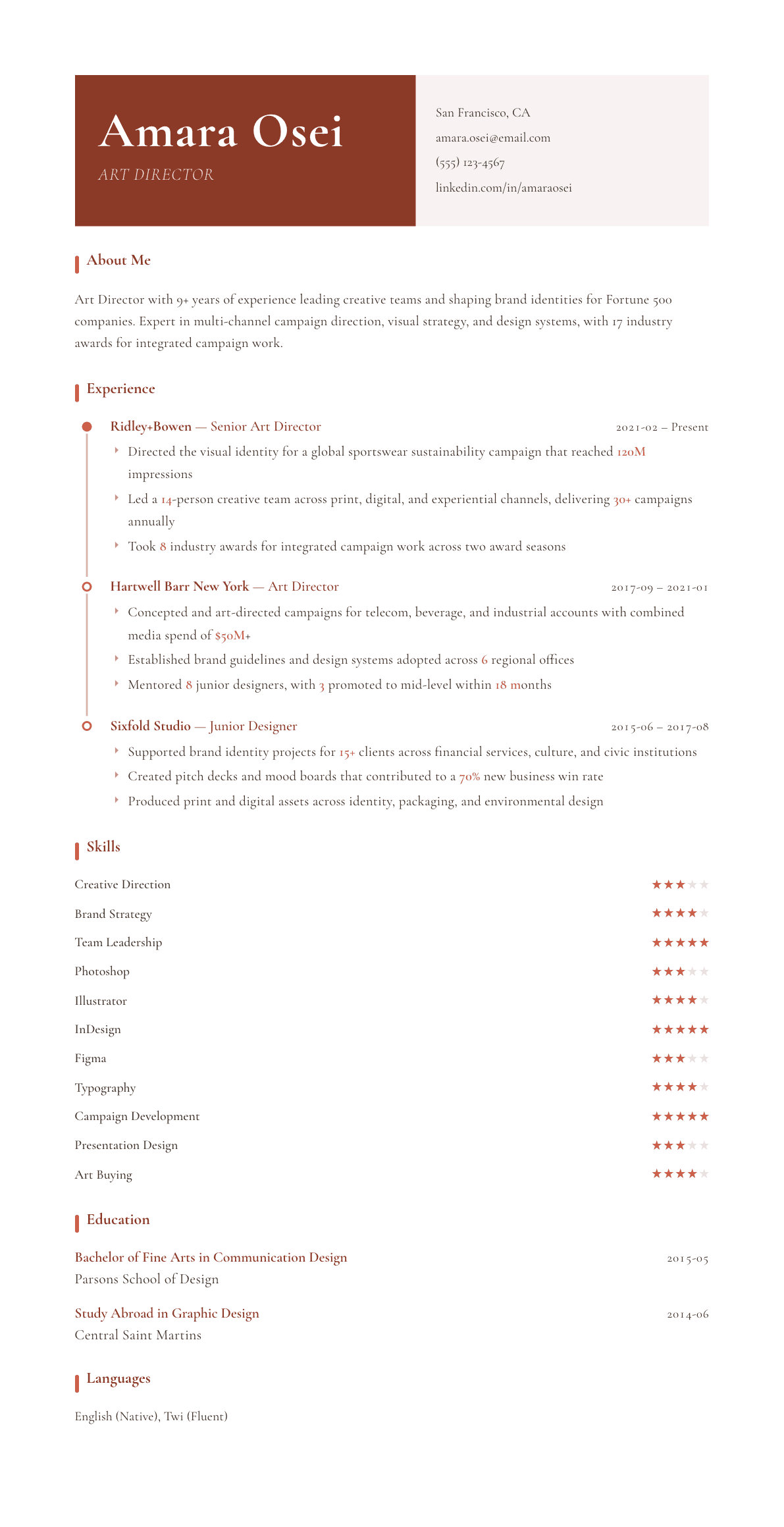
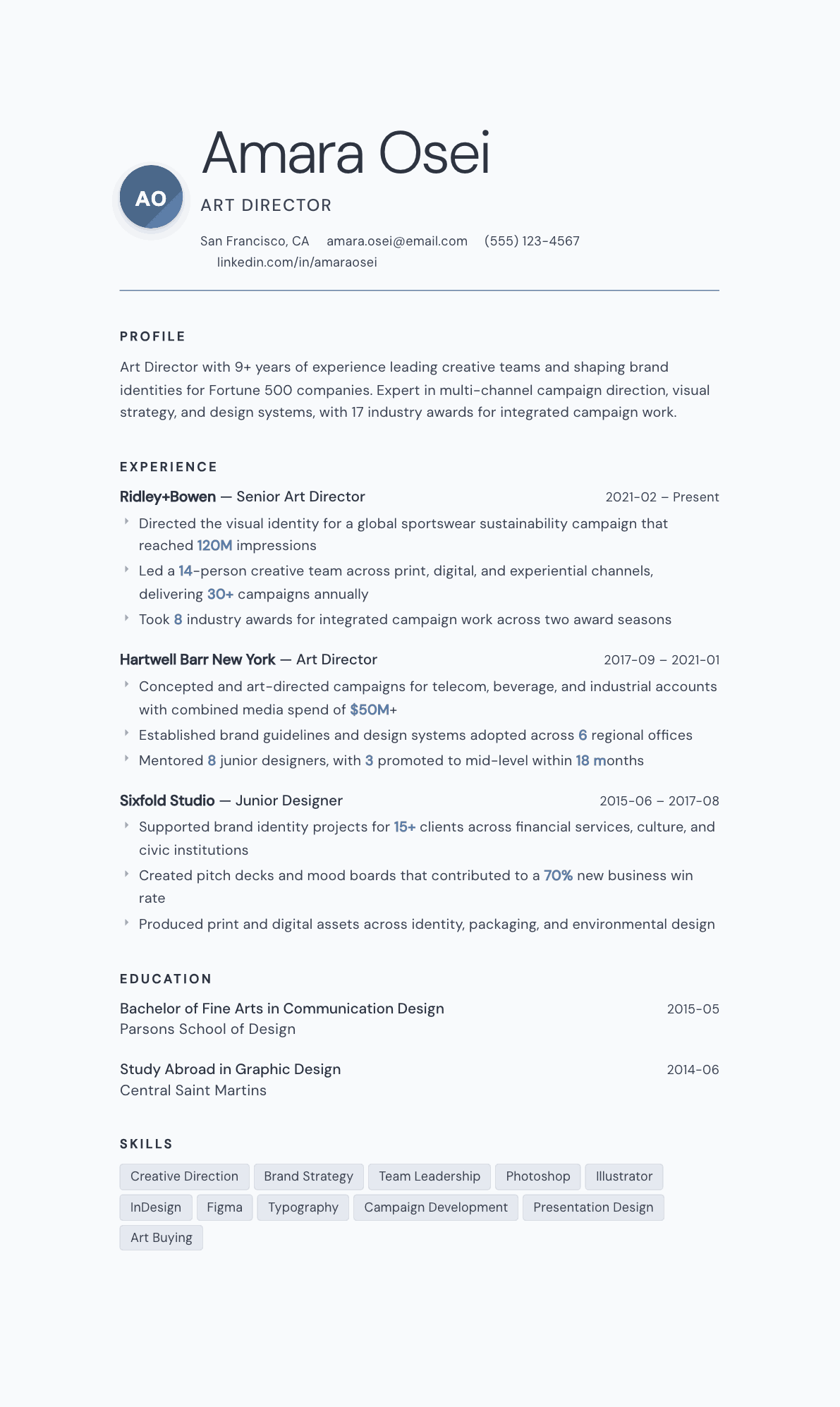
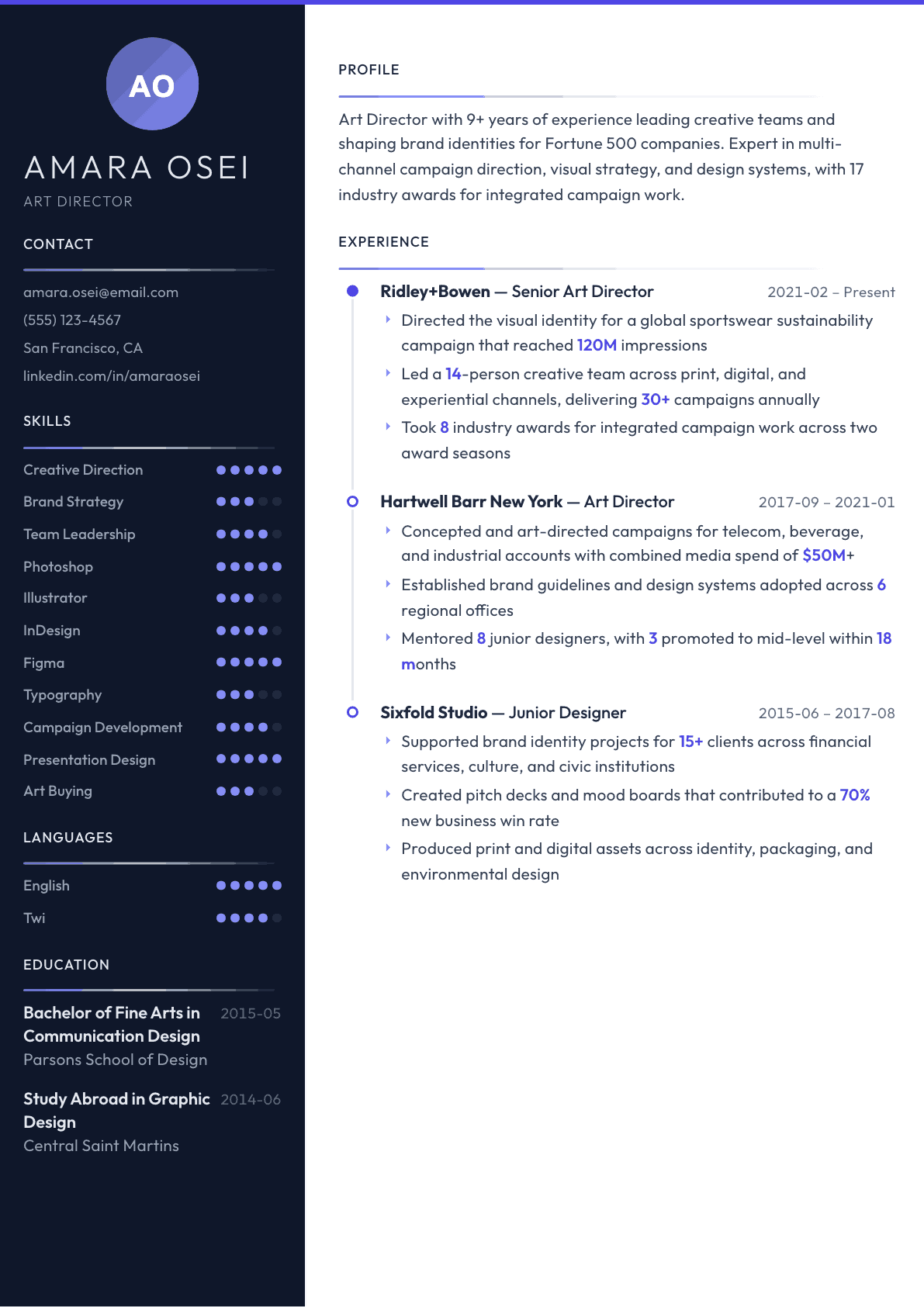
Example Art Director summary
Art Director with 9 years directing multi-channel campaigns for large consumer brands. Leads creative teams of up to 14 across print, digital, and experiential, ships 30+ campaigns a year, and has taken 17 industry awards for integrated work. Mentored 8 junior designers, 3 of them promoted within 18 months.
Skills to list on a Art Director resume
- Creative Direction
- Brand Strategy
- Visual Identity
- Team Leadership
- Campaign Development
- Typography
- Photography Direction
- Art Buying
- Presentation Design
- Figma
- Adobe Creative Suite
- Print Production
- Motion Direction
- Client Management
What actually gets this resume read
- Lead with award-winning campaigns and measurable impact: impressions, revenue lift, brand awareness scores.
- Showcase your leadership skills: team size managed, mentorship outcomes, cross-functional collaboration.
- Include specific brand names and campaign titles to immediately establish credibility.
- Demonstrate versatility across media: print, digital, experiential, social, video, and packaging.
- Link to a curated portfolio that shows both the final work and your creative process.
- Mention any industry recognition: Cannes Lions, D&AD, Webby Awards, Communication Arts.
How to write a art director resume
An art director is hired for judgment, not for execution. The person reading your resume already assumes you can set type and build a layout. What they are trying to learn is whether you can hold a visual idea across a campaign, direct people who are better than you at individual crafts, sit in front of a client and defend a route, and land the work on the date it was promised.
Art director also means different jobs in different buildings. In an advertising agency you work in a team with a copywriter, present concepts, and direct photographers, illustrators and production. In house at a brand you steward a system and run a small internal team against a marketing calendar. On a production or editorial side you own the look of a set, an issue or a shoot. A resume that does not say which of those you have done makes the reader guess, and they guess conservatively.
This guide covers the layout creative recruiters expect, how to describe concept and direction work without drifting into designer language, how to handle awards and team leadership honestly, three summaries from first art director title through group level, before and after bullets, and the questions art directors ask when they update the page.
Format: one page, portfolio link first, restraint everywhere
One page. Two only if you have more than a decade and genuinely distinct chapters. The header carries your name, the title you are applying for, city, email and the portfolio link written in full. The portfolio is the argument and the resume is the index to it, so the link goes above everything.
The page itself is a work sample whether you intend it or not. A creative director will notice the type choices, the alignment and the hierarchy within seconds. Set it carefully, use one or two type sizes with real spacing, and resist the urge to prove range on the resume itself. Restraint reads as confidence, and a page that tries too hard reads as a portfolio that will too.
- Header: name, title, city, email, portfolio link, and a single line of contact rather than a row of icons.
- Sections: summary, experience, selected work or campaigns, awards and recognition, skills and tools, education.
- Under each role, name the agency or brand type, the accounts or categories, and who reported to you.
Experience: the account, the idea, the channels, the outcome
Each role needs the shape of the work: the clients or brands, the categories, the media you directed across, and the team structure. An art director on a single retail account producing weekly work and one on a pitch team building platform ideas for three brands are doing different jobs, and the reader needs to know which.
Then write about ideas rather than deliverables. What the campaign idea was, what your visual approach did for it, which channels it ran in, and what happened. Deliverable lists such as created social assets describe production, and production is what an art director is supposed to be directing rather than doing.
Name the craft you personally directed: photographers and directors you briefed and worked with on set, illustrators and animators, retouchers, typographers, set and prop teams. Directing specialists is the part of the job the title is named after, and many art director resumes never mention it.
Leadership: team, pitch and the client room
Say who reported to you, formally or on a project basis, and what you were responsible for in their work: assigning routes, reviewing, giving notes, developing juniors, hiring freelance. Numbers help, but the responsibilities matter more, since a director of two who owns hiring and reviews is doing more than a director of eight who only assigns.
Presenting is half the job at this level. Say which rooms you presented in: internal reviews, client teams, marketing leadership, new business pitches. Note whether you built the deck and the story or presented someone else in the work. Creative directors hire art directors who can carry a route through a difficult meeting, because that is the failure mode that costs the agency work.
Awards and recognition: precise or leave it out
Awards are a real currency and also the most inflated part of these resumes. List the show, the year, the level, the category and the piece. A shortlist is not a win and a team credit is not a personal one, and everyone in the room knows the difference. Precision protects you and vagueness invites a question you do not want.
If your work has been published, exhibited or picked up by the industry press, that belongs in the same section with the outlet and the piece. If you have judged a show, spoken at a conference or taught, put it there too, since it signals standing in the craft beyond your own output.
Skills, tools and what recruiters search
Tools matter less at this level but they still get filtered on. List the design and prototyping software you work in, presentation tools, and the production side you understand such as prepress, packaging dielines, motion handoff and web build constraints. Understanding production is what keeps an idea from dying between the concept and the finished piece.
Recruiters search for concept development, campaign direction, brand identity, visual strategy, art direction on set, typography, photography direction, and the channel words such as broadcast, out of home, social, packaging and experiential. Use the words that match the work you actually want next, since the resume is a filter in both directions.
Art Director resume summary examples
First art director title
Art director with 4 years, promoted from designer inside a mid size agency and now paired with a copywriter on two consumer accounts. Concepts and presents campaign routes, directs photographers and retouchers on shoots, and reviews the work of two junior designers.
Senior art director
Senior art director with 8 years across agency and in house, leading campaign work for retail and consumer technology brands. Directs across broadcast, out of home, social and packaging, briefs and works on set with directors and photographers, and presents to client marketing leadership.
Group or associate creative director
Associate creative director with 13 years, running two accounts and a creative team of 9 including art directors, designers and a motion lead. Owns concept through production, hires freelance craft partners, and has led the visual case in 6 new business pitches.
Work experience bullets: before and after
Before: Created designs for marketing campaigns.
After: Concepted and art directed a national campaign for a retail client, taking one idea from a pitch board through broadcast, out of home and social with a consistent visual system across all three.
Owning an idea across channels is the art director job, while creating designs describes the designer you are meant to be directing.
Before: Worked with photographers on photo shoots.
After: Briefed and directed a three day product shoot, building the shot list and lighting references with the photographer, approving frames on set and running the retouch review to final delivery.
Naming the brief, the on set decisions and the retouch review shows actual direction rather than attendance.
Before: Managed junior designers.
After: Directed two junior designers and a freelance illustrator, assigning routes at the start of each project, holding a midpoint review and rewriting briefs when the first round showed the ask was unclear.
The specific management rituals show a director who develops people instead of only distributing tasks.
Before: Presented work to clients.
After: Built and presented the visual case in client reviews and two new business pitches, walking marketing leadership through the idea, the routes and the production plan behind each.
Saying what you presented and to whom proves you can carry a route through the room where work usually dies.
Before: Kept brand consistency across projects.
After: Wrote and rolled out a visual usage guide covering photography direction, type hierarchy and layout grids, then reviewed agency and regional partner work against it each quarter.
A written standard plus an ongoing review turns a vague claim into a system somebody actually ran.
Hard skills
- Concept development
- Campaign art direction
- Typography
- Photography and film direction
- Brand identity systems
- Layout and composition
- Storyboarding and pitch boards
- Packaging and print production
- Motion and broadcast handoff
- Retouching direction
- Presentation and deck building
- Design and prototyping software
Soft skills
- Defending a route without digging in
- Giving notes people can act on
- Reading a client room
- Deciding when an idea is dead
- Protecting a team under deadline
Mistakes that cost art director candidates the interview
- Writing a deliverable list instead of ideas, which reads as a designer resume with a director title on top.
- Omitting the portfolio link or hiding it behind a shortener that a printed resume cannot carry.
- Overstating an award by leaving out whether it was a win, a shortlist, or a team credit, in an industry where everyone can check.
- Never mentioning the specialists you directed, when directing craft partners is the core of the job.
- Overdesigning the resume itself, which sets an expectation your portfolio then has to survive.
- Leaving out who reported to you and what you owned in their work, so the reader cannot size the leadership.
Art Director resume questions
How much should an art director resume say versus the portfolio?
The portfolio shows the work and the resume explains your part in it. Use the page for the accounts, the channels, the people you directed, the rooms you presented in and the results. Never describe a piece the portfolio already shows better than words can.
Should I list awards I was shortlisted for?
Yes, but label them as shortlists and name the show, year and category. Creative people know the difference and will read an honest shortlist as credible. Presenting a shortlist as a win is one of the few resume errors that follows a person around this industry.
How do I move from designer to art director on paper?
Lead with anything conceptual: campaign ideas you originated, routes you presented, shoots you helped direct, juniors or freelancers you briefed. Reframe execution bullets around the thinking behind them, and make sure the portfolio opens with ideas rather than with finished artwork.
Is agency or in house experience better for an art director?
Neither is better, they are different jobs, so write for the one you want. Agency reads as concept, pitch and range across clients. In house reads as system stewardship, stakeholder work and running to a marketing calendar. Name the transferable half explicitly when you cross over.
Do art directors need certifications?
No. Hiring rests on the portfolio, the credits and the interview. If you have taught, judged a show or spoken at a conference, put that in the recognition section instead, since standing in the craft carries more weight than any course certificate.