TV Producer Resume Examples: free ATS score and gap list
Create a TV Producer Resume That Commands Attention
By Mustafa Tarabya, founder of CVBooster · Published · Updated
Build a professional TV producer resume highlighting show development, audience growth, and production management expertise for broadcast and streaming networks.
Sample resumes for a tv producer
The same tv producer content laid out in three CVBooster templates, so you can see what the finished document looks like before you write a word.
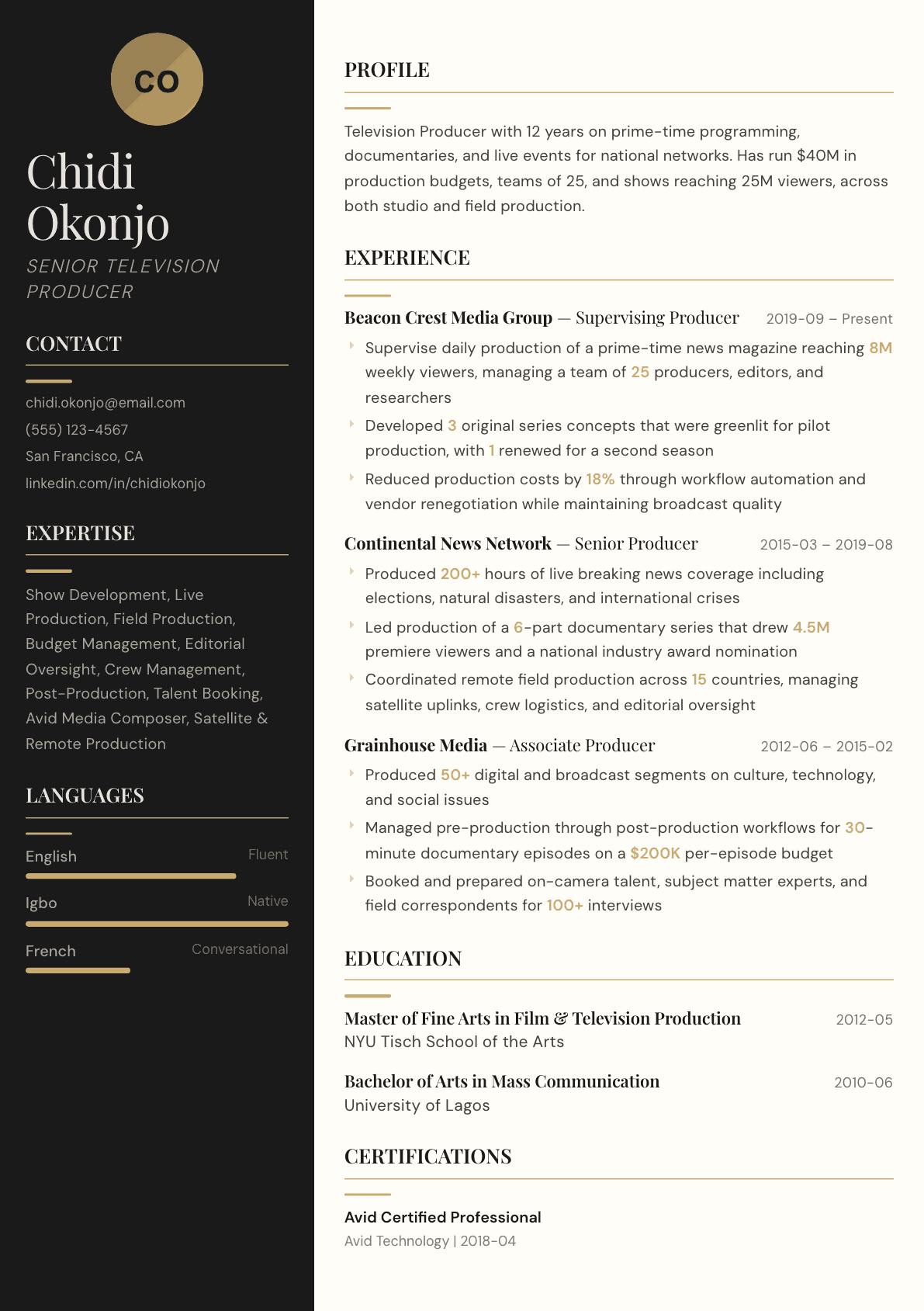
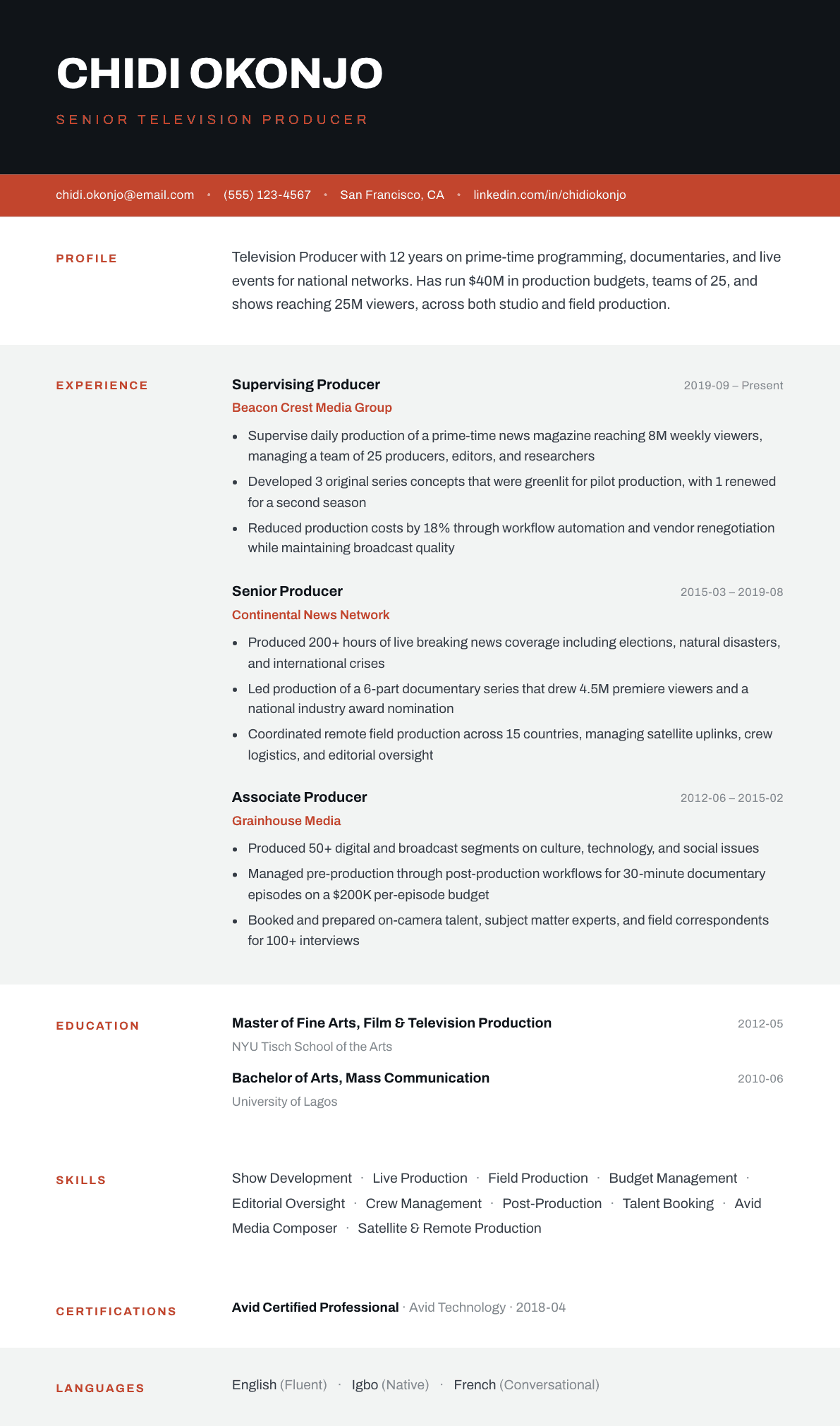
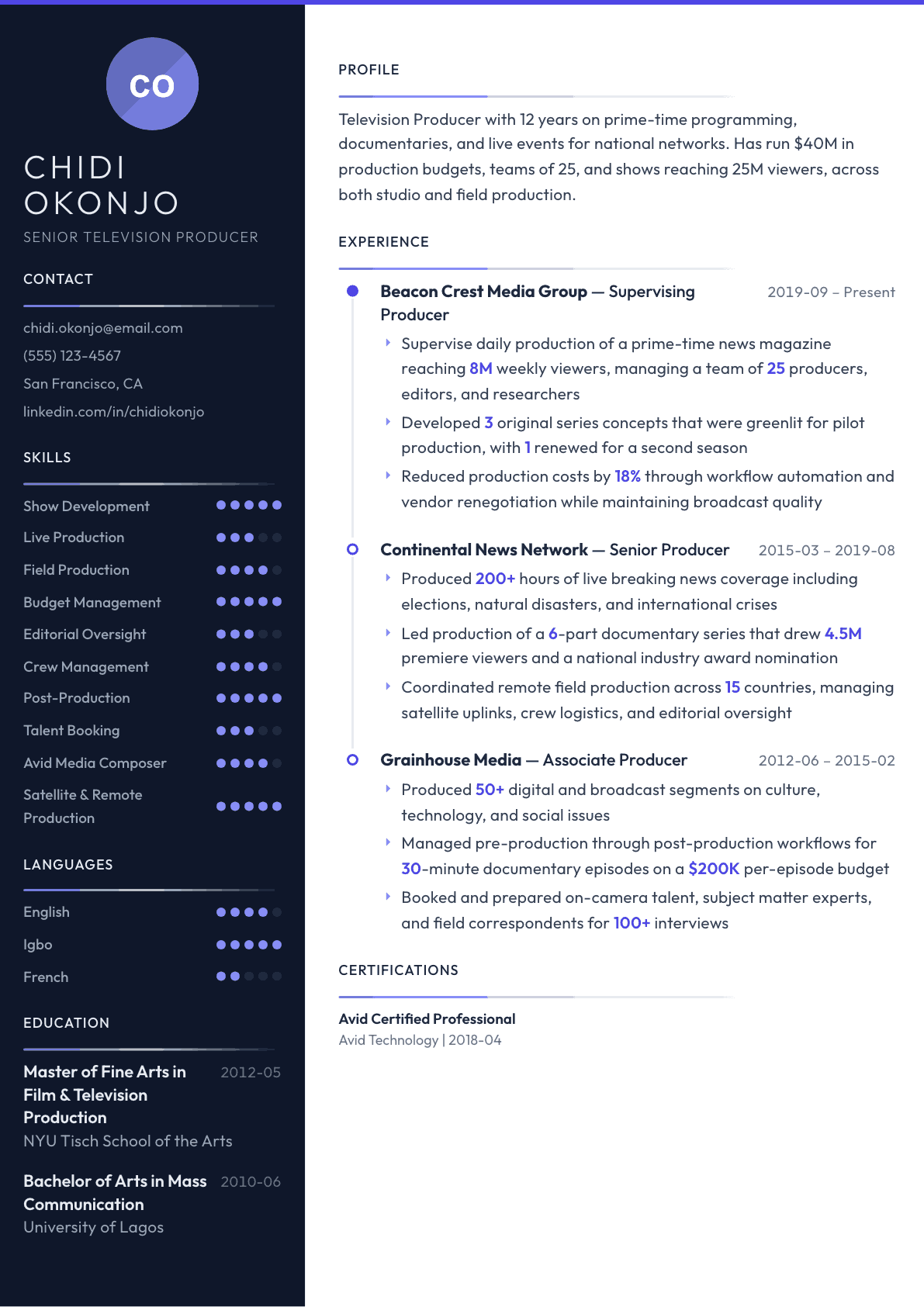
Example TV Producer summary
Television Producer, 12 years across prime-time programming, documentaries, and live events. Has managed $40M in production budgets, led teams of 25, and delivered content reaching 25M viewers, including three original concepts greenlit for pilot.
Skills to list on a TV Producer resume
- Show Development
- Live Production
- Field Production
- Budget Management
- Editorial Oversight
- Crew Management
- Post-Production Supervision
- Talent Management
- Scriptwriting
- Remote Production
- Digital Content
- Audience Analytics
What actually gets this resume read
- Lead with audience numbers, viewership ratings, and awards or nominations to establish credibility.
- Quantify budgets managed, team sizes led, and hours of content produced.
- Highlight versatility across formats: live news, scripted series, documentaries, and digital content.
- Include technical proficiencies: editing suites, control room systems, and production management software.
- Showcase your ability to develop original concepts and get them greenlit.
How to write a tv producer resume
Producer is the least precise title in television, which is exactly why the resume has to be precise. The same word covers a field producer chasing a shoot in another country, a segment producer cutting a six minute piece for a daily show, a line producer holding a budget, a supervising producer running a unit, and an executive producer who never touches a timeline. The person hiring you has one of those jobs in mind and will discard the page if she cannot tell which one you did.
Networks and streamers also hire by genre. Scripted, unscripted competition, documentary, daily news, live events and branded content run on different schedules, different crews and different budget structures. A producer who has delivered a hundred hours of live news is not automatically a fit for a nine episode documentary series, and a resume that blurs the two will lose both. Declare the genre and the format in the first two lines.
This guide covers the credit-led structure television hiring expects, three summaries covering associate producer to executive producer, before and after bullets built on budgets, crews and delivery, and the questions producers ask when a career spans several formats.
Format: one page, credits by show, function stated for every one
One page up to a decade of credits, two after that with the second page as a credit list. The header carries name, city, phone, email, and a link to a reel or to two representative pieces. For producers whose work is largely off camera, a short show reel matters less than a list of finished programs a reader can go and watch.
Structure by show rather than by employer. Each entry gets the program, the network or platform, the production company, your exact title, the number of episodes or hours, and the dates. A producer credit without an episode count is unreadable, because delivering two episodes and delivering forty are different careers.
- Title, network or streamer, production company, your credit, episode or hour count, dates.
- Say whether the work was studio, field, live or post, because they staff differently.
- Include the crew size you ran and the budget scope you were trusted with.
- Keep a short line naming the union or guild status of the productions you have worked on.
Summary: genre, format, scale, and the part of production you own
Say the genre first, then the format, then the scale. A reader needs to place you in one pass: unscripted competition series, prime time news magazine, feature documentary, daily talk, live sports, branded content. Then the volume you have delivered in hours or episodes, and the size of the operation you have run.
Then name your lane inside production. Development and pitching, casting and booking, field production and travel logistics, studio and control room, story producing in the edit, or budget and schedule ownership. Producers who claim all of it read as producers who have done none of it at depth.
Experience: the hours, the crew, the budget, the delivery
Build every bullet around one of four things: what you delivered, who you ran, what you spent, and what the audience did. Delivery is episodes and hours cut, aired and accepted by the network. Crew is the size and composition of the team reporting to you: producers, associate producers, researchers, editors, crews in the field. Budget is the number you held and how you held it against a schedule. Audience is ratings, streaming performance, or the platform metric the show was judged on.
Development work belongs in its own bullets. Pitching, sizzle production, format documents, casting tapes and getting something greenlit is a distinct skill from executing a show already ordered. If you have taken an idea from a document to a series order, that is the strongest sentence you can write, so give it the specifics: what you pitched, to whom, and what happened.
Field and logistics work is undervalued on most resumes and it is what a supervising producer worries about. Location clearances, permits, fixers, travel for a crew, satellite or bonded cellular transmission, insurance, risk assessment and shooting in difficult environments. Naming those tells a reader you can be sent somewhere with money and come back with the show.
- Give delivery in hours or episodes, never in vague phrases like extensive programming.
- State whether budget authority was actual or advisory, since line producers are hired on that distinction.
- Name the post workflow you supervised and the editing platform the shows were cut on.
- Include compliance work: legal and standards review, clearances, rights and music licensing.
Story producing and the edit
In unscripted and documentary, a lot of the writing happens in the edit, and producers who can story produce are hired for it specifically. Describe how you work with an editor: building a paper cut from transcripts, structuring an act break, tracking character arcs across a season, writing narration or scripted links, and running notes from the network without losing the show.
Say how much footage you were working from and how it was managed. Ratio matters: producing a story from four hundred hours of raw footage is a different problem from producing from ten. Mention the media management and logging systems you have used and whether you supervised assistant editors on ingest, transcripts and selects.
Networks, guilds and the vocabulary of the trade
Television postings reuse a precise vocabulary and using it correctly signals that you have been on real productions: greenlight, series order, pilot, pattern budget, above and below the line, call sheet, shooting schedule, prep and wrap, locked cut, network notes, standards and practices, delivery spec, QC. Mirror the words in the posting where you have genuinely done the work.
Be specific about the buyers you have delivered to. A broadcast network, a cable channel, a global streamer and a branded content client each have different notes processes, delivery requirements and tolerance for change. Naming which ones you have worked with tells the reader whether you will be surprised by theirs.
TV Producer resume summary examples
Associate producer
Associate producer with three years in unscripted television, credited on 40 episodes across two series. Handles casting research, booking, release paperwork and field logistics, and story produces short segments in the edit from logged and transcribed footage.
Field and story producer
Producer with seven years in documentary and unscripted series, having delivered 60 episodes across four shows for cable and streaming buyers. Runs field shoots with crews of six, holds episodic budgets, and story produces from raw footage through locked cut against network notes.
Supervising producer
Supervising producer with fourteen years in prime time unscripted and documentary programming. Has delivered more than 200 hours to broadcast and streaming buyers, managing teams of 25 across field, story and post, and taking three original formats from pitch document to series order.
Work experience bullets: before and after
Before: Produced episodes of a documentary series.
After: Produced 8 episodes of a documentary series for a streaming platform, running field shoots in five countries and delivering each hour from shoot through locked cut on an eleven week schedule.
Episode count, buyer, geography and the schedule tell a supervising producer exactly what load you can carry.
Before: Managed budgets for the production.
After: Held episodic budgets for a series with above and below the line line items, tracking cost reports weekly against the pattern budget and closing the season without an overage.
Real budget authority and the tracking rhythm are what separate a line producer from someone who saw a budget.
Before: Worked with editors to shape the story.
After: Story produced from 300 hours of raw footage per episode, building paper cuts from transcripts, structuring four act breaks and taking two rounds of network notes to a locked cut.
The footage ratio, the paper cut method and the notes rounds show the actual craft of story producing.
Before: Helped develop new show ideas for the network.
After: Developed three original unscripted formats from concept through format document, casting tape and sizzle, with one ordered to pilot and one going to a six episode series order.
Naming the development artifacts and the outcome proves you can get something bought, not just imagined.
Before: Coordinated crews and logistics on location.
After: Ran field logistics for crews of six across international locations: permits, fixers, insurance and risk assessments, media transfer from remote sites, and daily transmission back to the post house.
Logistics detail is what convinces a reader you can be sent somewhere expensive and return with the material.
Hard skills
- Show development and pitching
- Field production and logistics
- Studio and control room production
- Story producing and paper cuts
- Episodic and series budgeting
- Shooting schedules and call sheets
- Casting and talent booking
- Post production supervision
- Avid Media Composer
- Adobe Premiere Pro
- Rights, clearances and music licensing
- Network notes and standards review
- Delivery specifications and QC
- Crew hiring and management
Soft skills
- Decision making under a shooting clock
- Handling network notes without losing the show
- Crew leadership on location
- Talent and contributor trust
- Negotiating with vendors
- Calm in live production
Mistakes that cost tv producer candidates the interview
- Using the word producer without ever saying which producing job you did, so the reader cannot place you at all.
- Listing shows with no episode or hour count, which hides whether you delivered two hours or two hundred.
- Claiming budget ownership when the authority was advisory, a claim that collapses in the first line producer conversation.
- Mixing scripted, unscripted, live and branded credits into one undifferentiated list with no genre signal.
- Leaving out the buyer, when a broadcast network, a streamer and a brand client run completely different notes and delivery processes.
- Skipping compliance, clearances and delivery, the unglamorous work that decides whether a season actually airs.
TV Producer resume questions
How do I make my producer title clear when the word means so many things?
Add a short function line under each credit describing what you actually did: field production, story producing in the edit, budget and schedule ownership, casting, or development. The title alone tells a hiring executive nothing, and she will assume the least demanding version.
What numbers belong on a TV producer resume?
Episodes and hours delivered, crew size managed, budget scope held, footage ratio you story produced from, and the audience or platform metric the show was judged on. Those four categories cover almost every producing job in television.
How do I move from news production into documentary or unscripted series?
Lead with the transferable strengths: fast turnaround, field logistics, contributor access and story instinct under deadline. Then show any long form work you have, and reframe the bullets around arcs and act structure rather than the daily rundown you used to run.
Should I list shows that were never picked up or aired?
Yes for development work, stated plainly as pilot, sizzle or format development that was not ordered. Producers are hired partly for the ability to get things in front of buyers, and unaired work still shows the pitch, the casting and the packaging you did.
Does a television producer need a reel?
A link to two or three finished programs is usually enough, since a producer is judged on the whole hour rather than a cut down. A reel helps most for field and story producers, where showing a self shot or self cut piece proves hands on capability.