Freelance Graphic Designer Resume Examples: free score
Write a Freelance Graphic Designer Resume Clients Take Seriously
By Mustafa Tarabya, founder of CVBooster · Published · Updated
Freelance graphic designer resume examples that organize many clients into clear entries, with pricing and process bullets, keywords and a guide.
Sample resumes for a freelance graphic designer
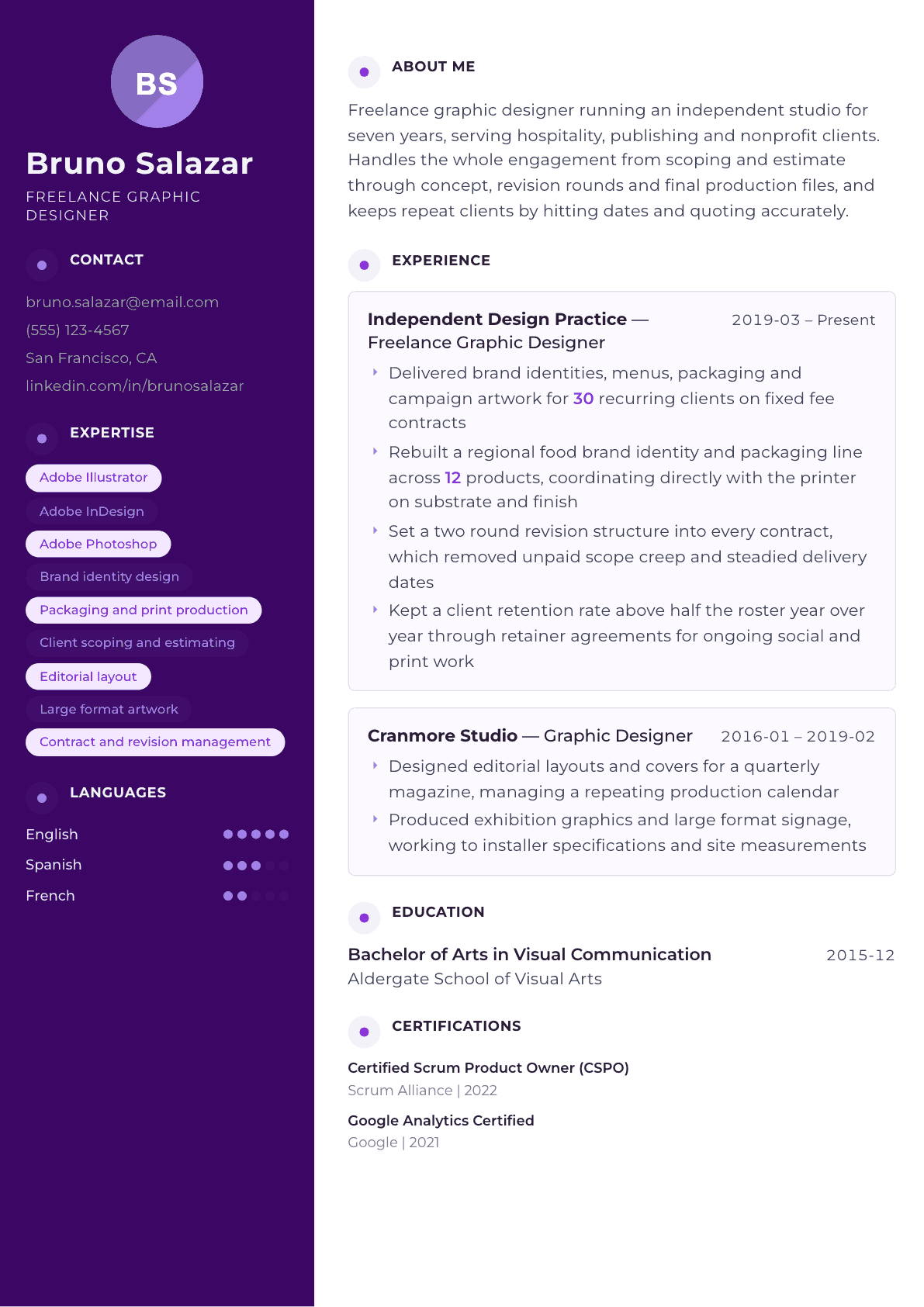
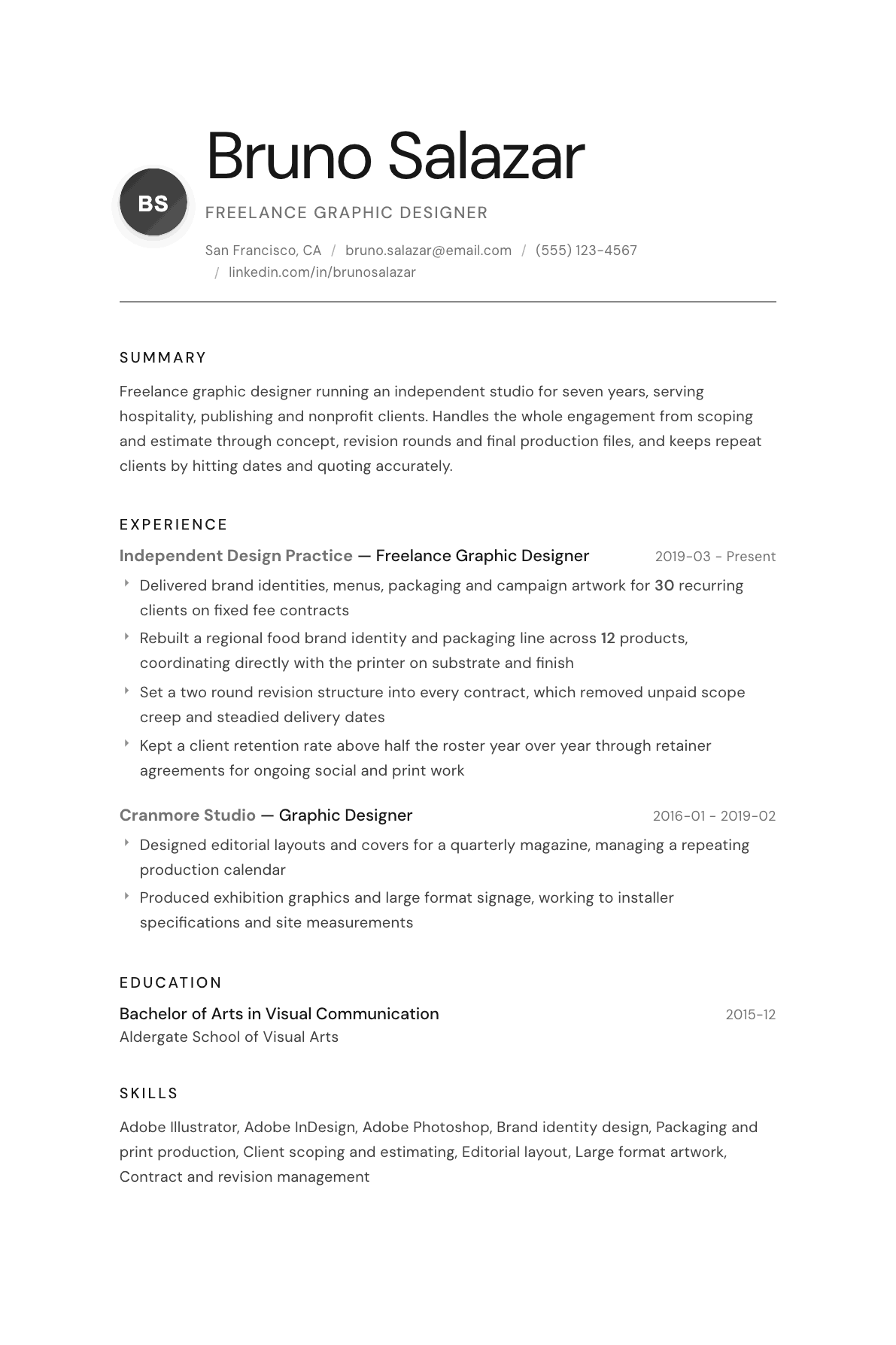
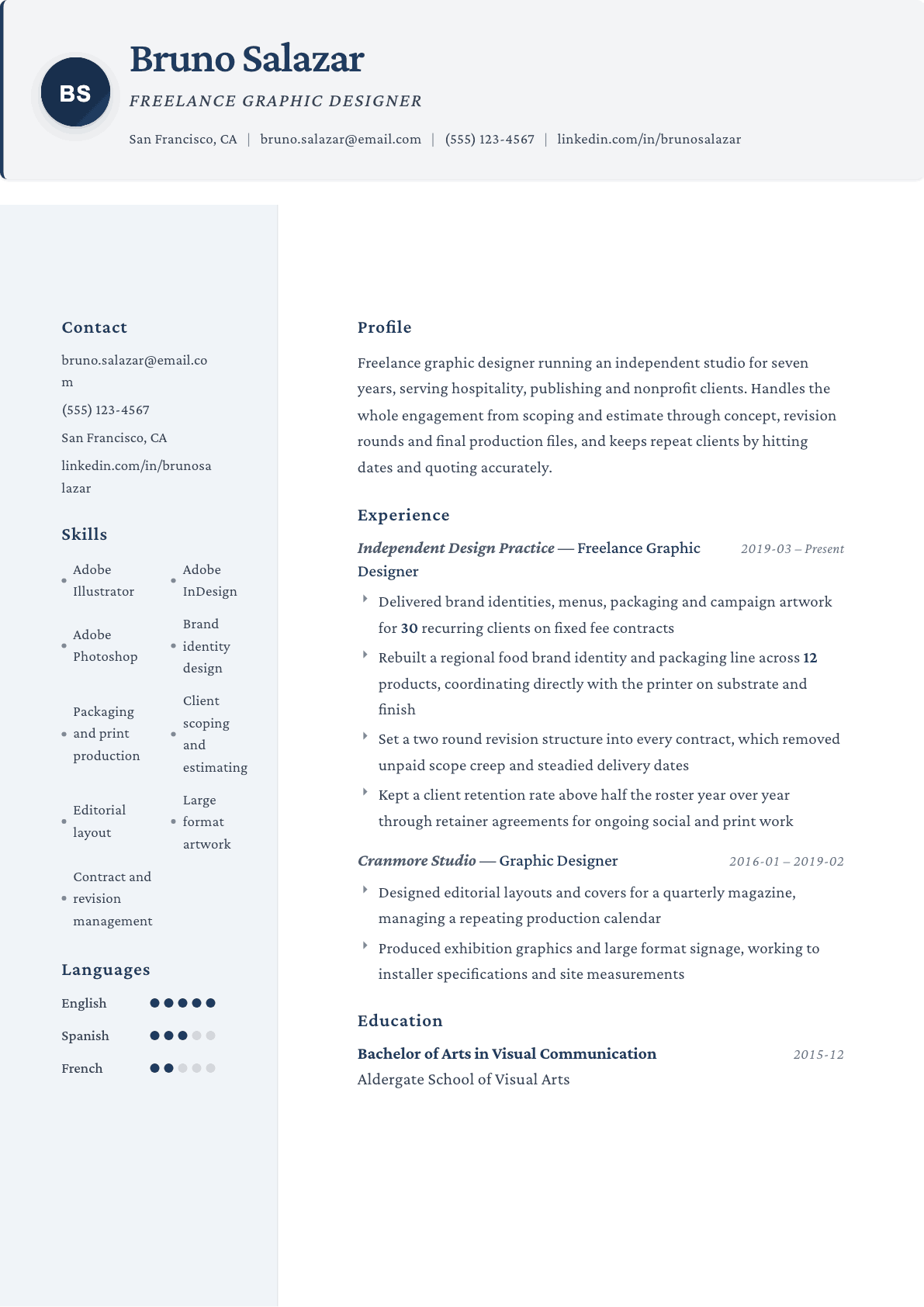
The same freelance graphic designer content laid out in three CVBooster templates, so you can see what the finished document looks like before you write a word.
Example Freelance Graphic Designer summary
Freelance graphic designer with seven years running an independent practice for hospitality, publishing and nonprofit clients. Handles scoping, estimating and contracts as carefully as the design itself, delivers brand identities and packaging through to press ready files, and coordinates substrate and finish directly with printers. Built a two round revision structure that removed unpaid scope and steadied delivery dates across a roster of thirty recurring clients.
Skills to list on a Freelance Graphic Designer resume
- Brand identity design
- Adobe Illustrator
- Adobe InDesign
- Adobe Photoshop
- Figma
- Typography
- Packaging design
- Editorial and publication layout
- Print production and prepress
- Large format and signage artwork
- Client scoping and estimating
- Contract and revision management
- Printer and vendor coordination
- Retainer and account management
- Portfolio and case study writing
What actually gets this resume read
- Group your freelance years under one studio or practice entry, then list named clients and projects underneath.
- Show the business side: scoping, estimating, contracts, revision limits and retainers, because clients hire reliability.
- Give client counts, retention or repeat work instead of listing every one off job you have ever taken.
- Prove print production depth, since freelancers own the printer relationship with no studio production team behind them.
- Keep the portfolio link and a short list of sectors near the top so a reader can place your work fast.
- If you are moving to a staff role, add a line on collaboration and feedback so you do not read as a solo operator only.
How to write a freelance graphic designer resume
A freelance graphic designer resume has a shape problem before it has a content problem. Years of independent work produce dozens of clients, overlapping dates and projects that lasted anywhere from an afternoon to a year, and candidates try to list them all. The result is a page that looks like churn instead of a practice, and a reader who cannot tell whether you are a designer with a business or someone between jobs.
The fix is structural. Group the independent years under one practice entry with a start date and a continuous run, then organize the work underneath by sector or by named engagement. That single change turns a scattered history into a business with a track record, which is exactly how a studio, an in house team or a larger client wants to read it.
The second thing that reader is testing is reliability. Independent designers are hired on the belief that they will quote accurately, hold a date, take feedback inside an agreed number of rounds and hand over files that print correctly with no studio production team behind them. This guide covers how to prove each of those on paper, and the questions freelancers ask when they are pitching a large client or moving back into staff work.
Format: one practice entry, sectors underneath, portfolio link in the header
Create a single entry for your independent practice with a role title, a start date and a present end date. Underneath it, write bullets that group work by sector or by the largest named engagements. This keeps the timeline clean and stops a reader from mistaking a long healthy run of contracts for a series of short jobs.
Keep any pre freelance staff roles below it in normal reverse chronological order. They matter, particularly if you are moving back toward employment, because they show you can work inside a studio structure and not only alone.
- Header: name, city, phone, email, portfolio link and the sectors you serve.
- Sections in this order: summary, independent practice, earlier staff roles, skills, education.
- Add a selected clients line rather than a full client list, and only name clients who would not mind.
Summary: sectors, years running, and what you handle end to end
Four lines. Say how long the practice has been running, the sectors you serve, the deliverables you produce, and the fact that you own the engagement from scoping through final production files. That last part is the difference between a freelancer and a contractor who needs to be managed.
If you are aiming at staff work, add a line about collaboration. The most common objection to an independent candidate is that they will struggle inside a team, and answering it in the summary is cheaper than answering it in the interview.
Experience: engagements, repeat business, and production ownership
Write bullets around whole engagements rather than single files. A regional food brand identity rebuilt across twelve products, with the substrate and finish coordinated directly with the printer, is one bullet that carries scope, craft and production ownership at once. Twelve separate label bullets carry none of it.
Repeat business is your strongest evidence and most freelance resumes leave it out. Client counts, ongoing retainer arrangements and the share of the roster that returns year after year all prove the thing a buyer most wants to know, which is that people who hired you once hired you again.
Production ownership deserves its own bullet. Independent designers deal with printers without a studio production manager in between, so proofing, substrate selection, finish decisions, press checks and large format installer specifications are all yours. Naming them separates a designer who delivers files from one who delivers a finished object.
Add the business mechanics that made delivery reliable: written scopes, a fixed number of revision rounds, staged payments and clear deliverable definitions. Those bullets sound unglamorous and they are the ones that reassure a nervous client.
Client list: curate it, do not dump it
A selected clients line with six to ten names in a sensible order does more than a list of forty. Choose for recognizability, for sector match with the job you want, and for the ones whose work is in your portfolio so the reader can follow the thread. Leave out any client whose agreement or discretion would make naming them awkward.
Where you cannot name a client, describe it: a national bakery chain, a university press, a regional arts festival. That keeps the scope legible without breaking a confidence, and no reader objects to it.
- Six to ten named clients, ordered for relevance rather than alphabetically.
- Unnamed clients described by sector and scale.
- A line naming the sectors you work in most, so a reader can place you fast.
- Portfolio pieces that match the named clients, so the resume and the site agree.
If you are moving back to a staff role
Rewrite the emphasis rather than the facts. Lead with collaboration, feedback loops, working inside supplied brand systems and any time you worked as part of an agency team on a larger project. Then keep the business skills, because scoping, estimating and printer management are genuinely valuable inside a studio and few staff designers have them.
Address the obvious worry directly in the summary. A sentence saying you are looking to work inside a team on longer projects removes the question the hiring manager was going to ask anyway, and it reads as clarity rather than as apology.
Freelance Graphic Designer resume summary examples
First year independent
Independent graphic designer in a first year of practice, working with cafes, small publishers and local arts organizations on identity, menus and event collateral. Scopes each job in writing with two revision rounds, and delivers press ready files coordinated directly with the printer.
Seven years running
Freelance graphic designer running an independent practice for seven years across hospitality, publishing and nonprofit clients. Handles scoping, estimating and contracts as carefully as the design, and rebuilt a regional food brand identity and packaging line across 12 products with the printer engaged from the first proof.
Established studio of one
Independent designer with twelve years of practice, working with a roster of recurring clients on identity, packaging and editorial systems. Sets scope and schedule, subcontracts illustration and retouching when a job needs it, and manages print production from proofing through press approval.
Work experience bullets: before and after
Before: Worked with many clients on design projects.
After: Delivered brand identities, menus, packaging and campaign artwork for 30 recurring clients across hospitality, publishing and nonprofit sectors on fixed fee contracts.
Client count, deliverable types, sectors and the commercial arrangement replace a sentence that could describe anyone.
Before: Redesigned packaging for a food brand.
After: Rebuilt a regional food brand identity and packaging line across 12 products, coordinating substrate, finish and proofing directly with the printer through to press approval.
Product count and production ownership show a finished object rather than a set of supplied files.
Before: Managed my own projects and deadlines.
After: Wrote a two round revision structure into every contract with a defined scope and staged payments, which removed unpaid additional work and steadied delivery dates across the roster.
The specific business mechanism is what reassures a client that dates will hold.
Before: Kept good relationships with clients.
After: Held more than half the client roster year over year through ongoing retainer agreements covering social and print work, with new work arriving mainly through referral.
Retention and referral are measurable proof of reliability, which is the trait an independent designer is really selling.
Before: Produced large signage for an exhibition.
After: Produced exhibition graphics and large format signage to installer specifications, working from site measurements and supplying artwork at the correct scale with viewing distance accounted for.
Naming the installer constraints proves environmental production knowledge rather than enlarging a poster file.
Hard skills
- Brand identity design
- Vector illustration and mark drawing
- Page layout and editorial systems
- Packaging design and dielines
- Print production, proofing and press approval
- Large format and signage artwork
- Interface tool for social and web assets
- Typography and type licensing
- Client scoping and estimating
- Contract and revision management
- Printer and vendor coordination
- Retainer and account management
- Case study and portfolio writing
Soft skills
- Accurate quoting under uncertainty
- Saying no to unscoped requests
- Direct client communication
- Managing several deadlines at once
- Following up on invoices without friction
- Turning criticism into a next round
Mistakes that cost freelance graphic designer candidates the interview
- Listing every client as a separate job entry, which turns a stable practice into what looks like constant turnover.
- Hiding the business side, when scoping, contracts and revision limits are exactly what a nervous client is looking for.
- Naming forty clients instead of curating ten chosen for relevance to the job in front of you.
- Leaving out print production ownership, the part of the work no studio production team was there to cover for you.
- Omitting repeat business and referrals, the clearest available proof that people who hired you once came back.
- Applying to a staff role with no mention of collaboration, leaving the obvious objection unanswered.
- Letting the resume and the portfolio show different clients, which makes a reader wonder which one is accurate.
Freelance Graphic Designer resume questions
How do I list years of freelance work without it looking unstable?
Use one entry for your practice with a continuous date range, then organize the work underneath by sector or by major engagement. A reader sees an unbroken run of self employment rather than a list of short jobs, which is a completely different impression from identical facts.
Should I name my freelance business or just say freelance designer?
Either works, but be consistent with your invoices, your site and your professional profiles. A practice name reads slightly more established, while your own name is simpler when the relationship is with you personally. What matters is that a reader can verify it easily.
How much should I say about rates and contracts?
Describe the structure without the figures. Fixed fee contracts, staged payments, defined scopes and a set number of revision rounds all signal a professional operation. Actual rates belong in a conversation where you know the scope, not on a document that circulates without you.
Can I use a freelance resume to apply for a staff design job?
Yes, with the emphasis shifted. Lead with collaboration, working inside supplied brand systems and any team based projects, keep the business skills because studios value them, and say directly in the summary that you are seeking a team environment for longer projects.
Do freelance designers need certifications?
Almost never. Clients hire on the portfolio, the referral and how clearly you scope the job. A software certification does no harm on a thin page, but a well written case study showing the brief, the constraint and the result will persuade a buyer far more effectively.