Spanish Teacher Resume Examples: the lines they read
Write a Spanish Teacher Resume That Shows Proficiency Growth
By Mustafa Tarabya, founder of CVBooster · Published · Updated
Spanish teacher resume example with proficiency levels, comprehensible input methods, certification placement and the keywords world language departments search.
Sample resumes for a spanish teacher
The same spanish teacher content laid out in three CVBooster templates, so you can see what the finished document looks like before you write a word.
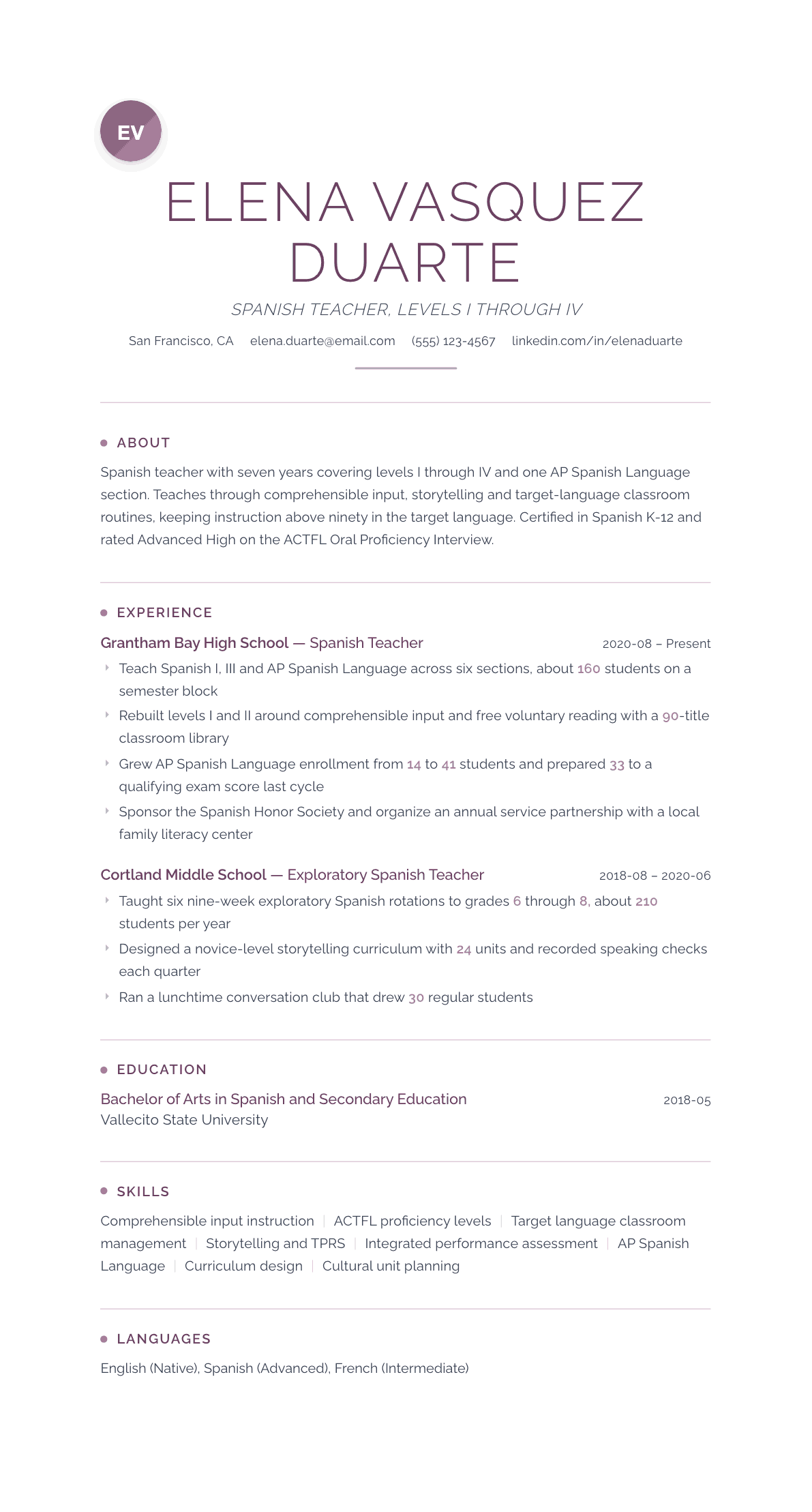
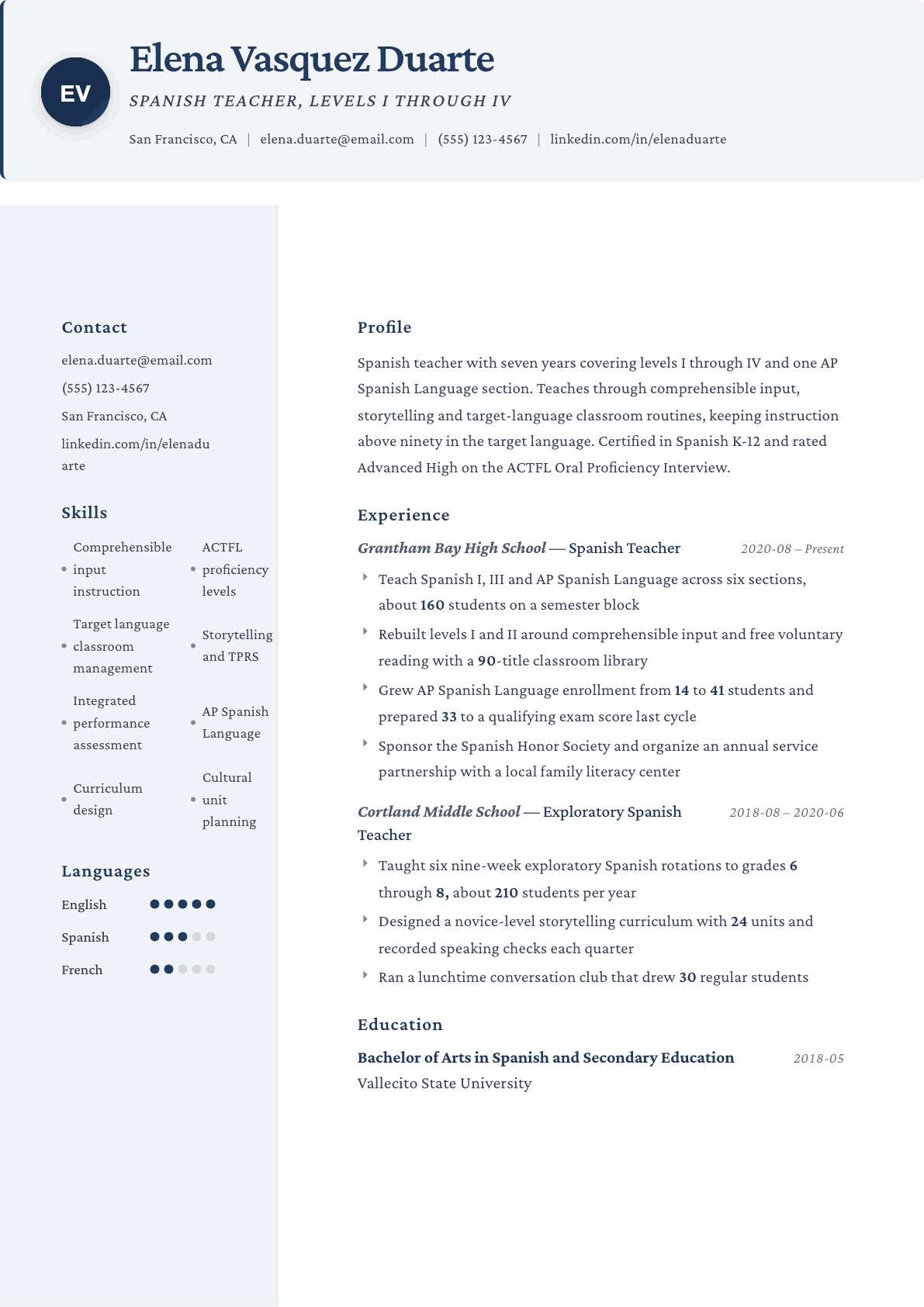
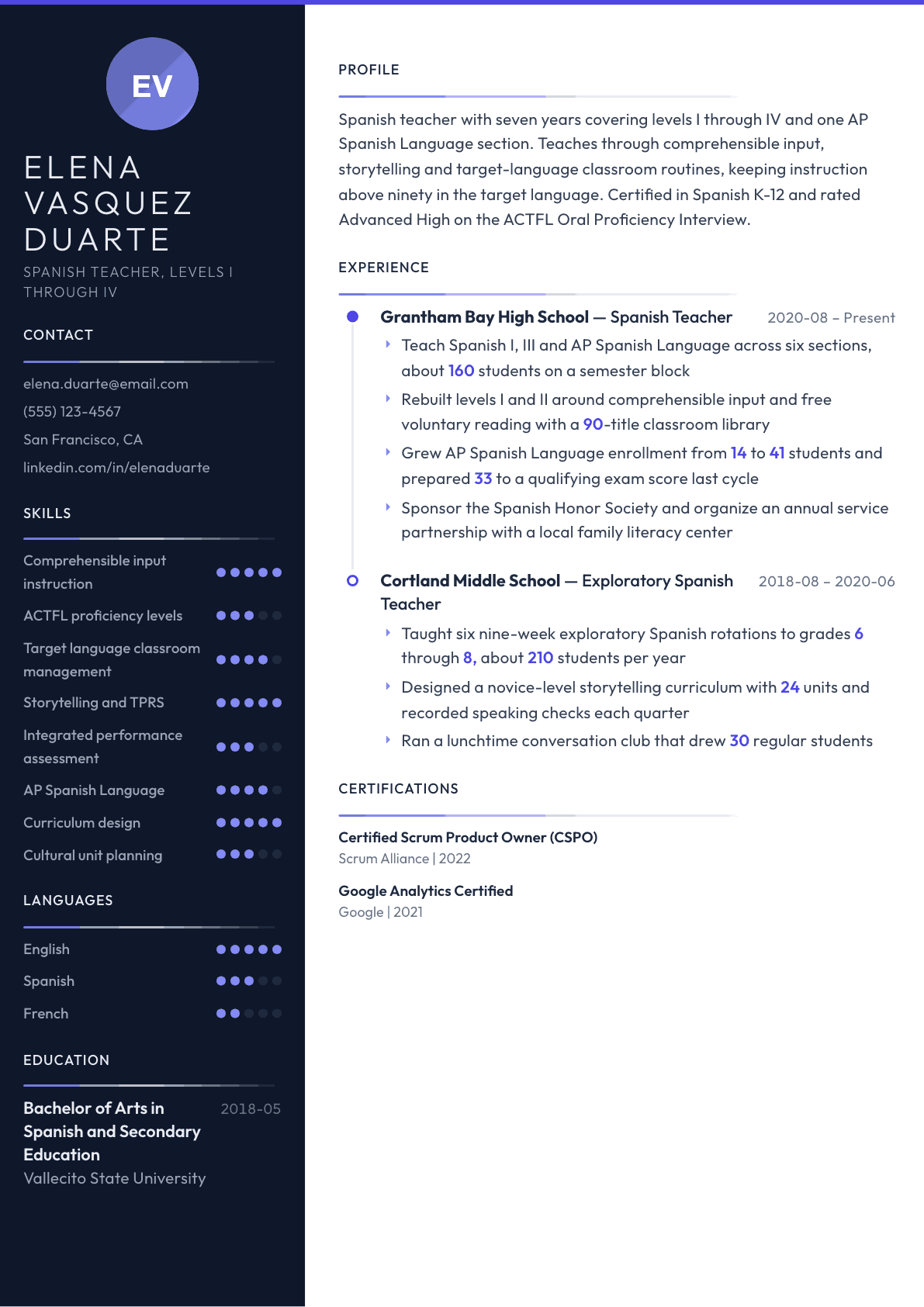
Example Spanish Teacher summary
Spanish teacher with seven years across exploratory through AP Spanish Language, certified K-12 and rated Advanced High on the ACTFL Oral Proficiency Interview. Rebuilt levels I and II around comprehensible input and free voluntary reading, and grew AP enrollment from 14 to 41 students. Sponsors the Spanish Honor Society. Seeking a world language department that supports proficiency-based grading.
Skills to list on a Spanish Teacher resume
- Spanish language instruction
- Comprehensible input
- TPRS storytelling
- ACTFL proficiency benchmarks
- Integrated performance assessment
- AP Spanish Language
- Target language instruction
- Free voluntary reading
- Cultural competency instruction
- Curriculum design
- Speaking and listening assessment
- Differentiated instruction
- Google Classroom
- Honor society sponsorship
- Novice to intermediate scaffolding
What actually gets this resume read
- Report your own proficiency with the rating and instrument, such as an ACTFL Oral Proficiency Interview result.
- Name the levels you have taught, from exploratory and level I through AP or dual credit Spanish sections.
- Describe your instructional approach concretely: comprehensible input, storytelling, free voluntary reading or task-based units.
- Show growth in proficiency terms, for example students moving from Novice High to Intermediate Low on speaking checks.
- Include cultural programming, honor society sponsorship, exchange trips or community partnerships in a short activities block.
- State the share of class time you hold in the target language, because department heads ask that in the interview.
How to write a spanish teacher resume
A world language department head reading a spanish teacher application is checking two things that most applicants never state. The first is your own proficiency, measured rather than asserted. The second is what happens in your room: whether class runs in the target language or in English about the target language. Those two answers decide the interview long before anyone reads about your classroom management.
The rest of the file is coverage. Which levels can you hold, from exploratory rotations through level IV, AP Spanish Language, AP Spanish Literature or a dual credit section. Departments are built level by level, and the candidate who covers a gap and an upper level at once is the one who gets the call.
This guide covers how to state proficiency credibly, how to describe your method without reciting acronyms, how to show growth in proficiency terms rather than test scores, three example summaries, before and after bullets, and the questions Spanish teachers ask when they are applying across state lines.
Format and the levels line that answers the staffing question
One page under five years, two once you carry AP sections, curriculum authorship or department duties. Reverse chronological, single column. Put a levels line straight under the header: exploratory, I, II, III, IV, AP Spanish Language, heritage speaker sections. A chair building next year's schedule reads that line and knows immediately whether to keep going.
If you have taught a heritage or native speaker section, name it separately. Teaching Spanish to heritage speakers is a different course with different materials, and departments with growing heritage enrollment hire specifically for it.
- Header: name, city and state, contact, certification title with grade band.
- Levels line covering every course you can hold, including heritage sections.
- Then summary, proficiency and certification, teaching experience, education, skills, sponsorships.
Proficiency: state it with the instrument and the rating
Saying you are fluent means nothing to a reader who has seen it on every file. Give the measured rating and the instrument behind it, for example an Advanced Low or Advanced High result on the ACTFL Oral Proficiency Interview or a Writing Proficiency Test result. If you passed a state content exam in Spanish, name it.
If you grew up speaking Spanish at home, say so and still give a measured rating where you have one. Heritage background plus a formal rating is the strongest combination on the page, because it answers both the credibility question and the credential question at once.
Method: what actually happens in the room
Describe your instruction concretely. Comprehensible input with storytelling, free voluntary reading with a classroom library, task-based units, integrated performance assessments with interpretive, interpersonal and presentational tasks. Then say what share of class time runs in the target language, because that is the question every department head asks in the interview.
Name the routines a colleague would recognize: personalized questions and answers, story asking, weekend chat, reading circles, timed writes, and speaking checks recorded each quarter. A reader who teaches the same way will see themselves in your file.
Avoid a paragraph of acronyms with nothing under them. One method plus the routine that carries it beats four method names in a row.
Experience: levels taught, growth in proficiency terms, enrollment
Head each entry with school, title, the levels and student counts. Then show movement the way a language department measures it: students advancing from Novice High to Intermediate Low on speaking checks, timed write word counts rising across a semester, or the share of a level III class passing an integrated performance assessment.
Add enrollment. Upper level and AP Spanish sections survive on enrollment, so growing a roster from fourteen students to forty is a direct argument that you keep students in the program. Retention from level II to level III is the number departments quietly track.
Skills, keywords and cultural programming
Mirror the posting language once in skills and once in a bullet: comprehensible input, proficiency-based grading, integrated performance assessment, target language instruction, differentiated instruction, cultural competency and standards alignment. Add the tools: the learning platform, the reading library, the speaking assessment app and the digital portfolio system.
Give cultural programming a short block. Spanish Honor Society sponsorship, exchange or travel trips, Hispanic Heritage Month events, community interpretation and family literacy partnerships all read as work a department wants covered, and several Spanish vacancies exist because the person who ran those events left.
- Instruction: comprehensible input, storytelling, free voluntary reading, task-based units, timed writes.
- Assessment: integrated performance assessments, quarterly speaking checks, proficiency-based grading.
- Programming: Spanish Honor Society, travel and exchange, heritage month events, community partnerships.
Spanish Teacher resume summary examples
First classroom
Newly certified Spanish teacher, K-12, with a 16-week placement teaching three level I sections and a semester of middle school exploratory rotations. Rated Advanced Low on the ACTFL Oral Proficiency Interview and trained in comprehensible input. Seeking a world language position teaching levels I through III.
Seven years in
Spanish teacher with seven years across levels I to IV and one AP Spanish Language section, rated Advanced High on the ACTFL Oral Proficiency Interview. Rebuilt the lower levels around comprehensible input and free voluntary reading, and grew AP enrollment from 14 to 41 students.
World language chair
World language chair with twelve years teaching Spanish through AP Language and a heritage speaker section, and four years leading a department of six across three languages. Moved the department to proficiency-based grading with integrated performance assessments at every level.
Work experience bullets: before and after
Before: Taught Spanish to high school students.
After: Taught Spanish I, III and AP Spanish Language across six sections, about 160 students on a semester block schedule.
Levels, section count and schedule type let a chair test you against next year's master schedule.
Before: Used a communicative approach in class.
After: Rebuilt levels I and II around comprehensible input and free voluntary reading with a 90-title classroom library.
The library size makes the method a program the school can see rather than a label.
Before: More students signed up for advanced Spanish.
After: Grew AP Spanish Language enrollment from 14 to 41 students and prepared 33 to a qualifying exam score last cycle.
Enrollment and outcome together prove you filled the section without lowering the result.
Before: Spoke Spanish in class as much as possible.
After: Hold class above ninety in the target language using visual anchors, gestured comprehension checks and posted question stems.
Naming the supports shows how the target language stays comprehensible rather than aspirational.
Before: Helped organize cultural events at school.
After: Sponsor the Spanish Honor Society and organize an annual service partnership with a local family literacy center.
A named sponsorship plus a recurring partnership is coverage a department needs rather than a one-time event.
Hard skills
- Spanish language instruction, levels I to IV
- AP Spanish Language and Culture
- Comprehensible input instruction
- Storytelling and story asking
- Free voluntary reading programs
- Integrated performance assessment
- ACTFL proficiency benchmarks
- Proficiency-based grading
- Heritage speaker instruction
- Cultural unit design
- Speaking and listening assessment
- Curriculum design and pacing
Soft skills
- Building a low-anxiety speaking environment
- Sustained target language patience
- Family communication in two languages
- Student recruiting for upper levels
- Department collaboration across languages
- Mentoring new language teachers
Certifications worth listing
- ACTFL Oral Proficiency Interview (American Council on the Teaching of Foreign Languages)
- ACTFL Writing Proficiency Test (American Council on the Teaching of Foreign Languages)
- National Board Certification, World Languages (National Board for Professional Teaching Standards)
- AP Course Audit Approval, Spanish Language and Culture (College Board)
- Praxis Spanish: World Language (Educational Testing Service)
Mistakes that cost spanish teacher candidates the interview
- Writing that you are fluent instead of giving a measured rating and the instrument that produced it.
- Listing four methodology acronyms with no routine, library or assessment underneath any of them.
- Omitting the levels line, so a chair cannot tell whether you can hold an upper level section.
- Reporting only exam scores when a language department measures movement in proficiency levels.
- Leaving heritage speaker experience unnamed when districts with heritage enrollment hire for it directly.
- Burying honor society and travel sponsorship when it is often the duty attached to the open position.
Spanish Teacher resume questions
How do I prove my Spanish proficiency on a resume?
Give a measured rating with the instrument, such as an ACTFL Oral Proficiency Interview result, plus the state content exam you passed. If you are a heritage speaker, say that as well, because background and a formal rating together answer both credibility and credential questions.
Should I list the methodology I teach with?
Yes, but pair it with the routine that carries it. Comprehensible input backed by a classroom reading library, quarterly recorded speaking checks and integrated performance assessments is far more convincing than a list of approach names with nothing under them.
How do I show student growth in a language class?
Use proficiency movement rather than only exam averages. Students advancing from Novice High to Intermediate Low on speaking checks, timed write word counts rising over a semester, or retention from level II into level III are the measures departments actually track.
Does teaching a heritage speaker section matter to hiring committees?
Considerably, because it is a distinct course with its own materials and goals. Name it separately from levels I through IV, and describe how the curriculum differed, particularly around academic register, literacy and regional variation.
What changes when I apply for a Spanish position in another state?
Certification wording and grade bands differ, so list your license exactly as issued and state whether a reciprocity application is filed and where it stands. An unexplained out-of-state license is the most common reason a strong world language file stalls in screening.