Tennis Coach Resume Examples: free ATS score and gap list
Build a Tennis Coach Resume for Clubs and School Teams
By Mustafa Tarabya, founder of CVBooster · Published · Updated
Tennis coach resume example with certification detail, lesson and drill language, ranking outcomes, keywords and a full writing guide.
Sample resumes for a tennis coach
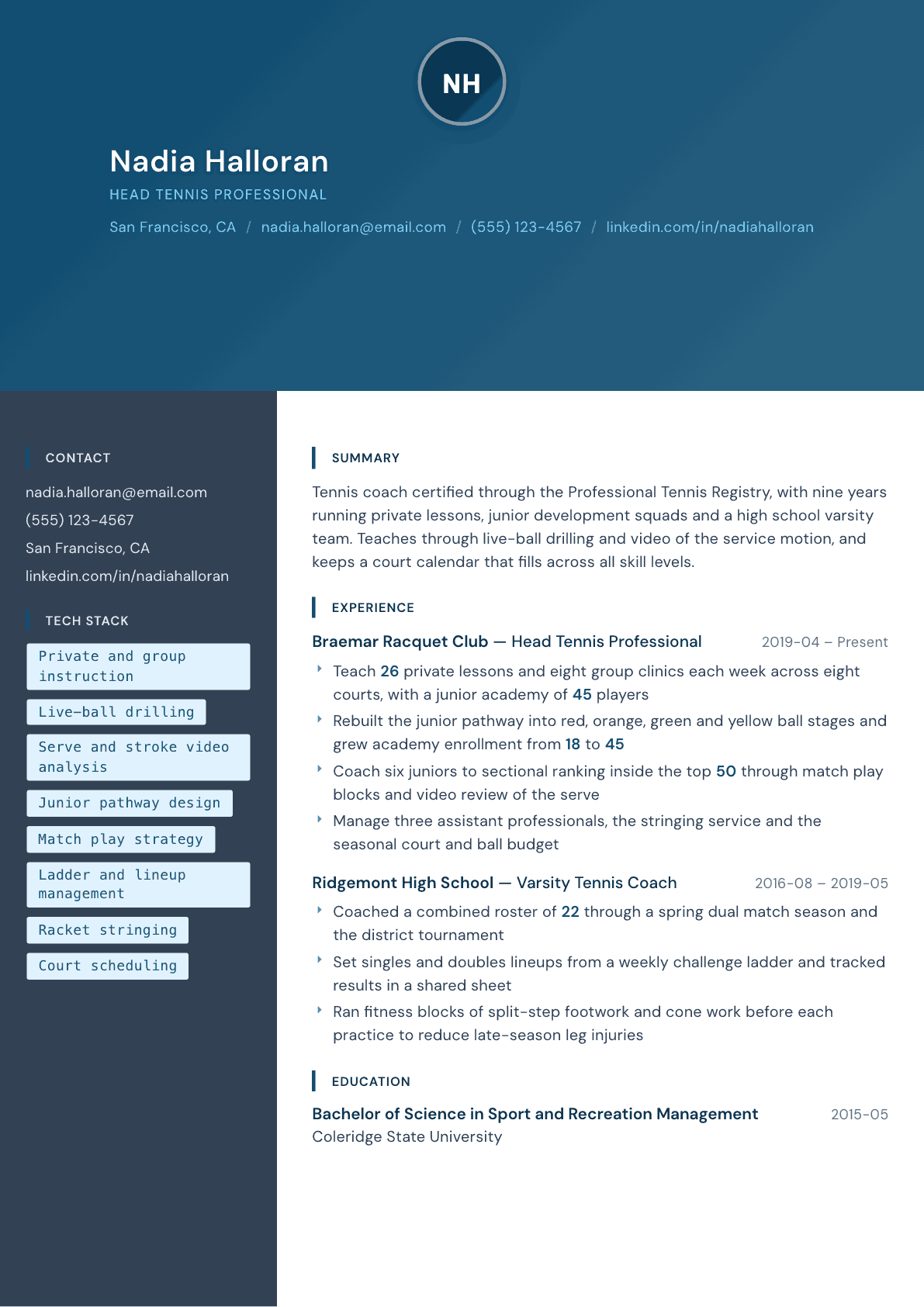
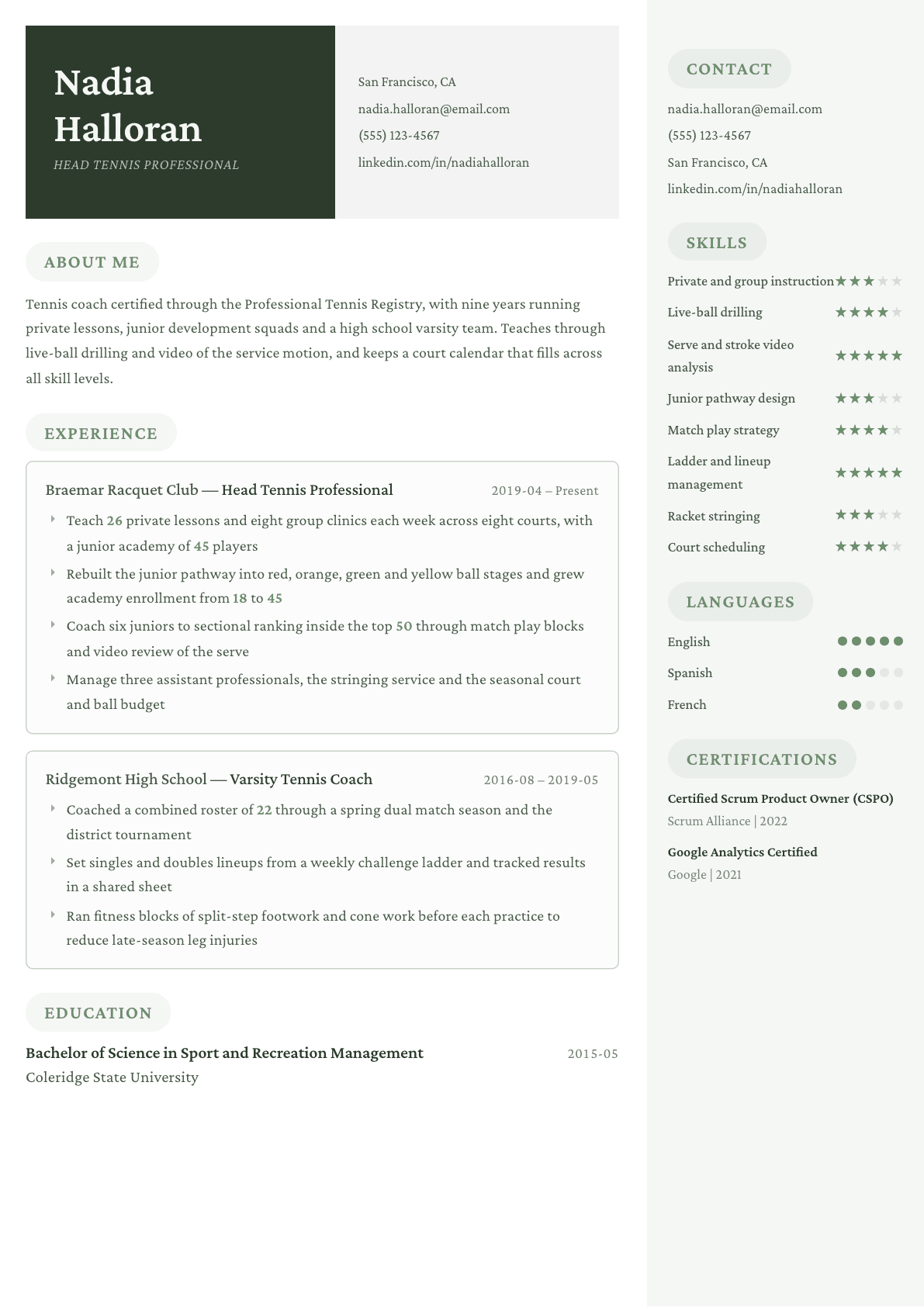
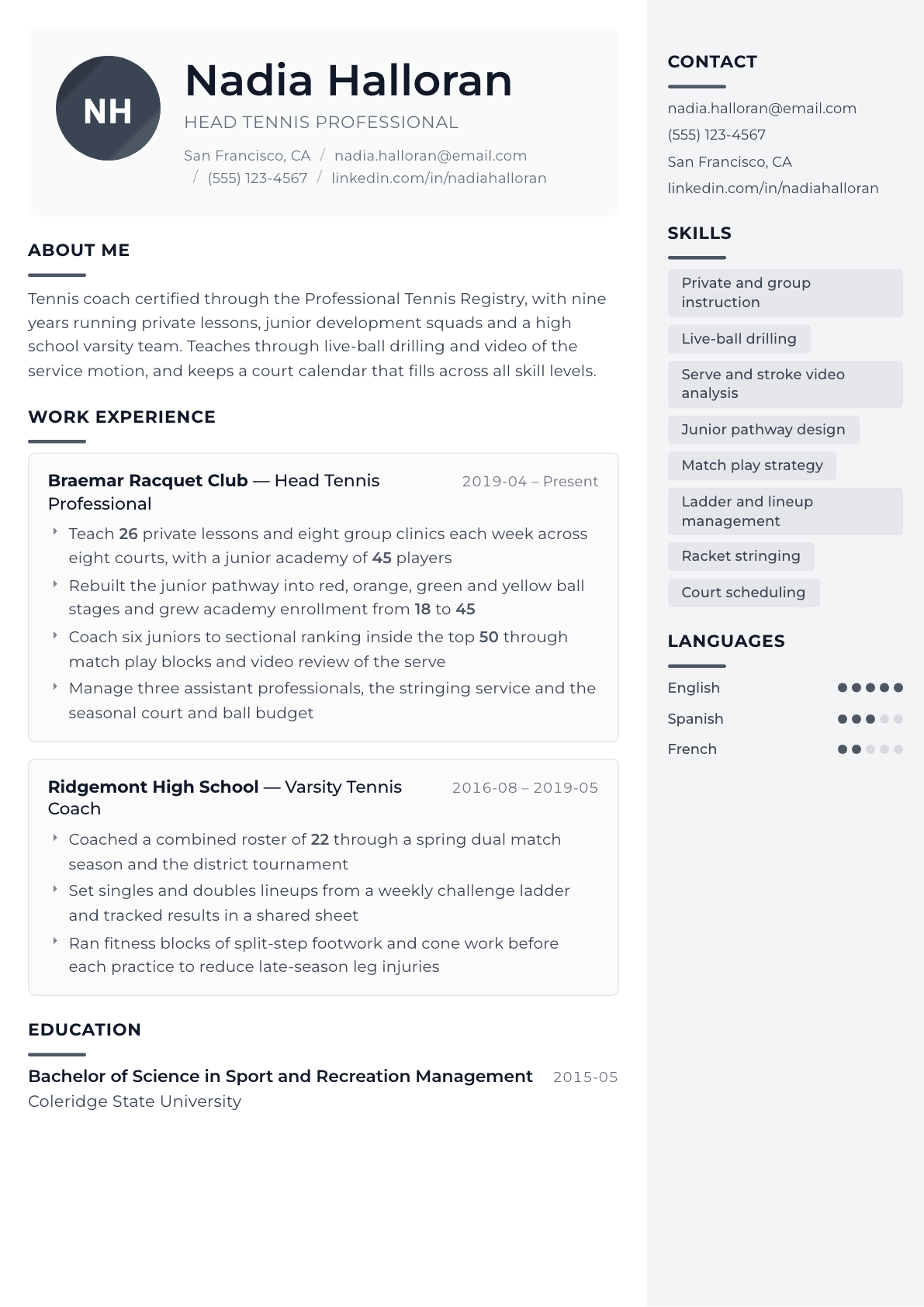
The same tennis coach content laid out in three CVBooster templates, so you can see what the finished document looks like before you write a word.
Example Tennis Coach summary
Tennis coach certified by the Professional Tennis Registry with nine years of club and high school experience. Teaches around twenty five private lessons and eight clinics a week, runs a junior academy across the red, orange, green and yellow ball stages, and uses video review of the serve to fix technical faults. Has coached juniors into sectional rankings, and is looking for a head professional role at a club that wants a stronger junior pipeline.
Skills to list on a Tennis Coach resume
- Private lesson instruction
- Group clinic delivery
- Live-ball drill design
- Stroke and serve technical coaching
- Video analysis
- Junior development pathway
- Match strategy and tactics
- Tournament entry and travel planning
- Challenge ladder management
- Footwork and agility conditioning
- Racket stringing and equipment fitting
- Court scheduling and utilization
- Membership retention
- Assistant professional supervision
What actually gets this resume read
- Lead with your teaching certification and its issuing body, because clubs screen for a recognized coaching credential.
- Give lesson volume in a real unit: private lessons a week, clinic size, academy headcount, courts you are responsible for.
- Split your resume by the two jobs a club pro does: on-court teaching and running the program as a small business.
- Show player results with rankings, tournament rounds and college placements rather than saying players improved.
- Name the drills and the technical work you teach, from split-step timing to a kick serve, so the level is clear.
- Include stringing, pro shop and court booking duties, since smaller clubs expect the pro to cover all of it.
How to write a tennis coach resume
A tennis coach resume is read by someone running a business with courts attached. At a racquet club the director of tennis wants to know how many lessons you can fill, whether students rebook, and whether the junior program grows under you. At a school the athletic director wants a lineup managed fairly and a season run without complaints. Both need evidence, not enthusiasm.
The credential comes first. Clubs screen for a teaching certification from a recognized body, and a resume without one drops out of consideration before the experience section is reached. After that the reader is looking for teaching volume, because a professional who fills the court calendar is the professional who earns the club money.
This guide lays out the sections in the order a director scans them, three summaries for an assistant professional, a teaching professional and a head professional, five before and after bullets, and the questions that come up when a coach applies to a club and a school in the same month.
Format: credential, teaching volume, program results
Reverse chronological, opening with a two line credential block: the teaching certification and its issuing organization, safeguarding status, and first aid and CPR. Then each position with the facility, the court count and the size of the program you taught inside.
One page is enough for a teaching professional. Two pages fits a head professional carrying staff management, program design and a budget, but only if the second page holds program numbers rather than a longer list of clinics.
- Credential block: teaching certification and issuer, safeguarding, first aid and CPR.
- Each role: facility, courts, indoor or outdoor, membership or roster size, seasons worked.
- Teaching volume: private lessons per week, clinics per week, average clinic size, academy headcount.
- Program outcomes: enrollment growth, retention, rankings, tournament results, college placements.
Summary: certification, lesson volume, who you teach
Three or four lines naming the certification, the years on court, the mix of students you teach, and the program you have built. Directors sort applications into teaching professionals and program builders, so say plainly which one you are and where you want to go next.
If you are strong with juniors, say so and give the pathway you run. If your book is mostly adult members and leagues, say that instead. A club with a thin junior academy and a full adult calendar is hiring for the gap, not for a generalist.
Experience: the court calendar and what filled it
Give lesson volume in a unit a director recognizes: private lessons a week, group clinics a week, average clinic headcount, and how many courts you were responsible for. That single line tells her whether you can carry the schedule she needs covered.
Then describe the teaching. Live-ball drilling, feeding patterns, cross-court and down the line rally targets, serve and return blocks, point play with a constraint. Add the technical work you actually fix: split-step timing, a topspin forehand with a stable racket face, a kick serve, a compact volley. This is how a director judges whether you can teach a four and a half player and a beginner in the same afternoon.
Finish with the business side, because a tennis professional runs a small operation: court booking, clinic pricing, cancellation policy, pro shop and stringing, and membership retention. Clubs are wary of teachers who cannot handle the calendar.
Player development and competitive results
Show a pathway rather than a list of students. The red, orange, green and yellow ball stages give you a structure to describe: how a child moves between them, what the entry standard is, and how many players sit in each stage. Directors and parents both understand that language.
Then attach results. Sectional rankings, tournament rounds reached, high school lineup positions, college placements. Use ranking bands and round names rather than a story about a player who improved, because a band is checkable and a story is not.
- Junior pathway stages and how a player advances between them.
- Competitive outcomes: rankings achieved, tournament rounds, team lineup positions.
- Adult programming: leagues managed, clinic levels offered, social play events run.
- Video and analysis: what you film, how often, and what students receive afterward.
Certification, safety and facility duties
List the teaching certification with its issuing organization, the level attained, and any specialist workshop such as junior development or performance coaching. Add first aid and CPR, since a professional on court alone with a group is the responder if anything goes wrong.
Then the facility duties: court maintenance and net checks, ball inventory, machine and stringing equipment, weather and lightning policy, and how you handle indoor court allocation in winter. Small clubs assume the professional does all of it.
Keywords in tennis job postings
Club and school listings repeat a narrow set of terms: private and group instruction, junior development, adult programming, member engagement, court scheduling, tournament coordination, and the certification level required. Mirror them once at the top and once in the body.
Name the facility type as well, since a seasonal outdoor club, an indoor academy and a school program each want to see their own words on the page before they call a candidate in.
Tennis Coach resume summary examples
Assistant professional
Newly certified teaching professional and former college player seeking an assistant role. Teaches eight private lessons and four junior clinics a week, runs the ball machine sessions and handles stringing. Holds current first aid and CPR and is available for summer camp weeks.
Teaching professional
Teaching professional with six years on court, delivering around twenty five private lessons and six clinics a week across adult leagues and a junior academy. Uses serve video review and live-ball drilling, and has coached four juniors into sectional ranking. Looking for a club with an indoor season.
Head professional
Head tennis professional managing eight courts, three assistant professionals and a junior academy that grew from 18 to 45 players. Owns the lesson calendar, clinic pricing, stringing service and seasonal budget, and coaches the top junior group. Seeking a director of tennis role at a multi-court facility.
Work experience bullets: before and after
Before: Taught tennis lessons to juniors and adults.
After: Taught 26 private lessons and eight group clinics a week across eight courts, covering beginner adults through a competitive junior academy of 45 players.
Weekly volume, court count and student mix let a director see whether the calendar gets filled.
Before: Built the junior program.
After: Rebuilt the junior pathway into red, orange, green and yellow ball stages with a written advancement standard, growing enrollment from 18 to 45 players over three seasons.
A named structure and an enrollment change turn program work into a measurable result.
Before: Helped players improve their serve.
After: Filmed the service motion at high frame rate each month and coached toss consistency and a kick serve, moving six juniors into the sectional top 50.
The method, the frequency and the competitive outcome replace an unverifiable improvement claim.
Before: Managed the school tennis team.
After: Set singles and doubles lineups from a weekly challenge ladder for a combined roster of 22 and published results in a shared sheet so families could see the standings.
The selection method and its transparency address the complaint that follows every school lineup.
Before: Handled club duties outside of coaching.
After: Ran the court booking calendar, the stringing service and the seasonal ball and equipment budget, and managed three assistant professionals across summer clinic weeks.
The unglamorous operations work is exactly what a head professional job is made of.
Hard skills
- Private lesson instruction
- Group clinic design and delivery
- Live-ball drilling and feeding
- Stroke and grip correction
- Serve and return technical work
- High frame rate video analysis
- Junior pathway design
- Match strategy and tactical patterns
- Challenge ladder and lineup management
- Tournament entry and travel planning
- Racket stringing and equipment fitting
- Court scheduling and utilization
Soft skills
- Member relationship building
- Teaching across ability levels
- Patience with beginners
- Parent conversations about rankings
- Assistant professional mentoring
- Composure in disputed calls
Certifications worth listing
- PTR Certified Professional (Professional Tennis Registry)
- USPTA Certified Professional (United States Professional Tennis Association)
- Safe Play Approved (United States Tennis Association)
- Adult First Aid, CPR and AED (American Red Cross)
Mistakes that cost tennis coach candidates the interview
- Applying to a club without a recognized teaching certification listed anywhere on the page.
- Describing lessons without any volume, so a director cannot tell a part time teacher from a full book.
- Leading with a personal playing ranking from years ago instead of teaching outcomes.
- Ignoring the business duties, when court booking and retention are half of a club professional job.
- Listing students by name rather than showing a pathway with stages and standards.
- Skipping stringing, pro shop and maintenance work that small clubs expect the professional to cover.
- Using the same page for a junior academy job and an adult member club, which have opposite priorities.
Tennis Coach resume questions
Which tennis teaching certification do clubs look for?
Either of the two main teaching organizations is accepted at most clubs, and the level within it matters more than which one you chose. List the certification, the issuing organization and any specialist workshop you completed alongside it.
How do I show teaching volume on a tennis resume?
Give private lessons per week, clinics per week and average clinic size, then the number of courts you covered. A director is building a schedule and needs to know how much of it one professional can realistically carry.
Does my own playing level matter for a coaching job?
It opens a door and nothing more. Two lines with your highest competitive level are enough. Clubs have all seen strong players who could not teach a beginner to rally, so the teaching evidence has to carry the page.
How should a high school tennis coach handle lineup decisions on a resume?
Describe the selection method, not the results. A weekly challenge ladder with published standings shows a director that you have a defensible process, which is the thing that prevents parent complaints reaching her office.
What program outcomes belong on a tennis coach resume?
Enrollment growth, retention between seasons, junior rankings and tournament rounds, and college placements. Membership retention counts too, because a club measures the tennis operation by whether members renew and keep booking court time.
Related resume examples
- Sports Coach Resume example
- Personal Trainer Resume example
- Athletic Coach Resume example
- Fitness Coach Resume example
- Golf Instructor Resume example
- Soccer Coach Resume example