Fitness Coach Resume Examples: free ATS score and gap list
Craft a Fitness Coach Resume Gyms and Online Clients Trust
By Mustafa Tarabya, founder of CVBooster · Published · Updated
Fitness coach resume example with client retention numbers, certification placement, program design keywords and tips for gym floor and remote coaching roles.
Sample resumes for a fitness coach
The same fitness coach content laid out in three CVBooster templates, so you can see what the finished document looks like before you write a word.
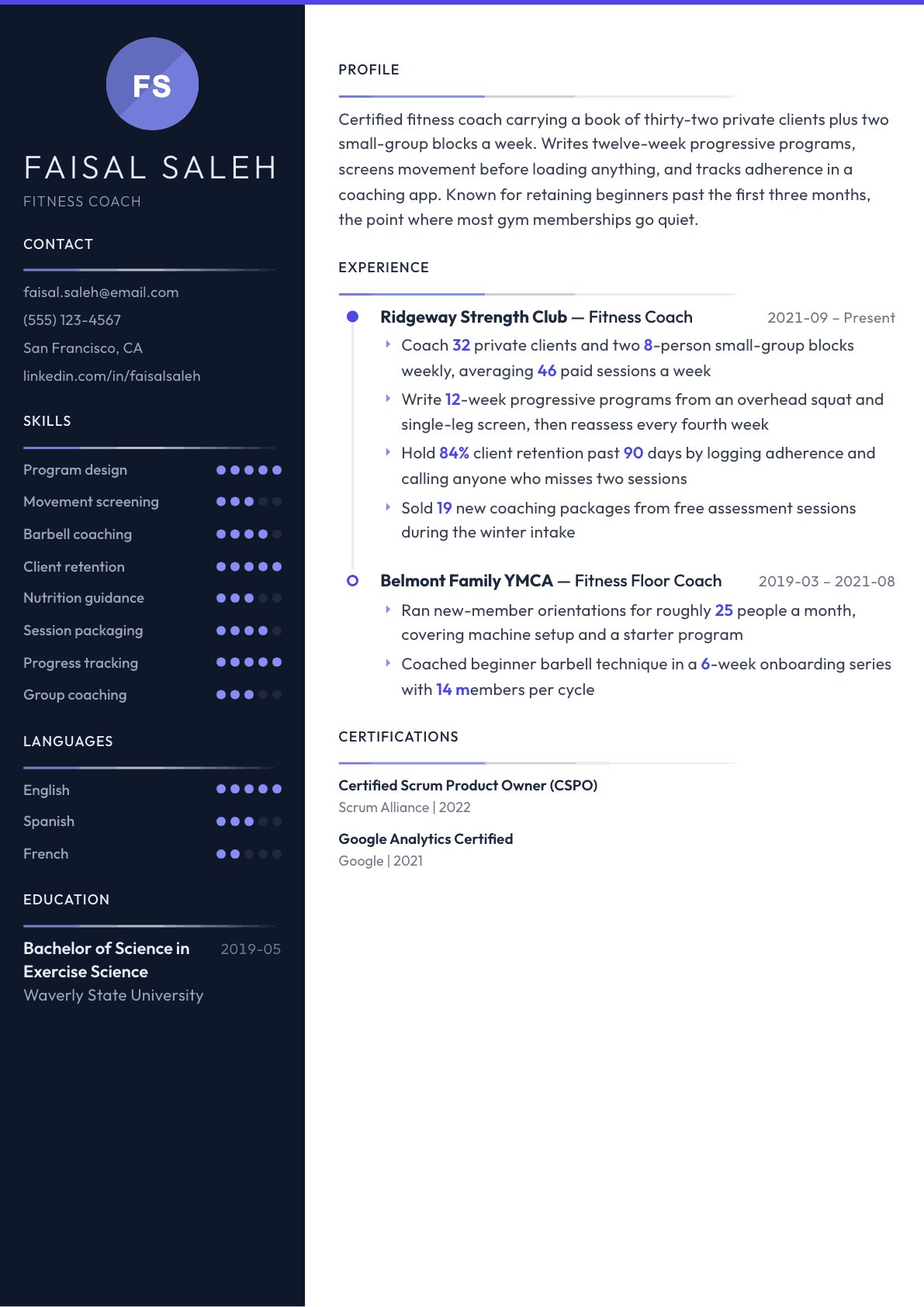
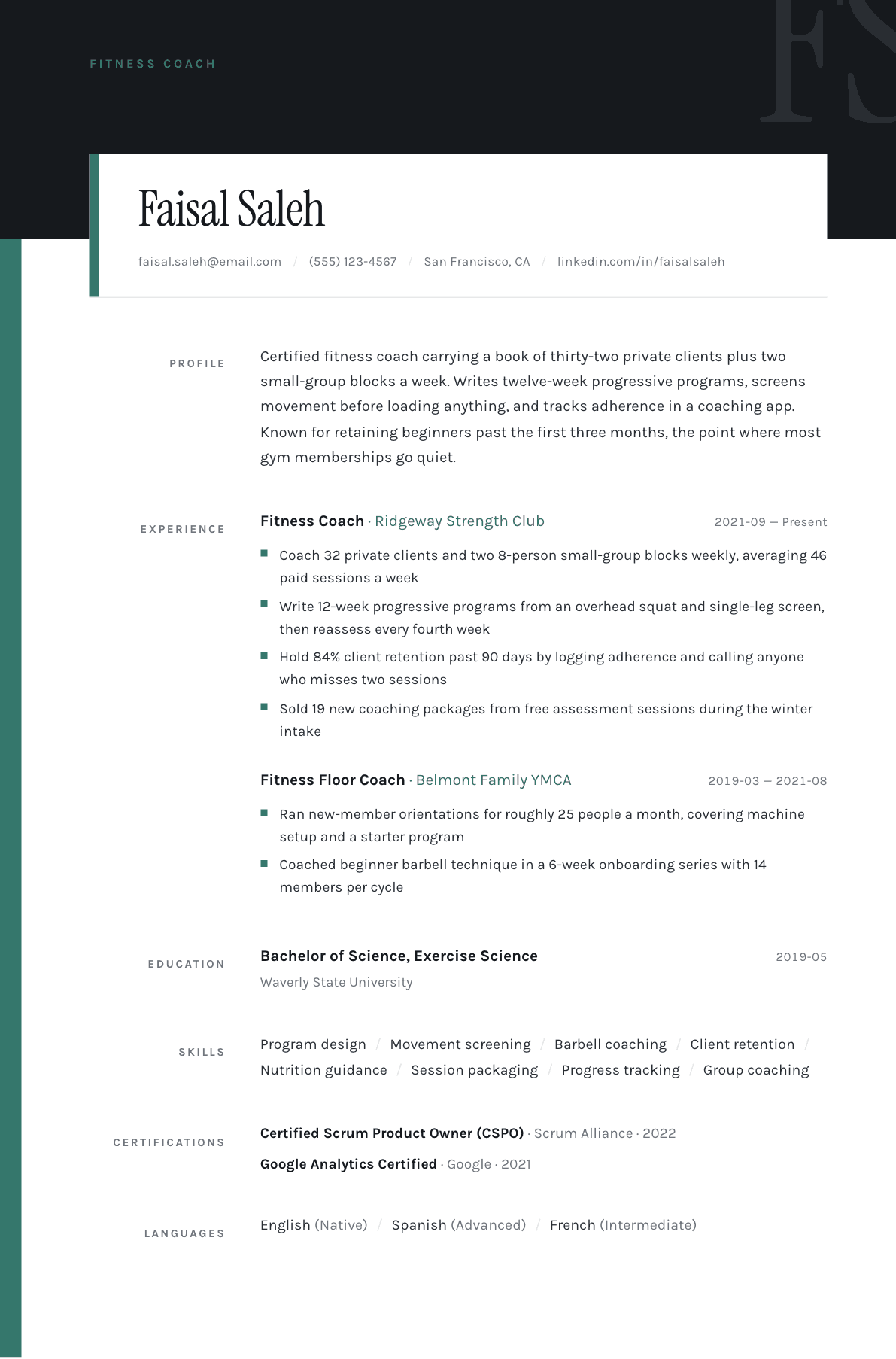
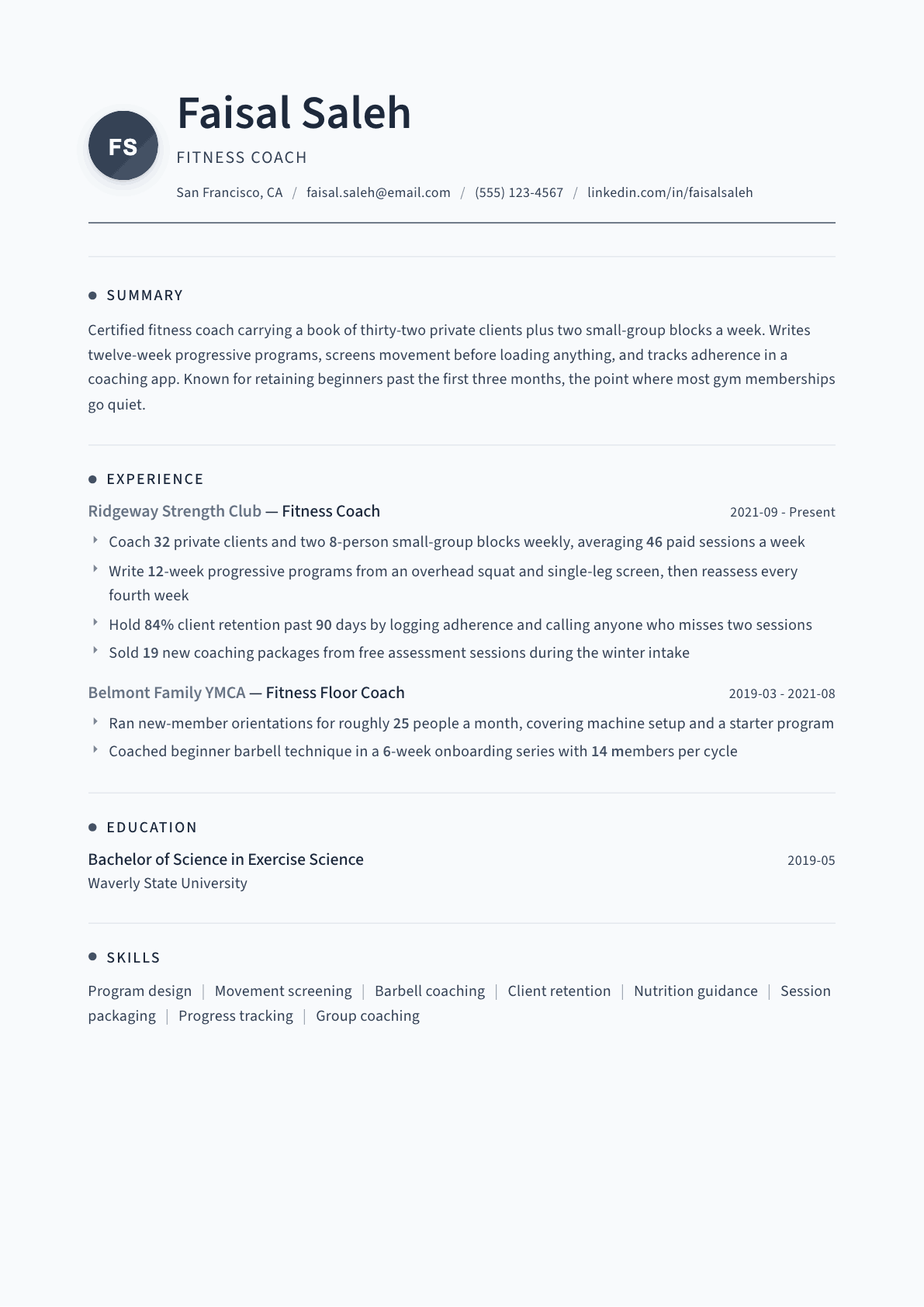
Example Fitness Coach summary
Certified fitness coach with five years on a gym floor and a private book of thirty-two clients. Builds twelve-week progressive programs from a movement screen, coaches barbell technique to beginners, and holds retention past the ninety-day mark where most new members drop off. Adds nineteen package sales a season from free assessments. Seeking a senior coaching seat with programming ownership.
Skills to list on a Fitness Coach resume
- Program design
- Movement screening
- Barbell technique coaching
- Progressive overload
- Client retention
- Session packaging
- Small-group coaching
- Remote coaching
- Habit coaching
- Nutrition guidance
- Body composition tracking
- Injury-aware regression
- Goal setting
- Member onboarding
What actually gets this resume read
- Put the certifying body next to every credential, because gyms verify the issuer before they verify anything else.
- Count what a manager counts: active clients, paid sessions per week, retention past ninety days and package renewals.
- Describe your screening process by name so the reader knows you assess before you load a barbell.
- Separate one-to-one coaching from small group and remote coaching; the pay models and skills behind them differ.
- Name the coaching app or tracking system you use for programs, check-ins and adherence, since gyms buy those tools.
- Show one line on sales without sounding like a closer: assessments booked, packages sold, referrals earned from existing clients.
How to write a fitness coach resume
A fitness coach resume is read by a gym general manager who has a payroll target and a floor to fill. She is checking three things in the first pass: that your certification is from a body her insurer accepts, that you can hold a client book without her feeding you leads forever, and that you will still be on the schedule in six months. Everything else on the page is supporting evidence.
The trap is writing a resume about your own training. Nobody hiring a coach cares about your deadlift. They care about how many people you keep training, how you decide what a beginner does in week one versus week nine, and whether you know when to stop loading someone and send them to a clinician.
What follows is the structure that works for gym floor jobs, boutique studios and remote coaching, with example summaries at three career stages, rewritten bullets, the credentials worth listing, and the questions coaches ask when their resume keeps stalling at the application stage.
Format: credentials at the top, client evidence underneath
One page. A coaching resume that runs long is almost always padded with class descriptions and personal athletic history. Reverse-chronological, clean single column, and the certification block sits directly under the summary rather than at the bottom, because that is the field a manager verifies before she schedules an interview.
Write the certification with the issuing organization spelled out and the current status. Insurers and franchise groups maintain approved lists, and an acronym with no issuer forces a manager to look it up or skip you.
- Header: name, city, phone, email, and your primary certification with the issuing body written out.
- Section order for coaching: summary, certifications, coaching experience, specialties, education, skills.
- Add a line for current cardiopulmonary resuscitation and automated external defibrillator training, because no gym can put you on the floor without it.
Experience: the book, the load, the retention
Each coaching job opens with the facility type and the size of the book you carried. A big-box floor, a private studio, a semi-private gym and a remote roster all imply different work, and active client count plus paid sessions per week tells a manager instantly whether you can sustain a schedule.
Then write bullets about the coaching itself. How you assess before you program, how a twelve-week block is structured, how you progress a beginner who cannot hinge yet, what you do with a client whose shoulder hurts on day one. Coaching judgment is the product, and generic phrases like created customized workout plans hide it completely.
Retention is the number that gets you hired. Share of clients still training past ninety days, package renewal rate, referrals from existing clients. A manager reads retention as evidence that your revenue does not evaporate the moment the introductory offer runs out.
Specialties: say who you are actually good with
A specialty section beats a longer skills list. Deconditioned beginners, general population strength, postnatal return to training, older adults working on balance and bone density, desk-bound clients with cranky hips, weight-room-curious teenagers. Gyms staff against the members they have, and a coach who names a population is easier to slot into a schedule.
Keep this section honest and inside your scope. Nutrition guidance means habit coaching, food logging and portion structure unless you hold a clinical credential that says otherwise, and writing anything stronger will cost you credibility with a manager who has had that conversation before.
- Name two or three populations you are genuinely strong with rather than claiming all of them.
- Say which formats you deliver: one to one, semi-private pairs and threes, small group blocks, remote programming with video check-ins.
- State your referral boundary clearly, since knowing when to send someone to a physical therapist is a professional skill.
Systems and the business half of coaching
Name the tools. The coaching app you write programs and check-ins inside, the gym management and booking software, the assessment you use, the way you track body composition or performance markers. Managers screen for the platform they already pay for, and a coach who knows it is productive in the first week.
Then the commercial half, written without sounding like a closer. Free assessments booked and converted, packages sold, renewals, and how you fill a new schedule when you move to a new facility. This is the part most coaches leave out, and it is the part that decides who gets the interview when two candidates have the same credential.
Keywords a gym posting repeats
Postings for these roles run on a narrow vocabulary: program design, client assessment, movement screening, progressive overload, client retention, member onboarding, small group training, goal setting, session packages and lead conversion. Use each once in a place where it is demonstrated rather than in a keyword block at the bottom.
Mirror the certification wording exactly as the posting writes it. If a listing asks for a nationally accredited personal training credential, name yours with the issuing organization in the same sentence so the screener never has to interpret.
Fitness Coach resume summary examples
First year on the floor
Certified fitness coach in the first year on a gym floor, running new-member orientations and a beginner barbell series. Carries 11 private clients built entirely from floor conversations and free assessments, and holds current cardiopulmonary resuscitation training. Seeking a full-time coaching seat with a mentor on staff.
Five years, full book
Fitness coach with a book of 32 private clients and two small-group blocks, averaging 46 paid sessions a week. Programs in 12-week progressive blocks from a movement screen and keeps 84% of clients training past the 90-day mark. Looking for a senior coaching role with programming ownership.
Lead coach
Lead fitness coach responsible for a team of six coaches, the assessment standard and the onboarding track for new members. Still carries 18 private clients, mentors coaches through their first client books, and rebuilt the small-group offer that now fills four evening blocks a week.
Work experience bullets: before and after
Before: Created customized workout plans for clients.
After: Wrote 12-week progressive programs from an overhead squat and single-leg screen, reassessing every fourth week and adjusting load, tempo or exercise selection from the reassessment.
It names the assessment, the block length and the review cycle, which is what programming actually means.
Before: Trained clients one on one and in groups.
After: Coached 32 private clients and two 8-person small-group blocks weekly, averaging 46 paid sessions across a six-day schedule.
Counts and formats let a manager work out whether you can carry the schedule she needs filled.
Before: Helped clients stay motivated and reach their goals.
After: Held 84% client retention past 90 days by logging session adherence and calling any client who missed two sessions in a row before the third was booked.
Motivation is invisible until it is attached to a retention figure and a concrete follow-up habit.
Before: Worked with clients who had injuries.
After: Adapted programs for clients returning from shoulder and knee surgery by working within the range their physical therapist cleared and referring anyone reporting new pain back to the clinic.
It shows scope of practice and a referral boundary rather than implying you treat injuries.
Before: Sold personal training packages.
After: Converted 19 free assessment sessions into coaching packages over a winter intake and generated 7 additional clients from referrals by existing members.
Two specific numbers make the commercial contribution visible without turning the bullet into sales language.
Hard skills
- Program design
- Movement screening
- Progressive overload
- Barbell and dumbbell technique coaching
- Small group programming
- Remote coaching and check-ins
- Body composition tracking
- Habit and nutrition coaching
- Warm-up and mobility prescription
- Deconditioned beginner progressions
- Older adult training
- Gym management software
- Session packaging and renewals
- Emergency response on the floor
Soft skills
- Client rapport
- Accountability follow-up
- Clear cueing
- Listening during intake
- Boundary setting
- Consistency and punctuality
Certifications worth listing
- Certified Personal Trainer (NASM-CPT) (National Academy of Sports Medicine)
- Certified Personal Trainer (ACE-CPT) (American Council on Exercise)
- Certified Personal Trainer (ACSM-CPT) (American College of Sports Medicine)
- Certified Strength and Conditioning Specialist (CSCS) (National Strength and Conditioning Association)
- Adult CPR and AED (American Heart Association)
Mistakes that cost fitness coach candidates the interview
- Opening with your own athletic achievements, which tells a manager what you can lift and nothing about what you can coach.
- Listing a certification acronym with no issuing organization, so a screener cannot check it against the approved list.
- Writing about custom plans and motivation without a single number on active clients, sessions or retention.
- Claiming nutrition programming that sits outside a coaching scope of practice, which reads as a liability rather than a strength.
- Leaving out cardiopulmonary resuscitation status, which is a hard requirement rather than an optional extra.
- Ignoring the commercial side entirely, when filling a schedule is half of what a gym is paying a coach to do.
Fitness Coach resume questions
Which certification should I put first on a fitness coach resume?
The one the posting names, if you hold it. Otherwise lead with your accredited personal training credential and list specialty certifications underneath. Always write the issuing organization out in full, because managers and insurers verify against approved provider lists.
How do I write a fitness coach resume with no paid clients yet?
Use the work you did in training: supervised practicum hours, people you coached for free with their consent, gym floor orientations, class coverage. Give each a headcount and a structure, then lead the summary with your certification and assessment ability.
Should I include client transformation results?
Include outcomes you can describe without identifying anyone, such as adherence, strength progress or return to activity after a break. Avoid before and after weight claims as the centerpiece, since managers hire on retention and coaching process more than on individual results.
Is a degree in exercise science necessary for coaching jobs?
Not for most commercial gym roles, where an accredited certification and floor experience matter more. A degree helps for corporate wellness, clinical adjacent settings and college positions, so list it plainly but never in place of your certification and client evidence.
How do I show remote coaching experience?
Give the roster size, the check-in cadence, the platform you deliver programs through, and how you coach technique without being in the room, usually video review with written feedback. Add retention across the roster, since remote clients are easy to lose quietly.
Related resume examples
- Personal Trainer Resume example
- Fitness Instructor Resume example
- Wellness Coach Resume example
- Strength and Conditioning Coach Resume example
- CrossFit Coach Resume example
- Fitness Manager Resume example