Storyboard Artist Resume Examples: the lines they read
Build a Storyboard Artist Resume Directors Actually Read
By Mustafa Tarabya, founder of CVBooster · Published · Updated
Storyboard artist resume guide with animatic and camera keywords, a production sample, and the details a director checks before booking you.
Sample resumes for a storyboard artist
The same storyboard artist content laid out in three CVBooster templates, so you can see what the finished document looks like before you write a word.
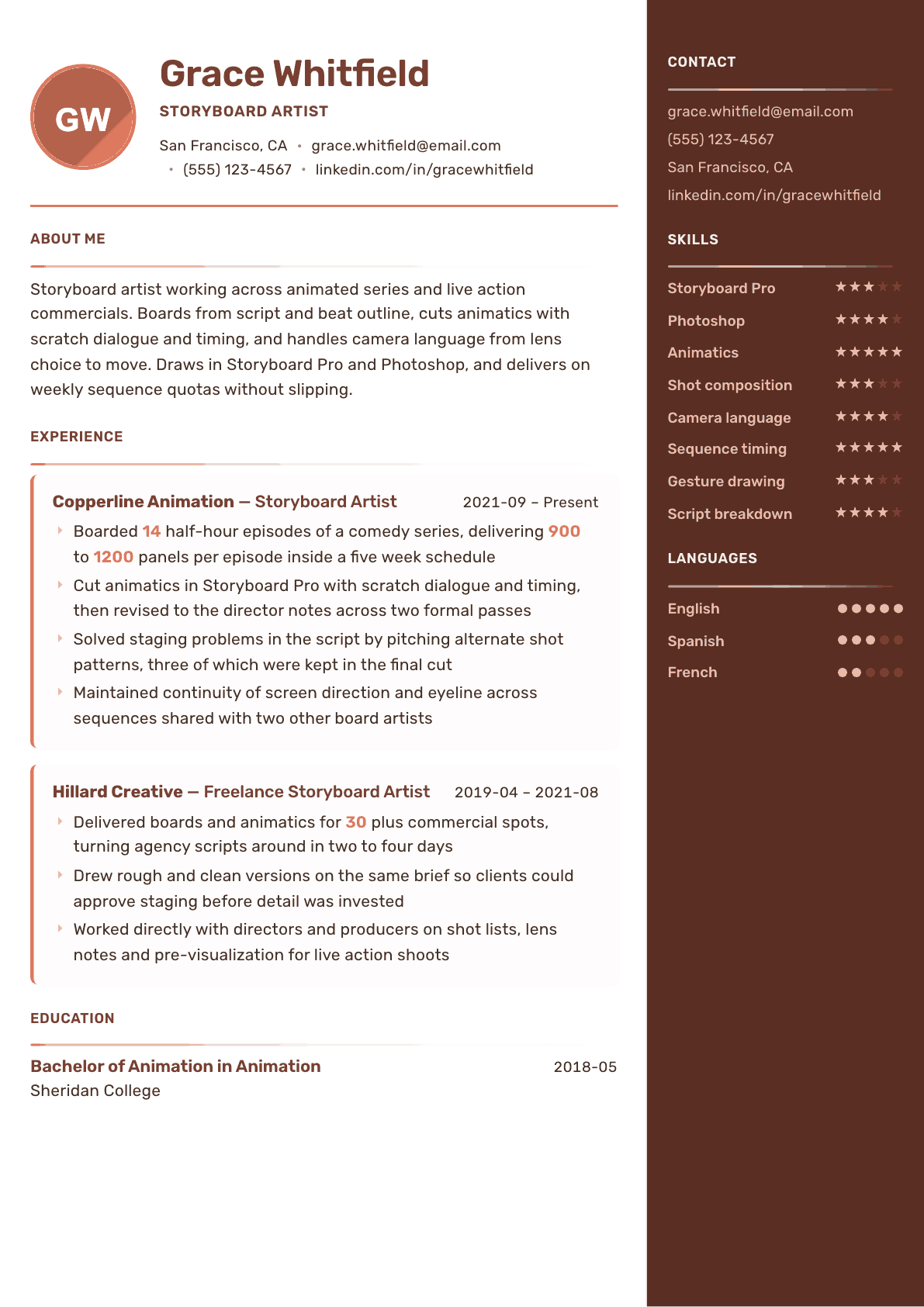
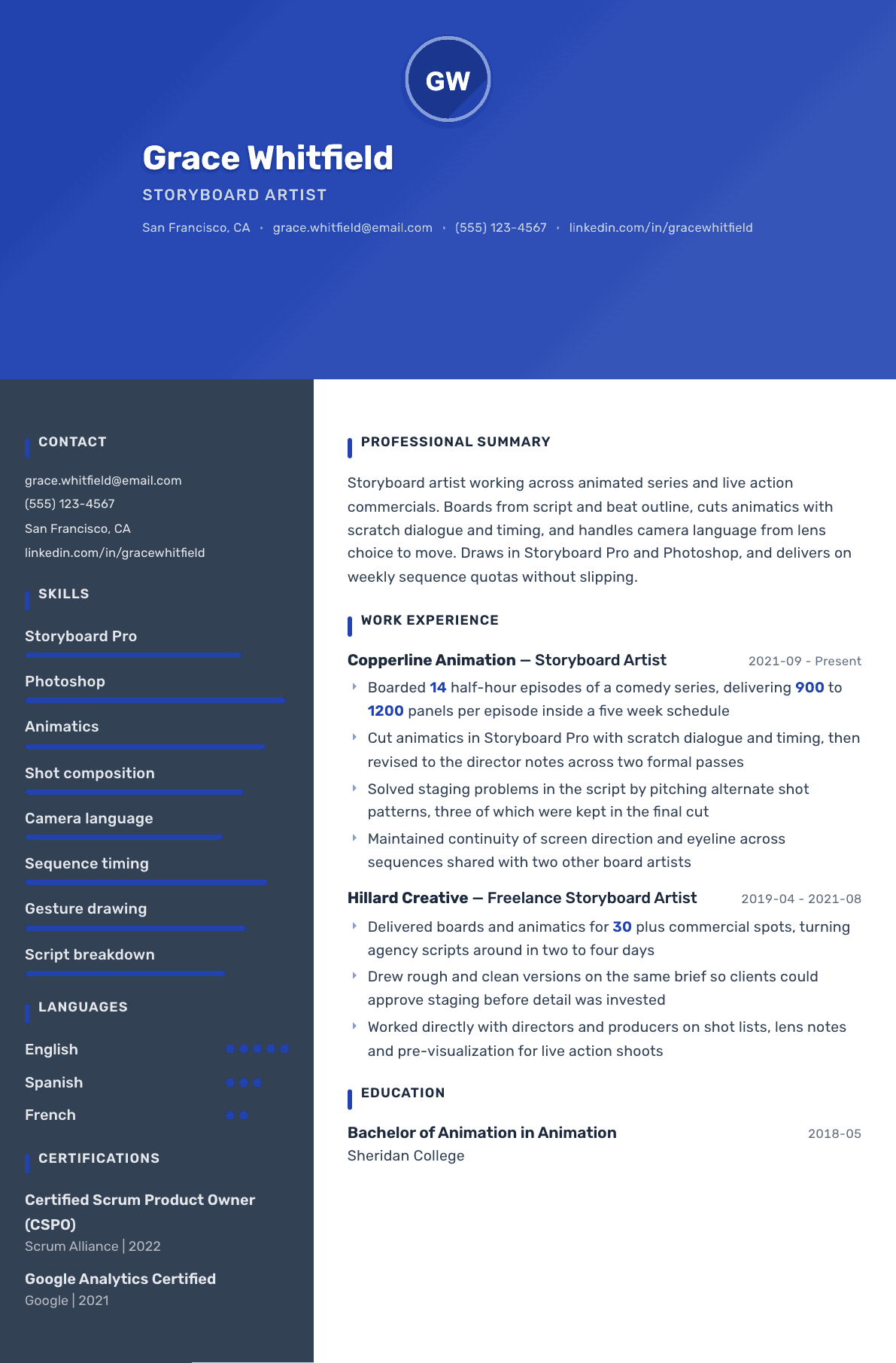
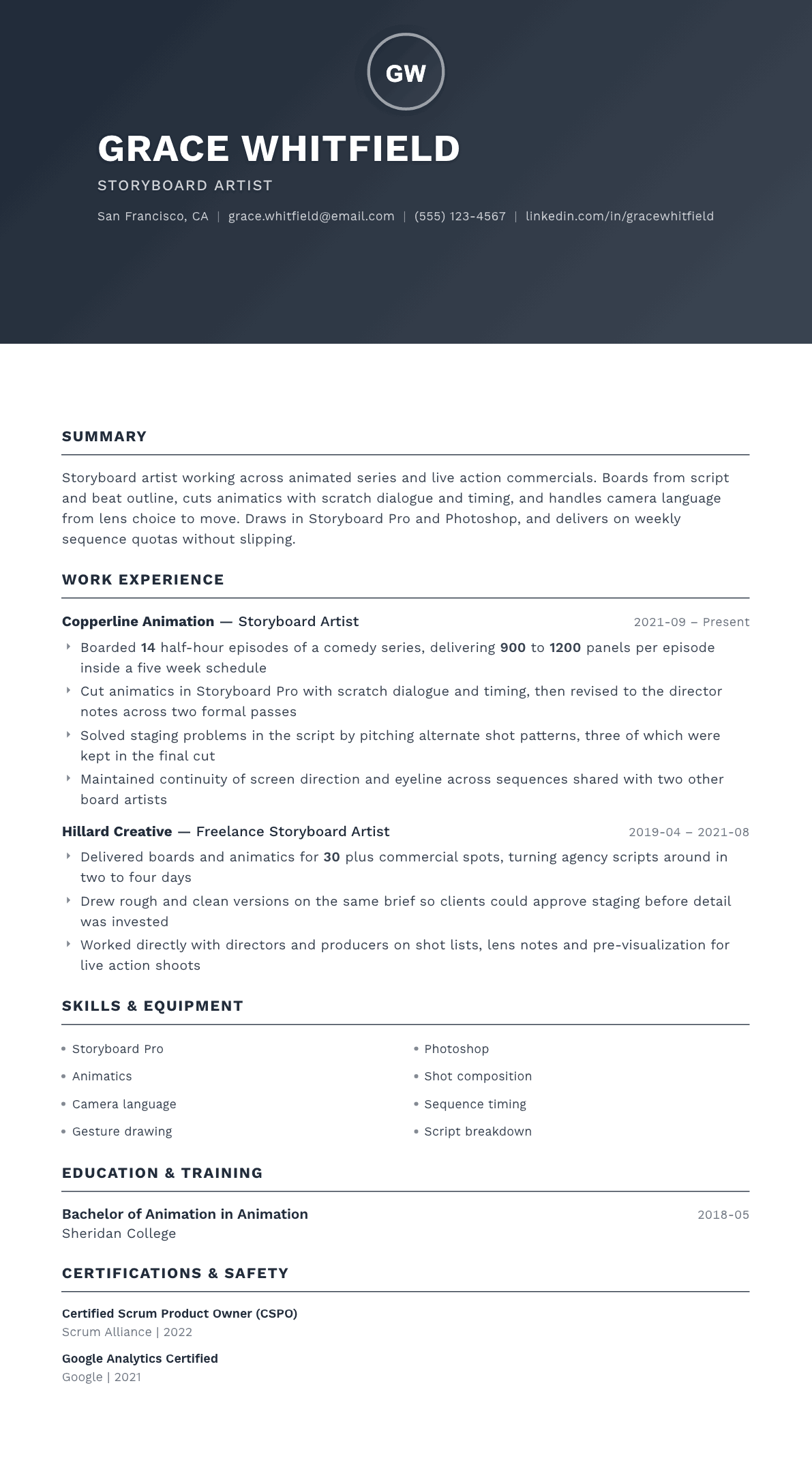
Example Storyboard Artist summary
Storyboard artist with six years on animated series and commercial spots. Boards from script and beat outline, then cuts animatics with scratch dialogue and timing so the edit reads before animation begins. Delivers around a thousand panels per half-hour episode on a five week schedule, and takes director notes cleanly across formal revision passes.
Skills to list on a Storyboard Artist resume
- Storyboard Pro
- Photoshop
- Animatics
- Shot composition
- Staging
- Camera language
- Screen direction
- Sequence timing
- Gesture drawing
- Perspective
- Script breakdown
- Beat boards
- Premiere Pro
- Previsualization
What actually gets this resume read
- Give panel volume and schedule together, because a director wants to know how fast you board at usable quality.
- Name the software you board in, since Storyboard Pro, Photoshop and Blender previs suit different production setups.
- Say whether you board comedy, action, drama or commercial work, as directors hire for a specific instinct.
- Show that you cut your own animatics with timing and scratch audio, not just delivered flat panels.
- Mention how you take notes, because revision temperament matters as much as draftsmanship on a board crew.
- Link a portfolio with at least one full sequence playing as an animatic, not only a grid of pretty panels.
How to write a storyboard artist resume
A director hiring a storyboard artist is buying speed at a usable quality level, and nothing else. Drawings that are beautiful but slow break a board schedule, and drawings that are fast but confusing break the edit. The resume has to answer both halves at once: how many panels you deliver in a week, and whether those panels solve staging problems rather than just illustrating the script.
The second filter is genre instinct. Comedy boarding lives on timing and reaction shots, action lives on geography and continuity of screen direction, drama lives on eyelines and held frames, and commercial work lives on client approval inside two days. Directors hire for one of these, so name yours.
This guide walks through the resume order animation and live action productions expect, three summaries across career stages, before and after bullets from real board work, and the questions board artists ask when they move between series, features and advertising.
Format: one page, with a link to a full sequence
One page. Put the portfolio link in the header and make sure it opens onto at least one complete sequence playing as an animatic with timing and scratch audio, not only a grid of finished panels. A director judges a board artist on how a sequence cuts, and static panels cannot show that.
Keep the layout plain. Board work is often hired through a production coordinator who forwards the file to a director and a producer, so the document should read the same everywhere. Reverse chronological order, single column, no icons.
- Header: name, portfolio link, city and time zone, email, and union or guild status if you have it.
- Order: summary, credits, experience, software, education and training.
- Artists starting out lead with short film, student production and spec commercial boards described with panel counts and schedules.
Summary: format, genre, throughput
Two or three lines. Say what you board, whether that is animated series, feature, commercial spots, live action previs or games cinematics. Then the genre instinct you are hired for. Then the throughput, expressed as panels against a schedule, because that number is the single fact a producer needs before booking you.
If you cut your own animatics, say it in the summary rather than burying it in a bullet. An artist who edits timing and scratch dialogue delivers a sequence the director can watch, which is a different and more valuable product than a stack of drawings.
Experience: episodes, panels, schedule, revisions
Each credit needs the production, the format and your role. Then bullets built around volume against time: episodes boarded, panels per episode, the length of the board schedule, and how many formal revision passes the production ran. Producers plan around exactly these numbers, so a resume that supplies them reads as professional.
Add the problem solving. A board artist earns their reputation by fixing scenes the script left ambiguous: proposing a shot pattern that makes a joke land, resolving geography in a chase, or cutting three shots that were slowing the sequence. Name a case where your solution stayed in the final cut.
Continuity work belongs here too. Screen direction, eyeline matching, and prop and costume continuity across sequences shared with other board artists show that you can work inside a crew rather than only on your own pages.
- Give panel counts alongside the delivery window, never one without the other.
- Say who you took notes from: director, showrunner, agency creative, or client.
- Note the deliverable format you exported, since productions differ on file and edit expectations.
Software and craft: board tool, edit tool, drawing foundation
Name the board package first. Storyboard Pro is the standard on most animated series, while Photoshop with an edit in a video tool is common in commercials, and three dimensional previs packages appear on action heavy live action. Then name what you cut animatics in, because editing is part of the deliverable.
Then the drawing foundation, stated plainly: gesture, perspective construction, acting and expression, and camera language including lens choice, height and movement. Those are the skills a director tests in the first sequence and they belong on the page even though they feel obvious to you.
Keywords a boarding posting repeats
The vocabulary is consistent across productions: beat boards, thumbnails, rough pass, clean pass, animatic, timing, scratch dialogue, staging, screen direction, eyeline, shot list, coverage, continuity, revision pass, and previsualization. Use the ones you actually deliver once in your skills and once inside a bullet.
Add the format words for your target. Series work speaks in episodes and acts, commercial work speaks in spots, cutdowns and client rounds, and live action previs speaks in setups, lenses and camera moves. Matching the language is the fastest way to read as an insider.
Storyboard Artist resume summary examples
Entry-level
Animation graduate boarding comedy and action shorts, with two student films boarded and cut as animatics from script to picture lock. Works in Storyboard Pro and Photoshop, draws strong gesture and clear staging, and delivers around 200 usable panels a week on a fixed schedule.
Six years in
Storyboard artist with six years on animated series and commercial spots. Boards from script and beat outline, then cuts animatics with scratch dialogue and timing so the edit reads before animation begins. Delivers roughly a thousand panels per half-hour episode across a five week schedule and takes director notes cleanly.
Supervising board artist
Supervising storyboard artist with eleven years across four animated series. Runs a crew of five, assigns sequences, holds continuity and screen direction across acts, and reviews every board before it reaches the director. Boards the most difficult action sequences personally and pitches them in the room.
Work experience bullets: before and after
Before: Boarded episodes for an animated series.
After: Boarded 14 half-hour episodes of a comedy series, delivering 900 to 1200 panels per episode inside a five week board schedule.
Panel volume against a named schedule is the only throughput evidence a producer can plan around.
Before: Made animatics from my boards.
After: Cut animatics in Storyboard Pro with scratch dialogue and timing, then revised to director notes across two formal passes before handoff to layout.
Editing your own timing is a separate deliverable, and naming the passes shows how you fit the pipeline.
Before: Suggested ideas to improve scenes.
After: Solved staging problems left open in the script by pitching alternate shot patterns, three of which were kept through to the final cut.
A pitched solution that survived the edit is proof of story judgment rather than enthusiasm.
Before: Worked with other artists on the show.
After: Held continuity of screen direction, eyeline and prop placement across sequences shared with two other board artists, using a running continuity sheet per act.
It shows crew discipline, which is what supervisors worry about when sequences are split.
Before: Did storyboards for commercials.
After: Delivered boards and animatics for 30 commercial spots, turning agency scripts around in two to four days and providing rough and clean versions of the same brief for approval.
Turnaround and the rough-then-clean approach describe how commercial work is actually bought.
Hard skills
- Storyboard Pro
- Photoshop
- Animatic editing
- Shot composition
- Staging and blocking
- Camera language and lens choice
- Screen direction and continuity
- Sequence timing
- Beat boards
- Script breakdown
- Gesture drawing
- Perspective construction
- Premiere Pro
- Previsualization
Soft skills
- Pitching a sequence
- Taking director notes
- Story judgment
- Meeting fixed deadlines
- Crew continuity discipline
- Client communication
Mistakes that cost storyboard artist candidates the interview
- Showing a grid of polished panels with no sequence playing, so a director cannot judge how your work cuts.
- Leaving panel counts and schedules off the resume, when throughput is the number producers book against.
- Drawing every panel to a finished rendering standard, which reads as slow rather than skilled.
- Failing to name the genre you board best, which makes a director guess whether you fit the show.
- Skipping any mention of revision passes, since note handling matters as much as draftsmanship on a board crew.
- Listing software without saying which tool you cut timing in, when the animatic is often the real deliverable.
Storyboard Artist resume questions
How many panels should a storyboard artist deliver per week?
It varies by show and by how rough the pass is, so state your own honest range against a real schedule rather than a number you have never hit. Producers compare your figure against their board plan before they call you.
Should a storyboard portfolio show finished drawings or rough panels?
Both. Include one rough sequence that reads clearly and one cleaner sequence, because most productions board rough and polish only key frames. A portfolio of fully rendered panels can suggest you cannot work at production speed.
Do I need to cut my own animatics?
Increasingly yes on animated series, since directors want to watch timing rather than page through panels. If editing is not your strength, say what you deliver instead and name the tool a production would need to cut in.
How do I board for live action if my background is animation?
Speak in production terms: setups, coverage, lens choice, camera height and moves, and practical buildability of the space. Add one sample sequence drawn to a live action script so a director sees the translation already done.
What belongs in the credits section of a boarding resume?
Production title, format, studio, your role and the number of episodes or spots you boarded. Separate credits from general employment, because directors and coordinators scan the credit list first to see whose crews you have already survived.