Tooling Engineer Resume Examples: the lines they read
Build a Tooling Engineer Resume That Gets Shop Floor Interviews
By Mustafa Tarabya, founder of CVBooster · Published · Updated
Write a tooling engineer resume with die and mold design examples, tryout bullets, ATS keywords, and a full section by section guide.
Sample resumes for a tooling engineer
The same tooling engineer content laid out in three CVBooster templates, so you can see what the finished document looks like before you write a word.
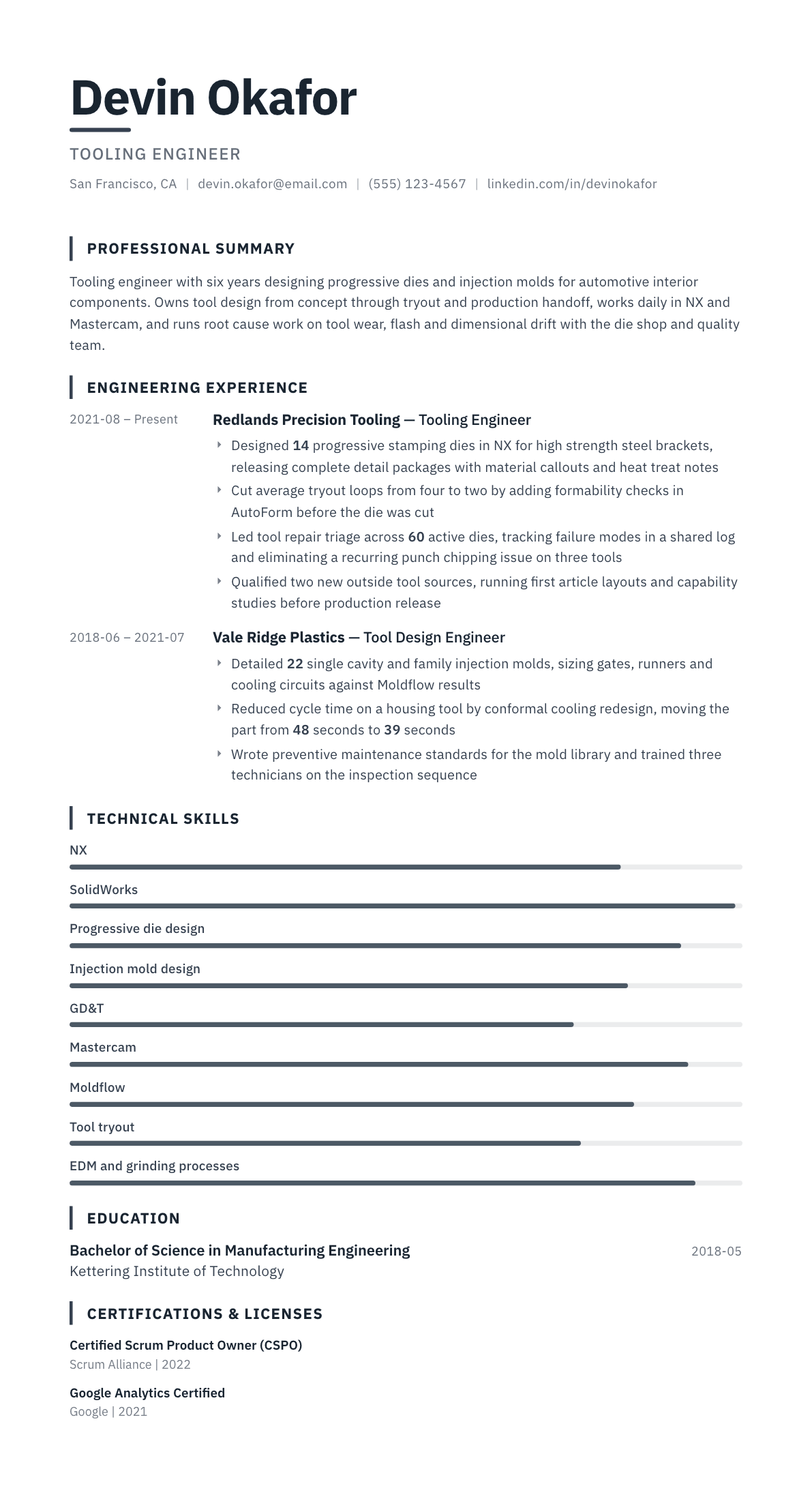
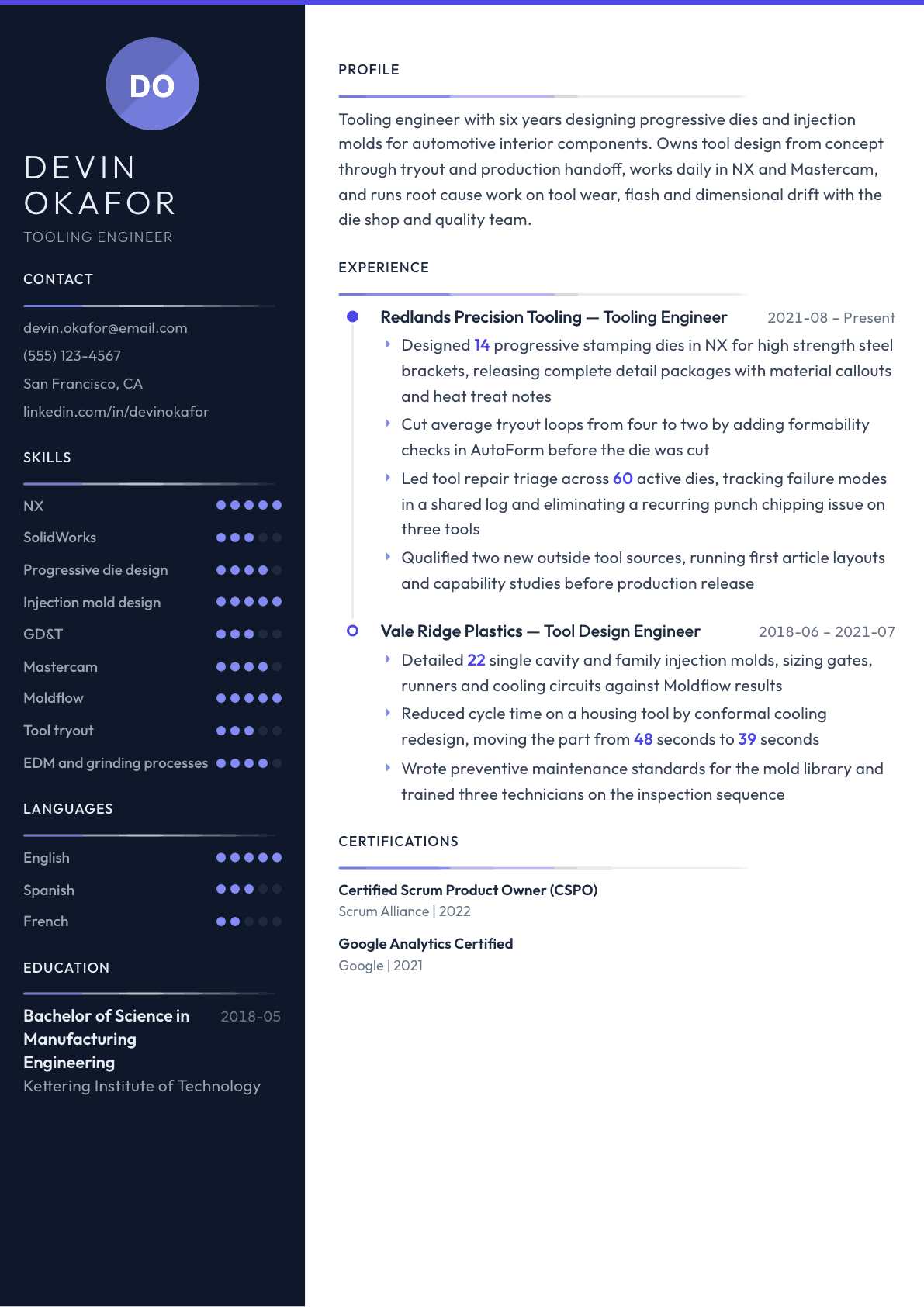
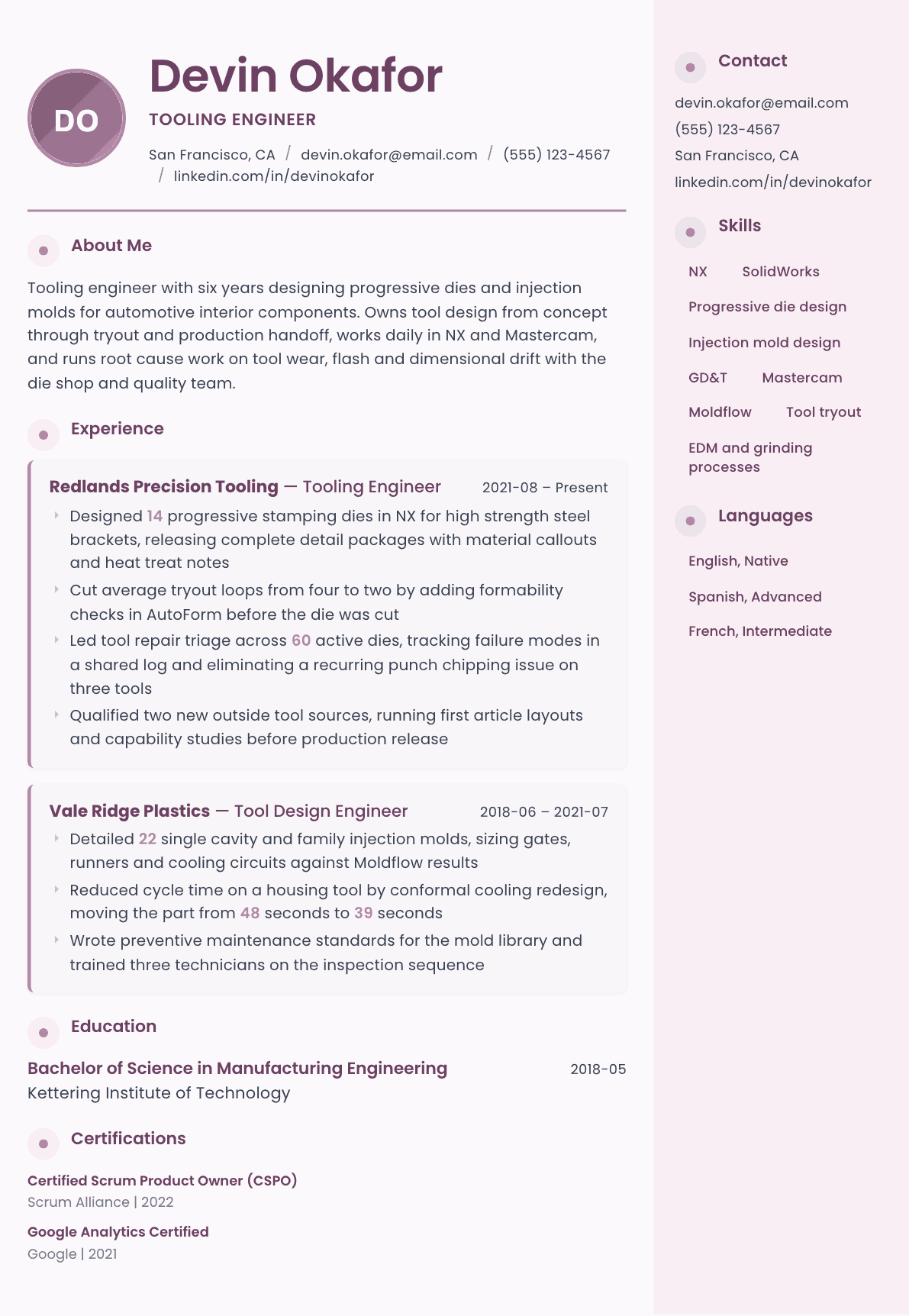
Example Tooling Engineer summary
Tooling engineer with six years of die and mold design for automotive and appliance parts. Releases full tool packages in NX, sizes cooling and ejection systems against simulation results, and runs tryout at the press with the die makers. Reduced repeat repairs on a 60 tool library by tracking failure modes and correcting three chronic designs. Looking for a plant role that owns tooling from quote through production.
Skills to list on a Tooling Engineer resume
- Progressive die design
- Injection mold design
- NX
- SolidWorks
- CATIA
- GD&T
- Tool steel selection
- Moldflow
- AutoForm
- Mastercam
- Wire EDM
- Tool tryout and debug
- First article inspection
- DFM reviews
- Preventive tool maintenance
What actually gets this resume read
- Name every tool type you have released: progressive dies, transfer dies, injection molds, fixtures, gauges or check fixtures.
- State the CAD system and version you design in, because tool shops filter hard on NX, CATIA and SolidWorks.
- Give tryout numbers: how many loops a tool needed, and what you changed to remove one of them.
- Show the material side of the job, from tool steel grades and hardness to coatings such as nitride or PVD.
- Include GD&T fluency and the inspection method you use, since tool acceptance is decided on a layout report.
- Add one bullet on cost or lead time to a tool build, because tooling budgets are the reason the role exists.
How to write a tooling engineer resume
A tooling engineer resume is judged by a tool room manager who has a die on the bench, a press waiting, and a build schedule that is already tight. He is not reading for polish. He is reading for whether you have released a complete tool package, stood at the press through tryout, and known what to change when the first hits came out with flash, thinning or a burr on the wrong side.
That means the resume has to be specific about tool types. Progressive dies, transfer dies, draw dies, single cavity and family injection molds, welding fixtures, check fixtures and assembly nests are all called tooling, and the shops that build them hire from different pools. A resume that says only tool design engineer forces the reader to guess, and guessing usually ends with the file going back in the pile.
This guide covers the section order a tooling group expects, how to write tryout and repair bullets that carry evidence, which CAD and simulation names belong in your skills block, and the questions tooling engineers ask most when they sit down to rewrite this document.
Format: reverse chronological, one page early, two pages once you have a tool list
Keep it plain and single column. Tool shops and automotive suppliers run everything through an applicant tracking system before a human sees it, and a two column layout with icons scrambles the date column. Put your city and state, your phone and your email in the header, and add a line naming the CAD system you design in, because that is the single hardest filter in this field.
Once you have released more than a handful of tools, a second page is normal and expected. Use it for a tool list rather than for adjectives: tool type, part family, station count or cavitation, press tonnage and the material you formed. A reader scanning that list learns more in ten seconds than any summary paragraph can carry.
- Header: name, city and state, phone, email, and your primary CAD platform.
- Sections in this order: summary, technical skills, experience, tool list, education, certifications.
- New graduates move education up and add a co-op or capstone project with the tool they helped detail.
Summary: tool types, industry, and where you sit between design and the press
Three or four lines. Name the tool types you have released, the industry that bought them, the CAD system, and whether you own the design only or carry it through tryout and production handoff. Those last two are different jobs and the posting almost always picks one.
A tooling engineer who has stood at tryout should say so in the first two lines, because a design only background is the most common gap in this candidate pool. If you have run the die at the press with the die makers, that sentence is worth more than any list of software.
Experience: the tool, the problem, and what came off the press afterward
Open each job with a scope line before the bullets: the shop, what it builds, the press sizes or molding machine range, and how many active tools the group supports. A reader who knows you maintained a library of sixty dies reads every following bullet differently than one who assumes you detailed three tools a year.
Then write bullets around tool events. A die that needed four tryout loops and went to two is a bullet. A punch that chipped on three tools until the clearance and the shear angle changed is a bullet. A cooling circuit redesign that took a cycle from forty eight seconds to thirty nine is a bullet. The mechanism belongs in the sentence, not just the result, because your reader wants to know whether you understood the failure or just replaced the part.
Leave out the lines that describe the job itself. Created tool designs and supported manufacturing are true of every applicant and eat the space a real tool story needs.
Skills: CAD, simulation, materials, and the shop processes you specify
Split the block so a screener can scan it. Put CAD first, since NX, CATIA, SolidWorks and Creo are named directly in the posting. Then simulation: AutoForm or similar formability tools for stamping, Moldflow for plastics. Then CAM if you program, with Mastercam or the equivalent. Then the shop side: wire EDM, sinker EDM, jig grinding, hard milling and heat treat.
The materials line is the one most candidates skip and the one that separates a designer from a tooling engineer. Name the tool steel grades you specify, the hardness you call out, and the coatings you have used such as nitride or physical vapor deposition. Add your GD&T fluency and the inspection route, because a tool is accepted on a layout report and a capability study, not on a rendering.
Numbers a tooling manager actually checks
Four numbers carry this resume. Tryout loop count, because loops are the schedule. Repair frequency or downtime on the tools you own, because that is the plant metric. Tool build cost or lead time against quote, because tooling budgets are the reason the department exists. And dimensional capability at first article, because that is when the tool becomes production.
Give the before and the after where you have them, and name the change that moved the number. A figure with no mechanism behind it reads as a claim; a figure with the design change attached reads as engineering.
Tooling Engineer resume summary examples
New graduate
Manufacturing engineering graduate with a co-op year in a progressive die shop, detailing strip layouts and die sets in NX under a senior designer. Comfortable with GD&T, tool steel selection basics and wire EDM print preparation. Seeking a junior tool design role with tryout floor time.
Six years in
Tooling engineer with six years releasing progressive dies and injection molds for automotive interior parts. Designs in NX, checks formability in AutoForm before the die is cut, and runs tryout at the press. Cut average tryout loops on new dies from four to two across a full program.
Tooling lead
Tooling lead with twelve years covering die and mold design, outside source qualification and a library of more than eighty active tools. Owns tool quoting, build schedules and repair triage, mentors three designers, and has closed chronic failures on high volume stamping tools through clearance and coating changes.
Work experience bullets: before and after
Before: Designed dies for stamping operations.
After: Designed fourteen progressive stamping dies in NX for high strength steel brackets, releasing full detail packages with material callouts, clearances and heat treat notes.
Tool count, CAD system, material and the contents of the release package tell a shop exactly what you can hand them.
Before: Worked on tool tryout and made adjustments.
After: Ran tryout on nine new dies with the die makers, adding formability checks in AutoForm before cutting so average loops dropped from four to two.
The bullet now names the tool, the software, the change and the loop count that the build schedule depends on.
Before: Fixed problems with tools that were breaking.
After: Traced a recurring punch chipping failure across three transfer dies to insufficient clearance on a thick gauge station, revised the detail print and specified a nitride coating that ended the repeat repairs.
A repair bullet is only convincing when the root cause and the design change are both in the sentence.
Before: Designed injection molds for plastic parts.
After: Detailed twenty two single cavity and family injection molds, sizing gates, runners and conformal cooling circuits against Moldflow results and taking one housing tool from a 48 second cycle to 39 seconds.
Cavitation, the simulation tool and a cycle time number turn a generic line into measurable mold engineering.
Before: Worked with outside tool suppliers.
After: Qualified two new outside tool sources, auditing their grinding and EDM capability, then running first article layouts and capability studies on the first three tools before production release.
Naming the audit, the layout and the capability study shows you own supplier tooling rather than just placing orders.
Hard skills
- Progressive and transfer die design
- Injection mold design
- NX
- SolidWorks
- CATIA
- GD&T to ASME Y14.5
- Tool steel selection and heat treat specification
- Moldflow
- AutoForm
- Mastercam
- Wire and sinker EDM
- Tool tryout and debug
- First article inspection
- Design for manufacturability reviews
- Preventive tool maintenance planning
Soft skills
- Working alongside die makers on the floor
- Root cause discipline
- Schedule negotiation with build shops
- Clear print communication
- Cost awareness on tool quotes
- Mentoring junior detailers
Certifications worth listing
- Certified Manufacturing Engineer (CMfgE) (SME)
- Certified Manufacturing Technologist (CMfgT) (SME)
- Geometric Dimensioning and Tolerancing Professional (GDTP) (ASME)
- Certified SolidWorks Professional (CSWP) (Dassault Systemes)
- Fundamentals of Engineering (FE) (NCEES)
Mistakes that cost tooling engineer candidates the interview
- Writing tool design engineer without ever naming the tool types, which leaves a die shop and a mold shop equally unsure whether to call you.
- Leaving the CAD platform out of the header and the skills block, when NX and CATIA are the hardest keyword filters in this field.
- Listing software instead of tools, so the resume proves you own a license but not that you released a package that got cut.
- Hiding tryout experience at the bottom, when floor time is the rarest thing in the candidate pool and the first thing a manager asks about.
- Skipping materials entirely: no tool steel grades, no hardness, no coatings, which reads as a draftsman rather than a tooling engineer.
- Giving results with no mechanism, so a cycle time or loop count improvement looks borrowed from the team rather than earned.
- Using a decorative two column template that scrambles dates in the parsing step before a human ever sees the tool list.
Tooling Engineer resume questions
Should a tooling engineer resume include a separate tool list?
Yes, once you have released more than a few tools. A compact table of tool type, part family, station count or cavitation, press tonnage and material gives a hiring manager the scope of your work faster than any block of prose, and it is the page most shops read first.
How do I show tryout experience if I only did design work?
Be honest and specific about the handoff instead. Describe the buyoff reviews you attended, the tryout reports you read and acted on, and the design changes you made in response. A reader will accept a design only background stated plainly, but not one dressed up as floor experience.
Do I need to list every CAD system I have touched?
List them, but rank them. Put the platform you design production tooling in first with the years attached, then a second tier for systems you can read and edit. Tool shops standardize on one system and want to know how long your ramp up will take.
How much detail should I give about a tool failure I solved?
One sentence with three parts: the failure mode, the root cause you proved, and the design or process change that closed it. That is enough to show engineering judgment without turning a bullet into a report, and it gives the interviewer an obvious question to open with.
Is a professional engineer license worth listing for tooling work?
It is uncommon in tool design and rarely required, but the Fundamentals of Engineering result is worth a line if you have it. Certifications from SME and a GD&T credential carry more weight with a tooling manager, since both map directly to daily work.
Related resume examples
- Manufacturing Engineer Resume example
- Mechanical Engineer Resume example
- Design Engineer Resume example
- Supplier Quality Engineer Resume example
- Mechanical Design Engineer Resume example
- Engineering Technician Resume example