Manufacturing Engineer Resume Examples: read this first
Produce a Manufacturing Engineer Resume That Delivers Results
By Mustafa Tarabya, founder of CVBooster · Published · Updated
Build a manufacturing engineer resume highlighting CNC programming, process development, and production efficiency with quantifiable achievements.
Sample resumes for a manufacturing engineer
The same manufacturing engineer content laid out in three CVBooster templates, so you can see what the finished document looks like before you write a word.
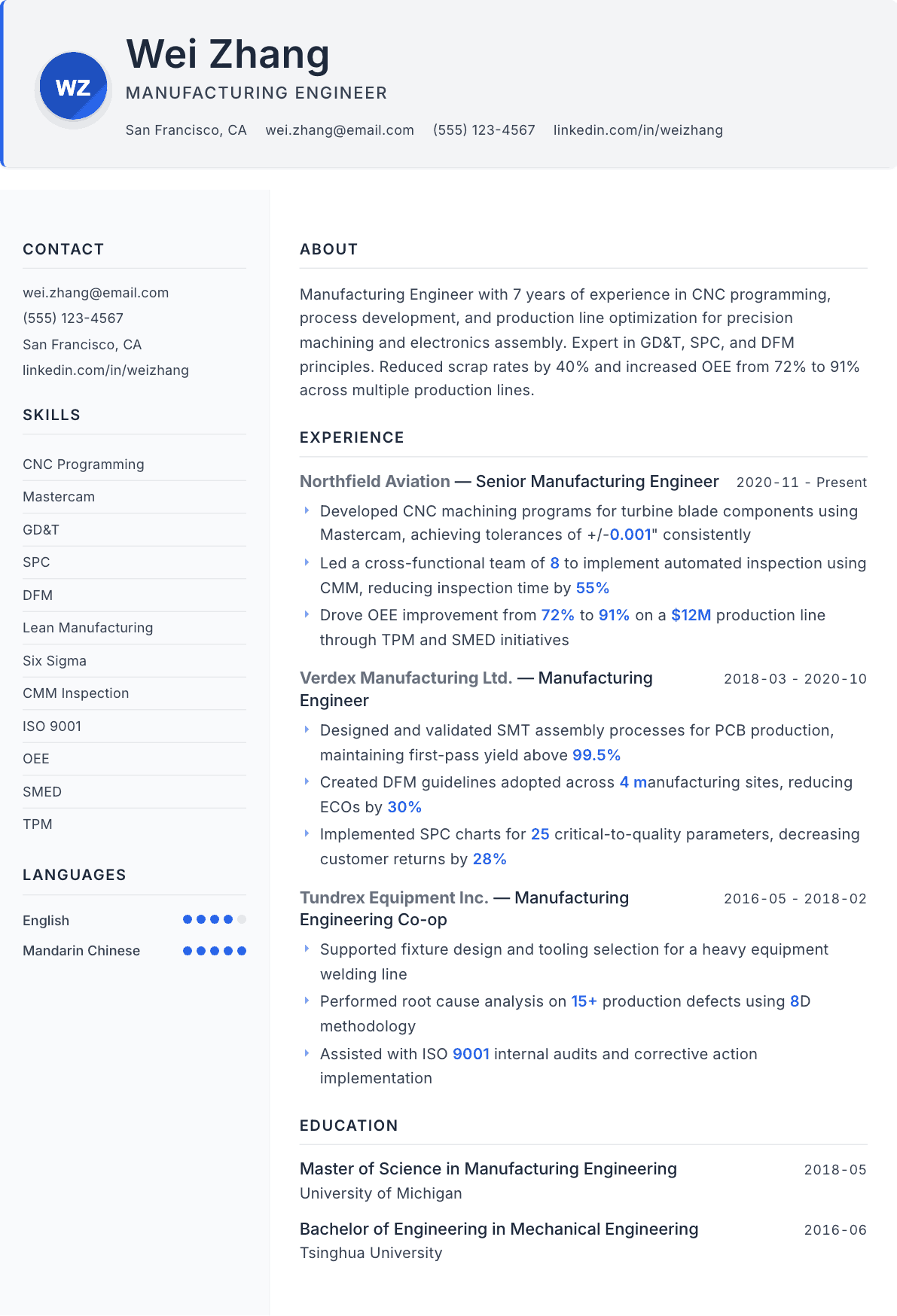
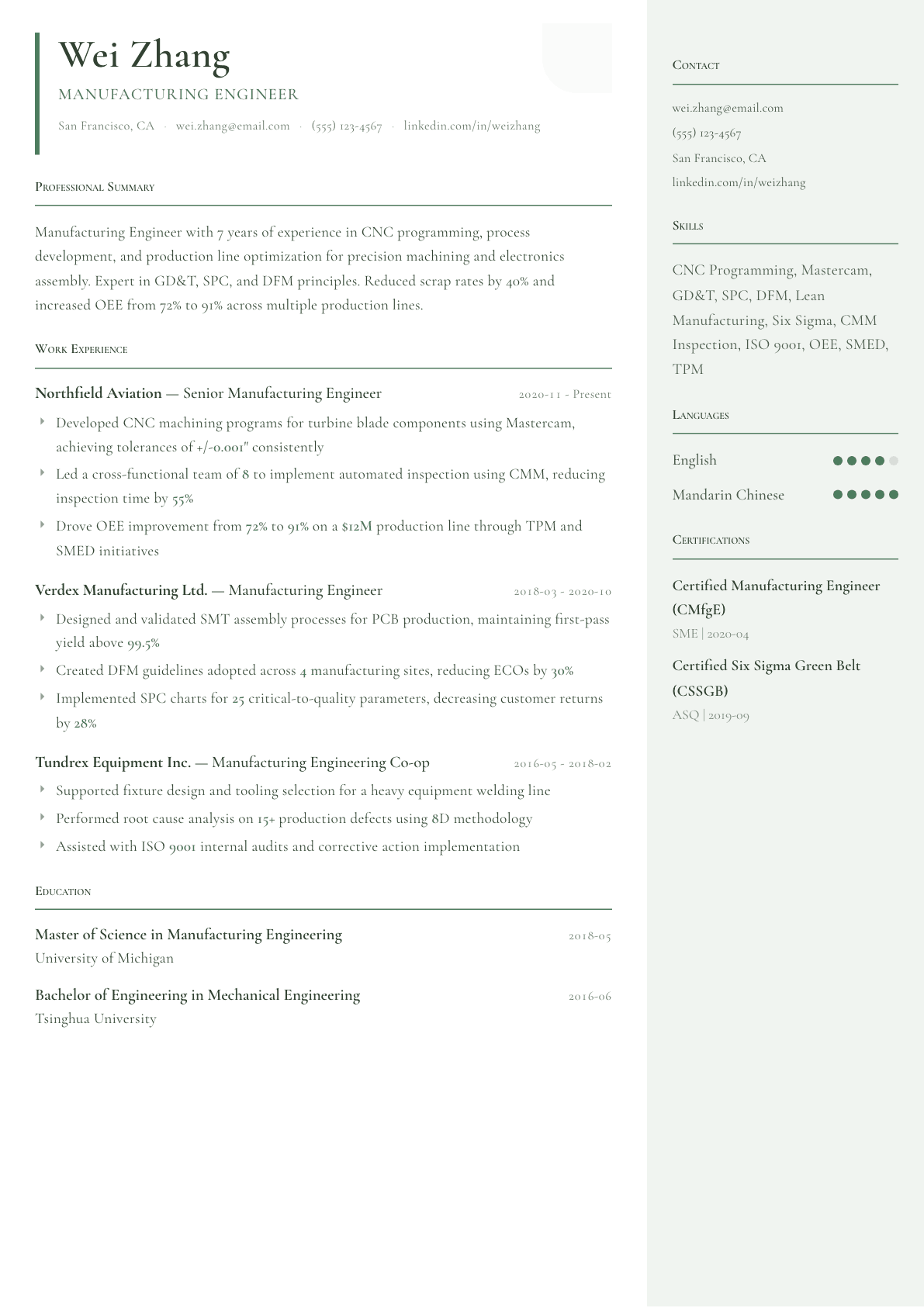
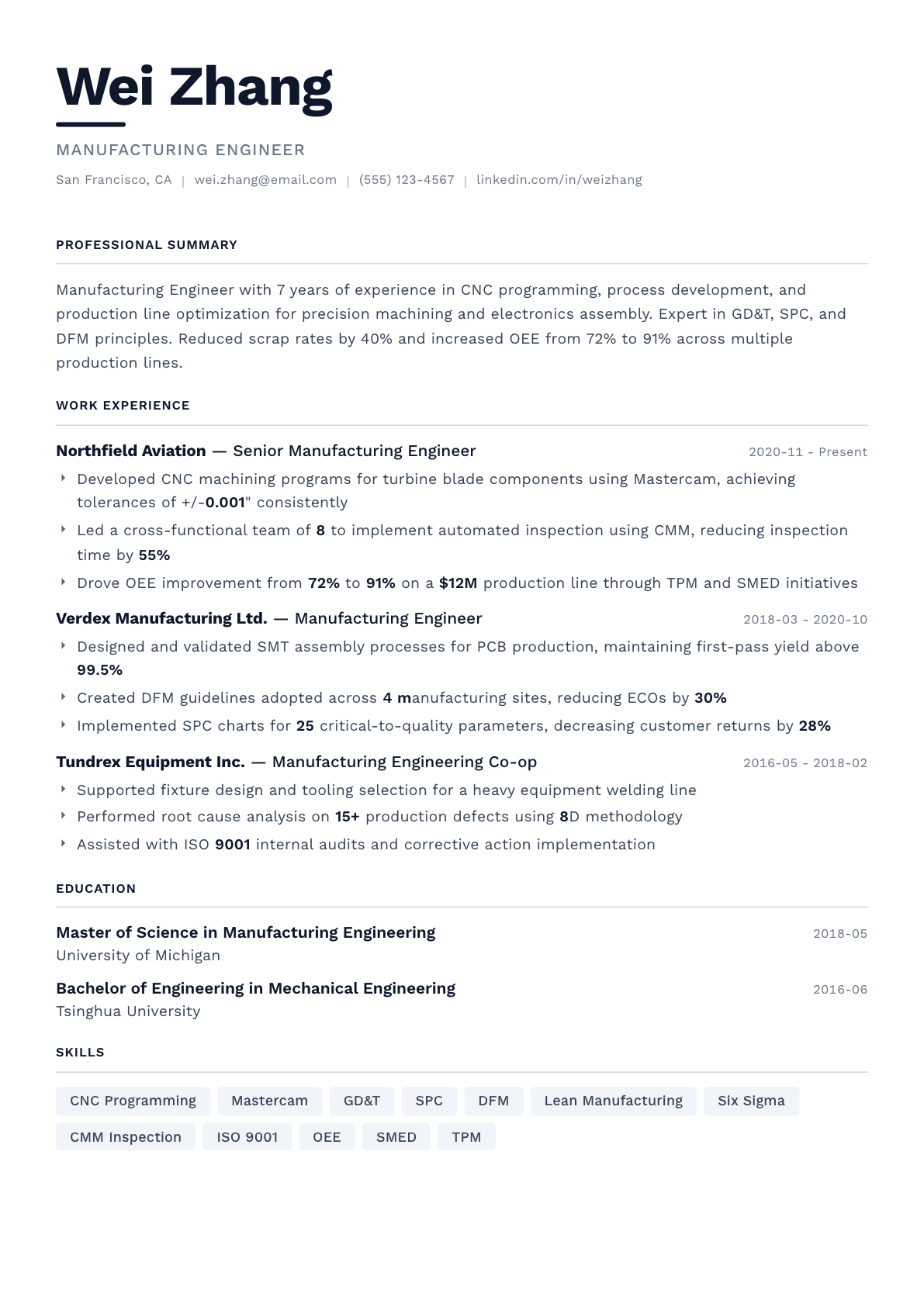
Example Manufacturing Engineer summary
Certified Manufacturing Engineer with 7 years of experience in CNC programming, process development, and production optimization. Expert in GD&T, SPC, and lean methodologies. Improved OEE from 72% to 91% and reduced scrap rates by 40% across precision machining and electronics assembly lines.
Skills to list on a Manufacturing Engineer resume
- CNC Programming
- Mastercam
- SolidWorks
- GD&T
- SPC
- FMEA
- DFM / DFA
- Lean Manufacturing
- Six Sigma
- OEE Improvement
- SMED
- TPM
- ISO 9001
- CMM / Metrology
- Root Cause Analysis
What actually gets this resume read
- List CNC and CAM software: Mastercam, NX CAM, PowerMill, CATIA Manufacturing.
- Quantify production metrics: OEE, yield, scrap rate, cycle time, throughput, PPM defect rates.
- Include quality tools and methodologies: SPC, FMEA, 8D, PPAP, APQP, MSA.
- Mention manufacturing standards: ISO 9001, IATF 16949, AS9100.
- Describe process types: CNC machining, injection molding, SMT assembly, welding, stamping.
- Reference DFM/DFA experience and cross-functional collaboration with design and quality teams.
How to write a manufacturing engineer resume
A manufacturing engineer resume is judged by whether the reader believes you can take a drawing and turn it into a repeatable process that holds tolerance at rate. The engineering manager reviewing your file has a line that is not making yield, a launch that is late, or a scrap number that will not come down, and is looking for someone who has fixed that exact class of problem before.
That makes specificity non negotiable. The parts, the materials, the processes, the tolerances, the volumes and the quality system are the resume. Manufacturing engineering in a machining cell for aerospace hardware and manufacturing engineering on a surface mount electronics line share a job title and almost nothing else.
This guide covers how to structure the document, how to write process bullets that read like engineering rather than coordination, summaries at three stages of a manufacturing career, and answers to the questions that come up when moving between industries or from design into production.
Format: process focused, one column, launches called out
Keep it reverse chronological and plain. Manufacturers screen through applicant tracking systems and then print the resume for a panel, so avoid shading, columns and anything that loses information on a black and white printer.
If your career is built around program launches, add a short launch or program block near the top listing each product, the volume, and your role in the build phases. Automotive, medical device and aerospace hiring managers read that block before anything else because it tells them whether you have taken a part from prototype through validation to full rate.
- Header: name, city and state, phone, email, and any quality or manufacturing credential.
- Order: summary, core processes and software, experience, launches or key programs, education, certifications.
- Name the manufacturing environment for each job: high mix machining, progressive die stamping, injection molding, surface mount assembly, welded fabrication.
Summary: process family, materials, volume, quality system
The first sentence should let a reader place you in a plant. Precision machining of nickel alloys to tight positional tolerance is a different engineer from high volume plastic injection molding, and both are different from electronics assembly. Say which processes you own and in what materials.
Add the quality framework you have worked inside, since it drives the paperwork half of the job. Aerospace, automotive and medical device suppliers each run different standards, and an engineer who has already lived through production part approval or design validation paperwork is worth more to them than one who has not.
Experience: the process, the tolerance, the yield
Start each role with the plant context: what is built, the annual or daily volume, the number of lines or cells you supported, and the customers if they are recognizable. A reader wants to know if you supported one cell or an entire value stream.
Write process development bullets end to end. What you selected or designed, how you proved it, and what it produced. That means naming the machine and control, the cutting or forming parameters, the fixture or tooling you specified, the gage or measurement method, and the capability result. A process capability index, a first pass yield, a scrap rate or a cycle time is the payoff line.
Problem solving belongs in its own bullets and should name the discipline used: an eight discipline report, a fishbone and five whys, a designed experiment, a process failure mode and effects analysis update. Say what the root cause turned out to be. A root cause stated in one clause is more convincing than any adjective.
Do not forget the documentation the job actually produces: routings and work instructions, control plans, tooling and gage specifications, engineering change requests, and validation protocols. These are the deliverables a manufacturing engineer is measured on, and leaving them off makes the resume read like an operator rather than an engineer.
Skills: processes, metrology, software, quality tools
Split processes from software. Processes should list what you have actually developed: computer numerical control milling and turning, grinding, electrical discharge machining, injection molding, stamping, casting, welding, brazing, surface mount reflow and wave soldering, additive manufacturing, and assembly automation.
List metrology explicitly, because measurement capability separates engineers. Coordinate measuring machines and their software, optical comparators, vision systems, surface finish and roundness measurement, gage repeatability and reproducibility studies, and geometric dimensioning and tolerancing to the ASME Y14.5 standard.
Software belongs in a separate line: computer aided design and cam packages, simulation for molding or forming if you use it, statistical tools, and the enterprise resource planning or manufacturing execution system where routings and shop orders live.
Education, certification and the industry keywords
A degree in manufacturing, mechanical or industrial engineering is standard, and it moves below experience after your first job. Technologist and technician backgrounds are common and welcome in this field, so state the degree plainly and let the process work carry the resume.
Match the vocabulary of the target industry once in the summary and once in a bullet. Automotive suppliers write about advanced product quality planning, production part approval, control plans and process failure mode analysis. Medical device writes about installation, operational and performance qualification. Aerospace writes about first article inspection and special process approval. Using the wrong dialect is the clearest signal that a resume was not tailored.
Manufacturing Engineer resume summary examples
Recent graduate
Manufacturing engineering graduate with a co-op on a heavy equipment welding line and a senior project on fixture design. Trained in geometric dimensioning and tolerancing, computer numerical control programming and statistical process control. Supported eight-discipline investigations that closed 15 recurring weld defects during a nine-month rotation.
Five years in production
Manufacturing engineer for precision machined aluminum and stainless components at volumes near 40 thousand parts per year. Owns process development, fixture design and capability studies for 12 machining cells. Raised first pass yield from 91% to 99% on the highest volume family and cut scrap cost by a third.
Lead or program engineer
Senior manufacturing engineer with 12 years across surface mount electronics and mechanical assembly, leading new product introduction from prototype build to full rate. Launched 9 products under automotive quality planning, ran the capital justification for two automated lines, and mentors four process engineers.
Work experience bullets: before and after
Before: Improved manufacturing processes to reduce scrap.
After: Traced a 6% scrap rate on a turned shaft to inconsistent bar stock hardness, added an incoming hardness check and a compensating feed program, and brought scrap under 1% within two months.
A stated root cause and the specific countermeasures make the improvement believable instead of asserted.
Before: Wrote CNC programs for production parts.
After: Programmed five-axis milling for a titanium bracket family in Mastercam, selected tooling and cutting parameters, and held true position within 0.02 mm across a validation run of 60 parts.
The material, the axis count, the tolerance and the validation size prove capability rather than familiarity.
Before: Responsible for new product introduction activities.
After: Ran manufacturing readiness for two product launches: built the control plan and process failure mode analysis, specified 14 fixtures and gages, and cleared production part approval with the customer on the first submission.
Naming the launch deliverables and a clean first submission shows the reader you have done the paperwork half of a launch.
Before: Worked on reducing machine downtime.
After: Applied single minute exchange of die analysis to a stamping press changeover, moved die preheating and staging off-line, and cut average changeover from 90 to 34 minutes across three shifts.
The method and the before and after minutes let a plant manager convert the result into available capacity.
Before: Assisted with quality inspections and audits.
After: Built the coordinate measuring machine programs and first article inspection reports for 30 new part numbers, and closed an internal audit finding on gage repeatability with a revised measurement procedure.
Metrology deliverables and a closed finding are engineering work; assisting with inspections is not.
Hard skills
- CNC programming and machining
- Fixture and tooling design
- Geometric dimensioning and tolerancing
- Process failure mode and effects analysis
- Statistical process control and capability studies
- Gage repeatability and reproducibility
- Coordinate measuring machine programming
- Design for manufacturing and assembly
- Injection molding process development
- Surface mount assembly and reflow profiling
- Single minute exchange of die
- Root cause analysis and eight-discipline reporting
- Work instruction and control plan authoring
- Enterprise resource planning routings
Soft skills
- Working with machinists and operators
- Supplier communication
- Calm during line-down events
- Technical writing for the floor
- Cross-functional launch coordination
- Training and qualification of operators
Certifications worth listing
- Certified Manufacturing Engineer (CMfgE) (SME)
- Certified Manufacturing Technologist (CMfgT) (SME)
- Certified Quality Engineer (CQE) (American Society for Quality)
- Certified Six Sigma Green Belt (CSSGB) (American Society for Quality)
- Geometric Dimensioning and Tolerancing Professional (GDTP) (ASME)
- Certified in Planning and Inventory Management (CPIM) (Association for Supply Chain Management)
Mistakes that cost manufacturing engineer candidates the interview
- Describing the plant instead of your work. A reader wants what you changed, not a tour of the facility.
- Omitting tolerances, materials and volumes, which are the three facts that let an interviewer judge whether your experience transfers to their parts.
- Confusing supporting a process with developing one. Say whether you sustained an existing line or took a new process from concept through validation.
- Leaving metrology off the page. Many teams are short of engineers who can program a coordinate measuring machine and read a gage study.
- Using one industry quality vocabulary for every application. Automotive, medical device and aerospace each expect their own terms.
- Skipping the cost side. Tooling spend, capital justification and cost per part are how manufacturing engineering results get approved, and showing you think that way is a differentiator.
Manufacturing Engineer resume questions
What is the difference between a manufacturing engineer and a process engineer resume?
The titles overlap heavily and many employers use them interchangeably. Match whichever term the posting uses in your summary and job titles where it is accurate, and let the bullets show the same underlying work of process development, capability and yield improvement.
How do I show new product introduction experience?
Give each launch its own compact entry with the product, the volume, your phase involvement and the deliverables you owned. Hiring managers want to know if you have been through prototype builds, tooling trials, validation runs and the customer approval submission, not just steady state production.
Do I need a Six Sigma belt as a manufacturing engineer?
It is common but rarely a requirement. What matters more is evidence that you can run a designed experiment or a structured problem solve and get a measurable result. If you have a belt, list the issuing body and describe the project it was earned on.
How do I move from design engineering into manufacturing?
Lead with anything you did that touched producibility: design for manufacturing reviews, tolerance stack analysis, supplier drawing reviews, prototype builds, and time spent on the floor during trials. Then use the manufacturing dialect of the target industry so the reader sees you already speak it.
Should I list the machines and controls I have worked with?
Yes, and be specific about machine types and control systems rather than writing a generic line about equipment. A shop hiring for five-axis work wants to see that you have programmed and proved out five-axis parts, and the control brand tells them how short your learning curve will be.
Related resume examples
- Industrial Engineer Resume example
- Quality Engineer Resume example
- Mechanical Engineer Resume example
- Process Engineer Resume example
- Plant Engineer Resume example
- Supplier Quality Engineer Resume example