Travel Agent Resume Examples: free ATS score and gap list
Craft a Travel Agent Resume Around Bookings and Repeat Clients
By Mustafa Tarabya, founder of CVBooster · Published · Updated
Travel agent resume example with booking volume, supplier detail and GDS skills, plus the keywords agencies search for and a writing guide.
Sample resumes for a travel agent
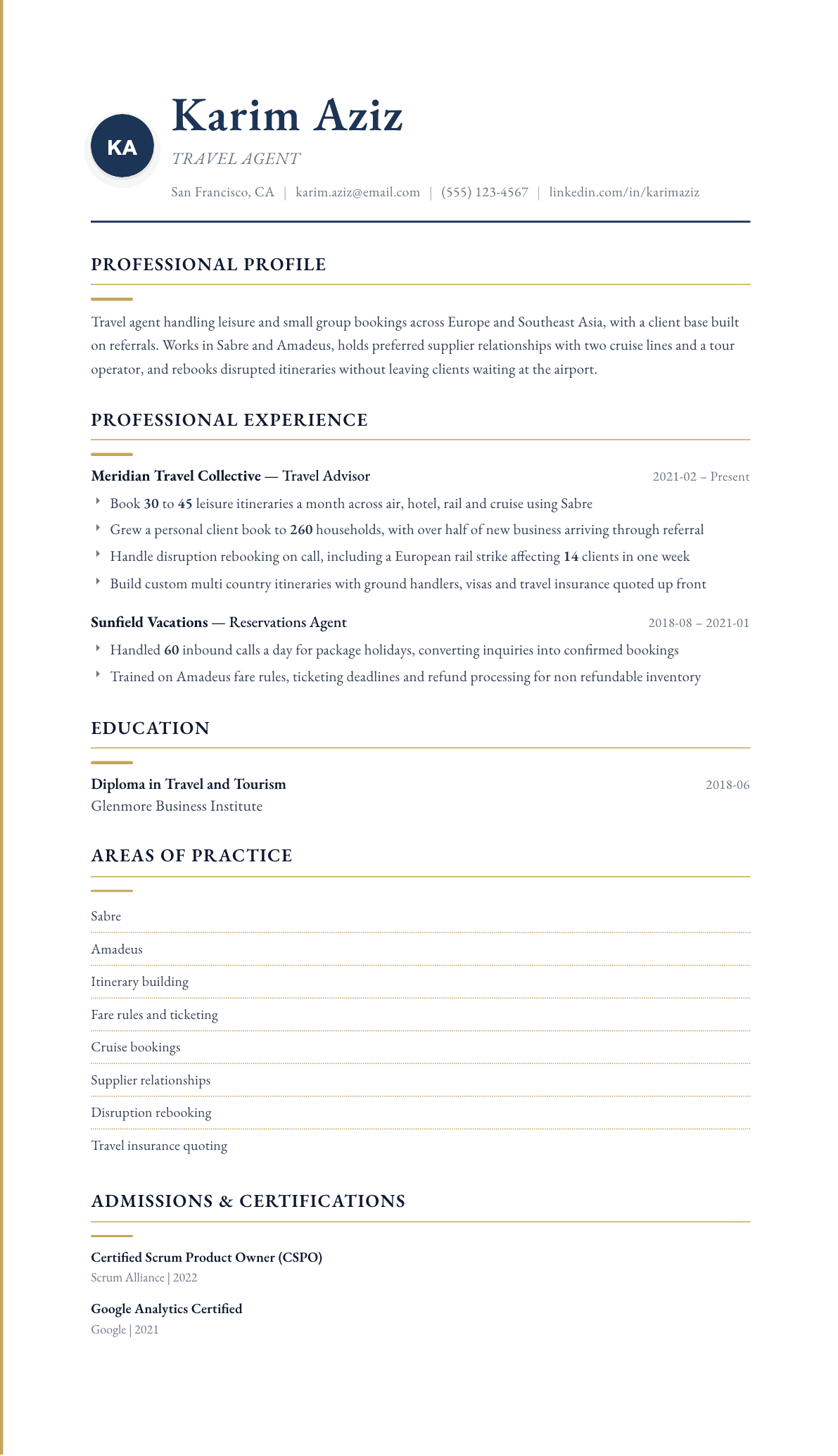
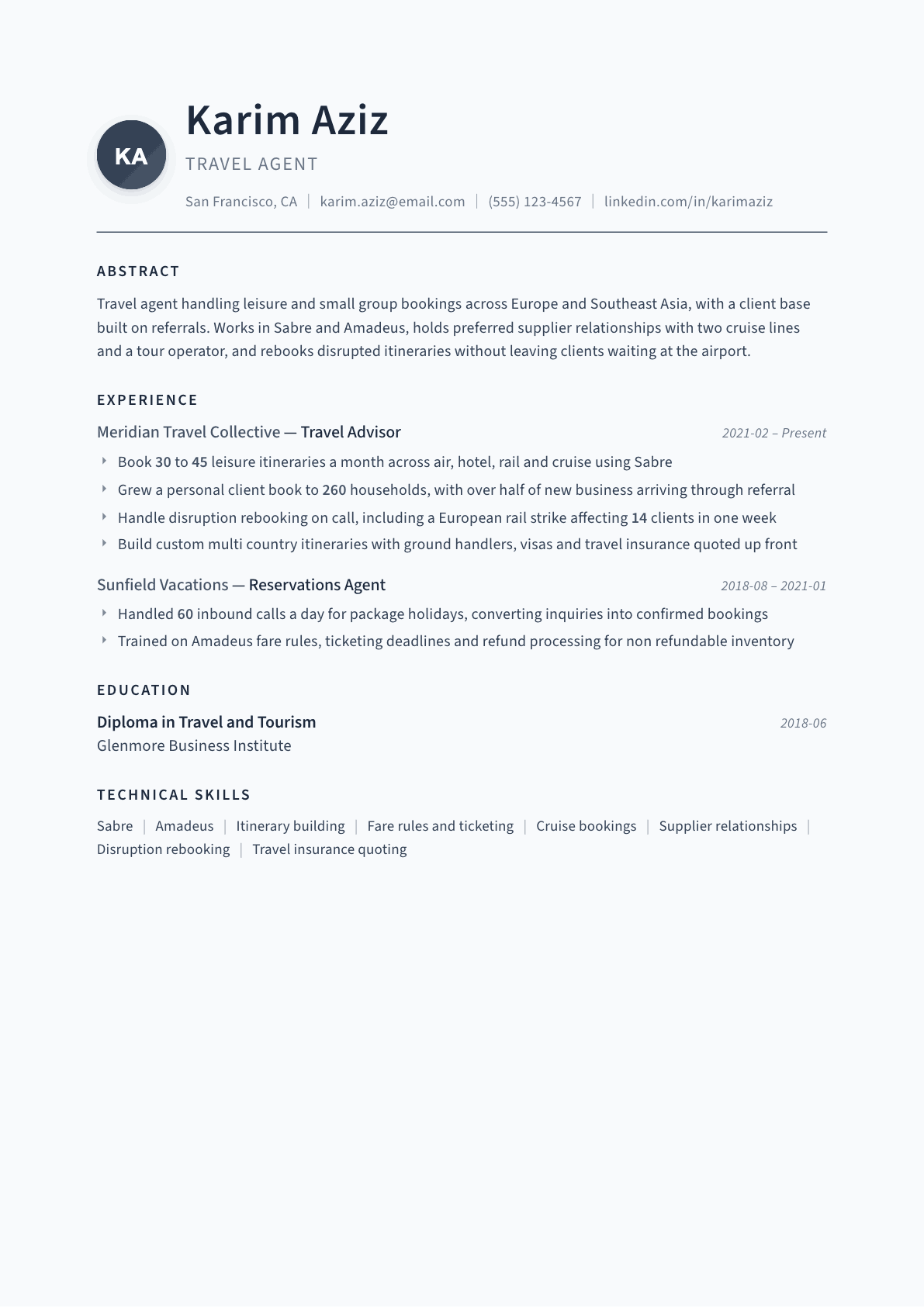
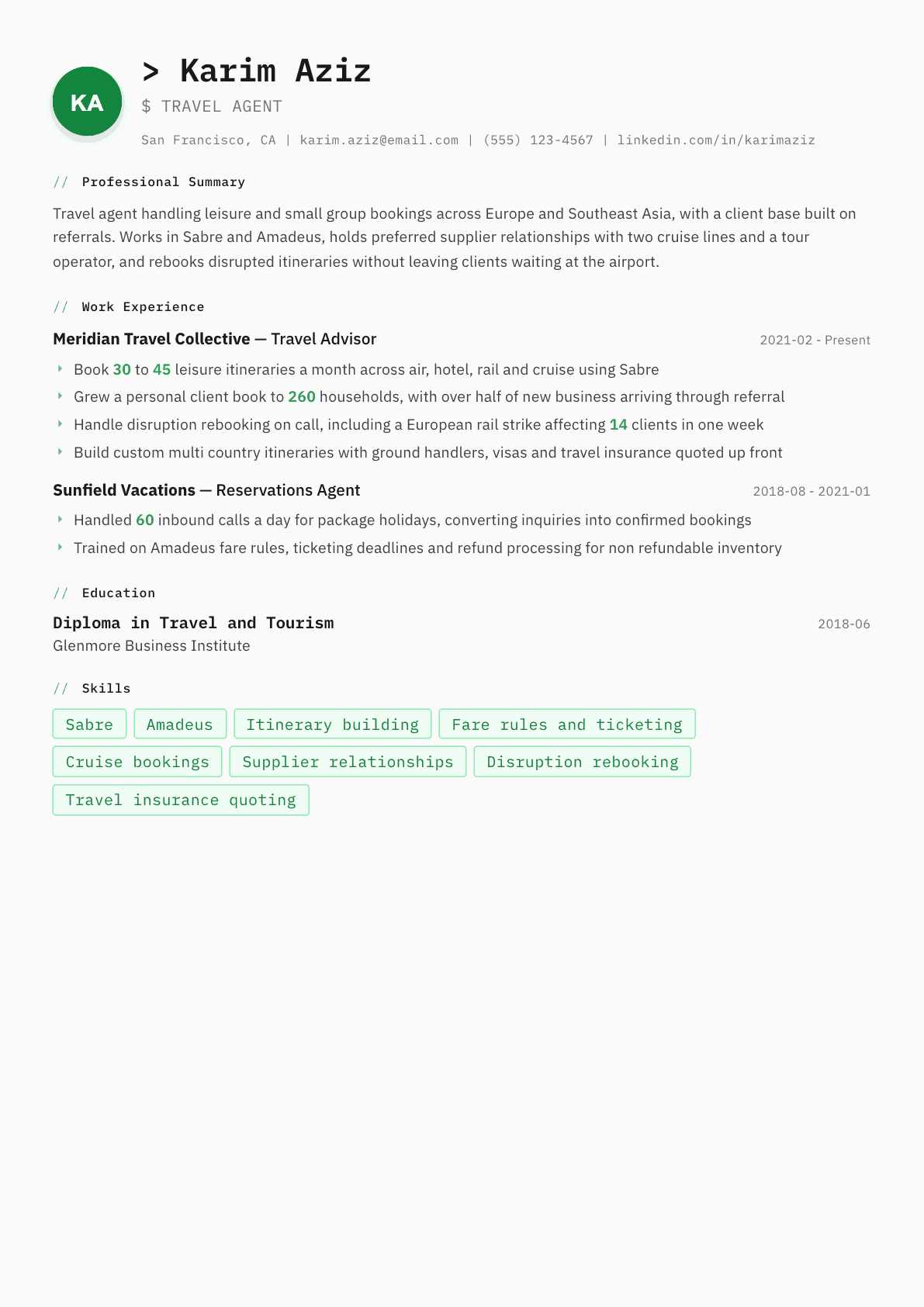
The same travel agent content laid out in three CVBooster templates, so you can see what the finished document looks like before you write a word.
Example Travel Agent summary
Travel agent with six years booking leisure and small group travel across Europe and Southeast Asia, working in Sabre and Amadeus. Runs a client book of more than 250 households built mostly on referral, holds preferred supplier terms with cruise and tour partners, and handles disruption rebooking on call. Looking to join an agency building a custom itinerary practice.
Skills to list on a Travel Agent resume
- Sabre
- Amadeus
- Travelport
- Itinerary building
- Air fare rules and ticketing
- Cruise and rail bookings
- Group travel coordination
- Supplier and consortium relations
- Disruption rebooking
- Visa and entry requirements
- Travel insurance quoting
- CRM and client records
- Commission tracking
- Destination expertise
What actually gets this resume read
- Lead with booking volume and destination specialties, because an agency owner hires for a gap in the map.
- Name every reservation system you have worked in, such as Sabre, Amadeus or Travelport, with your level in each.
- Show the referral and repeat side of your book, since that is the asset an agency is actually buying.
- Give one disruption story with numbers: the event, the clients affected and how fast they were rebooked.
- List supplier and consortium relationships by category, for example cruise, rail passes, villas or tour operators.
- Include destination expertise you have visited yourself, because clients and managers both ask that question.
How to write a travel agent resume
A travel agent resume is judged on three assets: the systems you can work in, the destinations you can sell without research, and the client book you can influence. Agency owners are buying capacity and a network at the same time, and the resume has to price both.
The technical half is unforgiving. Fare rules, ticketing deadlines, refund and exchange handling, and knowing what a schedule change does to a connection are skills that either exist or do not. Saying booked travel for clients hides them. Naming the system and the work performed inside it exposes them.
This guide covers the sections an agency reads, three summaries from a new advisor through a senior specialist, before and after bullets, and the questions agents ask when they move between corporate, leisure and independent contractor work.
Format: one page early, two once you have a book
Keep it single column and put systems, specialties and credentials in a short block near the top. Agencies screen for a system match first, and a manager who has to read three jobs deep to find out whether you know Sabre will often stop reading.
Once you have a real client base and supplier relationships, two pages is fine, with the second page carrying destination depth, familiarization trips and supplier partnerships. Keep the achievements on the first page regardless.
- Systems block: Sabre, Amadeus, Travelport, plus any agency back office or booking engine.
- Specialties: destinations, cruise, rail, groups, corporate, luxury, adventure, family.
- Credentials and consortium membership, plus any host agency arrangement.
- Destinations visited personally, since clients and managers both ask.
Volume, mix and the client book
Give bookings per month and the mix across air, hotel, rail, cruise and packages. Mix matters more than raw count, because an agent who does forty simple domestic bookings and an agent who does fifteen multi country itineraries are doing different jobs at similar volumes.
Then describe the book. Number of active households or corporate accounts, how much new business arrives by referral, and whether the relationships travel with you. Be careful and honest here, since agency owners will test the claim politely in the first conversation.
The technical section: fares, tickets and disruption
Write about the work that goes wrong. Involuntary schedule changes, a strike, a canceled sailing, an airline downgrade, a visa refused at check in. Explain what you did, how quickly and for how many travelers. Disruption handling is the highest value skill in this trade and it is almost never described on a resume.
Add the quiet technical work: fare construction, ticketing deadlines, exchange and refund rules, name corrections, seat and special service requests, and the difference between a published fare and a negotiated one. Naming these tells a manager you will not need supervision on a complex file.
Suppliers, commission and the commercial layer
List supplier relationships by category rather than dropping brand names alone: cruise lines, tour operators, villa portfolios, rail pass providers, ground handlers, insurance partners. Preferred status and consortium access change what you can offer a client, so say what your relationships unlocked.
Commission and revenue work belongs here too, described without invented figures. How you track commission, how you handle service fees, how you present insurance, and how you build a package with margin rather than assembling components at cost are all commercial signals an owner is looking for.
Skills and the words agencies search for
Agency postings repeat a tight vocabulary: GDS, Sabre, Amadeus, itinerary, ticketing, fare rules, cruise, group travel, supplier relationships, client retention, disruption rebooking, visa requirements. Mirror them where they are true, once in the systems block and once inside a bullet.
Skip the customer service filler. Every applicant is friendly on the phone. Rebooked fourteen clients during a European rail strike inside two days is the same claim with a spine.
Travel Agent resume summary examples
New advisor
Reservations agent moving into advisory work after two years handling package holiday calls, trained on Amadeus fare rules, ticketing deadlines and refund processing. Sells Mediterranean and Caribbean beach product confidently, and is looking for a leisure travel agent role with a mentor and a warm client base.
Five years in
Travel agent booking thirty to forty five leisure itineraries a month across air, hotel, rail and cruise in Sabre. Specializes in Southern Europe and Southeast Asia, holds a client book of more than two hundred households built largely on referral, and handles disruption rebooking on call.
Senior specialist
Senior travel advisor running a luxury and adventure practice with preferred status across two cruise lines and a villa portfolio. Builds multi country itineraries with ground handlers, visas and insurance quoted up front, mentors two junior advisors, and manages the agency response during large scale disruption.
Work experience bullets: before and after
Before: Booked flights and hotels for clients.
After: Booked thirty to forty five leisure itineraries a month across air, hotel, rail and cruise in Sabre, including multi country routings with open jaw ticketing.
Volume, mix and the system together describe a workload an agency can staff against.
Before: Built good relationships with clients.
After: Grew a personal client book to 260 households, with over half of new bookings arriving through referral from existing travelers.
A referral share is the only honest measure of a client relationship, and it is the asset being bought.
Before: Helped clients when their trips were disrupted.
After: Rebooked fourteen clients affected by a European rail strike within two days, including revised hotel nights and rerouted onward flights.
Scale, speed and the knock on components show real disruption handling rather than a phone call.
Before: Worked with travel suppliers.
After: Held preferred terms with two cruise lines and a small group tour operator, using allocation to confirm cabins during peak release weeks.
Explaining what the relationship unlocked turns a list of partners into a commercial advantage.
Before: Knew the destinations well.
After: Sold Portugal, Greece and Vietnam from personal travel, building day by day itineraries with ground handlers rather than packaged departures.
First hand knowledge plus custom build is exactly what separates an advisor from an order taker.
Hard skills
- Sabre
- Amadeus
- Travelport
- Air fare construction and ticketing
- Exchanges, refunds and schedule changes
- Cruise and rail reservations
- Custom itinerary building
- Group travel coordination
- Visa and entry requirements
- Travel insurance quoting
- Supplier and consortium relations
- Commission and service fee tracking
Soft skills
- Consultative questioning
- Expectation setting on budget
- Composure during disruption
- Follow up discipline
- Written itinerary clarity
Certifications worth listing
- Certified Travel Associate (CTA) (The Travel Institute)
- Certified Travel Counselor (CTC) (The Travel Institute)
- Travel Agent Proficiency (TAP) Test (The Travel Institute)
- Accredited Cruise Counsellor (ACC) (Cruise Lines International Association)
Mistakes that cost travel agent candidates the interview
- Writing booked travel for clients without naming a single reservation system or fare rule you can handle.
- Listing destinations you have only read about, which unravels the moment a manager asks a specific question.
- Leaving disruption handling off the page when it is the work clients remember and pay for.
- Describing a client book in vague terms rather than accounts, households and referral share.
- Ignoring the commercial layer, so the resume reads as service delivery with no margin awareness.
- Hiding a host agency or independent contractor arrangement that explains how your book actually operated.
Travel Agent resume questions
Which reservation system should I put first on my resume?
The one the posting names, if you genuinely know it. Otherwise lead with the system you can work unsupervised in and state your level honestly, because a practical test during hiring is common in this field.
Can I put my client book on a travel agent resume?
Describe its size and composition, never client names. Households or corporate accounts, referral share and typical trip type give an owner what she needs while respecting the confidentiality your current agency expects.
Do travel agent certifications actually help?
They help most early, when you need proof of formal training in fares, ticketing and destination knowledge. Later, supplier relationships, destination depth and a demonstrable book of business carry far more weight with a hiring agency.
How do I show destination expertise credibly?
Separate what you have visited from what you sell from training. List countries and regions with the year of travel inside an example if needed, and describe an itinerary you built there rather than naming the place alone.
What if I have only worked in corporate travel?
Say so and lead with the strengths it builds: policy compliance, speed, complex routings, exchanges and duty of care. Then show any leisure work you have done privately, because agencies hire corporate agents into leisure teams regularly.
Related resume examples
- Concierge Resume example
- Front Desk Manager Resume example
- Tour Guide Resume example
- Hotel Front Desk Agent Resume example
- Wedding Planner Resume example
- Host Resume example