Host Resume Examples: what a hiring manager reads first
Host Resume: Hostess Job Description, Responsibilities and Sample
By Mustafa Tarabya, founder of CVBooster · Published · Updated
Host resume examples, a sample with real seating and waitlist numbers, keywords hiring managers scan for, and a section by section guide.
Sample resumes for a host
The same host content laid out in three CVBooster templates, so you can see what the finished document looks like before you write a word.
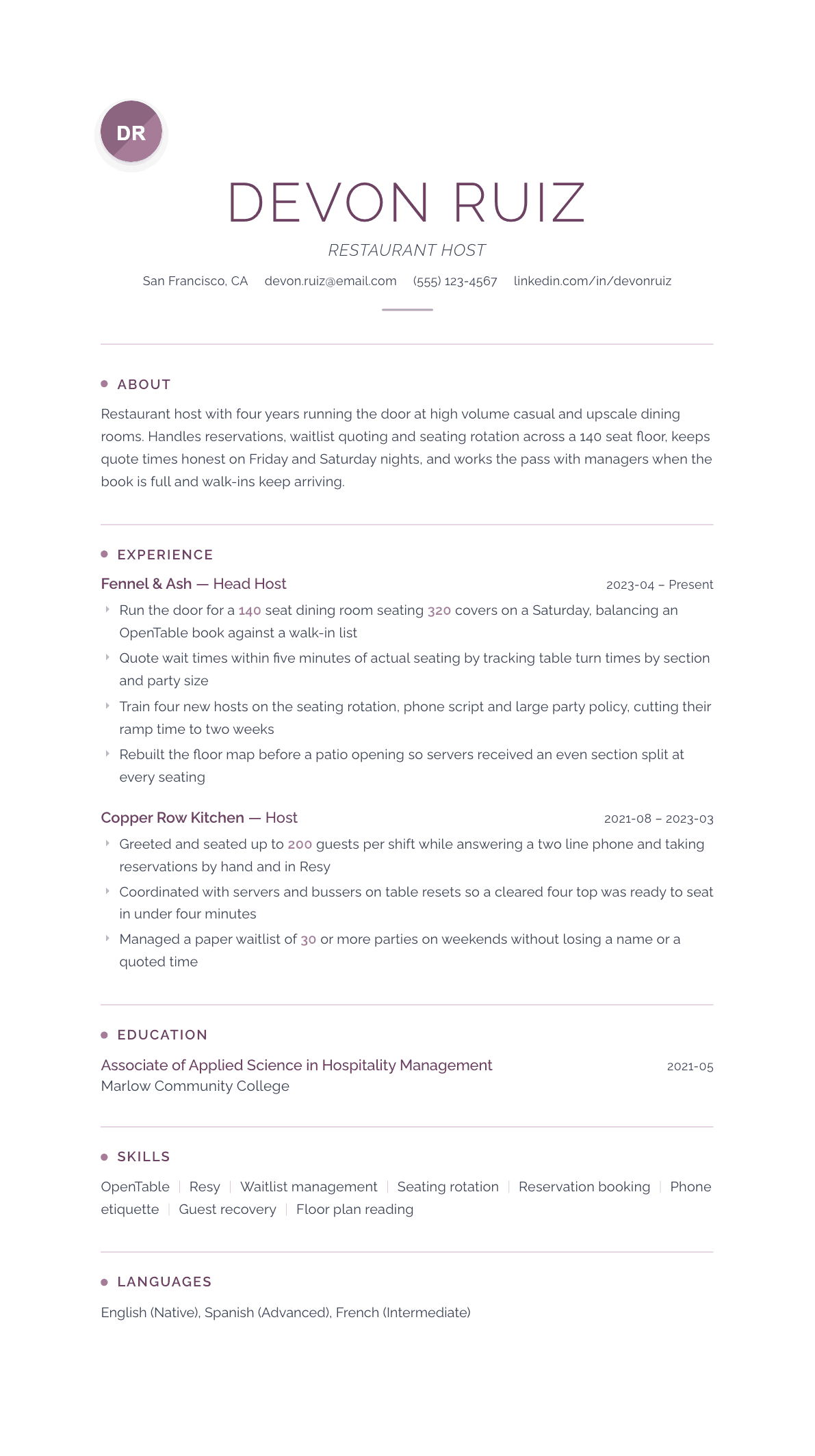
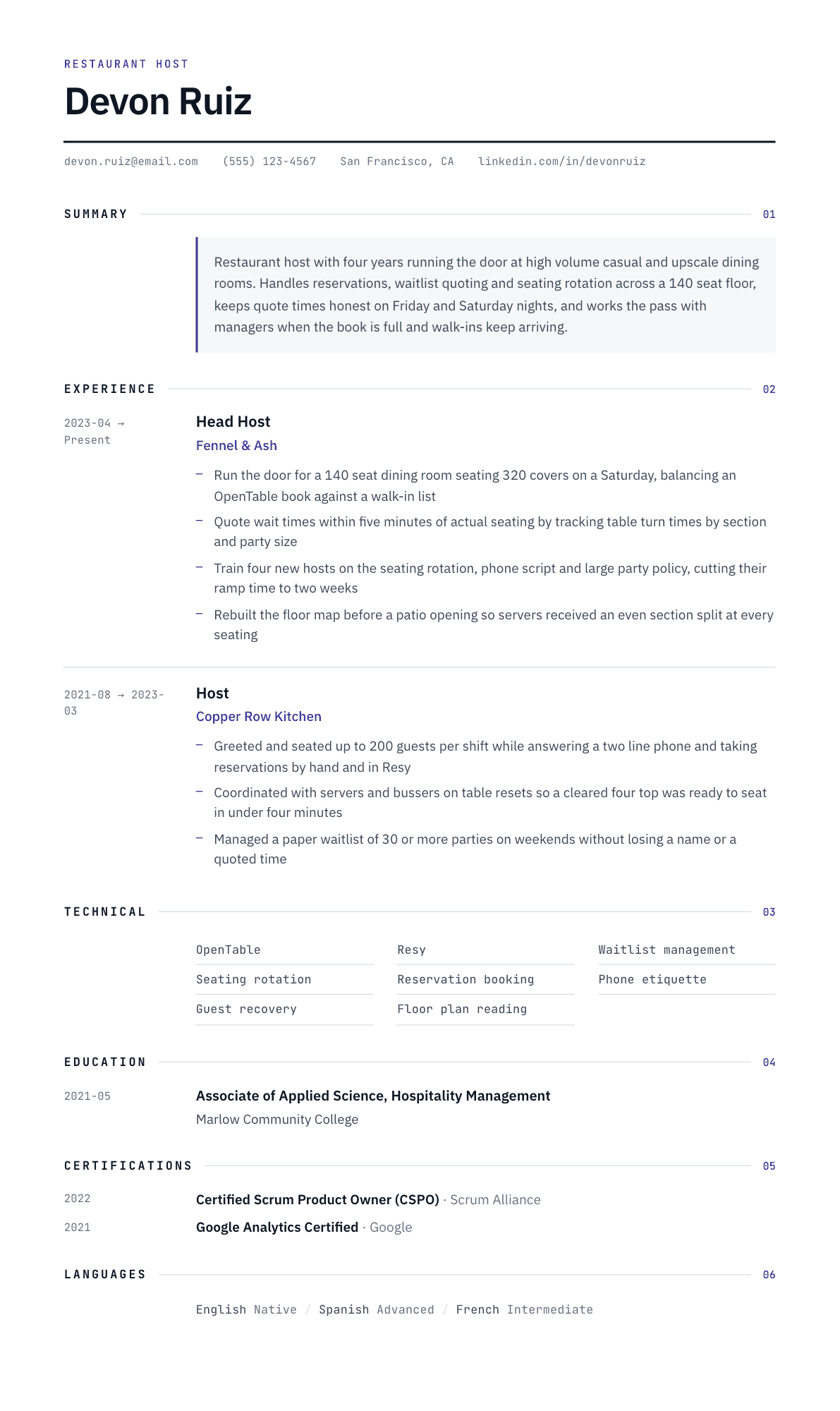
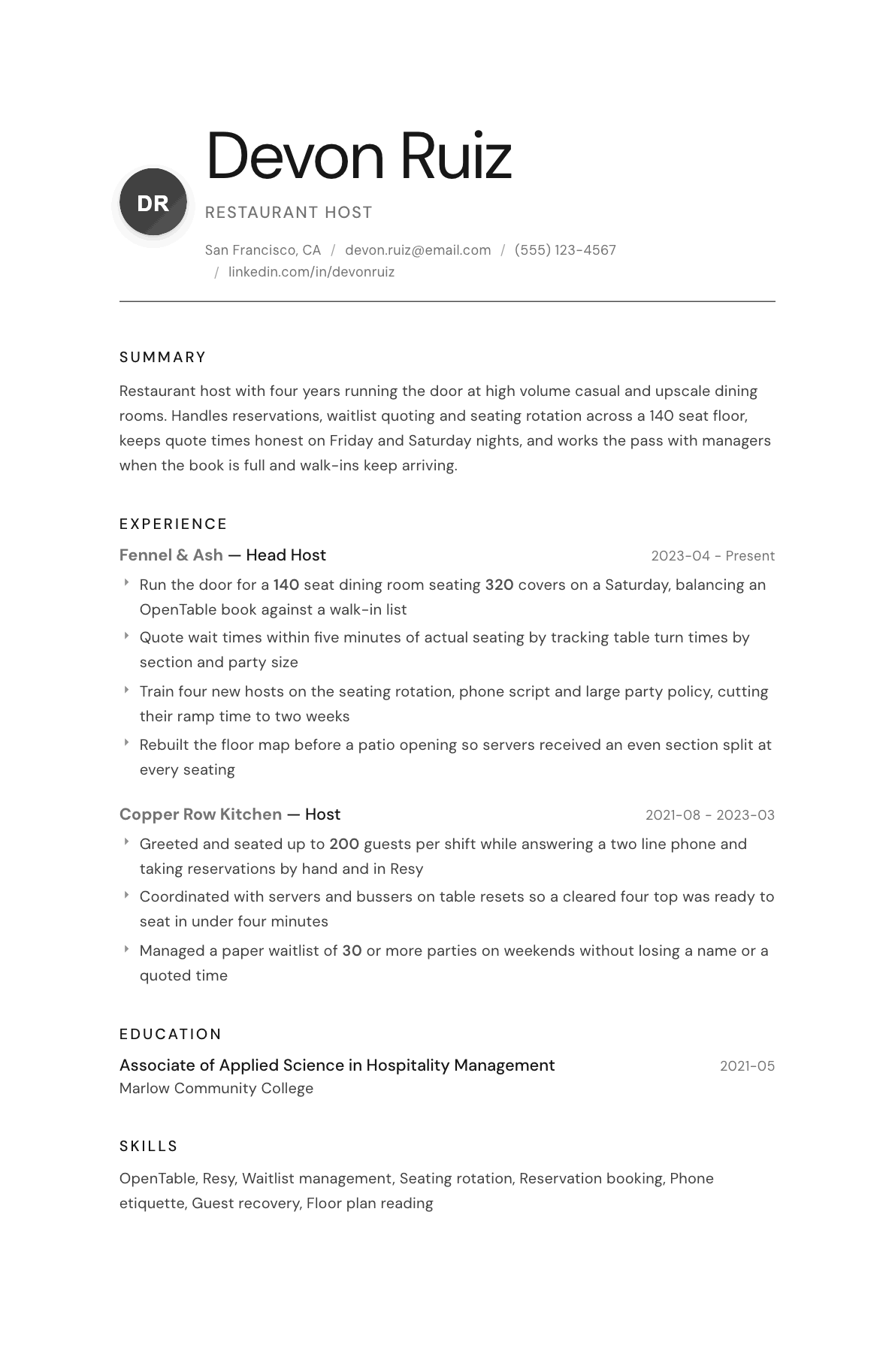
Example Host summary
Restaurant host with three years at the door of a 120 seat neighborhood dining room. Books and manages reservations in Resy, quotes accurate wait times on a 40 party weekend list, and keeps server sections balanced through a full turn of the floor. Known for reading a lobby quickly and moving anxious parties before they walk out. Available nights, weekends and holidays.
Skills to list on a Host resume
- Reservation management
- Waitlist quoting
- Seating rotation
- OpenTable
- Resy
- SevenRooms
- Floor plan management
- Guest greeting
- Phone handling
- Large party coordination
- Guest recovery
- Point of sale entry
- To go order intake
- Table turn tracking
- Menu knowledge
- Shift opening and closing
What actually gets this resume read
- Name the reservation platform you have worked in, because managers filter on OpenTable, Resy, SevenRooms and Yelp Guest Manager.
- Give the size of the dining room in seats and the busiest cover count you have seated in one shift.
- Show that you understand seating rotation, not just greeting: mention section balance, table turn times and quote accuracy.
- Put one bullet on guest recovery, since every manager wants to know how you handle a blown quote time.
- List weekend, holiday and closing availability near the top, because scheduling flexibility decides many host hires.
- Mention any second language you speak on the floor, especially if the restaurant sits a large tourist or business crowd.
How to write a host resume
A host resume is read fast, usually by a general manager who is standing at the podium between a lunch and a dinner service and has a stack of applications on the host stand. What that manager is trying to answer in about fifteen seconds is simple: can this person hold a reservation book, a walk-in list and a ringing phone at the same time on a Saturday night, and will they still be pleasant to the guest at the front of the line.
That question is not answered by adjectives. It is answered by the size of the room you have worked, the reservation platform you have used, the cover count you have seated in one shift, and the way you talk about seating rotation. A host who writes about section balance and quote accuracy has clearly stood at a door on a bad night. A host who writes about being friendly and reliable has not shown anything a manager can check.
This guide covers the layout, the summary line, the experience bullets, the skills block and the availability line that decides more host hires than anything else, with example summaries for three stages of a front of house career and rewrites of the bullets applicants send most often.
Format: one page, availability visible without scrolling
Keep it to a single page in reverse chronological order. Restaurants hire on a short timeline and a manager who has to hunt for your last job will move to the next application. Use one clean font and avoid columns, because independent restaurants often paste applications into a hiring inbox where a two column layout scrambles.
The header should carry your name, city, phone, email and, on the same line or immediately below, your availability. Nights, weekends and holidays are the shifts that are hardest to staff, so a header that reads open availability including weekends and holidays does more work than an objective statement ever will.
- Header: name, city and state, phone, email, availability, and any food handler card.
- Section order: summary, experience, skills, education, certifications.
- A first job applicant moves education up and adds a volunteer or school activity section.
Summary: room size, reservation system, and the volume you have carried
Two or three sentences. Name the seat count of the dining room, the reservation platform, the busiest cover count you have seated, and one habit that separates you from the pile. A line such as host at the door of a one hundred twenty seat dining room, booking in Resy and quoting a forty party weekend list, gives a manager three checkable facts before the second sentence.
If you are moving from a fast casual counter to a full service or upscale room, say that in the summary and name the transferable piece: phone reservations, large party handling, or a point of sale you already know. A manager will forgive a gap in fine dining experience if you show you understand what changes.
Experience: the door, the book, and the rotation
Give every job the restaurant, the service style, the seat count and the peak covers. Head host, one hundred forty seats, three hundred twenty covers on a Saturday tells a manager more about your capacity than a paragraph of duties. Then write three to five bullets that describe the mechanics of the door rather than the courtesy of it.
The strongest bullets are about the parts of the job that go wrong. Quote accuracy against actual seating time. Holding tables back for a concierge or a manager. Rebuilding a floor map when a patio opens and the sections stop being even. Moving a party off a blown wait onto a bar seat so they stay instead of walking. Every one of those is a story a manager has lived and will recognize.
Leave out the bullets that describe the job title itself. Greeted guests with a smile and seated them at tables is true of every host who has ever worked, and it takes the line where a real number should be.
Skills, certifications and the first host job
This block is what a hiring manager scans for the software. Name the reservation and waitlist systems you have actually worked in, then the point of sale, then the floor skills: seating rotation, waitlist quoting, large party coordination, to go order intake, table turn tracking. Restaurants increasingly attach the to go window to the host stand, so include it if you have done it.
Second languages belong here and near the top of the page when the restaurant sits a tourist or business crowd. So does phone handling, because a host who can take a reservation, read a note back and confirm a spelling by voice is rarer than one who can tap a screen.
A hospitality management degree or a culinary school certificate belongs on the page with the school, the credential and the field. A high school diploma is enough for most host postings and should simply be listed without apology. If you have a current food handler card, name the issuing program, because in many jurisdictions a host who touches plates or packs to go bags needs one before the first shift.
With no restaurant history at all, build the experience section out of anything where you managed a line, a schedule or a phone: retail holiday floors, a school front office, a reception desk, a ticket booth, a church or club event you seated. Describe the volume and the system you used, and the section stops looking empty.
- Reservation and waitlist platforms by name, including any you used only for a season.
- Point of sale systems, since hosts often ring to go orders and split tabs.
- Floor mechanics: rotation, quoting, floor plan reading, large party seating.
Hostess job description and responsibilities for a resume
When you write a hostess job description for a resume, do not copy the job posting. Write the tasks you actually did, with the room size, the system and the volume. The lines below are ready to adapt; keep the ones that are true for you and add your own numbers.
Order the hostess responsibilities by what the new restaurant needs most. A hotel dining room cares about reservations and guest notes first, a busy casual chain about waitlist quotes and table turns, and a fine dining room about pacing and VIP handling.
Hostess tasks a manager wants to see on a resume, written as bullets:
- Greeted and seated guests for a 120 seat dining room and patio, up to 300 covers on a Friday night.
- Managed reservations and the waitlist in OpenTable, quoting wait times guests could rely on.
- Rotated seating across five server sections so no section was double sat.
- Answered the phone, took to go orders and confirmed next day reservations.
- Kept the host stand, menus and entrance clean and ready before each service.
- Walked guests to large party and private dining tables and passed allergy notes to the server.
- Handled complaints at the door and brought in the manager when a guest needed more than an apology.
- Tagged allergies, birthdays and repeat guests in guest profiles so servers opened each table with the details in hand.
- Opened and closed the stand: floor plan, reservation sheet, and an end of night note on covers and no shows for the manager.
Hostessing resume sample, start to finish
Here is a complete hostessing resume for a host with two years at a busy casual dining restaurant who is applying to a fine dining room. The person is invented. Restaurants use host and hostess for the same job, so match whichever word the posting uses.
Profile: Emily Carter, Host. Two years at the front door of a 180 seat casual dining restaurant, seating up to 350 covers on a weekend night on Resy. Known for honest wait quotes and calm turns on a full book. Available evenings and weekends.
- Current role, Host, Harbor Grill, two years: greet, seat and manage the waitlist for a 180 seat room with a patio.
- Run the reservation book on Resy and balance seating across six server sections.
- Trained four new hosts on the floor plan, the rotation and the phone script.
- Previous role, Cashier, Corner Market, one year: register, cash handling and customer questions.
- Skills: Resy, OpenTable, Toast POS, seating rotation, guest recovery, bilingual English and Spanish.
- Certification: food handler card.
Host resume summary examples
First restaurant job
Hospitality student seeking a first host role, with two years greeting and directing visitors at a campus welcome desk handling 200 arrivals a day and a booking calendar for six event rooms. Comfortable on a multi line phone, quick with names, and available nights, weekends and holidays.
Three years at the door
Restaurant host with three years running a 120 seat neighborhood dining room. Books and manages reservations in Resy, quotes accurate wait times on a 40 party weekend list, and keeps five server sections balanced through three full turns. Reads a lobby quickly and moves anxious parties before they walk out.
Head host
Head host with six years across casual and upscale rooms, currently running the door for 140 seats and 320 Saturday covers. Owns the floor map, the large party policy and the phone script, trains every new host on the rotation, and works the pass with managers when the book is full and walk-ins keep arriving.
Work experience bullets: before and after
Before: Greeted guests and seated them at their tables.
After: Ran the door for a 140 seat dining room seating 320 covers on a Saturday, balancing a full reservation book against a rolling walk-in list.
Seat count and peak covers tell a manager the volume you can hold; greeting is the part of the job nobody doubts.
Before: Answered phones and took reservations.
After: Handled a two line phone through dinner service, taking reservations by voice and confirming spelling, party size and occasion notes back to the guest before booking.
The detail shows a reservation habit that prevents the errors managers actually spend their evening fixing.
Before: Made sure guests did not wait too long.
After: Quoted wait times within five minutes of actual seating by tracking table turn times per section and party size, which cut walkaways on weekend nights.
A method and a measurable outcome replace a promise that every applicant makes.
Before: Helped train new hosts.
After: Trained four new hosts on the seating rotation, the phone script and the large party policy, bringing their ramp time down to two weeks.
Naming what you taught and how long it took turns a vague claim into evidence you can run the stand.
Before: Worked with servers to keep the floor running.
After: Rebuilt the floor map before a patio opening so every server received an even section split at each seating, and adjusted the rotation live when a section fell behind.
This is the part of hosting servers complain about, so showing you protect the rotation reads as real experience.
Hard skills
- Reservation management
- Waitlist quoting
- Seating rotation
- OpenTable
- Resy
- SevenRooms
- Floor plan management
- Large party coordination
- Phone reservations
- Point of sale entry
- To go order intake
- Table turn tracking
- Menu knowledge
- Opening and closing duties
Soft skills
- Guest recovery
- Composure under a full book
- Clear handoffs to servers
- Reading a lobby
- Team communication
- Patience with waiting parties
Certifications worth listing
- ServSafe Food Handler (National Restaurant Association)
- ServSafe Allergens (National Restaurant Association)
Mistakes that cost host candidates the interview
- Leaving the reservation platform off the page, when that is the single word many managers search an application for.
- Describing hosting rather than your hosting: greeted and seated guests appears on every application in the stack.
- Skipping the seat count and cover volume, so a manager cannot tell a forty seat cafe from a full service dining room.
- Burying availability at the bottom, when weekend, holiday and closing coverage is what decides most host hires.
- Writing only about greeting and never about the rotation, which reads as if you have stood at a podium but not run a floor.
- Using a decorative two column template with icons, which often scrambles when an independent restaurant prints or forwards it.
- Omitting to go and phone work, two duties now attached to the host stand at a large share of restaurants.
Host resume questions
What is a good hostess job description for a resume?
Write three to five bullets with the tasks you did: greeting and seating, reservations and waitlist in a named system, section rotation, phones and to go orders, and handling complaints. Add the room size and covers per shift. The hostess bullets on this page can be adapted line by line.
What are the main hostess responsibilities to list on a resume?
Greeting and seating, reservations and the phone line, balancing the seating rotation across server sections, running the waitlist, guest notes such as allergies and occasions, and floor support like bussing or to go orders. Write each one with a number or a system name, such as covers per service or the reservation platform you used.
What do I put on a host resume with no restaurant experience?
Use any role where you managed people arriving in person or on the phone: retail floors during a holiday rush, a school office, a reception desk, a gym check in, a ticket window. Give the daily volume and the booking or scheduling system you used.
How do I show that I can handle an angry guest?
Write one bullet about a blown quote time and what you did: moved the party to bar seating, offered a drink while they waited, or reset expectations with an honest new time. A specific recovery move is more convincing than the phrase excellent customer service.
Do hosts need a food handler card?
It depends on the jurisdiction and on whether you touch food, but many restaurants attach to go packing and bread service to the host stand and require one. If you hold a current card, list it with the issuing program near your contact details.
Related resume examples
- Restaurant Manager Resume example
- Bartender Resume example
- Hostess Resume example
- Server Resume example
- Food Runner Resume example
- Restaurant Supervisor Resume example