Local Truck Driver Resume Examples: the lines they read
Write a Local Truck Driver Resume That Gets You Home Daily
By Mustafa Tarabya, founder of CVBooster · Published · Updated
A local truck driver resume example with CDL class, hours-of-service detail, dock and pickup numbers, ATS keywords and a full writing guide.
Sample resumes for a local truck driver
The same local truck driver content laid out in three CVBooster templates, so you can see what the finished document looks like before you write a word.
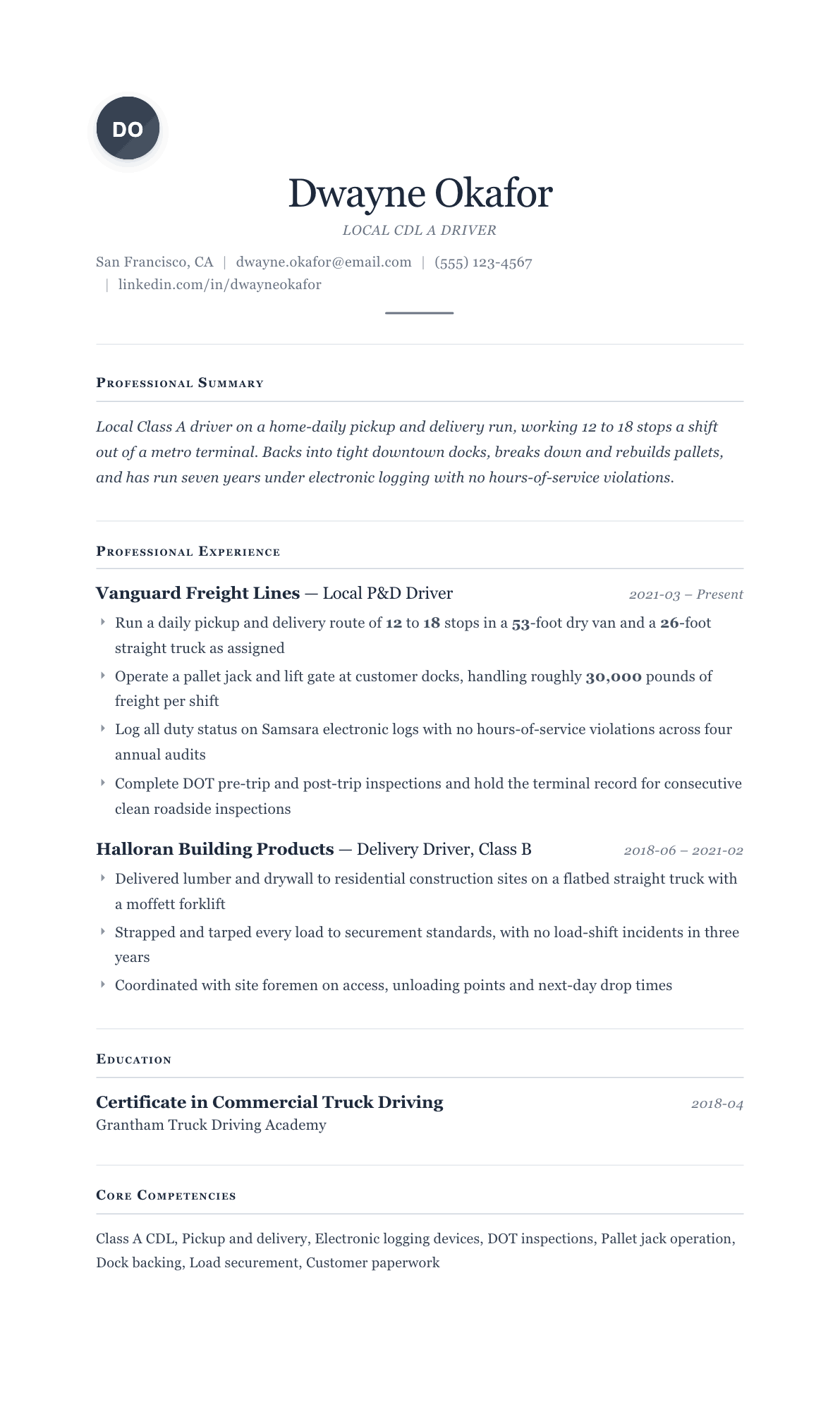
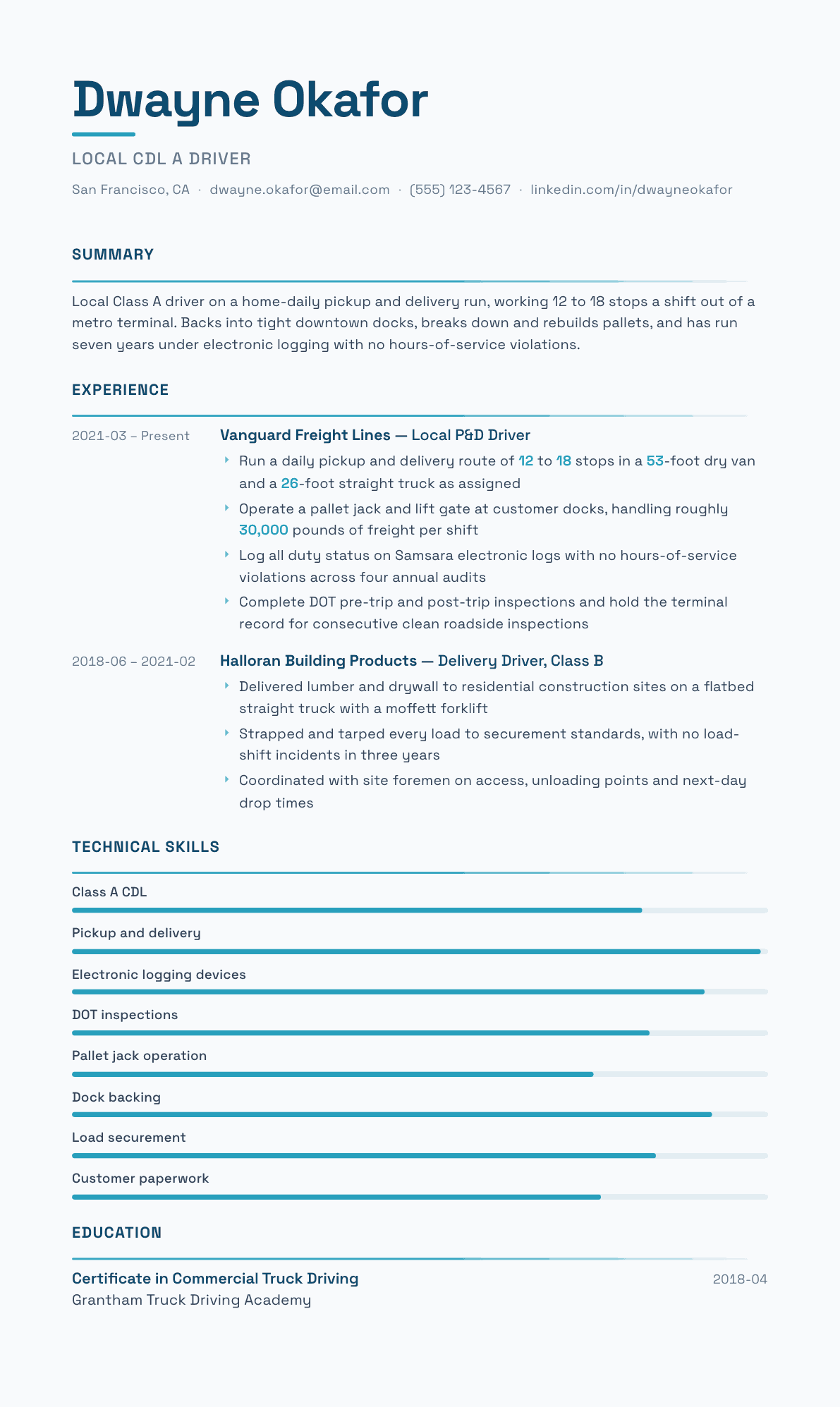
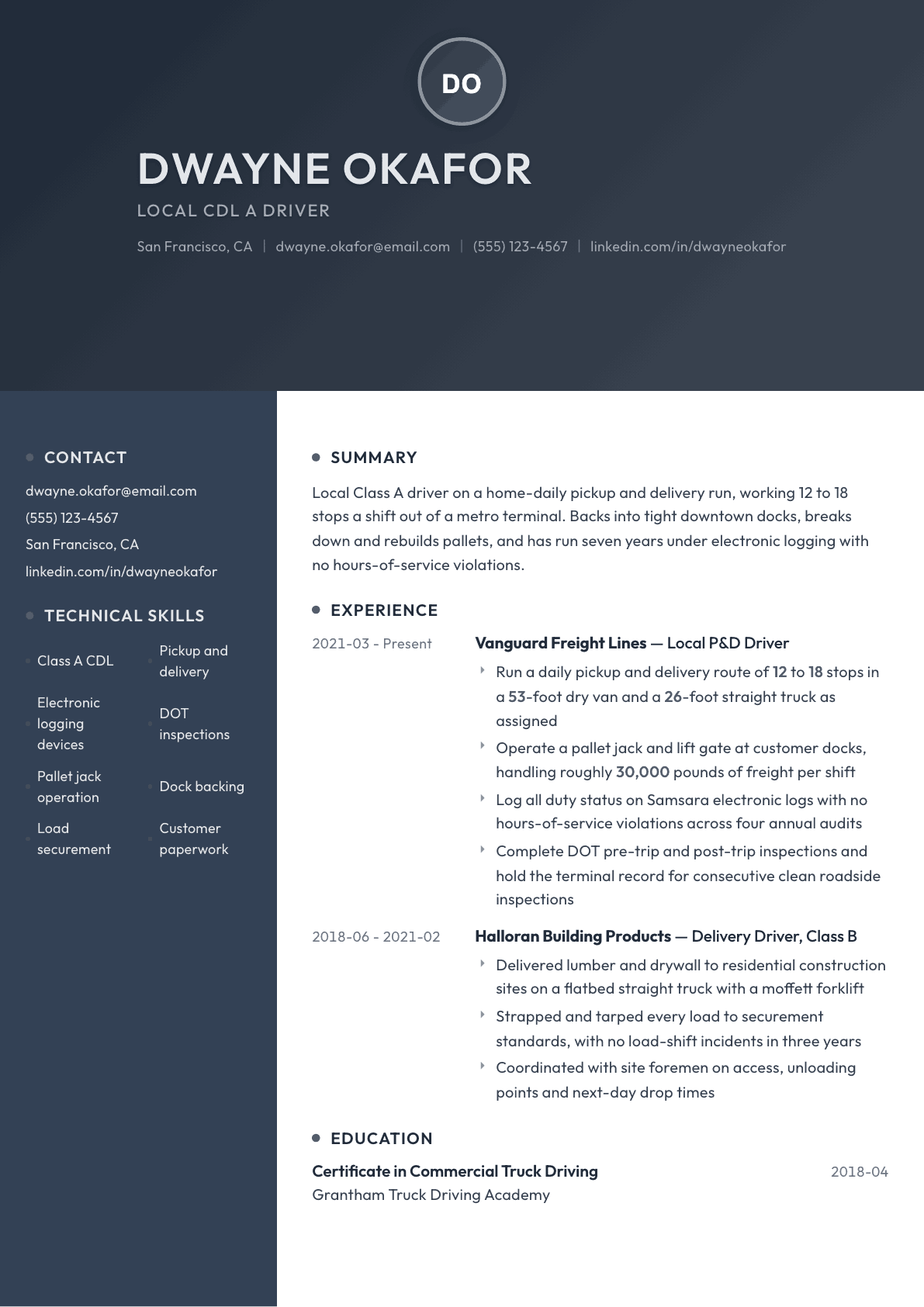
Example Local Truck Driver summary
Local Class A driver with seven years of home-daily pickup and delivery work out of a metro terminal, running 12 to 18 stops a shift in dry van and straight trucks. Backs into tight downtown docks, handles freight with a pallet jack and lift gate, and has a clean hours-of-service and roadside inspection record. Seeking a local route with a carrier that runs a maintained fleet.
Skills to list on a Local Truck Driver resume
- Class A CDL
- Pickup and delivery
- Dry van
- Straight truck
- Electronic logging device
- Hours of service
- DOT pre-trip inspection
- Load securement
- Pallet jack
- Dock backing
- Bills of lading
- Customer service
- Defensive driving
- Route planning
What actually gets this resume read
- Put the CDL class and any endorsements in the header, because a local carrier screens on that line first.
- Say how many stops you make in a shift and the truck you run, since local work is measured in stops and not miles.
- Show dock skill: alley docks, blind side backing, city delivery windows and the freight you handled by hand.
- Name the electronic logging system you used and state your hours-of-service and roadside inspection record.
- Include the freight type, whether dry van, reefer, flatbed or tank, because customers and handling differ by trailer.
- Mention that you want home-daily work, since local carriers care whether you will stay past the first winter.
How to write a local truck driver resume
Local truck driving is measured in stops, not miles. A terminal manager staffing a pickup and delivery board wants to know whether you can put a fifty-three foot trailer into an alley dock behind a grocery store, work a pallet jack in the rain, get the paperwork signed, and still clear the route before the receiving window closes. Long-haul mileage numbers do not answer that question, so a local truck driver resume has to be built around different evidence.
The second thing the manager checks is whether hiring you is safe and legal. License class, endorsements, medical card, hours-of-service history and roadside inspection results are a compliance file, and every driver he adds either strengthens or weakens the carrier safety score. Put those facts where they can be read in five seconds.
This guide walks through the page in the order a local terminal reads it: credentials, then the route work, then the dock skill, then the compliance record, with example summaries, rewritten bullets and the questions drivers ask when moving from over-the-road work to home-daily work.
Format: credentials block, then experience, one page
A local carrier recruiter reads dozens of driver resumes a week and screens on four lines. Give them their own block directly under your contact details so nobody has to hunt through paragraphs for your license class.
Keep the whole thing to one page unless you have more than fifteen years of driving worth listing, and keep the font plain. Terminal offices scan these into a driver qualification file, and a decorative layout comes out of the scanner badly.
- Credentials: CDL class and state, endorsements, medical examiner certificate expiry, and years of commercial driving.
- Safety line: preventable accidents, moving violations, and roadside inspection results.
- Then summary, driving experience, equipment list, skills, training and education.
Summary: home daily, stops per shift, and the equipment
Open by saying you drive local, because that single word tells a recruiter you are applying for the right board. Then give the stop count per shift, the equipment you run, and the freight. A driver who runs 12 to 18 stops a day in a fifty-three foot van and a straight truck as assigned is describing a skill set that took years to build.
If you are coming off over-the-road work, say that directly and give the reason: home time, a family situation, a move. Local terminals worry that an ex-long-haul driver will leave once the mileage pay tempts him back, and naming your reason answers that worry before the interview.
Experience: docks, freight handling and customer windows
Local freight is a customer service job. Every job entry should say what kind of customers you served, because a grocery distribution center, a downtown restaurant with a curbside delivery and a construction site each demand something different from the driver.
Write bullets on backing skill, on freight handling, and on the paperwork. Backing means alley docks, blind side approaches, tight yards and city streets with parked cars. Freight handling means pallet jacks, lift gates, hand unloading and rebuilding pallets that shifted in transit. Paperwork means bills of lading, delivery receipts, overage and shortage notation and getting the right signature.
Add one bullet on the day going wrong: a closed receiving door, a missing purchase order number, a customer who refuses a pallet. How you handle exceptions is what separates an experienced local driver from a new one, and it is the story a hiring manager remembers.
Compliance: logs, inspections and the qualification file
Name the electronic logging system you used and state your hours-of-service record in plain terms. Local drivers work under the fourteen-hour on-duty window, and a driver who plans his stops so the clock does not run out is worth more to a dispatcher than one who calls in at hour thirteen with two stops left.
Then give your roadside inspection history. Clean inspections, especially consecutive ones, are the single most persuasive line on a driver resume because they are recorded by the state and easy to verify. Mention any annual review or audit you have been part of, and note that your driver qualification file is current.
Equipment and keyword list
Give equipment its own short section: tractor and trailer types, straight trucks, lift gates, moffett forklifts, reefer units, dollies for pups, air brakes and automatic or manual transmission. Recruiters filter on equipment because insurance and customer requirements are written around it.
Repeat the words the posting uses. Local truck postings recur around pickup and delivery, home daily, dock backing, hours of service, electronic logging device, bills of lading, load securement, pallet jack, DOT inspection and clean motor vehicle record.
Local Truck Driver resume summary examples
First year with a CDL
Class A driver in the first year of commercial work, running a local delivery route in a 26-foot straight truck with a lift gate. Completed entry-level driver training, holds a current medical card and a clean record, and comfortable with pallet jacks and city backing.
Five years local
Local Class A driver on a home-daily pickup and delivery board, running 12 to 18 stops a shift in dry vans and straight trucks. Handles freight with a pallet jack and lift gate, logs on an electronic device with no hours-of-service violations, and has passed five consecutive clean roadside inspections.
Senior driver and trainer
Local driver with fourteen years of city pickup and delivery, currently the terminal trainer for new hires on backing, securement and customer paperwork. Runs the downtown board personally, holds tanker and hazmat endorsements, and has completed eleven years with no preventable accidents.
Work experience bullets: before and after
Before: Delivered freight to local customers every day.
After: Ran a daily pickup and delivery board of 12 to 18 stops in a 53-foot dry van and a 26-foot straight truck, covering grocery, retail and light industrial receivers.
Stop count, both pieces of equipment and the customer mix let a terminal manager slot you onto a specific board.
Before: Unloaded trucks at customer sites.
After: Unloaded roughly fifteen tons of palletized freight per shift with a pallet jack and lift gate, rebuilding shifted pallets before handoff to receiving.
Weight and method make the physical demand concrete, and rebuilding pallets is a detail only a driver who has done the work would write.
Before: Followed all DOT rules.
After: Logged duty status on Samsara electronic logs with no hours-of-service violations across four annual safety audits and no form-and-manner errors.
It names the system and points at an audit result, which is evidence a safety manager can verify instead of a promise.
Before: Good at backing into tight spots.
After: Executed alley dock and blind side backing daily at downtown receivers with no dock or trailer damage recorded in three years.
Naming the maneuver types and pairing them with a damage record turns a self-assessment into a track record.
Before: Handled delivery paperwork.
After: Managed bills of lading, delivery receipts and overage, shortage and damage notation for every stop, keeping billing corrections under one a month for the terminal.
Paperwork accuracy costs the office real time, so tying it to a correction rate shows the value the office actually feels.
Hard skills
- Class A commercial driving
- Pickup and delivery route work
- Alley dock and blind side backing
- Pallet jack and lift gate operation
- Load securement and weight distribution
- Electronic logging device use
- Hours-of-service planning
- DOT pre-trip and post-trip inspection
- Bills of lading and delivery receipts
- Air brake systems
- Straight truck and tractor-trailer operation
- City route sequencing
Soft skills
- Customer-facing composure
- Patience in traffic
- Problem solving at the dock
- Dependable attendance
- Clear radio and phone communication
Certifications worth listing
- Commercial Driver's License, Class A (State driver licensing agency)
- Entry-Level Driver Training (FMCSA Training Provider Registry)
- Medical Examiner's Certificate (FMCSA National Registry of Certified Medical Examiners)
- Powered Industrial Truck Operator Training (Employer certification under OSHA standards)
Mistakes that cost local truck driver candidates the interview
- Selling local work with mileage numbers. Miles are the wrong measure for a stop-based board and make a recruiter think you have not done city work.
- Leaving the endorsements out of the header. Tanker, hazmat and doubles change which boards you can be assigned to, so they belong at the top.
- Ignoring the freight handling. Local drivers touch the freight, and a resume that never mentions a pallet jack reads as a driver who expects the customer to unload.
- Skipping the roadside inspection record. Clean inspections are state recorded and verifiable, which makes them one of the strongest lines you can write.
- Failing to explain a move away from over-the-road work. Terminals fear turnover, so give the reason for wanting home-daily work in your own words.
- Listing carriers without dates or reasons for leaving. Employment verification covers three years, so gaps get discovered rather than overlooked.
Local Truck Driver resume questions
Can I get a local driving job with no local experience?
Yes, if you show backing skill and freight handling. Terminals will train city routes, but they will not train a driver who has never touched a pallet jack. Lead with dock work, straight truck time and any customer delivery you have done, however short the run.
How should a local truck driver handle the safety record on a resume?
Write it as facts: number of preventable accidents, moving violations in the last three years, and roadside inspection outcomes. Carriers pull your motor vehicle record and inspection history anyway, so an accurate line builds trust and a vague one costs you the interview.
Is a Class B license enough for local truck driving jobs?
It covers straight trucks, and plenty of beverage, building supply and food service routes run on Class B. It will not cover tractor-trailer work. Say which class you hold, which equipment you have driven, and whether you are upgrading, so the recruiter can match the board.
What does a terminal manager want to see about hours of service?
That you plan the fourteen-hour window rather than react to it. Mention the logging system, your violation record, and how you sequence stops so receiving windows and your clock line up. That planning is what keeps a board running without overtime approvals.
Should I list every truck I have driven?
List equipment types rather than individual models: tractor-trailer, straight truck, reefer, flatbed, lift gate, moffett, manual or automatic transmission. Recruiters filter on equipment and insurance requirements are written around it, so the type list matters more than the make.
Related resume examples
- Truck Driver Resume example
- CDL Driver Resume example
- OTR Truck Driver Resume example
- Dispatch Coordinator Resume example
- Owner Operator Truck Driver Resume example
- Van Driver Resume example