Stay-at-Home Parent Returning to Work Resume Examples
Resume for a Housewife or Stay-at-Home Parent Returning to Work
By Mustafa Tarabya, founder of CVBooster · Published · Updated
Resume for a housewife, homemaker or stay-at-home parent: an example that dates the gap plainly, lists refreshed skills and shows volunteer work a hiring manager counts.
Sample resumes for a stay-at-home parent returning to work
The same stay-at-home parent returning to work content laid out in three CVBooster templates, so you can see what the finished document looks like before you write a word.
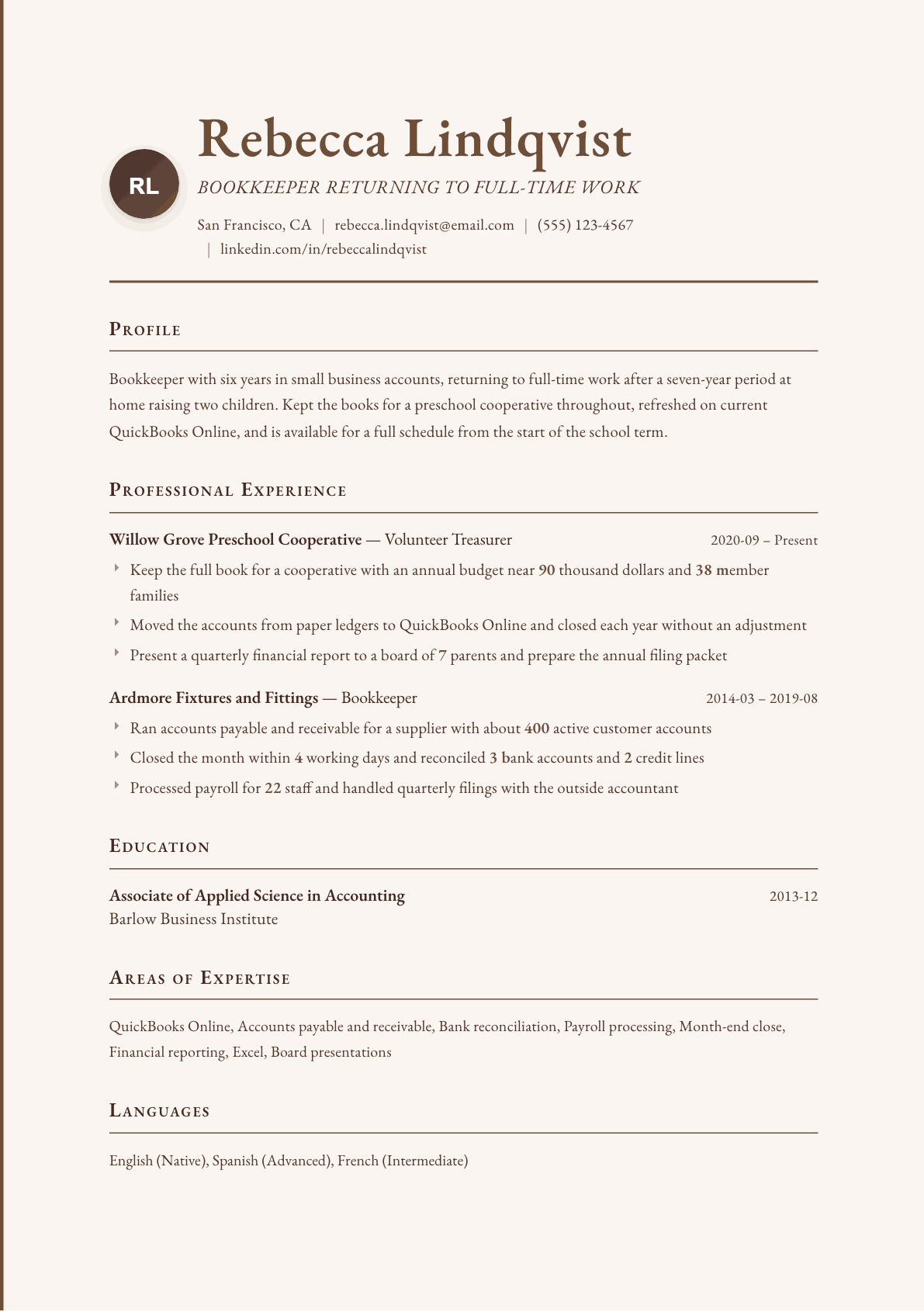
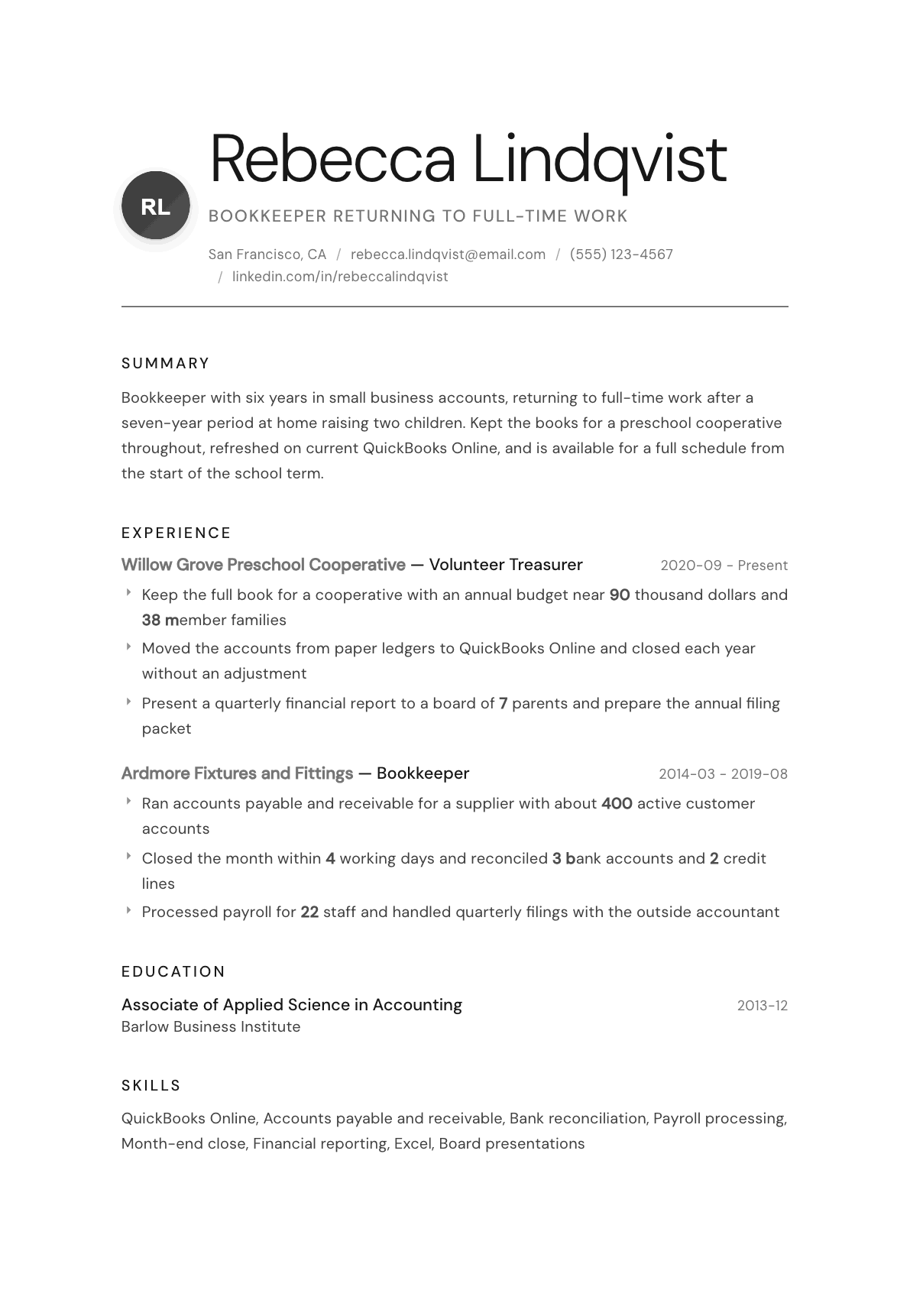
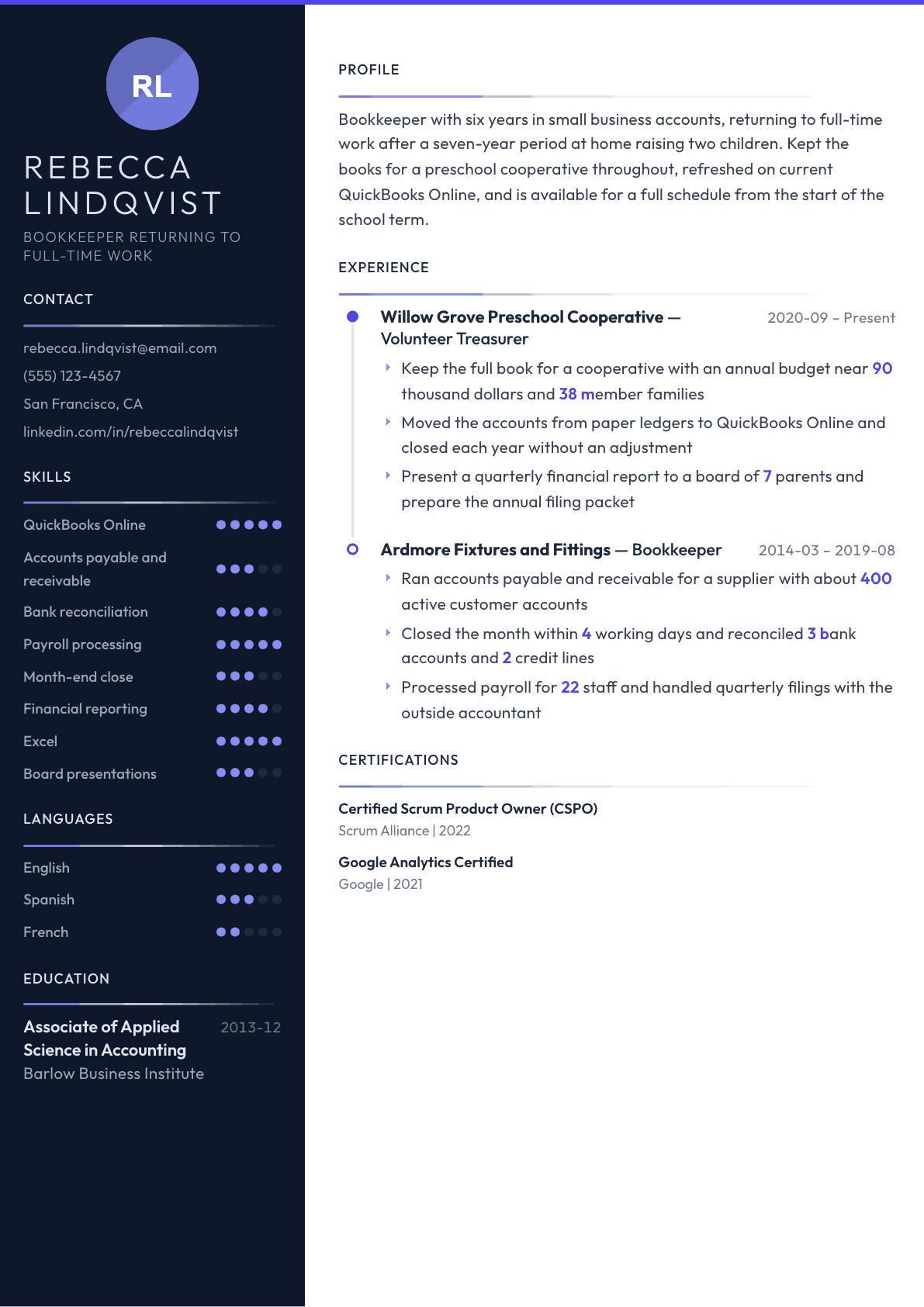
Example Stay-at-Home Parent Returning to Work summary
Bookkeeper returning to full-time work after seven years at home, with six years of small business accounts before the break and continuous unpaid bookkeeping since. Serves as treasurer for a preschool cooperative, moved its accounts to QuickBooks Online, and closes every year without an adjustment. Ran payables, receivables, payroll and month-end close for a supplier with hundreds of active accounts.
Skills to list on a Stay-at-Home Parent Returning to Work resume
- Return to work planning
- Gap presentation
- QuickBooks Online
- Accounts payable and receivable
- Bank reconciliation
- Payroll processing
- Month-end close
- Budget reporting
- Volunteer board experience
- Excel
- Refreshed software training
- Reference building
- Availability and scheduling
What actually gets this resume read
- Date the gap in one neutral line and move on, because an unexplained hole invites worse guesses than the truth.
- Put unpaid work with a real title, a budget and a headcount, since a treasurer role is bookkeeping experience.
- Name the current version of the software you refreshed on, because a manager assumes your tools went stale.
- State your availability plainly, including school hours or full days, so nobody screens you out on a guess.
- Refresh your references before you apply, since a manager from seven years ago may no longer be reachable.
- Drop the objective statement that apologizes for time away and replace it with what you can do next Monday.
How to write a stay-at-home parent returning to work resume
A hiring manager looking at a resume with a multi-year hole does not usually think the worst. She thinks nothing at all, because there is nothing on the page to think about, and an unexplained blank is the one thing a reader fills in herself. The single most useful edit a stay-at-home parent can make is to stop leaving the space empty and start putting a plain, dated line in it.
The second worry is currency. She assumes your software went out of date, your certifications lapsed, your references retired and your knowledge of how the work is done now stopped when you stepped away. Some of that may be true and all of it is fixable, but only if the page addresses it directly. Silence here is read as a yes.
This guide covers dating the career break without apology, how a resume for a housewife or homemaker names the years at home, writing unpaid and community work as the real experience it often is, showing that your tools are current, setting out availability honestly, and rebuilding a reference list when the last manager who supervised you has moved on.
Give the break a line, a date range and no apology
Put the break in the experience section where it belongs chronologically, with a neutral label and a date range. Career break, family care, followed by the years, and one short clause if you kept anything professional going during it. That is the whole treatment. A reader who finds it there stops wondering and reads on.
What does not belong is an explanation of your family circumstances, a justification, or an opening statement that starts by naming the years away as a weakness. A resume that apologizes teaches the reader to treat the gap as the main fact about you, when the ten years of work before it are the reason she is reading at all.
Consider using year ranges rather than months across the whole page if the exact months make the break look longer than it functionally was. Be consistent: year ranges everywhere or months everywhere, never a mixture that looks like editing.
- A dated career break entry in the experience section, labeled neutrally.
- One clause naming anything professional you sustained: a treasurer role, freelance work, a course.
- Consistent date formatting across every entry on the page.
- A summary that opens with your profession and years of experience, not with the time away.
Resume for a housewife or homemaker: what to call the years at home
Whether you search for a resume for a housewife, a homemaker resume or a stay-at-home mom resume, the problem is the same one: what to put in the space where a job title would go. Use a plain, neutral label with dates, such as Homemaker, Full-time parent or Career break for family care, and keep it to one line unless the time at home produced something an employer would pay for. Joke titles such as Chief Household Officer read as nervous, and the reader is looking for calm.
If you never held a paid job before marrying or having children, the resume still has material. Household budgeting, managing care for a relative, running a home business, school and faith community roles, and courses you completed are all evidence. Lead with a skills summary, list those activities with dates as you would list jobs, and keep the wording factual so a reader can check it in an interview.
If you did work before, put that job directly under the career break line so the reader sees what you did professionally and when you stepped away. The break explains the dates; the earlier job proves the level.
- Career break line: Homemaker and full-time parent, nine years, dated by month and year. Managed the household budget and care for two children; completed a QuickBooks Online certification last year to prepare for a return to bookkeeping.
- Homemaker with no paid history: Household Manager, family home, fourteen years. Planned and tracked the monthly household budget, coordinated medical care for a parent with dementia for three years and handled insurance claims and appeals.
- Community entry: Treasurer, Lincoln Elementary PTA, four years. Kept the books for the annual PTA budget, presented monthly reports to the board and ran the online payment system for school events.
- Skills summary for a returning housewife: scheduling and coordination, budgeting and record keeping, customer-facing communication from volunteer work, Microsoft Excel and Google Workspace, conversational Spanish.
Unpaid roles are experience when you write them like jobs
A parent who kept the books for a preschool cooperative did bookkeeping. A parent who ran the volunteer rota for a sports club did scheduling and staffing. A parent who managed a school fundraising campaign ran a project with a budget, a team and a deadline. These are not soft substitutes for work. They are the work, performed without pay, and a manager will count them once you give her the numbers she needs.
Write each one with an organization, a real title, a date range, and the same details you would give a salaried role: the budget you handled, the number of people you coordinated, the system you used, and what you produced. A treasurer line that names an annual budget, a member count and a clean year-end close is bookkeeping evidence that stands beside any employed equivalent.
Resist the temptation to list every activity. Two or three substantial roles written with detail beat a page of light involvement, and they give an interviewer something to ask about instead of a list to skim.
- Organization, title, dates, and a scope figure: budget, headcount, membership, volume.
- The software you used, because that is the currency proof hidden inside the role.
- A cycle you completed: a year-end close, a season, an audit, an annual report.
- A named person who supervised or worked alongside you, kept ready for references.
Show that your tools and knowledge are current
Name the current version of the software you work in and where you used it recently. A bookkeeper returning after several years who writes that she moved a cooperative's accounts onto the current cloud version of the ledger package has answered the currency question in a single bullet. Writing only the desktop version she used before the break confirms the manager's fear instead.
Where the field has moved, close the gap deliberately and put the proof on the page: a refresher course completed, a certification renewed, a short contract or temporary assignment taken to get the recent date on your record. A finished credential with a recent date does more than any paragraph about being a quick learner.
Regulated fields deserve special care. Licenses and registrations may need renewal, continuing education hours or a return to practice route, and a manager will check. State the current status of yours plainly, including a renewal already in progress, so nobody has to ask.
Availability, hours and what to say about childcare
State the hours you are available and the date you can start, and leave your childcare arrangements out of it. Available full time from the start of the school term is a complete and professional answer. The details of who collects the children are nobody's business, and volunteering them invites the very assumptions the line is meant to prevent.
If you want a phased return, say what you want plainly: three days a week initially, moving to full time within a term. Employers increasingly work with that and will tell you quickly whether the role allows it, which is better than discovering the mismatch after two interviews. Vagueness costs you both.
References, networks and the route back in
Reference lists go stale during a long break. Reach out before you apply rather than after an offer conversation begins: find the manager who supervised you, confirm she is still contactable, and tell her what you are applying for so the call goes well. Where old managers have scattered, a volunteer board chair, a client, or a colleague who has stayed in the field can carry the professional reference instead.
Consider the routes designed for this situation. Some employers run structured return programs for people re-entering after a career break, and temporary or contract assignments do the same job informally by putting a recent, verifiable employer on your record. A short assignment that ends with a reference is often worth more than three more months of applications.
Then treat the search as a professional project. Rejoin the professional body if you let it lapse, follow the changes in your field so you can talk about them fluently, and reconnect with former colleagues before you need something from them. Most returners find their way back through someone who already knows their work.
Stay-at-Home Parent Returning to Work resume summary examples
Short break, returning to the same work
Administrative coordinator returning after a three-year family break, with five years supporting a twelve-person legal team beforehand. Kept a part-time bookkeeping role for a local dance school throughout, and refreshed on the current version of the practice management suite. Available full time and can start within two weeks.
Long break, unpaid role kept the skills alive
Bookkeeper returning to full-time work after seven years at home, with six years of small business accounts before the break. Serves as treasurer for a preschool cooperative, moved its accounts to the current cloud ledger, and closes every year without an adjustment. Ran payables, receivables and payroll for a supplier with hundreds of accounts.
Senior professional re-entering
Marketing manager re-entering after a six-year break, with eleven years leading campaigns for a regional retail group beforehand. Chaired a school foundation that raised funds across three annual campaigns and rebuilt its donor database. Completed a current digital marketing certification and is seeking a manager role with a phased return.
Work experience bullets: before and after
Before: Took time off to raise my children.
After: Career break for family care, serving throughout as volunteer treasurer for a preschool cooperative and completing a refresher certification in the current ledger software.
A dated, neutral entry closes the gap and turns the period into something with content in it.
Before: Volunteer treasurer at my children's preschool.
After: Keep the full book for a preschool cooperative with an annual budget near 90 thousand dollars and 38 member families, closing each year without an adjustment.
Budget, membership and a clean close make an unpaid role read as the bookkeeping work it actually is.
Before: Familiar with accounting software.
After: Moved the cooperative from paper ledgers to the current cloud version of the accounting package and trained two incoming board members to run the monthly entries.
A recent migration and a training handoff prove your tools are current where a familiarity claim cannot.
Before: Previously worked as a bookkeeper for several years.
After: Ran accounts payable and receivable for a fixtures supplier with about 400 active customer accounts, closing the month within 4 working days across three bank accounts.
Account volume and a close time show the scale of the work rather than only its duration.
Before: Available to work flexible hours around my family.
After: Available full time from the start of the September term, open to a phased return of three days a week for the first month.
A date and a concrete arrangement answer the scheduling question without inviting assumptions about home life.
Hard skills
- QuickBooks Online and cloud ledgers
- Accounts payable and receivable
- Bank reconciliation
- Payroll processing
- Month-end and year-end close
- Budget preparation and reporting
- Excel and spreadsheet controls
- Records management and filing systems
- Board and committee reporting
- Refresher and recertification training
- Reference and network rebuilding
- Volunteer program administration
Soft skills
- Returning without apologizing
- Negotiating a phased schedule
- Working with a much younger team
- Asking for a refresher when a process changed
- Managing a search alongside caring duties
- Reconnecting with former colleagues
Certifications worth listing
- Certified Bookkeeper (American Institute of Professional Bookkeepers)
- Microsoft Office Specialist: Excel Associate (Microsoft)
Mistakes that cost stay-at-home parent returning to work candidates the interview
- Leaving the years blank, which is the only version of a career break a reader will interpret badly.
- Opening the summary with the time away rather than with the profession and the years of experience behind it.
- Listing a treasurer or committee role by title alone, without the budget, headcount or cycle that makes it evidence.
- Naming the version of the software you used before the break, which confirms rather than answers the currency doubt.
- Explaining childcare arrangements on the resume and inviting exactly the assumptions the page should prevent.
- Applying with a reference list of managers who left the company years ago and were never contacted beforehand.
- Mixing month ranges and year ranges across entries, which draws the eye straight to the dates you were smoothing.
Stay-at-Home Parent Returning to Work resume questions
How do I explain a seven-year gap on my resume?
Add a dated entry labeled career break or family care in the experience section, with one clause naming anything professional you sustained. That is enough. The explanation belongs in the cover letter only if the employer asks, and never as an apology.
Does volunteer work really count as experience?
It counts whenever it is written with the same specifics as a paid role: an organization, a title, dates, a budget or headcount, the software used and a completed cycle. Managers assess whether the work was real and relied upon, not whether it was paid.
Should I use a functional resume to hide the gap?
No. Removing the timeline replaces a small question with a larger one, and experienced recruiters read a dateless layout as concealment. Keep the chronology and use the break entry itself, plus a strong summary, to control what the reader notices first.
How do I show my skills are still current?
Name the current versions of the tools you use and where you used them recently, add a completed refresher course or renewed credential with its date, and take a short contract or temporary assignment if you can. Recent, verifiable activity settles the question.
What should a housewife put on a resume with no work experience?
Start with a short skills summary, then list the years at home as Homemaker or Household Manager with dates, followed by volunteer, community and caring roles written like jobs, with what you did and for whom. Add courses or certifications you completed. Keep every line factual, because an interviewer may ask about any of it.