Scholarship Applicant Resume Examples: read this first
Scholarship Applicant Resume: Sample Scholarship Resumes That Score
By Mustafa Tarabya, founder of CVBooster · Published · Updated
Sample scholarship resumes for a high school senior, a first generation student and a graduate fellow, built around award criteria and service hours.
Sample resumes for a scholarship applicant
The same scholarship applicant content laid out in three CVBooster templates, so you can see what the finished document looks like before you write a word.
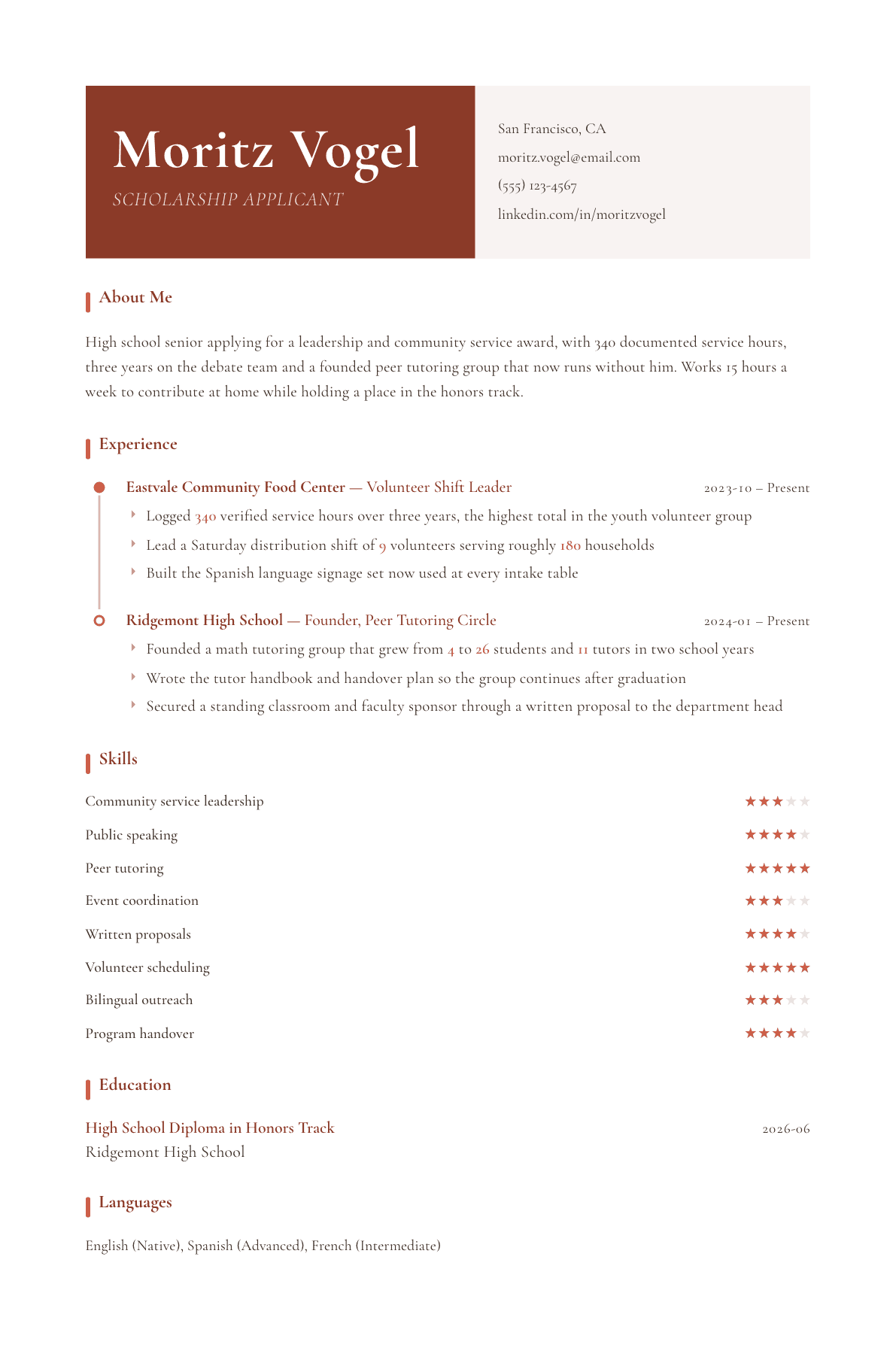
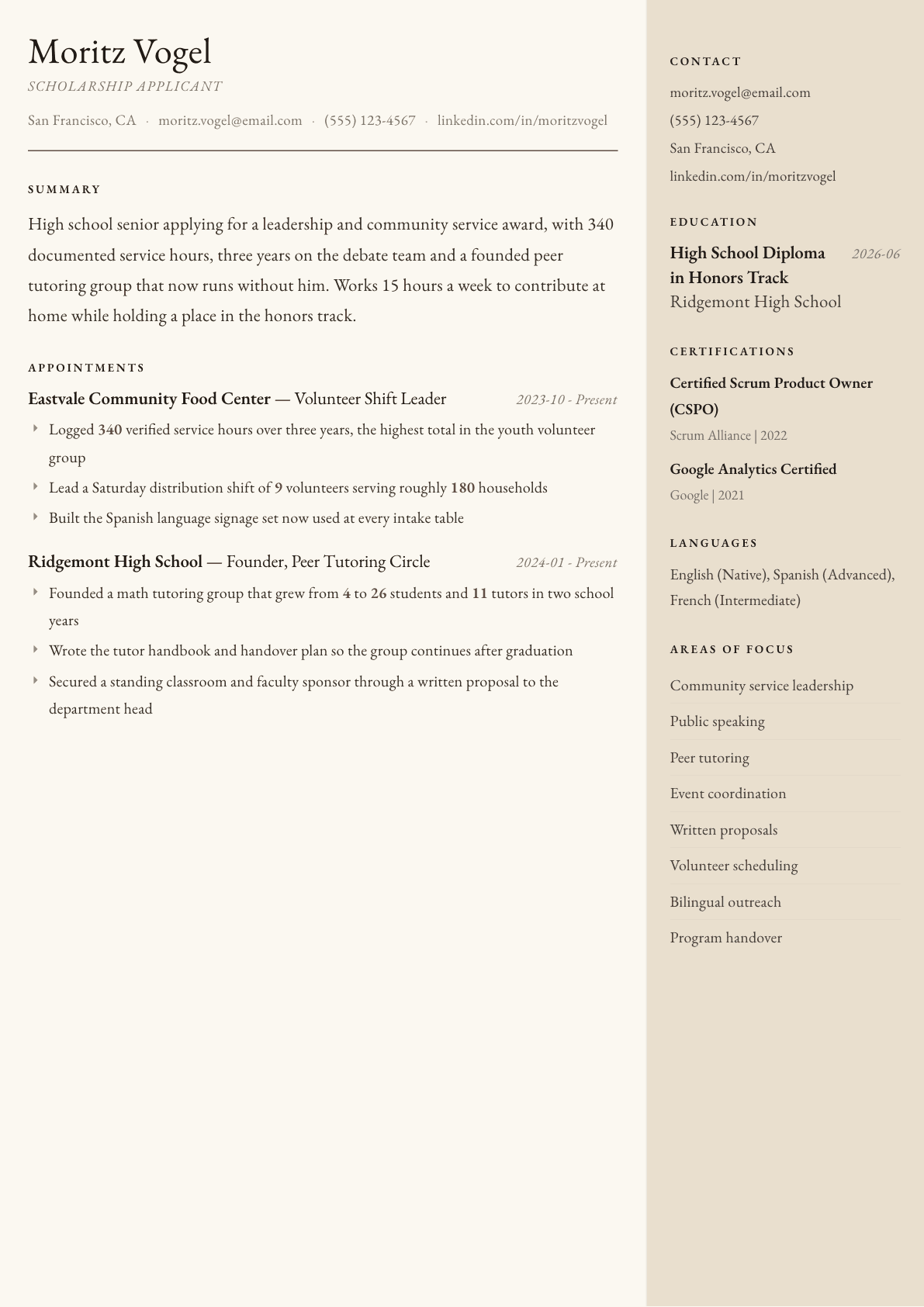
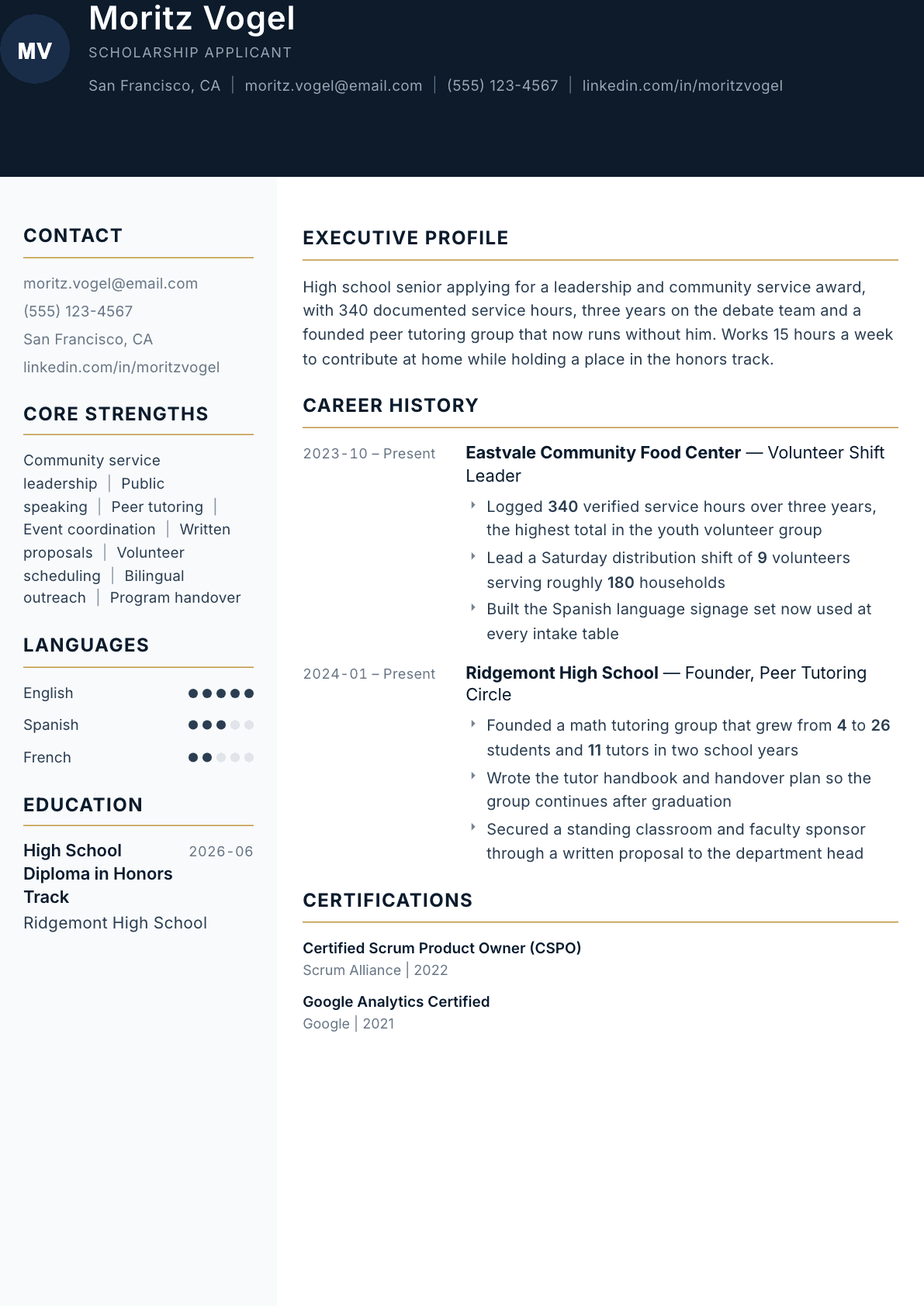
Example Scholarship Applicant summary
High school senior applying for a leadership and service award with 340 verified volunteer hours, a Saturday distribution shift of nine volunteers, and a peer tutoring group he founded and grew to twenty-six students. Wrote the handbook that lets the group continue after he graduates, competes on the debate team, and works fifteen hours a week while holding an honors track place.
Skills to list on a Scholarship Applicant resume
- Award criteria mapping
- Documented service hours
- Leadership and initiative
- Public speaking and debate
- Peer tutoring
- Event and drive coordination
- Grant and proposal writing
- Volunteer team scheduling
- Academic honors record
- Recommendation letter coordination
- Community outreach
- Program continuity planning
What actually gets this resume read
- Read the award criteria first and order your sections so the panel finds each criterion in the same order.
- Give service work an hour count and a verifying contact, because committees check totals more than titles.
- Show what you started or handed over, since a panel scores initiative far higher than membership.
- List honors with the awarding body and the pool you were selected from, not just the name of the prize.
- Explain paid work honestly, because hours worked at home or in a job strengthen a need-based application.
- Keep it to one page for a high school award and two only when the sponsor asks for a research record.
How to write a scholarship applicant resume
A scholarship resume is not a job resume with the word scholarship at the top. It is an evidence document read by a volunteer committee working through a stack of applications against a printed scoring sheet. Leadership, service, academic record, financial need, alignment with the sponsor's purpose: whatever the award publishes as its criteria, somebody is assigning points to each one and adding them up.
That reframes the whole page. A committee member scoring the service criterion needs to find your service quickly, with a number beside it and a person who can confirm it. If she has to hunt through a paragraph about your character to work out how many hours you actually gave, she scores what she can find and moves to the next file. Nobody in that room is being paid to interpret you generously.
This guide covers reading the criteria before writing a word, documenting service so it can be verified, showing initiative rather than membership, presenting financial circumstances without embarrassment, and how the resume should sit beside the essay and the recommendation letters in a complete packet.
Start from the criteria and order your sections to match
Find the published criteria for the specific award and write them down before you touch the page. A community foundation award for service to the local area, a sponsor award for students entering a trade, a merit award for academic standing and a need-based award all reward completely different evidence, and the same student can be a strong or a weak applicant depending on which one she is answering.
Then order your sections in the order the criteria are listed. If leadership is the first criterion, leadership goes first, even though a job resume would put employment there. A scorer reading in the same sequence as her sheet finds every item where she expects it, and the score rises for no other reason than that nothing was missed.
Rename sections to match the sponsor's language too. If the award asks about civic engagement, a section headed civic engagement will be read as an answer, where one headed activities will be read as a list.
- A section per published criterion, in the sponsor's order and using the sponsor's words.
- Academic standing given in the form your school issues, once, not repeated per term.
- Awards with the granting body and the pool selected from, not just the name of the prize.
- A verification contact where the sponsor allows it, since committees do check the large numbers.
Document service so a stranger can confirm it
Service is the criterion most often written badly. Volunteered at a food bank tells a scorer nothing. A count of verified hours, the period they cover, the organization, what you did on a shift and who supervised you tells her everything and survives a check. Where your school or the organization keeps a log, cite that it is logged, because committees have learned to be careful with hour totals nobody can trace.
Depth beats breadth here almost always. Three years at one organization with a growing responsibility scores higher than eight organizations touched once each, because the committee is trying to predict what you will do with their money over several years. A pattern of finishing things is the prediction they are looking for.
Describe the beneficiaries in concrete terms. A Saturday shift serving roughly one hundred and eighty households is a picture. Helping the community is not.
Show initiative: what you started, built or handed over
Committees separate members from founders in the first pass. Joining a club is participation. Starting a tutoring group, writing the proposal that secured a room and a faculty sponsor, growing it from four students to twenty-six and writing the handbook so it continues after you leave: that is a sequence of decisions, and it is what a scoring sheet calls leadership.
Handover is the detail nearly every applicant leaves out and the one experienced committee members notice. An activity that collapses when its founder graduates was a personal project. One that runs without you was an organization you built. If you documented the process, trained a successor or wrote anything down, put it on the page.
The same logic applies to smaller acts. Redesigning the intake signage, rewriting a shift rota, translating materials into a second language for the families who use them: each of these is an improvement you noticed and made, which is exactly the trait sponsors say they fund.
- Founded, proposed, rebuilt or trained: verbs that separate initiative from attendance.
- A before and after number for anything you grew, with the period it took.
- The approval you obtained, since persuading an adult with authority is itself evidence.
- What you left behind so the activity continues after you graduate.
Work, family responsibility and financial circumstances
Paid work belongs on a scholarship resume even when it is unglamorous, and so do family responsibilities that limit your available hours. A student working fifteen hours a week to contribute at home, or caring for a younger sibling every afternoon, is not a student with a thin activities list. She is a student who achieved her record with less time than her competitors had, and a committee scoring need or resilience wants exactly that context.
Write it factually and without pleading. Hours a week, the period, and what it was for. The essay is the place for the story if the sponsor asks for one, and the resume is the place for the facts that make the story credible. Committees are practiced at spotting the difference between context and performance.
The packet: resume, essay, transcripts and letters
The resume is one part of a submission, and it should not repeat the essay. Use it as the index: the verifiable record of what you did, in a form the scorer can check against your transcript and your letters. Let the essay carry the reasoning and the voice, and let the resume carry the evidence the essay assumes.
Give your recommenders the resume weeks before the deadline along with the criteria and a note on which two or three items you hope they will speak to. A letter that independently confirms a number already on your resume is far more persuasive than one that praises you in general, and recommenders write better letters when they know what the award is scoring.
Then check the mechanics: one page for most school and community awards, a plain readable typeface, a file named with your own name, and every deadline noted with the sponsor's time zone. Committees read many files in one sitting, and a packet that is easy to process is a packet that gets read properly.
Sample scholarship resumes: three written out
A sample scholarship resume is most useful when it matches your stage. The three below show a high school senior applying for a community award, a first generation college student applying for a departmental scholarship and a graduate student applying for a research fellowship, each written as the opening lines a committee member reads.
Notice that each sample leads with the evidence for the award's main criterion, then adds a number and a person who can confirm it.
- Sample one, high school senior, community service award: Service: Food bank volunteer, every Saturday for three years, about three hundred hours, supervised by the volunteer coordinator. Trained new student volunteers and ran the school's winter coat drive for two years.
- Sample one, academics and work: Honor roll each semester, Advanced Placement Biology and English. Works twelve hours a week as a cashier at a grocery store to help with family expenses.
- Sample two, first generation college student, departmental scholarship: Academics: Accounting major, Dean's List three semesters, peer tutor for Principles of Accounting, eight hours a week in the campus tutoring center.
- Sample two, leadership: Treasurer of the first generation student association, kept the budget and wrote the funding request that paid for a spring career trip.
- Sample three, graduate research fellowship: Research: Master's student in environmental engineering studying stormwater runoff in urban neighborhoods with a faculty advisor, two conference posters and one paper submitted to a journal.
- Sample three, service: Leads a monthly water testing day with a local watershed group and trains volunteers to collect samples.
Scholarship Applicant resume summary examples
Sophomore applying for a first award
High school sophomore applying for a community service award, with 120 logged hours at an animal shelter across 14 months and a second year on the robotics team. Started a Saturday reading hour at the branch library that now runs with four student volunteers. Maintains an honors course load.
Graduating senior, leadership award
High school senior applying for a leadership and service award with 340 verified volunteer hours and a Saturday distribution shift of nine volunteers. Founded a peer tutoring group grown to twenty-six students, wrote the handbook that lets it continue after graduation, and works fifteen hours a week while holding an honors track place.
Undergraduate applying for a major named award
Third-year undergraduate in public health applying for a national named scholarship, with two years coordinating a student-run clinic outreach reaching 40 households a month. Secured a departmental grant of 3,000 dollars by written proposal, presented at a regional conference, and mentors six first-year volunteers each term.
Work experience bullets: before and after
Before: Volunteered regularly at a local food bank.
After: Logged 340 verified service hours over three years at a community food center, the highest total in the youth volunteer group, with hours recorded in the center's own log.
A verifiable total across a stated period is scoreable, where regularly is a word a committee cannot mark.
Before: Member of the peer tutoring club.
After: Founded a math tutoring group that grew from 4 to 26 students and 11 tutors in two school years, after securing a standing classroom through a written proposal to the department head.
Founding, growth figures and an approval you obtained convert membership into demonstrated leadership.
Before: Helped organize community events.
After: Lead a Saturday distribution shift of 9 volunteers serving roughly 180 households, and built the Spanish language signage set now used at every intake table.
Naming who you led, who was served and what you left behind gives a scorer three separate things to credit.
Before: I have to work so I have less time for activities.
After: Work 15 hours a week at a grocery store to contribute to household costs while holding an honors track place and a standing weekly volunteer shift.
Stated as a fact with hours and outcomes it becomes context a committee scores rather than an apology.
Before: Won an award at school.
After: Received the district civic leadership medal, selected from 62 nominees across 7 high schools by a panel of community sponsors.
The granting body and the selection pool tell a committee how competitive the recognition actually was.
Hard skills
- Award criteria mapping
- Service hour documentation
- Written proposal and grant requests
- Volunteer team scheduling
- Event and drive coordination
- Program handover documentation
- Public speaking and debate
- Peer tutoring and instruction
- Bilingual community outreach
- Recommendation letter coordination
- Deadline and packet management
- Budget tracking for student groups
Soft skills
- Initiative without being asked
- Following through over several years
- Persuading adults with authority
- Working around family obligations
- Mentoring younger students
- Accepting a committee decision and reapplying
Mistakes that cost scholarship applicant candidates the interview
- Submitting a job resume unchanged, so employment leads the page while the criterion the committee scores first is buried.
- Writing service without hours, dates or an organization anyone could contact to confirm it.
- Listing memberships in eight clubs instead of showing depth and growing responsibility in one or two.
- Naming an award without the granting body or the pool it was selected from, which makes it unscoreable.
- Hiding paid work and family responsibility, which removes the context that explains a shorter activities list.
- Repeating the essay in resume form instead of providing the verifiable record the essay relies on.
- Sending the recommenders nothing, so the letters praise character generally and confirm none of your evidence.
Scholarship Applicant resume questions
How is a scholarship resume different from a job resume?
A job resume argues you can perform a role. A scholarship resume answers published criteria in a scorer's order, weighting service, leadership, academics and circumstances rather than employment. The same facts appear in both, arranged and emphasized very differently.
What does a sample scholarship resume look like?
It looks like a job resume reordered around the award criteria: academics, service, leadership and work, each with hours, dates and a contact who can confirm it. Keep it to one page for high school and community awards, and two pages only for research or graduate funding that asks for a fuller record.
What if I have no leadership titles at all?
Leadership on a scoring sheet means influence and initiative rather than a title. Training a coworker, rewriting a rota, starting a study group or organizing rides for a team all qualify. Describe what you changed and how many people it affected.
Should I mention my family's financial situation?
On the resume, only as facts: hours worked, contributions made, caring responsibilities held, and the period each covers. Keep the narrative for the essay if the sponsor asks for one. Committees respond to context stated plainly, not to appeals for sympathy.
Can I send the same resume to every scholarship?
Keep one master record and reorder it for each award. A service foundation and an engineering sponsor score entirely different criteria, and moving the matching section to the top with the sponsor's own wording takes minutes and changes how the file reads.