Warehouse Lead Resume Examples: the lines they read
Write a Warehouse Lead Resume That Shows Floor Authority
By Mustafa Tarabya, founder of CVBooster · Published · Updated
Warehouse lead resume example with team and throughput bullets, keywords for lead roles, skills to list, and a guide to each resume section.
Sample resumes for a warehouse lead
The same warehouse lead content laid out in three CVBooster templates, so you can see what the finished document looks like before you write a word.
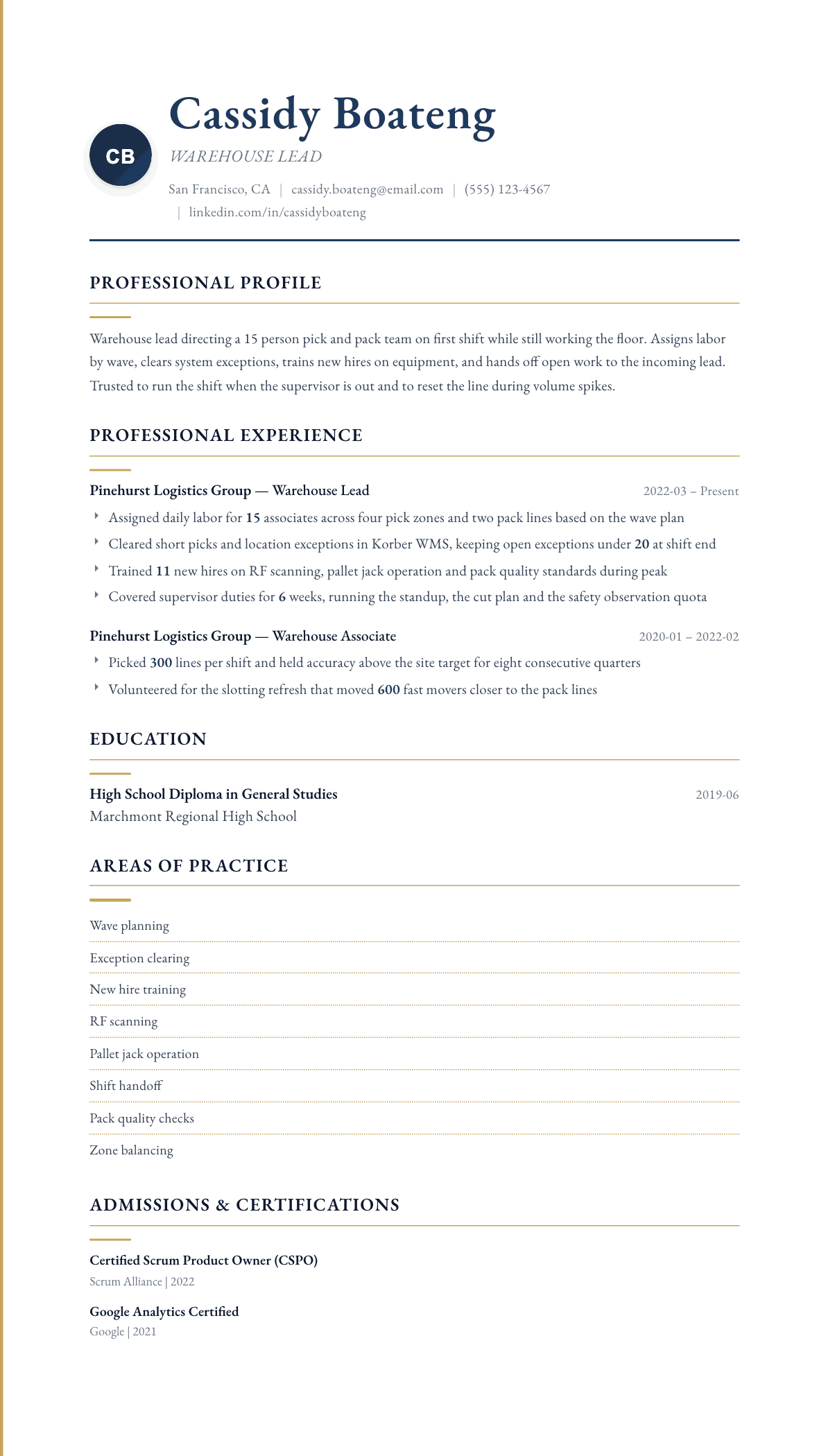
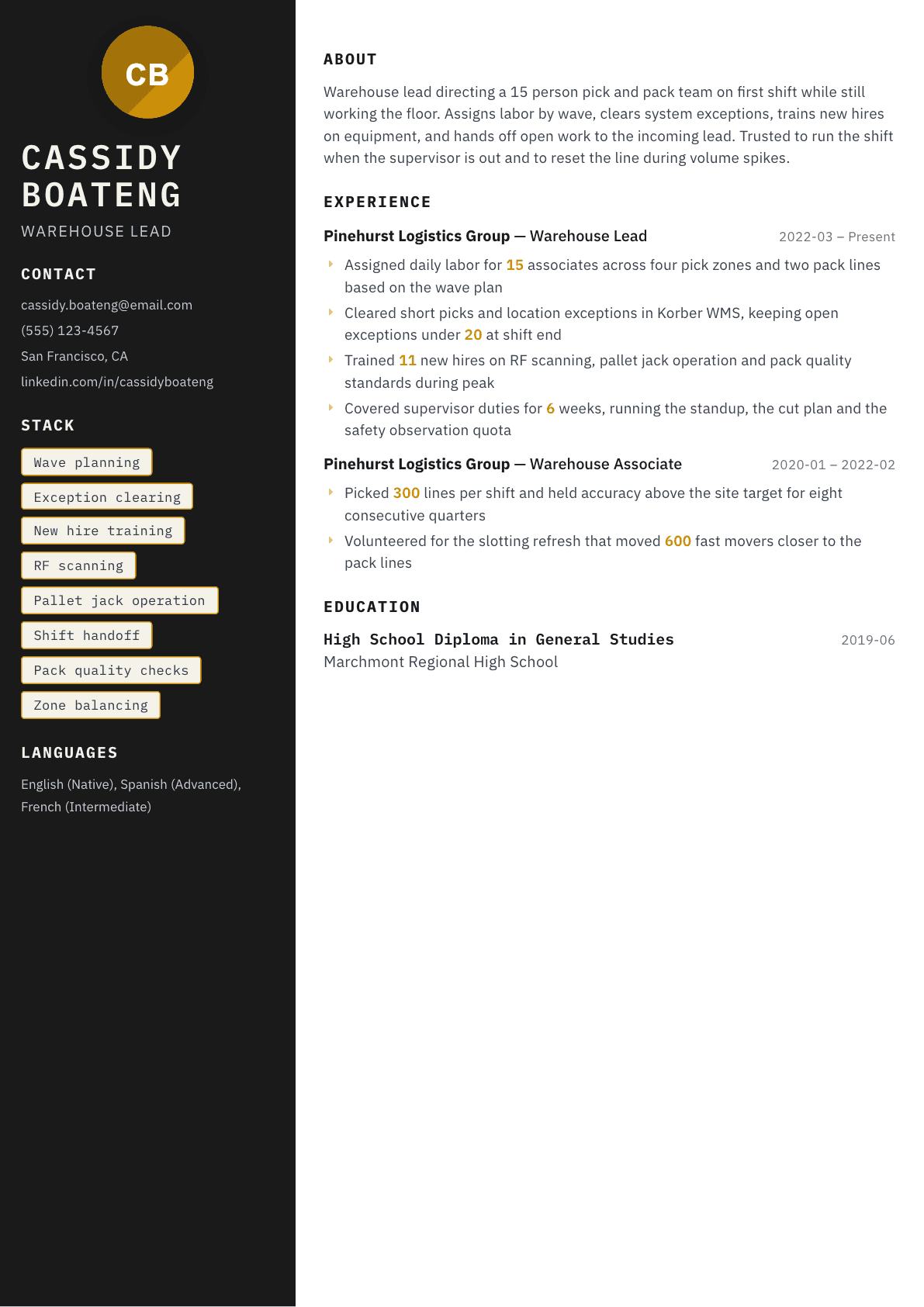
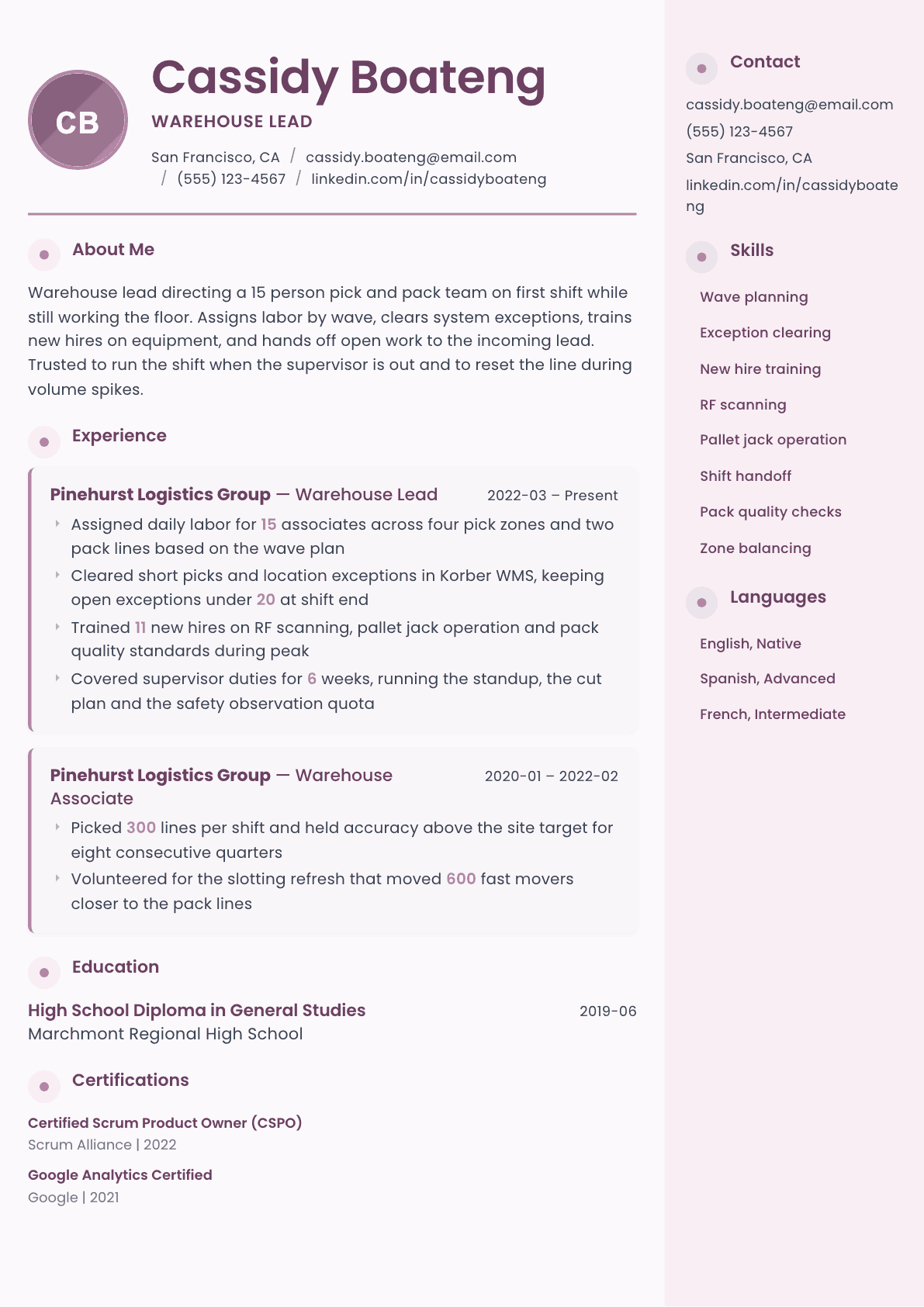
Example Warehouse Lead summary
Warehouse lead with five years at a third party logistics site, currently directing 15 associates across four pick zones and two pack lines while carrying a picking assignment. Runs the wave plan, clears system exceptions, and trained 11 new hires through peak season. Covered the supervisor role for six weeks without a missed cut. Ready for a permanent supervisor position.
Skills to list on a Warehouse Lead resume
- Team direction on the floor
- Wave and zone planning
- Labor balancing
- WMS exception handling
- New hire onboarding
- Equipment training
- Pack quality auditing
- Shift handoff documentation
- Cycle counting
- Safety observations
- Order picking
- RF scanner operation
- Overtime coordination
- Standup facilitation
What actually gets this resume read
- Say how many associates you direct and whether you still pick, because a working lead is a different hire.
- Show the decisions you make without a supervisor: labor moves, zone rebalancing, exception calls, overtime asks.
- Count the people you trained and what they were certified on, since training capacity is why leads get promoted.
- Note any stretch periods covering the supervisor role, with the length and what you owned during them.
- Keep your own throughput numbers on the page, because leads are still expected to carry a share of the work.
- Use the site vocabulary for waves, zones and cut times so the screener recognizes the operation you came from.
How to write a warehouse lead resume
The warehouse lead sits in the least documented seat in distribution. You direct people without hiring or firing them, you carry a pick or pack assignment of your own, and you make a hundred small routing decisions a shift that nobody writes down. A resume for this role has to make that invisible work visible, because on paper a lead who is careless about it looks exactly like an associate with a longer tenure.
The reader is usually the operations supervisor who wants a lead for a zone or a shift, or the manager promoting toward supervisor. Both are looking for the same three things: that people follow you without a title forcing them to, that you can hold the plan when volume moves, and that you know the system well enough to clear the exceptions rather than escalate all of them.
This guide sets out how to frame a working lead role, three summaries covering a first lead assignment through to a senior lead covering the supervisor, before and after bullets that pull the decisions out of the tasks, and the questions leads ask when they try to describe authority they hold informally.
Format: one page, with the lead scope stated immediately
One page, single column, plain headings. A lead resume competes in the same stack as associate applications, so it has to differentiate itself in the first four lines rather than at the bottom of page one.
Directly under the header, write a scope line: how many associates you direct, across which zones or functions, on which shift, and whether you still carry an assignment. Working lead is a real and respected description, so use it. A reader who knows the field will trust the resume more for the honesty, not less.
- Header: name, city, phone, email, shift, equipment certifications held.
- Scope line: associates directed, zones or lines, shift, and whether you also pick, pack or load.
- Sections: summary, experience, certifications, systems and equipment, education.
Summary: authority without a title
Three lines. Start with the number of people you direct and the area you own, then one sentence on the decisions you make alone, then one sentence on your own production. Directing fifteen associates across four pick zones and two pack lines while carrying a picking assignment is a complete picture in one sentence, and very few applicants offer it.
Do not open with tenure. Six years on the floor tells a supervisor nothing about whether people listen to you, and the whole point of a lead resume is to answer that question before the reader gets bored.
Experience: the decisions, not the tasks
Write bullets around the judgment calls. Where you moved labor when a zone fell behind, how you sequenced the wave when a trailer arrived late, when you asked for overtime and when you absorbed the volume, how you decided which orders got worked first as the carrier cut approached. Those are the moments a supervisor is buying, and they never appear in a bullet that starts with assisted.
System work is the second pillar. Leads clear short picks, location discrepancies, held orders and pick to clean exceptions, and the resume should name the exception types and the volume you carried. An exception count at shift end is a genuinely good metric because it reflects both diligence and system fluency.
Training is the third. Count the people you brought up, name what you certified them on, and say whether they stayed. New hire retention is the quiet reason leads get promoted, and it is easy to state and hard to fake.
Keep one bullet for your own output. A working lead who no longer produces is a supervisor without the title or the pay, and supervisors know it, so showing that you still hit a rate while running a team is a strength rather than a confession.
Coverage and handoff: the promotion evidence
Any period you covered the supervisor belongs on the page with its length and its content. Two weeks of vacation cover is worth a clause. Six weeks running the standup, the labor plan, the cut and the observation quota is worth its own bullet, because it is the closest thing to a trial run that a promotion committee can see.
The shift handoff is the other artifact leads own. If you built or improved the handoff, describe what it captures and what it changed for the incoming shift. Process design at lead level is rare, and a manager reading it will assume you think like a supervisor already.
Equipment, systems and the words that get you screened in
List every truck class you are certified on and every device and system you transact in, because leads are expected to cover any gap on the floor. A lead who can jump on a reach truck when an operator calls out is worth more than one who can only direct.
Mirror the vocabulary of the posting once in the summary and once inside a bullet: wave, zone, cut time, exception, short pick, pick to clean, standard work, cross-train. Warehouse postings are written from a template and screened against the same words, but a term with no story attached is obvious to the human who reads next.
Warehouse Lead resume summary examples
First lead assignment
Warehouse lead newly assigned to a six person pack line after three years as an associate, still carrying a packing station. Assigns work by wave, audits pack quality, and trained four new hires on scan verification. Certified on electric pallet jack and available for extended shifts through peak.
Three years leading a zone
Working warehouse lead directing 15 associates across four pick zones and two pack lines on first shift. Clears system exceptions to fewer than 20 open at shift end, trained 11 new hires through peak, and still picks a full assignment. Certified on reach truck and order picker.
Senior lead covering the supervisor
Senior warehouse lead across outbound and returns, directing 28 associates on second shift and covering the supervisor for six weeks last year without a missed carrier cut. Owns the shift handoff document, runs the standup, and has moved five associates into equipment operator roles.
Work experience bullets: before and after
Before: Assisted the supervisor with daily tasks.
After: Assigned daily labor for 15 associates across four pick zones and two pack lines from the wave plan, rebalancing zones twice a shift as volume shifted between them.
Naming the assignment decision and the rebalancing shows authority instead of a supporting role.
Before: Fixed problems in the warehouse system.
After: Cleared short picks, location discrepancies and held orders in Korber WMS through the shift, keeping open exceptions under 20 at handoff.
The exception types, the platform and the threshold you held make the system fluency measurable.
Before: Trained new employees.
After: Trained 11 new hires on RF scanning, pallet jack operation and pack quality standards during peak, with nine still on the shift six months later.
A retention figure attached to the training proves it worked rather than that it happened.
Before: Covered for the supervisor when needed.
After: Covered the supervisor for six weeks, running the standup, the labor plan, the cut plan and the daily safety observation quota with no missed carrier cut.
The duration and the specific routines you carried turn cover into demonstrated supervisory capability.
Before: Also picked orders when the team was busy.
After: Carried a full picking assignment alongside lead duties, holding my own rate above the zone target while directing the team through two peak seasons.
Stating that you produced and directed at once is the defining fact of a working lead role.
Hard skills
- Labor assignment and zone balancing
- Wave planning execution
- WMS exception resolution
- Order picking and packing
- RF scanner operation
- Reach truck and pallet jack operation
- Pack quality auditing
- Cycle counting
- Shift handoff documentation
- Safety observation routines
- New hire onboarding
- Overtime and coverage planning
Soft skills
- Influence without formal authority
- Direct feedback to peers
- Composure near the cut
- Judgment on when to escalate
- Patience while training
- Consistency across shifts
Certifications worth listing
- Certified Logistics Technician (CLT) (Manufacturing Skill Standards Council)
- OSHA 10-Hour General Industry (OSHA Outreach Training Program)
- Adult First Aid, CPR and AED (American Red Cross)
Mistakes that cost warehouse lead candidates the interview
- Opening with assisted, supported or helped, three verbs that erase the authority the whole application depends on.
- Leaving out how many associates you direct, which is the single number a supervisor reads for.
- Never saying whether you still carry an assignment, so the reader cannot tell what kind of lead you are.
- Describing training without counting the people or naming what they were certified on.
- Skipping supervisor coverage periods, which are the strongest promotion evidence a lead ever gets.
- Listing exception clearing as a duty with no volume, threshold or system name attached to it.
Warehouse Lead resume questions
What is the difference between a warehouse lead and a supervisor?
A lead directs work and usually still performs it, without owning hiring, discipline or the labor budget. A supervisor owns those and typically stops producing. Say which you did, because overstating it is exposed in the first interview question.
How do I show leadership when I have no direct reports on paper?
Count the people whose work you assign each day, name the decisions you make without asking, and describe the training and coverage you provide. Informal authority is normal at lead level and readers in this field understand it immediately.
Should a warehouse lead resume include my own pick rate?
Yes, when you still carry an assignment. Holding your own rate while directing a zone is the definition of a working lead, and it reassures a supervisor that you will not disappear into a clipboard on day one.
Do I need forklift certification to be a warehouse lead?
Not always, but it materially helps. Leads are expected to cover absences and clear bottlenecks, so equipment certification widens what you can personally fix and is often listed as preferred on lead postings.
How do I use a lead resume to reach a supervisor role?
Put the supervisory work at the top: labor planning, coverage periods, coaching, the handoff document, safety routines. Then keep production evidence lower on the page so the reader meets the supervisor before meeting the picker.
Related resume examples
- Warehouse Worker Resume example
- Supply Chain Analyst Resume example
- Warehouse Associate Resume example
- Forklift Operator Resume example
- Warehouse Supervisor Resume example
- Material Handler Resume example